





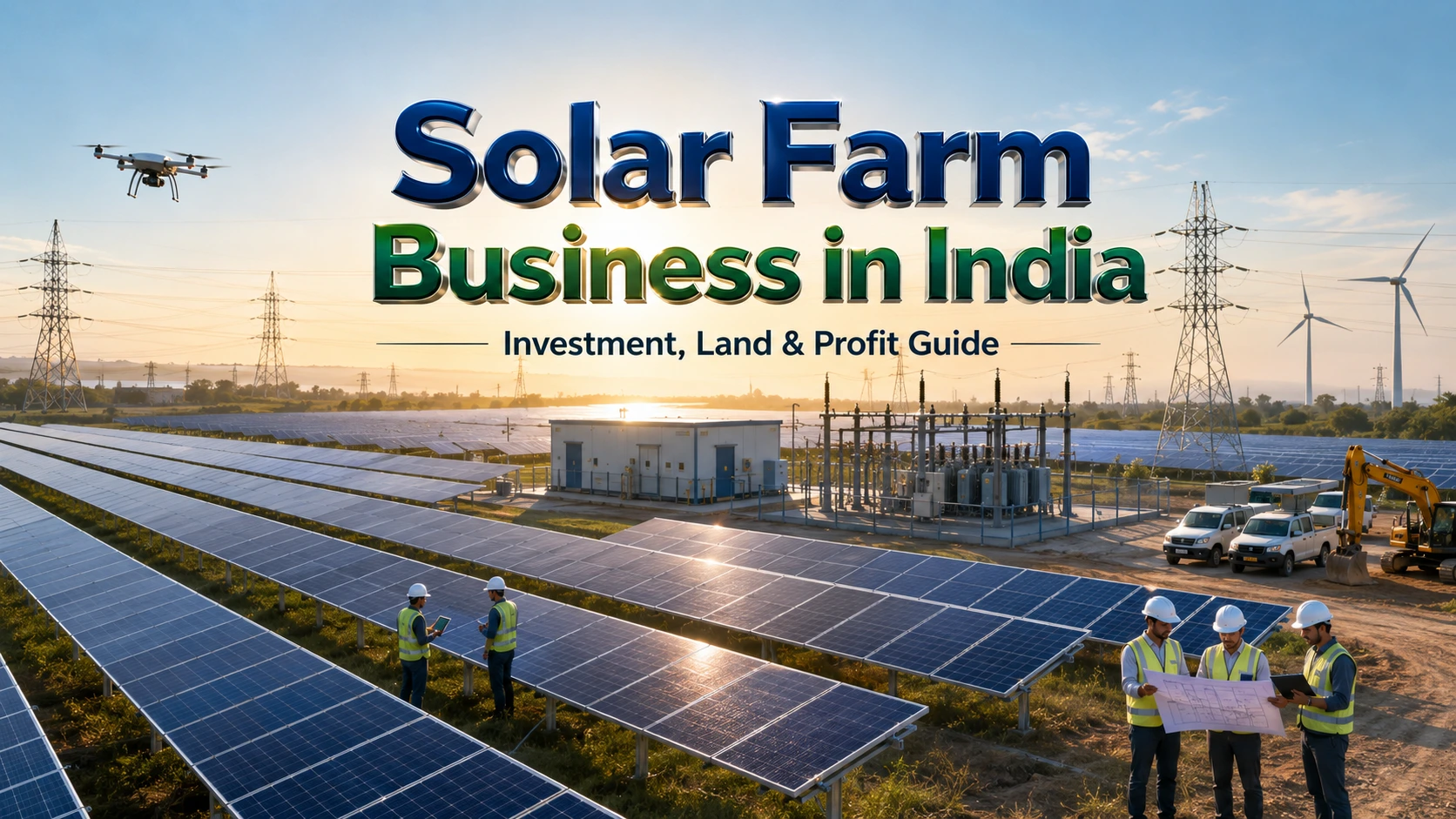
Solar Farm Business in India
A ground-mounted solar farm on leased agricultural land is one of the least common clean energy business ventures that are available to any entrepreneur in India today, that has a unique blend of scale, predictability and passive income generation ability. The Power Purchase Agreement (PPA) is a 25-year inflation-protected contract for a Rs.50 Crore investment in a 4-5 MW Solar Farm. Don’t have to be the land owner.
The PM-KUSUM scheme organised by the Ministry of New and Renewable Energy (MNRE) has a specific category for promoting solar farms on the agricultural land, thereby enabling farmers to generate agricultural income from an agrivoltaic system while also leasing their land to solar developers. Tenders are tendered by SECI (Solar Energy Corporation of India) and NTPC Renewable Energy for MW scale solar projects in which the independent developers can participate.
Why Ground-Mounted Solar Farms Are an Exceptional Investment in India
The cost of solar panels has dropped more than 90% over the past 10 years, and solar energy is now one of the lowest cost methods of supplying new electricity generation in the world. There is an increasing pressure on State electricity boards and central PSUs to acquire renewable energy. In bilateral PPA with commercial and industrial (C&I) consumers, a 5 MW scale project can be monetized at tariffs of Rs.3-4.5 p.u. which is much less than what the industrial consumers pay from grid. The SECI website will share the updated outcomes of the auctions and tariff comparisons, establishing the commercial feasibility of private solar farm development.
Get Detailed Insights from This Book: Solar PV Power and Solar Products Handbook
Government Policies and Incentives for Solar Farm Development
The PM-KUSUM scheme under MNRE is a specific initiative for setting up solar farms on agricultural land, which will enable the farmer to earn lease income and the solar developer to produce electricity. Under the PM-KUSUM Component A, a farmer or a farmer group can install solar power plant ranging from 500 kW to 2 MW and get the power supply sold to state DISCOMs at fixed tariffs. SECI and NTPC Renewable Energy have been continually issuing tenders for solar procurement of MW-scale projects.
The rapid depreciation benefit of 40% of the cost of solar plant equipment under the Income Tax Act will enhance the overall post-tax returns. Renewable energy development agency portals provide state-specific incentives, such as waiver of land conversion charges and wheeling charges for solar projects in states like Rajasthan, Gujarat, MP and AP.
Top Business Ideas Within the Solar Farm Development Model
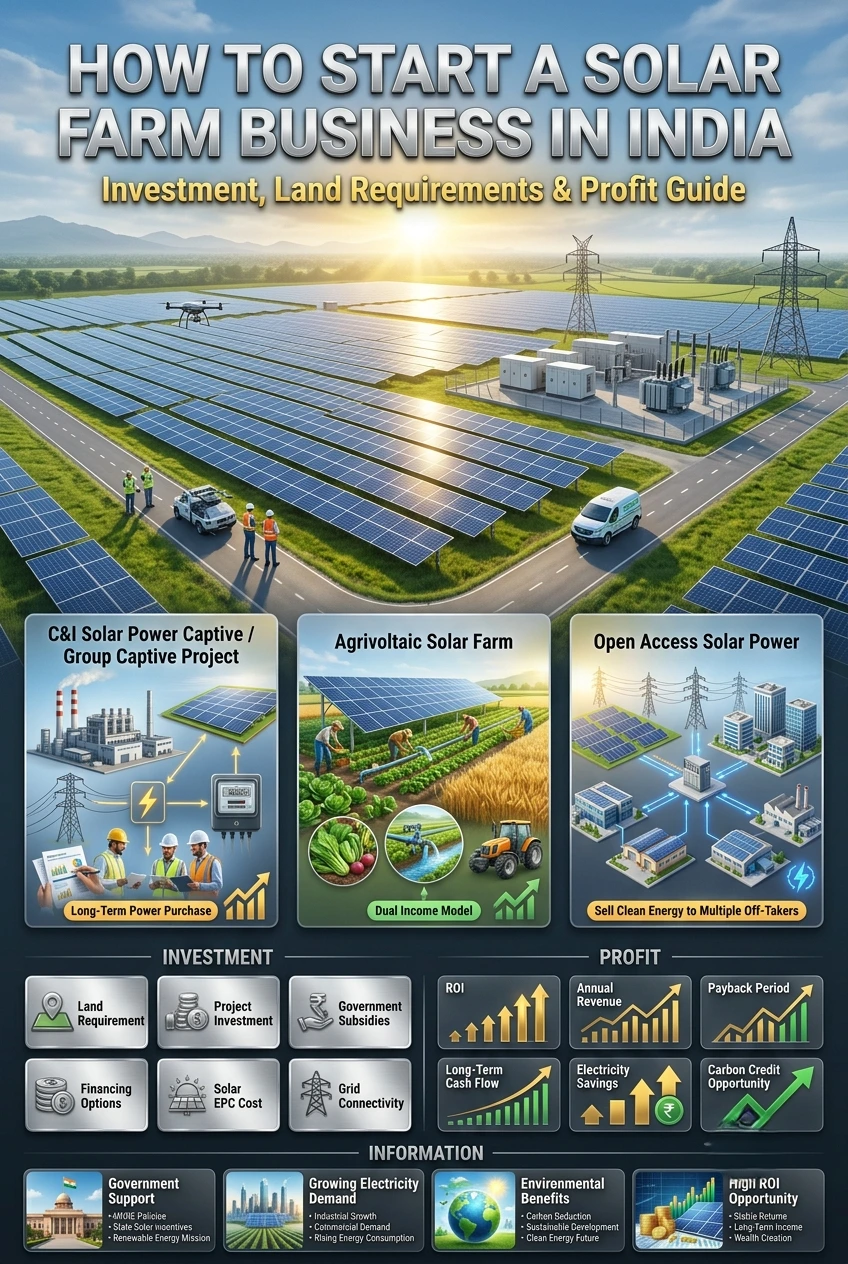
C&I Solar Power Captive or Group Captive Project on Leased Land
The electricity cost to the Commercial and Industrial (C&I) buyers, who are large factories, data centres, hospitals, malls, manufacturing parks, is Rs.7–12 per unit from the grid. This solar developer who becomes successful to develop a solar farm of 5 MW and signs a PPA for 15-25 years with a C&I buyer at Rs.3.5-4.5 per unit creates a compelling value proposition. The group captive model involves decentralised ownership of the solar farm (at least 26%) and a captive consumption agreement with the C&I user that benefits the user by exempting them from some state electricity surcharges. Connect with SECI for information about C&I and group captive solar procurement models.
Access Complete Business Plan: Renewable Energy Sector: Green Power, Solar, Wind & Bioenergy
Agrivoltaic Solar Farm Combining Agriculture and Power Generation
In India, Agrivoltaics, the integration of solar photovoltaics and agricultural activities on the same land, has become quite popular. The purpose of the elevated solar panel structures is to let crops grow beneath the shade and use solar to produce electricity. The dual use model enables the entrepreneur to receive revenue from solar power, and also takes into account the farmer’s income from agriculture, which is considerably more attractive for the farmer to share than a land lease. The possibility to receive funding under PM-KUSUM and entice ESG-driven buyers of C&I solar is an added advantage of Agrivoltaic projects.
Open Access Solar Power Wheeling to Multiple Off-Takers
The Open Access regulations allow a solar developer to produce electricity at one location and wheel (transmit) the electricity through the state transmission grid to off-takers at multiple delivery points. Revenue diversification from a 5MW solar farm supplying three or four C&I customers via Open Access. Most states have state electricity regulatory commission websites that provide Open Access charges, CERC publishes Open Access framework guidelines at CERC’s official portal. This model is most suitable in states with well-defined and stable Open Access frameworks like Gujarat, Rajasthan, Karnataka and Maharashtra.
Import-Export Opportunity Analysis
PLI has spurred a surge in the Indian solar module manufacturing industry, with players such as Waaree Solar, Adani Solar, and Vikram Solar ramping up their production levels. Import duty exemption with MNRE’s Approved List of Models and Manufacturers (ALMM), and better supply chain are two factors that make it easier for solar farm developers to use locally made modules. Indian IPPs (Independent Power Producers) are securing bids for solar projects in Bangladesh, Sri Lanka, Nepal and East Africa on the international side. These international project adventures are facilitated by EXIM Bank’s Lines of Credit.
Find the most profitable startup for your investment range
Indian Developer Success Stories in Solar Farms
Sprng Energy — Building a Multi-GW Portfolio from Scratch
Sanjay Grewal’s Sprng Energy started as a greenfield solar and wind developer and expanded to a portfolio of more than 2,000 MW that was bought by Shell for more than USD 1.5 billion. Sprng’s approach was a series of disciplined site purchases, robust grid connectivity planning and a combination of Government auction PPAs and C&I bilateral contracts. They have collaborated with SECI for government auctions and have signed direct PPA with corporates which is a hybrid model that IPPs must follow in India.
Rays Power Infra — Regional Solar Developer with National Scale
Neeraj Bhargava founded Rays Power Infra, one of the largest mid-sized EPC and development firms in India, who has completed solar projects in Rajasthan, UP and MP. The projects started at the MSME scale and then gradually scaled up to a utility scale project, thereby showing that an entrepreneur with execution power and local site knowledge, can compete with big players in the solar industry. The company has been targeting tier-2 states, where land is more readily available, enabling it to establish a large pipeline without the heavy competition that typifies high-value SECI tenders.
How NPCS Supports Solar Farm Project Development
We at Niir Project Consultancy Services (NPCS) provide professional consulting for the preparation of Market Survey cum Detailed Techno-Economic Feasibility Reports (DPRs) for setting up new industries or businesses. Our reports include detailed manufacturing processes, market research and demand analysis, process flow diagrams, product mix and capacity planning, machinery and raw material details, and complete project financials with profitability analysis.
Conclusion
A Rs.50 Crore solar farm on leased agricultural land is one of the most compelling infrastructure investments available to Indian entrepreneurs today. The combination of PM-KUSUM support, falling module costs, accelerated depreciation under the Income Tax Act, and a growing pool of industrial buyers seeking to reduce electricity costs makes the financial case compelling. Check SECI’s tender portal for government PPA opportunities and CERC’s portal for Open Access framework guidelines in your target state.
Related Article: Floating Solar Farms: The Next Big Renewable Energy Breakthrough
Solar Farm (5 MW on Leased Land) — Key Parameters
| Parameter | Details |
| Total Project Investment | Rs.45–55 Crore |
| Typical Plant Capacity | 4–5 MW (ground mounted) |
| Land Requirement | 15–20 acres (leased) |
| Key Government Scheme | PM-KUSUM Component A, SECI Tenders |
| PPA Tariff Range (C&I) | Rs.3.5–4.5 per kWh |
| Annual Generation (5 MW) | 70–80 lakh units |
| Annual Revenue (at Rs.4/unit) | Rs.2.8–3.2 Crore from power + green attributes |
| Accelerated Depreciation Benefit | 40% in Year 1 under IT Act |
| Payback Period | 6–8 years |
| PPA Tenure | 15–25 years |
Frequently Asked Questions (FAQ)
What is PM-KUSUM and how does it support solar farm development?
PM-KUSUM scheme (managed by MNRE) focuses on solarising agricultural land with solar power plants. Under component A of the scheme, the farmers/ agri-entrepreneurs can set up 500 KW to 2 MW solar projects and sell the electricity at a feed-in tariff to state DISCOMs. The scheme offers a Viability Gap Funding (VGF), a preferential tariff and other waiver benefits. Please see the state-wise implementation guidelines at PM-KUSUM website by MNRE.
What is Open Access and how do I apply?
Open Access allows a solar developer to sell electricity to any buyer using the existing grid for transmission. The regulatory framework is set by CERC at the central level, with state implementation details on state electricity regulatory commission websites. Apply through the state SLDC (State Load Dispatch Centre) for Open Access approval — the process typically takes 30–60 days.
How does the group captive model work?
In the group captive model, multiple C&I buyers collectively hold at least 26% equity in the solar farm. They receive power under favourable captive consumption tariff provisions that exempt them from certain regulatory charges — making the effective power cost even lower. CERC has published detailed guidelines on group captive eligibility and compliance requirements.
What is SECI and why is it important for solar developers?
SECI (Solar Energy Corporation of India) is the nodal agency responsible for procuring renewable energy for government consumers. SECI publishes tenders for megawatt (MW)-scale solar projects, where any independent developer can participate in the bid. A SECI bid award has a government-backed PPA, which is highly bankable for raising debt to fund a solar project. You should frequently visit the SECI tender portal to stay aware of upcoming projects.
Do I need to own the land to build a solar farm in India?
No. Most solar farms are built on leased land. Long-term land lease agreements of 25–30 years with farmers or landowners are standard. The lease rental is a fixed annual cost for the developer. The PM-KUSUM scheme specifically promotes this model to benefit farmers through lease income.


