





Medical Consumables Manufacturing Business
Why the Medical Consumables Sector Deserves Serious Attention
Medical consumables are an idea worth exploring for manufacturing, particularly if it has defensible demand, recession-proof end markets and some real government tailwinds — and maybe your first rupee! The healthcare infrastructure in India is entering a period of being scaled up over the next few decades, as the population has become more hospitalised, health insurance penetration has increased and there has been a reconfiguration of how hospitals have been procuring essential disposables following the pandemic.
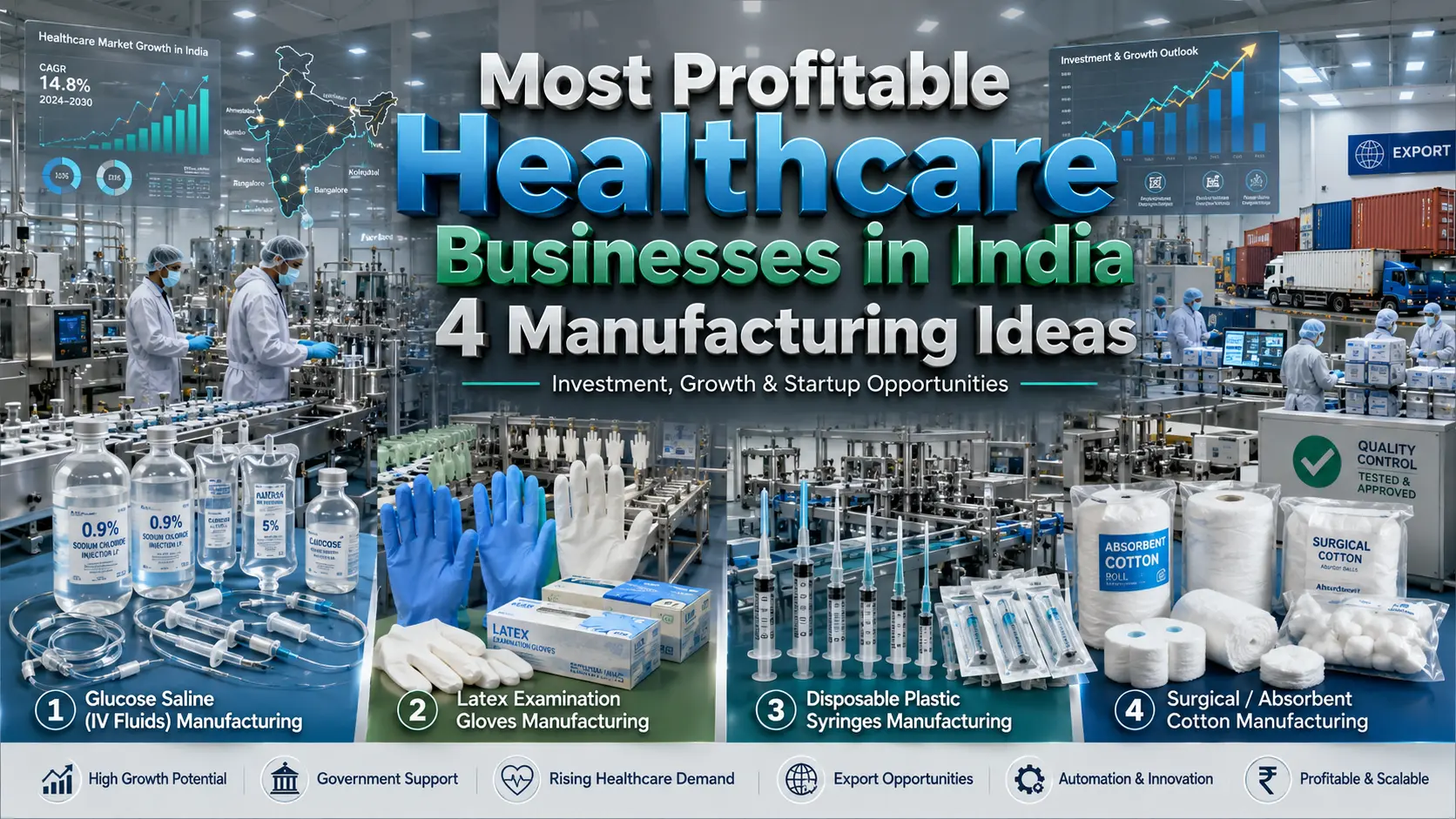
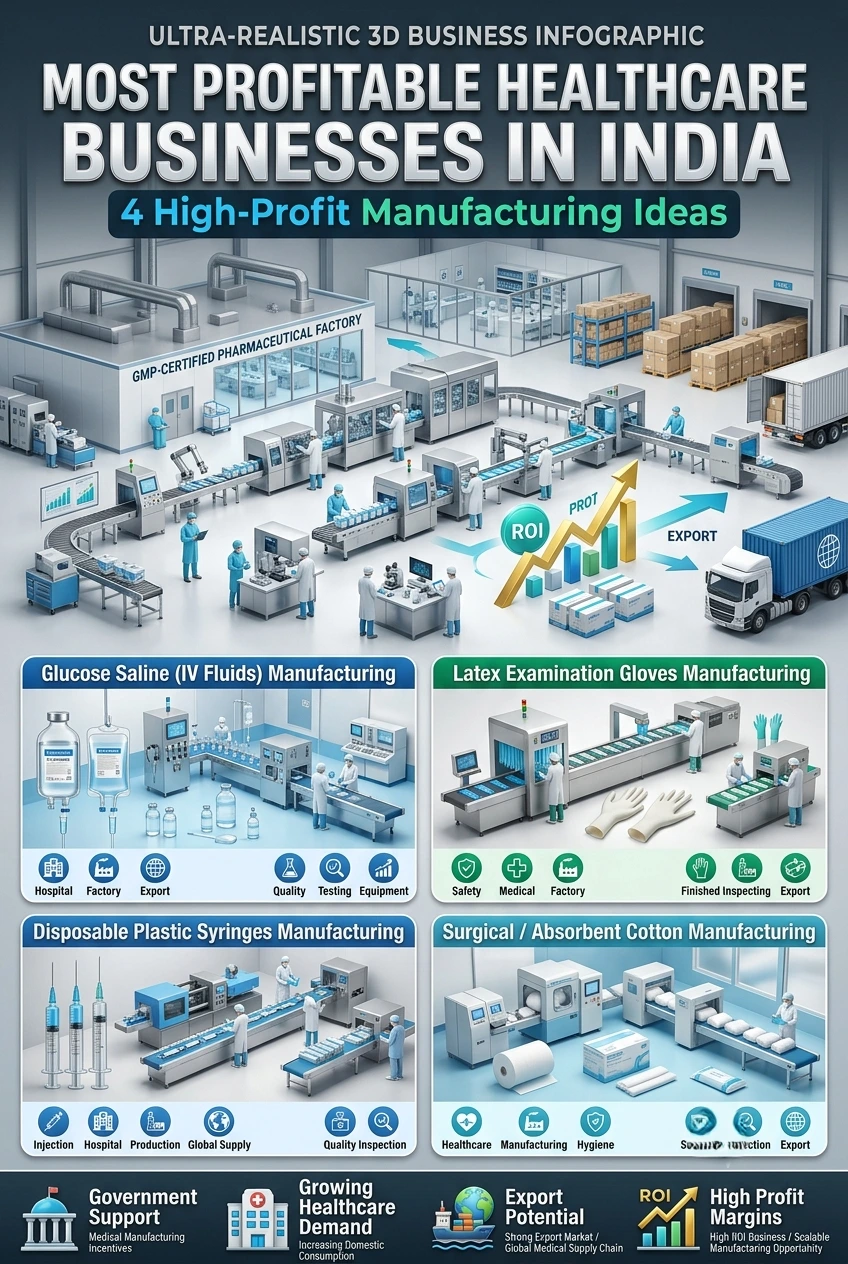
Four categories are located on the cusp of this structural demand, low entry capital and manageable regulatory complexity: Glucose Saline (IV fluids), Latex Examination Gloves, Disposable Plastic Syringes and Surgical/Absorbent Cotton. They are each independent product development journey and have their own chain of logic, margin profile and growth story — and when viewed together, they make for a compelling path to opportunity in the Indian medical consumables market
Explore This Book: Handbook on Medical and Surgical Disposable Products
Why This Sector, and Why Now
India’s need for medical consumables is at the scale of tens of medical consumable units per year. However, it is less widely recognised that domestic production continues to be structurally inadequate in several of these categories. This reliance on imports, especially for gloves, continues to put the country at risk of currency fluctuations, logistics delays and supply shocks affecting procurement chains. This is not a deficiency in the market thesis; it is what makes it desirable to enter the manufacturing arena.
The demand floor is compounded by the expansion of Ayushman Bharat scheme, the building of Jan Aushadhi Kendras on a fast track and the ambitious targets of hospital bed addition under National Health Mission. These products are absorbed by the hospitals, nursing homes, government medical stores and relief organizations at predictable volumes. In certain categories, pricing is regulated and in others, it is market-driven, and either can provide an attractive unit economics at scale.
Data on the industrial investment tracker (IIT) of the DPIIT shows that FDI inflows in India’s pharma and medical devices sector have remained steady, and the domestic MSME manufacturing ecosystem is being actively encouraged to contribute to the shortage of supply in these critical areas. When you consider the timing, it’s obvious that government procurement is deepening, export corridors to Africa and Southeast Asia are being expanded and raw material supply chains are more open than they have ever been.
Government Policies and Incentives Relevant to This Sector
The policy framework for medical consumable manufacturing in India is now truly strong, not only in terms of words, but also in actual implementation. For entrepreneurs establishing units in this area, there are several overlapping support mechanisms that could significantly decrease capital expenditure and risk of operation.
Under the PLI Scheme for Medical Devices, the Ministry of Health & Family Welfare and Department of Pharmaceuticals give financial incentives based on incremental sales of eligible categories of products. The PLI is aimed at mid and large size enterprises, but offers huge price and procurement advantages to MSME manufacturers supplying the institutional channel.
Collateral-free loans up to ₹2 crore are being offered under the MSME Ministry’s Credit Guarantee Fund Trust for Micro and Small Enterprises (CGTMSE), which is one of the most important requirements for first generation manufacturing entrepreneurs. This applies especially to units valued in the category of ₹30–90 lakh and are a feature of some of the products discussed in this article.
Effective capital costs further get reduced by the Prime Minister’s Employment Generation Programme (PMEGP), Technology Upgradation Fund Scheme for pharma clusters and state-level textile/cotton processing subsidies (applicable for surgical cotton manufacturing). MSME registration under Udyam also offers a range of benefits, such as priority sector lending, preference in government procurement on the GeM portal, and waiver of some compliance parameters which directly impact the startups in this sector.
Further, the Make in India initiative has made a special mention of Medical Devices and Healthcare Consumables as priority manufacturing sectors, with several dedicated medical device parks being established across states such as Andhra Pradesh, Uttar Pradesh and Telangana, providing plug and play infrastructure for new players in the sector.
Manufacturing Business Ideas: Product-by-Product Analysis
1. Glucose Saline (IV Fluids) Manufacturing
In any clinical setting, the largest consumption of any product is intravenous fluids, and among those fluids, the ones consumed in the largest volume include Normal Saline (0.9% NaCl), Dextrose Saline, and Ringer’s Lactate. Whether it’s post-surgical recovery or treatment for dehydration in rural health centres, the demand is constant and comes from institutions, not retail demand. A single mid-size District Hospital may use thousands of IV fluid bags monthly, providing a consistent opportunity for nearby manufacturers to use their existing facilities to manufacture IV fluid bags under the district’s standards.
The manufacturing steps include pharmaceutical grade water treatment (multi-stage RO and UF), dissolving salt/dextrose in pharmaceutical grade water under sterile conditions, aseptically filling into polyethylene/ PVC bags, autoclave sterilisation, and packaging. Investment areas are clean room infrastructure (Grade D at least with localized Grade A fill zones), autoclave capacity and water purification systems. Cost of raw materials is low; the main materials are: pharmaceutical-grade sodium chloride, glucose, water-for-injection and flexible plastic bags. The margins are dependent on scale – a unit with a capacity of 50,000 to 1,00,000 bags per month can expect to achieve the net margin in the 20-28% range after entering into institutional procurement contracts.
Regulatory compliance to Schedule M with the Drugs and Cosmetics Act is mandatory and a drug manufacturing licence from the State Drug Authorities takes another 6–12 months after pre-production. This is a moat and not a hurdle for entrepreneurs as it sows out those that come in on a trial basis and protects the certified producer’s market position.
Discover business ideas that actually make money
2. Latex Examination Gloves Manufacturing
The consumption of gloves in India has increased significantly in the post-pandemic period and a new higher base has been created. India’s need of examination grade latex gloves is huge, as they are required for various medical fields such as hospitals, diagnostic labs, dental clinics, veterinary clinics, and the food processing industry, with Malaysia and Thailand being a major supplier. This dependency is becoming more and more thought of as a procurement risk, and preference is being given to manufacturers who are from within the country, so they can ensure delivery consistency.
Natural rubber is extracted from rubber plantations mainly in Kerala, Tamil Nadu and Karnataka as latex, which is the first step in the manufacturing process. This latex is mixed with accelerators, vulcanising agents and anti-oxidants, and subsequently formed using ceramic formers through various dips, vulcanised in curing ovens, beaded, stripped and checked for quality. The operating cost of a dipping line is comparatively light once the line is in operation, although the equipment, such as dipping machine, oven banks and ventilation are moderately capital intensive.
The natural rubber production base of India (as monitored by the Rubber Board of India) provides a raw material proximity advantage to the domestic glove manufacturers as compared to importers, especially in the southern region of India. Logistics cost is lower and direct sourcing from farmers minimizes input price volatility for entrepreneurs in rubber-producing states. Further export potential to regulated markets in the Gulf, Africa and South Asia provides a further revenue layer.
3. Disposable Plastic Syringes Manufacturing
Disposable syringes are a high volume, high velocity consumable, where consumption is directly associated with immunization programmes, outpatient treatments and admissions. There is enormous and predictable demand from the Government of India’s Universal Immunisation Programme and the regulatory environment actively promotes the domestic syringe industry, as AEFI (adverse events following immunisation) guidelines call for the use of auto-disposable syringes only in government immunisation programmes.
Manufacturing technology is injection moulding based: polypropylene barrels, pistons and needle hubs are moulded, assembled and placed in sterile blister packs or paper pouches in a clean-room environment, with stainless steel needles added to the hypodermic syringes. There is a high degree of automation, with per-unit production costs being low after the installation of the tooling and moulding machines. The most expensive cost item other than the injection moulding machines are tooling investments with the 1 ml, 2 ml, 5 ml and 10 ml moulds.
It must be registered with the BIS (IS 10258) certification is an added quality mark that is preferred by institutional buyers in addition to product registration under the Medical Devices Rules, 2017 (Class A/B category). Syringe manufacturers bidding for government tenders need to adhere to the tender specification issued by DGHS and HLL Lifecare; these tenders create effective quality barriers to ensure that the low-quality competition does not get in the way of compliant manufacturers. A well-capitalised unit with 10 to 12 moulding machines could earn income of over ₹4–5 crore per year with a good margin of profit.
Related Article: Disposable Syringe and Needle Manufacturing Business in India: Investment, Licensing and Profit
4. Surgical / Absorbent Cotton Manufacturing
Surgical cotton (absorbent cotton) is the easiest and most readily available item in this product category – and it is always overlooked as a business opportunity. It consists of scouring the raw cotton to remove natural waxes and impurities, bleaching with hydrogen peroxide at controlled temperatures, drying and rolling, balling or making pads of the cotton of standardized GSM (grams per square meter). Surgical cotton production is not a drug manufacturing process and does not need a drug manufacturing licence, it’s under BIS certification (IS 1060) and basic GMP compliance so the entry process is significantly faster than pharmaceutical manufacturing.
Availability of raw cotton in India is one of the highest in the world, with cotton farming states like Gujarat, Maharashtra and Telangana being nearer to the raw cotton source, which directly means lower input cost. The base for use is wide: hospitals, nursing homes, manufacturers of firstaid cotton, cosmetics and skin products (they use massive amounts of absorbent cotton) and institutional packagers. Absorbent cotton is having stable and established export business to Middle East, South Asia and Africa.
Value-added variants (individually packed sterile cotton rolls or pre-cut surgical swabs or cotton products for the orthopaedic rehabilitation market) offer much higher realisations for the entrepreneur and less reliance on bulk hospital procurement tenders. One of the fastest ROI timelines from these products is a surgical cotton unit that requires an investment of ₹15-40 lakh with capital expenditure, which can be up and running in 3-4 months after planning is done.
Import–Export Opportunity Analysis
The Indian medical consumable trade scenario is paradoxical and requires careful analysis of. But the country is also a net importer of latex gloves and some high specification types of syringes, thus providing clear local opportunity for potential new manufacturers. On the other hand, India is a credible and an emerging exporter of IV fluids, surgical cotton and lower specification syringes to the developing country markets like the African market, South Asian and the Gulf Cooperation Council (GCC) region.
International institutional procurement avenues are opened through Export certification by the Export Inspection Council of India (EIC) and WHO-GMP compliance. Those manufacturers that develop a WHO-GMP or ISO 13485 quality system from the beginning rather than the end, are able to achieve higher realisations from their exports and lower rejections.
The Merchandise Exports from India Scheme (MEIS) is a duty drawback scheme for export of medical products that has been incorporated within the framework of Rotenone incorporated in the RoDTEP framework, the Merchandise Exports from India Scheme (MEIS) gives duty drawback benefits to the exporters of the medical products. The cost benefit of Indian production compared to the Southeast Asian alternatives is very high especially for surgical cotton and IV fluids and hence export can be considered as a viable avenue for revenue diversification from the 2nd year of the operations.
It is recommended that new entrepreneurs base their operations and establish quality documentation in Year 1, and then apply for export registrations in Years 2–3. Once quality systems are established, the export premium (usually 15–25% premiums above the domestic procurement prices) is a significant earnings boost.
Indian MSME Success Stories in Medical Consumables
Lifelong Meditech — Scaling Surgical Disposables from MSME Roots
Lifelong Meditech, promoted by entrepreneur Rahul Khanna, began as a modest surgical glove and disposable manufacturer in Delhi NCR before expanding into a comprehensive surgical consumables portfolio. The company’s growth model was built on winning institutional procurement tenders — particularly those floated by state government medical stores and large hospital chains — before investing in export certification. The critical decision that accelerated Lifelong’s trajectory was early adoption of BIS and CE certification, which unlocked both government tender eligibility and the European export channel. The lesson for new entrepreneurs: certification investment made upfront pays compounded dividends over every subsequent tender cycle and customer negotiation.
Albert David Limited — Pharma Manufacturing with IV Fluid Depth
Albert David Limited, a Kolkata-based pharma company with decades of manufacturing pedigree, built a significant share of its revenues on large-volume IV fluid manufacturing for institutional markets. What is instructive about Albert David’s story is not the scale — it is the decision logic: the company focused relentlessly on regulated-market quality standards even when serving domestic institutional buyers, which later enabled seamless transition into export markets. Promoter-driven quality consciousness, maintained across economic cycles, is the variable that separates durable manufacturers from volume players who exit during procurement slowdowns.
Poly Medicure — From Syringe Maker to Medical Device Exporter
Poly Medicure Limited, founded by Himanshu Baid and now listed on Indian stock exchanges, began its journey as a disposable syringe and IV catheter manufacturer serving the domestic hospital market. The company’s eventual pivot into high-value disposable medical devices — while maintaining its core syringe volumes — demonstrates the optionality that a well-capitalised manufacturing base creates. What started as a ₹ few crore MSME-level operation scaled into a publicly listed entity with revenues in hundreds of crores, largely because the promoter treated manufacturing quality as a strategic asset from Day 1. For founders entering syringe manufacturing today, Poly Medicure represents proof that this category can serve as a genuine platform for compounding growth.
How NPCS Can Support Your Manufacturing Journey
At Niir Project Consultancy Services (NPCS), we work with first-generation entrepreneurs, MSME investors, and industrial project planners to evaluate manufacturing opportunities with the rigour that investment decisions deserve. For each of the products discussed in this article — Glucose Saline, Latex Gloves, Disposable Syringes, and Surgical Cotton — we prepare comprehensive Market Survey cum Detailed Techno-Economic Feasibility Reports (DPRs) that go well beyond generic templates.
An NPCS feasibility report for any of these projects includes detailed manufacturing process flows, machinery specifications and vendor lists, raw material procurement analysis, capacity planning and product mix optimisation, demand and market research specific to your target geography, complete financial projections (capital expenditure, working capital, P&L, cash flow, and payback period), and profitability sensitivity analysis. Our reports are structured to help founders and investors make a go/no-go decision on a project with confidence — not with wishful thinking. If you are evaluating an entry into medical consumable manufacturing, our DPR preparation process is designed to surface both the opportunity and the risk before the first rupee is committed.
Get Detailed Project Report (DPR): Healthcare and Medical Businesses
Market Snapshot: Key Parameters by Product
| Product | Market Growth Rate | Approx. Project Cost (₹) | Margin Range |
| Glucose Saline (IV Fluids) | 9–11% CAGR | ₹30–75 Lakh | 20–30% |
| Latex Examination Gloves | 8–12% CAGR | ₹25–60 Lakh | 18–28% |
| Disposable Plastic Syringes | 10–13% CAGR | ₹40–90 Lakh | 22–32% |
| Surgical/Absorbent Cotton | 7–9% CAGR | ₹15–40 Lakh | 15–25% |
Note: Investment ranges are indicative for small-to-mid-scale MSME units. Market growth rates reflect domestic demand trends. Margins are net of direct costs; actual profitability depends on scale, geography, and procurement channel mix.
Frequently Asked Questions
Q1. Which of these four products has the lowest capital requirement for a first-time manufacturer?
Surgical cotton manufacturing typically requires the lowest capital outlay — a functional unit can be established for ₹15–40 lakh in capital expenditure. It also has the fastest regulatory approval timeline (BIS certification, no drug manufacturing licence required) and the most accessible raw material supply chain. It is a logical starting point for entrepreneurs who want manufacturing exposure before scaling into more regulated categories.
Q2. Is a drug manufacturing licence required for all four products?
(Glucose Saline) Since, Glucose Saline is considered as a drug it requires a drug manufacturing licence in the form of Drugs & Cosmetics Act, 1940 and Rules thereunder. However, for Disposable syringe it falls under the Medical Devices Rules, 2017 and thus needs device registration. Whereas for the generally used quality of the disposable syringe, latex gloves and surgical cotton do need the BIS certification but not necessarily the drug manufacturing licence. Entrepreneurs must cross-check the requirements of their specific product with the respective State Drug Controller / Bureau of Indian Standards office.
Q3. Can a startup realistically compete with large manufacturers in the syringe or glove category?
Yes — but the competitive strategy needs to be geographic and relationship-driven rather than volume-driven. Large manufacturers dominate national-level government tenders. But State Contracts, the “regionals”, diagnostic lab chains and hospital purchasing departments do present the volume which large manufacturers usually overlook. Start-ups that can make direct contact with the institution, that offer consistently high quality and reliable delivery slots gain share in these markets.
Q4. What export certifications should a new manufacturer pursue?
For exports to regulated markets (Europe, North America), ISO 13485 for medical devices and WHO-GMP for IV fluids are effectively mandatory. For developing market exports (Africa, South Asia, GCC), the Export Inspection Council of India (EIC) certificate and a CE mark (for devices) are typically sufficient. Manufacturers targeting government-to-government supply chains should additionally pursue empanelment with organisations such as HLL Lifecare Limited and RITES, which act as procurement aggregators for government health programme supplies.
Q5. What is the typical payback period for these manufacturing projects?
For correctly capitalized, institutionally-contracted opportunities, payback ranges from 3-5 years for IV fluids and syringes (higher capital, higher margin products) and 2-4 years for units that make surgical cotton or latex gloves (lower capital, faster ramp-up). Working capital for all four opportunities would need to be strong as institutional buyers tend to pay in 45-90 days, so there must be credit line support for this need.
Q6. Are there specific industrial clusters or zones were setting up these units is advantageous?
Yes, for natural rubber for latex gloves, proximity to regions in Kerala, Tamil Nadu and Karnataka helps in saving on raw material costs. For intravenous fluid manufacturing, presence of pharma clusters at Baddi (Himachal Pradesh), Haridwar (Uttarakhand) and Hyderabad (Telangana) help reduce transport costs and provides familiarity with the regulations and cluster benefits. For surgical cotton, locating close to the cotton producing areas of Gujarat and Maharashtra helps to save on transport of raw cotton. Several state governments also offer additional capital subsidies for units set up within notified industrial areas or special economic zones — worth investigating with state industrial development corporations before finalising plant location.


