





Packaging Business in India
Where Packaging Meets Profit
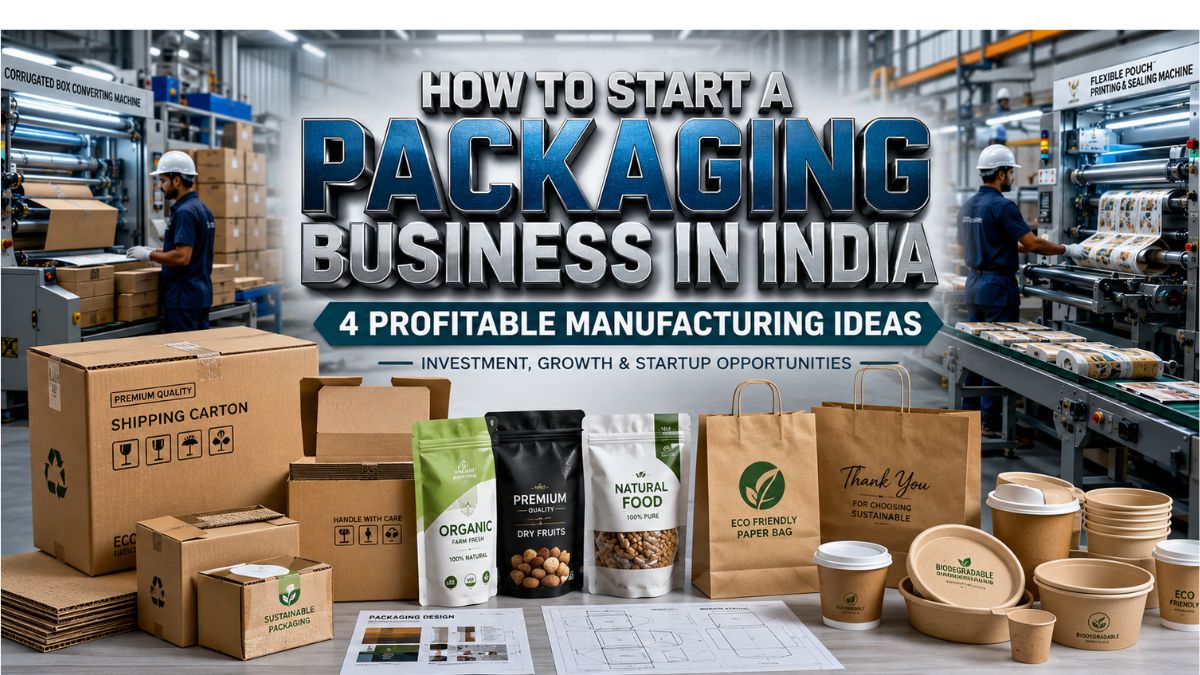
In the fast-changing manufacturing sector in India, there are certain business ideas that are quite predictable and repeatable, and are right under our noses: the everyday packaging and textile used to transport products from farms and factories to end consumers. From protecting the transport of grain in jute-based hessian to a multi-layer packaging film for ready-to-eat foods, it is a key and lucrative sector.
The textile and packaging industry has a mix of attributes—stable supply of raw materials, wide and varied end-markets, growing demand from exports, and robust government support—that is difficult to find in other sectors when a community of entrepreneurs wants to establish long-lasting, recession-proof manufacturing businesses. The following manufacturing businesses are considered from the perspective of practicality, positioning in the market and long-term profitability: Hessian Cloth Weaving, Kraft Paper, HDPE/PP Woven Bags, and Packaging Films.
Why This Sector Deserves Serious Attention
The packaging sector is one of the top growing sectors in Asia in India. E-commerce growth, modernization of the retail sector, agro-processing growth and export industries have all driven continued and multi-sector demand for packaging. The textile packaging sub-sector which encompasses natural fibre products such as hessian, as well as polymer-based products, is not just on the crest of this cyclical wave, but also benefiting from this structural shift.
Hessian is still standing tall as the mandatory or preferred packing material in segments such as sugar, cement and agri-produce, partly because of the Government procurement regulations, and partly because of its practical benefits in bulk packing. The anti-plastic sentiment and EPR (Extended Producer Responsibility) regulations have helped to shift buyers towards paper-based packaging, making Kraft paper the best decade of its life in recent years.
The demand for both HDPE and PP woven bags is high in the cement, fertiliser, chemicals, food grains and construction materials sectors, and the usage is significantly outpacing installed capacity in smaller production volumes. Used in FMCG and pharmaceutical packaging and food processing, barrier properties, shelf life and brand appearance are all dependent on film quality and flexible packaging films include BOPP, BOPET and multi-layered laminates.
This is a particularly compelling entry window – Indian manufacturers enjoy a competitive pricing edge over world-class competitors, domestic food and FMCG demand continue to rise from a middle-class population, and there is ever more often an interest from the global brands to near-shore their packaging supply chain closer to the Asian production base. The PM Gati Shakti initiatives to upgrade the logistics infrastructure in India are further reinforcing this argument.
Get Detailed Project Report (DPR): Packaging Industry: Beverage Cans, Bottles & Flexible Packaging
Government Policies & Incentives Supporting This Sector
Government of India has built multiple support systems for the packaging and textile entrepreneurs. The Credit Guarantee Fund Trust for Micro and Small Enterprises (CGTMSE) under the ministry of MSME, offers collateral-free loans of up to ₹ 5 crore to eligible manufacturing units — a crucial enabler for first time promoters who have no mortgageable assets. The PMEGP (Prime Minister’s Employment Generation Programme) also offers a capital subsidy between 15% and 35%, depending on the location and the entrepreneur group; important for hessian cloth and kraft paper startups.
The Ministry of Textiles has the National Jute Board which implements certain development scheme for the entrepreneurs of jute and hessian sector, such as technology upgradation, market development assistance and cluster-based infrastructure development assistance. The Jute Packaging Materials (Compulsory Use in Packing Commodities) Act requires the use of jutes in certain commodities, thus ensuring a minimum level demand for hessian cloth producers through a policy process.
On the plastic packaging side, DPIIT’s PLI (Production Linked Incentive) Scheme for packaging encourages investment in technical and specialty packaging. In the meantime, the EPR framework in the Plastic Waste Management Rules pushes producers and brands in the direction of alternatives to packaging made from plastic, such as packaging made from kraft paper, which increases the EPR/recyclable packaging market for kraft paper entrepreneurs. Startups in the HDPE/PP and flexible packaging industry can avail of machinery financing under TReDS (Trade Receivables Discounting System) and benefit from the term loan products of SIDBI, which are designed for capital intensive manufacturing units.
Manufacturing Business Ideas: A Deep-Dive Analysis
1 Hessian Cloth Weaving
One material that industrialists are apt to underestimate until they do a study of the demand fundamentals is Hessian cloth, woven from jute fibre. Hessian is woven using relatively simple technology that includes jute fibre preparation, spinning and weaving on the loom, and is used in many different applications from cement bagging to food grain storage, agri-produce transport, construction (geo-textiles used as reinforcement), and for premium home décor and retail packaging where the fabric’s natural look is appreciated and fetches a high price.
India continues to be one of the world’s biggest producers of raw jute (mostly from West Bengal and Bihar) which provides the domestic hessian producers a big feedstock advantage over overseas producers who have to import fibre.
The capital cost of a medium scale (20-30 power looms) hessian weaving unit can vary from ₹ 60 to ₹ 150 lakhs, depending on the machine configuration and land costs. The raw material is available regulated through raw jute and raw jute yarn that includes Jute Corporation of India. Once the level of capacity utilisation exceeds 70%, the gross margins of hessian weaving usually fall between 18–25% for plain hessian grades and can be higher for value added products such as laminated hessian or printed industrial bags.
The other disadvantages of jute are offset by the base demand cushion provided by the government mandatory norms for procurement of jute packing material under Jute Packing Materials Act. FIEO and the market linkage programmes of the Jute Board provide access to the market in Europe where the premiums for eco-packaging are high, for export-oriented units.
2 Kraft Paper Manufacturing
No industry has seen a more pronounced change in its image than kraft paper. All these factors have created a structural demand surge for kraft paper in every commercial grade – it is only fair to call it the market’s “paper revolution. Kraft paper is made of wood pulp or recycled fibers, which is then underwent a chemical pulping process and paper making. In India, the path of recycled-fibre route (recovered waste paper) is gaining economic advantage and is becoming the economical option for mid-scale entrepreneurs, as it significantly decreases the complexity of raw material sourcing.
The capital cost of such a project of 15-20 tonnes/day for kraft paper is in the range of ₹1.5-₹4 crore which is very sensitive to the level of integration and level of automation. There is no concentration risk for any particular manufacturer as the primary end-use industries including e-commerce fulfilment, cement and fertiliser multiwall bags, carry bags and food packaging are all growing at the same time.
The prices of the 80–150 GSM kraft paper have proven to be resilient, given a narrow trading range between quality grades of supply and demand. Those looking at certain industrial grades, such as extensible kraft for cement bags or food wrapping kraft (MG) can expect premium realisations with less competitive competition. Water availability and effluent management are the two most important site selection factors for a kraft plant, both of which are important considerations early in the planning process.
Get Detailed Insights from This Book: Modern Technology of Pulp, Paper and Paper Conversion Industries
3 HDPE/PP Woven Bags
Amongst the various industrial packaging formats prevalent in India, HDPE (High Density Polyethylene) and PP (Polypropylene) woven bags are perhaps the most ubiquitous packaging type. They are used in huge quantities by all cement plants, fertiliser distributors, grain traders, chemical companies, and also in the manufacture of construction material. It is a production process that extrudes HDPE/PP granules to form flat tapes, weaves these tapes on circular or flat looms to form fabric, cuts and sews the fabric to form bags of a specific size. It can be printed, laminated, and even put in a liner to attract higher-value segments if desired.
The scalability of the plant is another major benefit for the mid-market investors — the minimum investment required to set up a basic plant comprising 6–8 circular looms and extrusion lines is around ₹80 lakh to ₹1.5 crore and the expansion is relatively easy as the revenues start coming in. Prices for HDPE/PP granules follow the cycles of the petrochemicals, thus adding a little volatility to the prices of raw materials, but large and stable order books of cement and agri-sector clients offer predictability in cash flow.
Working capital planning is normally possible with annual rate contracts (ANC) that are used by industrial customers. It’s a competitive market that’s quite scale-driven — you need to be able to deliver quality print and consistent service, and customise them to your client’s requirements, and they’ll stick around for years. Proximity to industrial clusters, whether cement belts, fertiliser hubs, is a natural logistics and cost advantage for the entrepreneurs in tier-2 cities which can be built into the business model.
Related Article: HDPE/PP Woven Sack Manufacturing: Fertilizer & Cement Packaging Demand in India
4 Flexible Packaging Films
The most technically challenging and profitable portion of this article’s scope is flexible packaging films. These are the main materials used for the packaging of FMCG, pharmaceutical blisters, snack foods and personal care products, all of which are inspired by the latest developments in bi-layered and multilayer co-extruded films made from BOPP (Biaxially Oriented Polypropylene) and BOPET (Biaxially Oriented Polyethylene Terephthalate). This Indian flexible packaging film market is one of the most dynamic in the Asian region, supported by the increased penetration of FMCG products in the semi-urban Indian market, demanding export requirements of pharmaceuticals and premiumisation by brands in the consumer product industry.
The requirement of sophisticated capital for manufacturing film is quite high — the investment for a BOPP film line or a blown film multilayer co-extrusion line would be from ₹2 crore (small blown film) up to ₹6 crore and above (oriented film). Technology is proven and machinery is available from Indian OEMs such as Rajoo Engineers and Mamata Machinery, European suppliers with financing options. To run a film plant profitably, one has to have disciplined quality control, a correct polymer sourcing and good commercial relationship with the converters and brand owners.
Standard transparent films can’t compete with specialty films, such as high barrier structures, matte films and anti-fog grades for fresh produce. Entrepreneurs who are ready to specialize in a niche within the flexible films category, rather than commoditize the product are more likely to be able to find a sustainable differentiation.
Import–Export Opportunity Analysis
Textiles and packing is the fastest-growing of all the four categories of exports in India. The exports of Hessian cloth are well established and are major markets in the USA, UK, Germany and Australia who have witnessed an increasing demand for natural and biodegradable industrial packaging. The National Jute Board arranges export promotion, whereas the quality certified producers are able to avail premium price in eco-packaging market of the European countries.
Indian manufacturers are providing the markets in the Middle East and Africa with Kraft paper, particularly food-grade and industrial grade. Freight parity of major ports and cost competitiveness makes international contracts achievable for exporters with operations at 20+ TPD scale, in addition to domestic business. Rapid construction growth has been outpacing packaging capacity in Africa, Southeast Asia and the Middle East, all of which are seeing consistent demand for HDPE/PP woven bags for transporting construction and agri-commodity products. The flexible packaging film, especially BOPP grades are exported to markets in the Indian Ocean rim countries.
In the import market, high specification film and paper lines continue to be the technology benchmark, with high precision machinery from Germany, Italy and Japan still being the technology leaders, though the gap has been reduced markedly by machinery from India. In order to acquire world class technology with duty free import, export-oriented units can avail duty free import of EPCs (Export Promotion Capital Goods) against any export commitment which is an effective option for smart entrepreneurs to manage initial capex.
Indian MSME Success Stories
1 Hitkari Fibres & Fabrics – Hessian Weaving, West Bengal
In Bengal, which has a well-established jute and hessian industry, Hitkari is a case of family-run industrialists who scaled up their businesses with the help of government procurement contracts, gradual capacity enhancements and export market development. The main thing to learn from these ventures is that the early commitment to quality consistency – machines, trained weavers, quality control systems – rather than a commodity-based product is crucial. From a long-term standpoint, their reputation-building in a specification-driven marketplace is a source of long competitive moats for them, through their continued relationships with procurement agencies and private grain traders.
2 Ballarpur Industries (BILT) – Kraft & Paper, Pan-India
Although the BILT is not small and medium scale, scale-up lessons should be learned from their path. The company’s strategy was to rely on vertical integration (in house pulping facilities and papermaking), product grade diversification (writing, packaging, specialty paper) and aggressive backward integration (raw material security). The lesson for smaller kraft paper companies is that they should not try to scale, but that they should try to duplicate discipline: focus their paper production on selected grades, manage the raw material acquisition process effectively, and avoid under-investment in effluent treatment; failure to do so is the single greatest business risk for paper companies.
3 Uflex Ltd – Flexible Packaging Films, Noida
Uflex Ltd is perhaps the best case in point of entrepreneurs in flexible packaging films. As a small converter, Uflex decided to systematically invest in backward integration, from printing and conversion to film manufacturing, and then into polymer procurement in the early 1980s, founded by Ashok Chaturvedi. The company has not made a single massive gamble but rather a series of bets on capabilities that it shows are needed in the marketplace.
It is now one of the biggest flexible packaging manufacturers in Asia with operations around the world. The lesson to new entrants is that they need to begin with a narrow skill, demonstrate quality and reliability in a narrow niche, and then work back towards backward integration over time as resources and market position permit.
How NPCS Supports Entrepreneurs in This Space
At Niir Project Consultancy Services (NPCS), we work with entrepreneurs, investors and MSME promoters on just such manufacturing opportunities and prepare Market Survey cum Detailed Techno-Economic Feasibility Reports (DPRs) for new industry setups. We have the reports available for textile & packaging projects which include detailed documentation of manufacturing process, market research & demand study, process flow diagrams, product mix & capacity planning, details of machinery and raw material sourcing, and complete financials including NPV, IRR and payback period with profitability analysis.
We want to help entrepreneurs make a decision whether the business is feasible, profitable, and scalable before making an investment. Whether it’s hessian cloth weaving, kraft paper, HDPE/PP woven bags or flexible packaging films, NPCS has prepared project reports that have helped promoters to obtain bank finance, PMEGP subsidy and credit from CGTMSE. Go to niir.org to see our library of project reports or contact our consulting team to get project specific advice.
Discover business ideas that actually make money
Market Snapshot: Textile & Packaging Manufacturing – India at a Glance
The following table provides indicative market sizing, growth outlook, and project cost benchmarks for the four manufacturing categories addressed in this article. These figures are derived from sector intelligence and industry reports and should be treated as directional planning inputs rather than fixed projections.
| Product Segment | Est. Market Size (India) | Projected CAGR | Avg. Project Cost | Profitability Timeline |
| Hessian Cloth Weaving | ₹4,800 Cr+ | 6–8% | ₹60–₹150 Lakh | 2–3 Years |
| Kraft Paper Manufacturing | ₹18,000 Cr+ | 8–10% | ₹1.5–₹4 Cr | 3–4 Years |
| HDPE/PP Woven Bags | ₹22,000 Cr+ | 9–11% | ₹80 L–₹2 Cr | 2–3 Years |
| Flexible Packaging Films | ₹38,000 Cr+ | 10–13% | ₹2–₹6 Cr | 3–4 Years |
Note: Market sizes are indicative estimates based on industry reports. Project costs vary with location, capacity, and technology choice.
Frequently Asked Questions (FAQ).
Q1. What will the minimum investment to start an HDPE/PP woven bag manufacturing unit be?
A basic but commercially viable HDPE/PP woven bag plant can be set up with Rs 80 lakh to 1.5 crore which includes the extrusion lines, circular looms and sewing/printing lines. This includes plant and machinery cost, building infrastructure and initial working capital. Capital subsidy components can be effective in states which provide a state level industrial subsidy, as this can help to make project costs net negative.
Q2. Is kraft paper still profitable with the move towards recycled and alternative packaging?
Yes – and in a way that is disconcerting to some, kraft paper’s market strength has increased due to the sustainability transition. The shift away from single-use plastics has led to the boost in demand for kraft paper in carry bags, e-commerce packaging and FMCG secondary packaging. The good profitability of the recycled-fibre-based kraft mills has been observed at 15–25 TPD scale, especially targeting specific grades which are aimed to be supplied to industrial customers for long-term supply contracts.
Q3. Is a hessian cloth unit eligible for financing under PMEGP and/or CGTMSE?
Yes. The units of the hessian cloth sector are eligible for PMEGP with project cost up to the PMEGP ceiling (currently ₹25 lakh in case of micro manufacturing, and higher under CGTMSE for MSE). There are also possible extra benefits of jute development programmes, as the National Jute Board is actively promoting the development of jute. The District Industry Centre (DIC) in their state is advised to entrepreneurs for detailed scheme mapping.
Q4. What are the main problems faced in the manufacture of flexible packaging film?
The main hurdles are capital intensity (film lines are costly), process control to ensure reproducible optical and barrier properties, commodity film competition from well-established large companies and price volatility of the raw materials which is linked to polymer price cycles. Entrepreneurs who manage these risk factors by focusing on specialty or value-added films, keeping quality control systems in check, and having long-term offtake agreements with converters or brand owners are more likely to create a strong business model.
Q5. Is there any opportunity for export of HDPE/PP woven bags from India?
Absolutely. The markets for HDPE/PP woven bags in cement, fertiliser and building materials in construction boom markets across Africa, Gulf Cooperation Council (GCC) region and Southeast Asia are active importers. Indian manufacturers gain a competitive edge and have all the necessary logistics to serve these markets at a competitive price. Both FIEO and Plastics Export Promotion Council (PLEXCONCIL) have export facilitation measures in place such as providing access to international buyer databases and participation at the trade fairs.
Q6. What is the time from the concept of a packaging film/kraft paper plant till the production?
The time required for a kraft paper unit of 15-20 TPD is 18-24 months from project approval to commercial production, which includes land finalisation, civil construction, trial runs, and machinery procurement. A blown film or BOPP film line setup is similar; perhaps 18 to 30 months, depending on whether the machinery is procured from local manufacturers, or if it must be imported, and the machines have longer lead times. Evaluation and project planning in detail, involving a feasibility consultant, can significantly lower risk and timeline overruns during project implementation.


