





PMEGP Loan Rejection Reasons
Each year, thousands of first-time entrepreneurs submit genuine business plans, good intentions and the conviction that government support will see them through to fruition with the scheme, PMEGP (the Prime Minister’s Employment Generation Scheme). A lot of them are rejected. Not in the sense of poor business ideas. Not due to the programme’s failure. However, it was not clearly explained to the bank or loan officer what went wrong with the application.
This is a problem that MSME financing chops never like to admit. Despite the huge number of subsidies disbursed under the PMEGP, the rejection ratio has not come down from the perennially high level in all the states. Difficulties in getting applications approved are not due to funding, it’s due to preparedness. These files are used by banks to make a ruthless evaluation of the money-making potential. If they don’t add up, the file is put in the “out of balance” category. Quietly. Without detailed feedback.
Related Article: Why 88% of PMEGP Loan Applications Get Rejected by Banks
Why PMEGP Rejections Are More Common Than the Data Suggests
The focus of most published PMEGP data is disbursements and targets accomplished. It doesn’t emphasize that a lot of applications grind to a halt in the bank evaluation process. The Ministry of MSME has guidelines for the programme which state that it covers projects worth up to Rs 50,000/- in manufacturing and Rs 20,000/- in services, with the subsidy component varying from 15 per cent to 35 per cent based on the applicant’s category and geographical location. This is no small scale. However, the credit risk is borne by banks. That alters all the rules.
Banks are not charitable organisations. They are commercial lenders even in the government scheme. They are engaged in credit underwriting, collateral valuation and risk classification processes in each file that they process. Lending officers’ risk reflex takes over when an application comes in with a poorly organized project document, inconsistent financials or a dubious repayment schedule — and the file doesn’t go anywhere.
Besides, many of the applicants are not aware of the fact that only shortlisted applications are forwarded by the nodal agency, KVIC. These are then independently examined by banks. This double filter system is that a file may pass the administrative filter of KVIC and yet not pass the credit filter of the bank.
The Real Rejection Reasons — Decoded
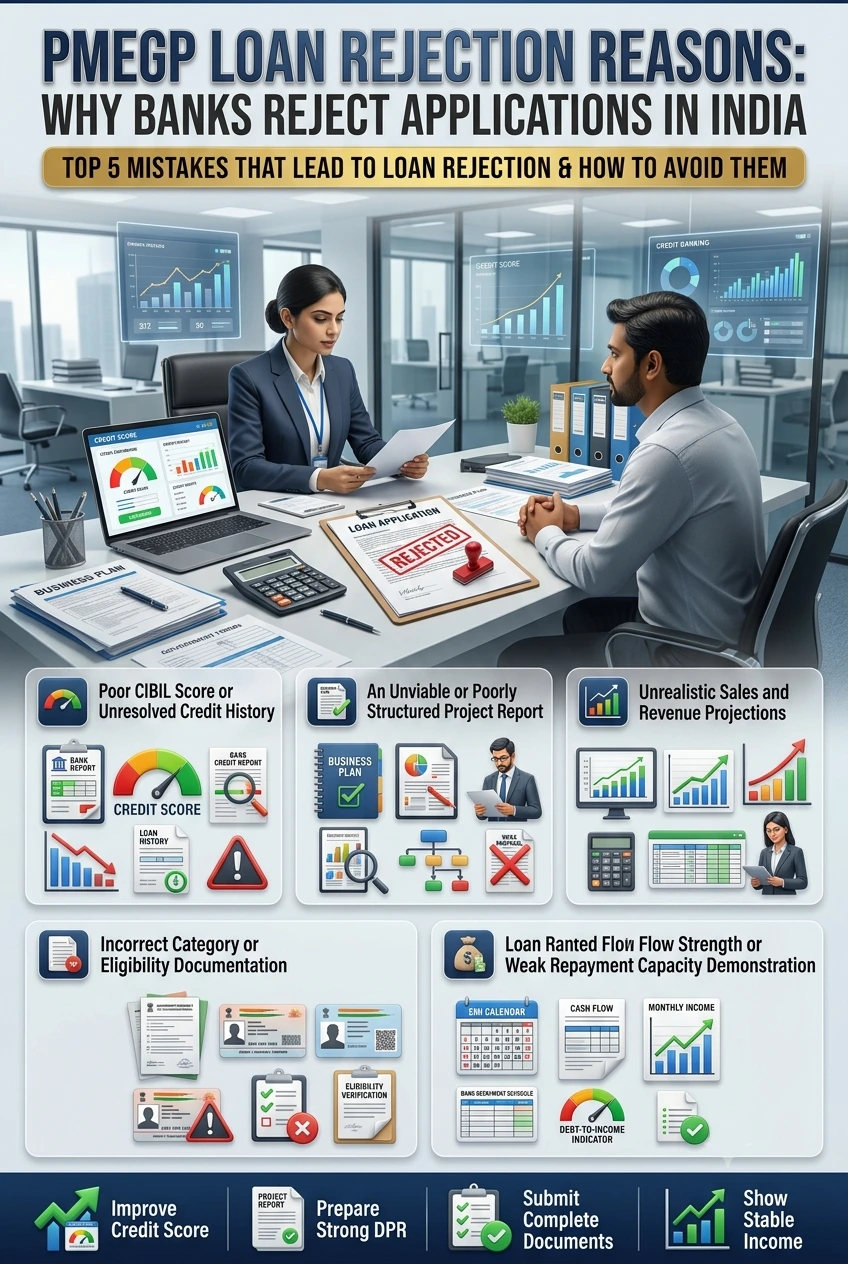
1. Poor CIBIL Score or Unresolved Credit History
The one most frequent silent killer of PMEGP applications. One of the first checks banks do is checking the applicant’s CIBIL report. A score under 650 is a red flag, and even worse, if there are any defaulted loans, settled accounts or overdue payments. Banks don’t usually convey this well. The file just freezes.
Also, there are many applicants who don’t realize that even a minor credit problem that occurred sometime in the past — such as failing to pay a credit card bill on time, a bounced microfinance loan payment or a missed payment on a personal loan — can become apparent from the bureau report and influence the decision. Under the RBI’s credit information framework, banks should take creditworthiness into consideration even for the government-backed schemes.
Get Detailed Insights from This Book: Select & Start Your Own Industry
2. An Unviable or Poorly Structured Project Report
The spine of all PMEGP applications is the Detailed Project Report (DPR). The poorly prepared DPR—one that lacks technical validity, is based on a wrong costing, or fails to justify the proposed product mix—ruins credibility in an instant. Bankers learn to recognize over-costed machinery, unconfirmed raw materials prices and overstated capacity that does not match the equipment installed.
One frequently made error is to present a generic project report that’s been found online or written by someone who isn’t a knowledgeable expert in the industry at hand. These reports are usually devoid of sector-specific cost benchmarking, do not sufficiently cover working capital cycles or clearly articulate how the entrepreneur plans to operate. Banks require depth in reporting; shallow reports do not cut it.
3. Unrealistic Sales and Revenue Projections
Being optimistic is not a way to invest money. Many applicants give revenue forecasts based on 100% utilisation from day one, best possible market conditions and margins that even well-known companies cannot ever attain. Banks (particularly their credit risk units) notice these inconsistencies right away.
A realistic DPR should reflect a seasonally varying demand, working capital shortfalls, competitive pricing and ramp up the capacity over time starting at 40-50% utilisation in Year 1. It can be used as a guideline to financial modelling considerations that lenders consider prudent in the context of the SIDBI’s MSME financing norms. Projects without compliance to these benchmarks are automatically rejected without a reason being provided.
4. Incorrect Category or Eligibility Documentation
PMEGP has certain eligibility criteria with respect to age, educational qualification, age group, geographical area (rural vs urban), and type of beneficiary. Automatic rejection will be made during verification of the applicants who apply under the wrong category, such as applying as SC/ST or women entrepreneur without relevant documents. In the same way, plans put forth in industries that have been placed on the negative list of PMEGP fail to proceed irrespective of the quality of the application.
5. Weak Repayment Capacity Demonstration
The bank must be convinced that the borrower will be able to pay the loan through his business income. This involves a transparent cashflow statement, a reasonable break-even analysis and some proof of entrepreneurial ability (from previous experience, training or education). If they are not provided, there’s no justification for the bank to trust that the loan will be repaid. The application fails.
Access Complete Business Plan: Project Reports & Profiles
Government Policy and What Applicants Often Miss
PMEGP is an initiative of the government under a larger ecosystem for supporting MSMEs such as the Credit Guarantee Fund Trust for Micro and Small Enterprises (CGTMSE), the Udyam Registration portal and the Startup India initiative by the Department of Promotion of Industry and Internal Trade (DPIIT). These schemes come together to minimize credit risk and make small business schemes bankable.
But numerous entrepreneurs opt for applying for PMEGP without Udyam Registration, without understanding the guarantee cover of CGTMSE, and without connecting it with any other government scheme. This puts the bank at risk. A thorough application with a clear reference to the CGTMSE coverage and technically sound DPR pointing towards sector relevance to Make in India initiatives, has a higher chance of going through the credit scrutiny process.
The KVIC has detailed procedure and project examples for each category on its official website. However, many applicants fail to make the most of these resources, or they choose to use third parties that skimp on documentation.
What a Bank-Ready PMEGP Application Actually Looks Like
Fixing Your CIBIL Profile Before You Apply
Get your own credit report from CIBIL or Experian before applying to PMEGP. Locate and clear past due accounts, disputes and outstanding defaults. If necessary, allow 3–6 months to clean up your credit profile. Any score of 700 or higher will greatly increase your chances of getting approved. This alone prevents the most common reason for rejection silently.
Building a Sector-Specific, Technically Sound DPR
The strong DPR is not a template, it is a tailored feasibility document tailored to your project, site and market. It should contain precise plant and equipment estimates, which are based on the appropriate current market value, realistic raw material sourcing plans, appropriate capacity utilisation phasing, working capital estimates that are consistent with operating cycle and a financial model with a clear debt serviceability. That’s where a professional consulting support becomes many times useful.
Aligning with the Correct PMEGP Category and Sector
Please check your eligibility category thoroughly before applying. Higher subsidy percentage is provided for SC, ST, OBC, women and Ex-Servicemen, but proper documents are needed. Subsidy rates go up in rural areas compared to urban areas. Look at the revised negative list: some industries, such as tobacco, alcohol, and some polythene items are no longer on the list. If a mortgage applicant is applying in the wrong sector, it not only wastes their time but it also hurts their chance of being accepted by the lending branch.
Indian MSME Leaders Who Built on a Strong Foundation
There are lessons to be learnt from the path followed by successful Indian MSME entrepreneurs. Biocon was started by Kiran Mazumdar-Shaw as a single businessman in a garage in Bangalore. There was one thing that made her not only fundable, but also made her a fund-worthy company: she had a technical understanding of her product, a defensible market rationale and a business model that wasn’t just aspirational, but operational.
Likewise, Jyothy Laboratories’ M.P. Ramachandran, who created the FMCG business from a small manufacturing unit in Kerala by deeply considering product-market fit and unit economics, was the same thing that made the PMEGP application attractive to the banker. His early growth and success were predominantly based on discipline in cost control and realistic growth plans, rather than on high expectations.
Near the MSME fabric, Chetna Sinha of Mann Deshi Foundation shared her insight on how the women entrepreneurs in rural Maharashtra can avail institutional finance by proving their financial track record, keeping proper documentation and being proactive in dealing with the formal credit system. Her model has since been replicated in the manner in which rural MSME lending is organized in various states. Each of the three stories is about the need to be prepared for credibility, not just ambition.
Turn your budget into a successful business plan
The Role of Professional Feasibility Support
This is where the difference in those who applied and those who got the job increases. At Niir Project Consultancy Services (NPCS) we are able to work with entrepreneurs right at the point where most applications fail — when the project report is being prepared. Our Market Survey cum Detailed Techno-Economic Feasibility Reports are developed with a keen eye for the demands of the commercial bankers and development finance institutions.
Our reports include detailed manufacturing processes, verified market research and demand data, process flow diagram, product mix and capacity planning, machinery & raw material cost benchmark, detailed project financials including profitability and sensitivity analysis. We assist businessmen in the feasibility study, profitability and sustainability analysis before they put any money but more particularly before they apply for the PMEGP. Having a bank-grade DPR prepared by sector experts offers a significant chance of approval.
PMEGP at a Glance: Key Parameters
| Parameter | Manufacturing Sector | Service / Trade Sector |
| Max Project Cost | ₹50 Lakh | ₹20 Lakh |
| General Category Subsidy (Urban) | 15% | 15% |
| General Category Subsidy (Rural) | 25% | 25% |
| SC / ST / Women / PH / NER Subsidy (Urban) | 25% | 25% |
| SC / ST / Women / PH / NER Subsidy (Rural) | 35% | 35% |
| Applicant’s Own Contribution | 10% (General), 5% (Special) | 10% (General), 5% (Special) |
| Minimum Age of Applicant | 18 Years | 18 Years |
| Nodal Implementation Agency | KVIC / KVIB / DIC | KVIC / KVIB / DIC |
| Bank Loan Component | Balance after subsidy & own contribution | Balance after subsidy & own contribution |
Source: Ministry of MSME, PMEGP Scheme Guidelines
Frequently Asked Questions
Q1. Is it possible if the PMEGP application is rejected to apply again?
Yes. No time limit for re-application. You should first find out why you were rejected however before reapplying, whether that’s due to your credit profile, project report or documentation. Re-submitting the same application with no changes in the information will likely yield the same result.
Q2. Is the low CIBIL Score a reason to reject the PMEGP Application?
It doesn’t just create a very high barrier, it does practically. There are different bank internal credit policies. If the project report is very strong and the applicant has a clear repayment ability, it is possible that some branches may accept the applications with a score of 600-650. If the score is less than 600, however, and there are unpaid defaults, it is highly unlikely that it will be approved.
Q3. Which document in PMEGP application is most important?
The Detailed Project Report (DPR) is, perhaps, the most important document. It should truly show the technical and financial viability of your business idea. Having a sector-specific DPR prepared by a professional can significantly enhance your approval prospects by providing a detailed analysis of machinery costs, market demand, working capital cycles, and profitability milestones.
Q4. What is the time limit for getting PMEGP?
The time frame varies from state to state and implementing agency. Initial shortlisting can be done after 4 to 8 weeks of submission on the KVIC portal. Once the file has been forwarded, bank evaluation and sanction can take up to 6–12 weeks. Delays frequently are caused because there is not enough documentation or the DPR must be changed. A well-prepared file propels itself faster through each stage.
Q5. Are Salaried person or person already engaged in business eligible for PMEGP?
Applicants who meet the income and eligibility requirements are eligible to apply. For existing business operators, expansion projects can also be submitted for under certain criteria. In general, beneficiaries who have already benefited from any government subsidy in the same scheme from the same business are not eligible to receive another PMEGP subsidy for the same business.
Q6. Which are the most prevalent industries approved under PMEGP?
Historically, food processing, agro based industries, textile and handloom industries, light engineering and fabrication, paper and packaging, and service industries such as repairing shop, beauty parlour, and retail industry have shown higher approval rates. The local demand is higher and the repayment logic is more evident in these sectors, which makes them less risky to underwrite.
Conclusion: Preparation Is the Competitive Advantage
PMEGP is one of the most generous entrepreneurship support schemes that India’s government has built. The subsidy quantum is real. The intent is genuine. But the programme rewards preparation — not just aspiration. Banks approve files that demonstrate technical credibility, financial realism, and a clear understanding of how the business will operate and repay.
The entrepreneurs who succeed under PMEGP are not necessarily the ones with the most innovative ideas. They are the ones who invested time in understanding the process, built a technically sound project report, resolved their credit profile issues in advance, and approached the application with the same rigour they would bring to the business itself. That discipline, applied before the loan, is what separates approvals from rejections.
If your application has been rejected — or if you are preparing to apply for the first time — consider investing in a professionally prepared feasibility report. The cost of preparation is a fraction of the subsidy you stand to receive. More importantly, it is the difference between a bank-worthy application and a file that quietly disappears into a rejection pile.
References & Further Reading
Reserve Bank of India – Credit Information Framework
SIDBI – MSME Financing Norms and Products


