




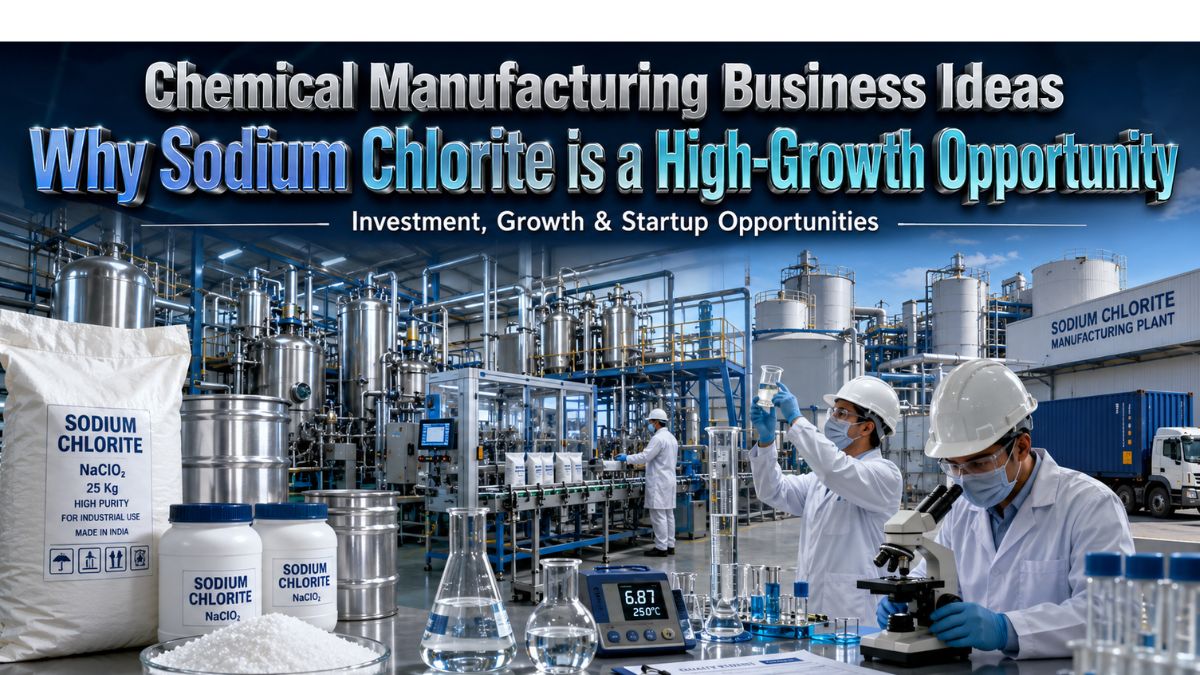
Sodium Chlorite Manufacturing Business
The global sodium chlorite market is valued at approximately USD 410 million and is expected to reach nearly USD 590 million by 2032 at a CAGR of 5.3% from 2026 to 2032. Disinfection of municipal water, pulp and textile bleaching, and metal surface treatment are the key growth areas, while Asia Pacific is the largest market for the production and consumption of these products.
Demand–Supply Gap: India’s requirement for sodium chlorite is always increasing, and the country is still importing sodium chlorite for use in its own utilities, paper mills and textile processors, each time a new municipal water project or effluent-treatment mandate becomes operational.
Get Detailed Insights from This Book: Handbook On Chemical Industries (Alcohol Based)
Why Sodium Chlorite Deserves a Serious Look Right Now
There are very few industrial chemicals that play a more prominent role in public health infrastructure, environmental compliance and export opportunity than sodium chlorite does. It is also not a commodity such as caustic soda or soda ash, but rather the raw material used to make chlorine dioxide, a disinfectant more widely favored than chlorine because it does not produce the cancer-causing by-products that regulatory agencies in various parts of the world are seeking to eliminate from drinking water systems.
That is the only technical advantage that is almost everything about the direction of the demand for a consultant who is evaluating the feasibility. Municipal water boards, pulp and paper bleaching lines, and textile finishing units and metal surface treatment plants are all now being pressed towards chlorine dioxide-based processes, and the sole feasible precursor for chlorine dioxide production on-site is sodium chlorite.
Global Market Snapshot: The Numbers That Matter
A 10-year time-series of historical performance and projections is a consistent message of steady, compliance-driven expansion, not speculation:
| Parameter | Detail |
| Current global market value | ~US$ 410 million |
| Projected value by 2032 | ~US$ 590 million |
| CAGR (2026–2032) | 5.3% |
| Leading region | Asia Pacific |
| Key product types | Liquid sodium chlorite, Solid (powder) sodium chlorite |
| Key applications | Water treatment, textile processing, pulp bleaching, metal surface treatment, others |
Asia Pacific’s dominance is no accident. The area is characterized by the largest wastewater treatment build-out, a concentrated textile/pulp processing facility and relatively low-cost access to the chlor-alkali intermediates used in the manufacturing of sodium chlorite. While China is still the dominant player in both production and consumption, India’s growth could well be the more interesting of the two for the new comers, as the domestic manufacturing base is still light when compared with the amount of demand around them.
By contrast, North America and Europe are established markets that are regulated. Growth there is incremental, closely coupled with replacement demand in municipal utilities, specialty bleaching applications, and not coupled with new capacity addition — helpful background for an Indian exporter considering where a differentiated, compliance-documented product might fit.
Get Detailed Project Report (DPR): Sodium Chlorite Manufacturing Plant Report
The Water Treatment Story Driving Demand
It would be a mistake to treat this purely as a chemicals-industry story. The true driver is in the public health infrastructure. The Department of Drinking Water and Sanitation under the Ministry of Jal Shakti, has promoted piped water supply to the majority of rural households in India through its own Jal Jeevan Mission, and disinfection, now often using chlorination and chlorine dioxide, is central to ensuring that the water is safe after it leaves the water tap. As India Water Portal points out, intermittent rural water supply is a real problem in terms of contamination, hence in-line and automated chlorination technologies are being tested and implemented across states including Andhra Pradesh, Madhya Pradesh and Rajasthan.
All these disinfection methods, from tablet feed to liquid dosing or using generators, use a chlorine dioxide precursor. In India, the most common one is sodium chlorite, and the linkage of water infrastructure spend (both rural and urban) to sodium chlorite offtake is pretty direct and should be understood by a lot of generic global market reports, but definitely not a consultant preparing a feasibility study.
Industrial effluent treatment plants connected with textile dyeing plants, pulp mills and metal finishing plants are increasingly being put under pressure by the state pollution control boards to reduce the toxicity of the effluents and chlorine dioxide oxidation is one of the more economical ways of achieving this, from the industrial as well as the municipal side.
Segment Analysis: Type and Application
By Type. Municipal utilities and smaller industrial processors who do not want to deal with solid oxidizers on-site are the ones that are using liquid sodium chlorite (typically 7.5%, 25% or 31%). Buyers with the handling capability to dilute locally (higher grade material, typically 50% and 80%) and where cost of transport outweighs the advantages of ready to use convenience, prefer the solid/powder form of chlorite.
By Application.
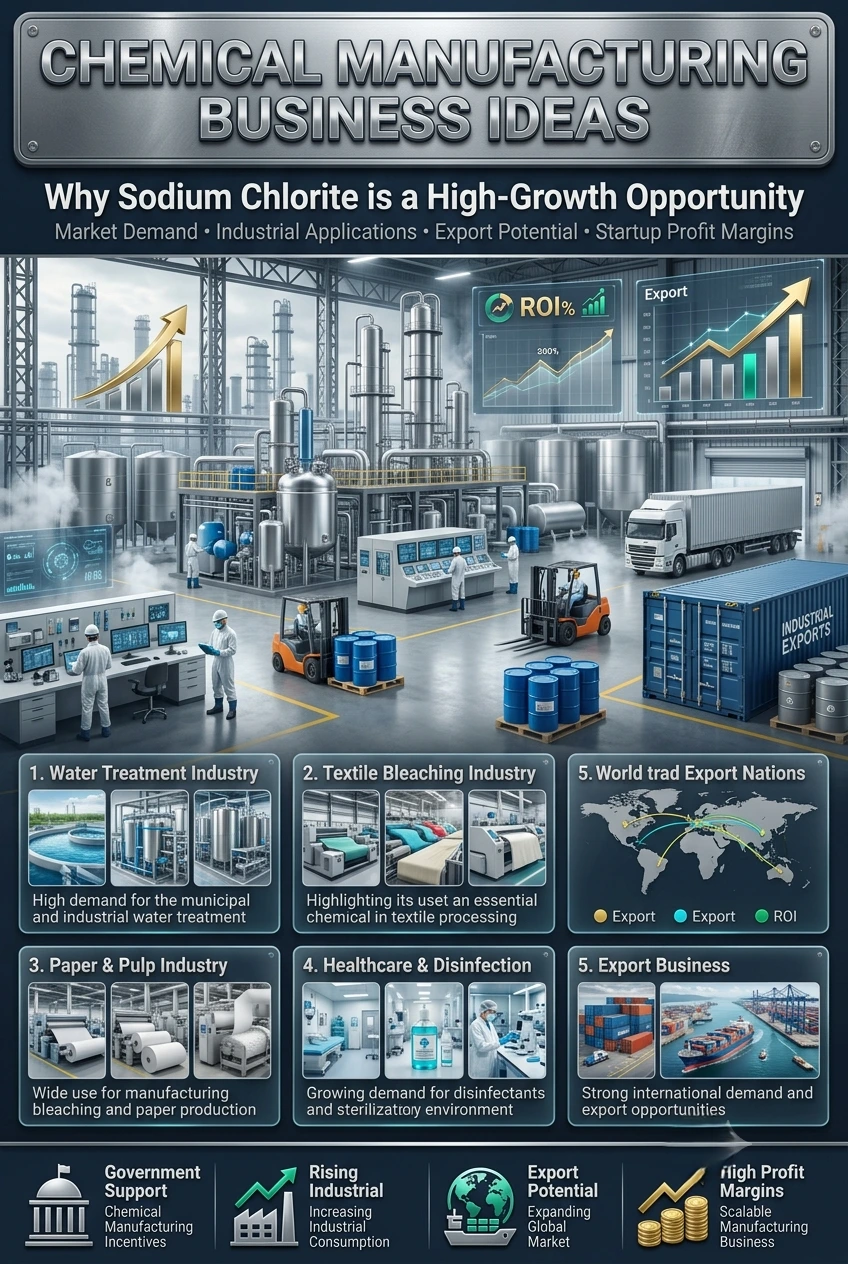
- The largest application of water treatment is still for potable water, both in rural piped water schemes and in municipal drinking water systems, as well as in industrial effluent treatment.
- The area of bleaching, which uses chlorine dioxide, produced from sodium chlorite, is a continuous captive demand in textile application area in India, which has significant processing base in Gujarat, Maharashtra and Tamil Nadu.
- Although some mills are trying elemental-chlorine-free bleaching, pulp application continues to be a relevant consumer and chlorine dioxide bleaching is the industry work-horse for high brightness grades.
- The niche market category of metal surface treatment is smaller but growing rapidly in support of industrial and automotive component finishing.
- Others refers to special oral care formulas, aquaculture disinfection and special sanitation products.
Regional Production Picture
The production is localized in a few geographies. Manufacturers like OxyChem and ERCO of North America, Ercros in Europe and a group of Chinese manufacturers such as Gaomi Kaixuan, Gaomi Yongkang, Shandong Gaoyuan, Dongying Shengya, Lianyungang Xingang, Gaomi Hoyond, Gaomi Dengshun and Shandong Xinyu make up the majority of installed capacity worldwide. Shandong province in China, in particular, is beginning to be a hotspot for manufacturing, with an integrated chlor-alkali system.
The organized manufacturing industry in India is relatively small. One of the oldest players in the country, Shree Chlorates has established a presence within the country since the late 1980s, catering to various concentration grades and a host of water treatment, pulp, and textile customers, leveraging on the preference of public-utility buyers. A tier of smaller regional players, mostly from Gujarat and Maharashtra such as SVS Aqua Technologies, Zed Chem, Kresko Projects, Vinipul Inorganic and some chemical units in Ankleshwar and Visakhapatnam, complete the domestic supply chain albeit with small capacity as compared to the rising demand in the country.
Indian consumption patterns reflect the overall chemicals situation, with demand growth outstripping new organised capacity. Municipal water boards are extending piped-water supply under rural and urban mission programmes, textile units are ratcheting up bleaching units to match export standards and pulp and paper units are matching the steady demand from the packaging sector; the demand for chlorine dioxide precursor chemicals is increasing at a faster rate than domestic sodium chlorite production.
Industry data confirms that this consumption growth is directly reflected in an increase in the import bill and that consumers who cannot get the quantity of goods they need domestically online are forced to place orders with foreign suppliers, particularly from China, the USA, and some European countries, when the landed costs and lead time are inferior.
Identify high-growth industries before others do
Pricing Trends and Competitive Dynamics
Sodium chlorite prices follow two main cost drivers very closely: power tariffs, because the production of upstream chlor-alkali and chlorate uses a lot of electricity; and the logistics, because the product’s strong oxidizer classification drives up handling and freight costs versus common bulk chemicals. The margin bands for liquid grades in the range of 25-31% are generally narrower, as multiple regional suppliers are easily compared to one another, whereas higher concentration powder grades (50% and 80%) are more differentiated, with pricing based on purity, packaging format and consistency of supply which are important considerations for pulp mills and larger industrial buyers that cannot tolerate batch-to-batch variability.
Competitive field – worldwide, there are large chemical companies like OxyChem and Ercros, and a large concentration of Chinese regional manufacturers who are very competitive on price for volumes exported. However, the level of competition is relatively low within India, with the domestic market being small enough that pricing power is likely to be held by the few big domestic producers instead of being driven out of the market by higher import volumes, unless the imports are driven by any of the three factors mentioned above.
Again, it is a cue to the newcomer that a well-run domestic unit does not need to fight a price battle with a large number of other companies in competition, since today, within the Indian borders, a large number of competitors does not exist.
Typically, consultants designing a DPR for this sector tend to propose a modest premium for consistency of product and reliable delivery, as compared to that of import sourced material, depending on the size of the project and the availability of local technical support in relation to Indian buyers, especially municipal utilities under tender norms, who value shorter delivery timelines, invoicing in rupees and local technical support for dosing systems.
Demand–Supply Gap: Where the Real Opportunity Lies
The key component of the feasibility case is this. India’s chemicals industry as a whole is worth nearly US$ 220 billion and represents one of the largest growth areas over the next few years but with such a big base, there is only one on a single hand in India that specializes in the production of sodium chlorite, scaled. according to the U.S. International Trade Administration’s India Chemicals guide Import data available with regional market analysts reveals that the Indian sodium chlorite market has been expanding at double-digit rates over the past few years, which mirrors the unabated growth of domestic demand for the product in line with the demand from water treatment, textile and pulp customers.
Three structural factors sustain this gap:
- Capital intensity at the beginning. The production of sodium chlorite usually begins with electrochemical product sodium chlorate, which also requires considerable power and process facilities, which limits the number of smaller sodium chlorite producers and makes it difficult for others to enter the market.
- Regulatory/handling complexity. Sodium chlorite is a strong oxidiser and has definite transport and storage precautions, thereby requiring a higher level of compliance for new entrants, which also safeguards those who have already established their safety infrastructure – a benefit to an MSME who is ready to invest in proper handling infrastructure from day one.
- Fragmented downstream demand. Even though total demand continues to steadily rise, different buyers from large municipal utilities to small textile businesses have historically blocked larger “greenfield” capacity additions.
The conclusion for a feasibility analyst: There’s no shortage of demand in India. It is not organized, scaled, quality certified domestic supply ready to take the hit of import dependency that the municipal and industrial buyers are faced with today as a cost and lead-time penalty.
Major Indian Players
- Shree Chlorates — One of the better-established Indian producers, is known to have a good variety of concentration range in both liquid and powder form, used in the water treatment industry, pulp and textile industry and has been operating since 1987.
- Acknowledged domestic chemical manufacturer, Vinipul Inorganic Pvt. Ltd. in the sodium chlorite and related inorganic salts sector.
- A group of small and medium scale units in Gujarat/Maharashtra such as SVS Aqua Technologies, Zed Chem and Kresko Projects that provide water treatment, disinfection and supply to industrial customers in the region, where most units operate at a scale, which is far below the national demand.
Notably, the organized Indian landscape remains dominated by a small number of names, which is itself the clearest evidence of the opportunity: there is room for a well-capitalized, quality-focused new entrant to establish a meaningful regional or national position without displacing an already-crowded field.
Related Article: Top Chemical Industry Consultants in India: A Complete Guide for Entrepreneurs and Investors
Startup Opportunity Insight
For a first-generation entrepreneur or an MSME evaluating diversification, sodium chlorite manufacturing offers a rare combination: recession-resistant demand (water treatment is not discretionary spend), a policy tailwind from rural and urban water infrastructure programmes, and a thin competitive field relative to the addressable market. A plant sized appropriately for regional textile, pulp and municipal utility customers — rather than an attempt to compete head-on with integrated global majors — can achieve reasonable payback while directly displacing imported material for local buyers who currently pay a landed-cost premium and tolerate longer lead times.
The chemicals export ecosystem also provides a ready channel for scaling beyond the domestic market. Councils such as CHEMEXCIL, the government-established Basic Chemicals, Cosmetics & Dyes Export Promotion Council, actively support exporters through market access schemes, B2B exhibitions and compliance assistance for overseas registration — infrastructure that a new sodium chlorite manufacturer could tap once domestic capacity is established and export-grade certification is in hand.
Policy and Institutional Support
India’s broader industrial policy architecture is supportive of new chemical manufacturing capacity. The Make in India initiative continues to position chemicals and petrochemicals as a priority sector, while industry bodies such as FICCI’s Chemicals Sector Council publish regular studies and policy recommendations that feed into government planning for the sector. The India Brand Equity Foundation (IBEF), a trust under the Ministry of Commerce and Industry, tracks India’s diversified chemicals output — spanning bulk chemicals, specialty chemicals and agrochemicals across more than 80,000 commercial products — providing useful benchmarking data for any techno-economic feasibility study in this space.
For entrepreneurs specifically, the Ministry of MSME’s schemes for capital subsidy, credit guarantee and technology upgradation remain relevant financing routes for a mid-scale sodium chlorite unit, particularly given that most viable plant configurations in this segment fall comfortably within MSME investment thresholds.
Industrial Scalability and Feasibility Potential
A well-designed sodium chlorite unit lends itself to phased scaling: an initial installation can serve regional textile and water-treatment buyers on liquid-grade product, with capacity for powder/solid grade added once volumes justify the additional handling and packaging infrastructure. Because customers span municipal, textile, pulp and metal-finishing segments, a manufacturer is not overly exposed to cyclicality in any single downstream industry — water treatment demand in particular tends to be the most stable, compliance-anchored component of the mix.
Key feasibility considerations a project report should address include raw material sourcing (chlor-alkali linkages or sodium chlorate availability), power cost given the electrochemical nature of upstream processes, statutory clearances for handling a strong oxidizer, effluent and safety compliance under state pollution control board norms, and a realistic customer acquisition plan built around the municipal tendering cycle and industrial buyer qualification processes — both of which tend to be slower but stickier than typical B2B sales cycles.
Frequently Asked Questions (FAQ)
Q1. What is sodium chlorite primarily used for?
Sodium chlorite, primarily used for producing chlorine dioxide (which disinfects municipal and industrial water, and whitens pulp and textiles, and is used to treat metal surfaces), is a primary and key industrial commodity.
Q2. Why is sodium chlorite preferred over chlorine for water treatment?
Chlorine dioxide derived from sodium chlorite does not create the regulated byproducts of typical chlorination, which include the trihalomethanes. That benefit also makes it desirable for municipal facilities working to meet ever stricter water quality standards.
Q3. Is there a real demand–supply gap for sodium chlorite in India?
Yes. Growing import volumes alongside a thin domestic manufacturing base indicate that current Indian production capacity has not kept pace with consumption from water treatment, textile and pulp customers.
Q4. What investment scale is typical for a new sodium chlorite manufacturing unit?
Project scale varies with capacity and product mix (liquid versus solid grades), but mid-sized units of the kind suited to MSME entrants typically fall within the investment bands supported by existing government MSME financing schemes.
Q5. Which regions in India offer the best location advantage for a new plant?
Gujarat and Maharashtra offer the strongest combination of chlor-alkali raw material access, chemical industry infrastructure, and proximity to textile and pulp customer clusters, though regional demand from water utilities can support units elsewhere as well.
Q6. How can a new manufacturer access export markets?
Registration with export promotion councils such as CHEMEXCIL, along with compliance to destination-market biocidal or water-treatment chemical regulations, provides a structured route into international markets.
About Niir Project Consultancy Services (NPCS)
Niir Project Consultancy Services (NPCS) — www.niir.org — provides professional consulting services for entrepreneurs and industrial investors through Market Survey cum Detailed Techno-Economic Feasibility Reports (DPRs). These reports typically cover the detailed manufacturing process, market research and demand analysis, Process Flow Diagrams (PFD/BFD), product mix and capacity planning, machinery and raw material specifications, import–export dependency analysis, and project financials and profitability evaluation. NPCS’s objective is to help entrepreneurs evaluate the technical feasibility, financial viability, market demand and scalability potential of new industrial and manufacturing projects — including opportunities such as sodium chlorite manufacturing.


