




Gypsum Manufacturing Business
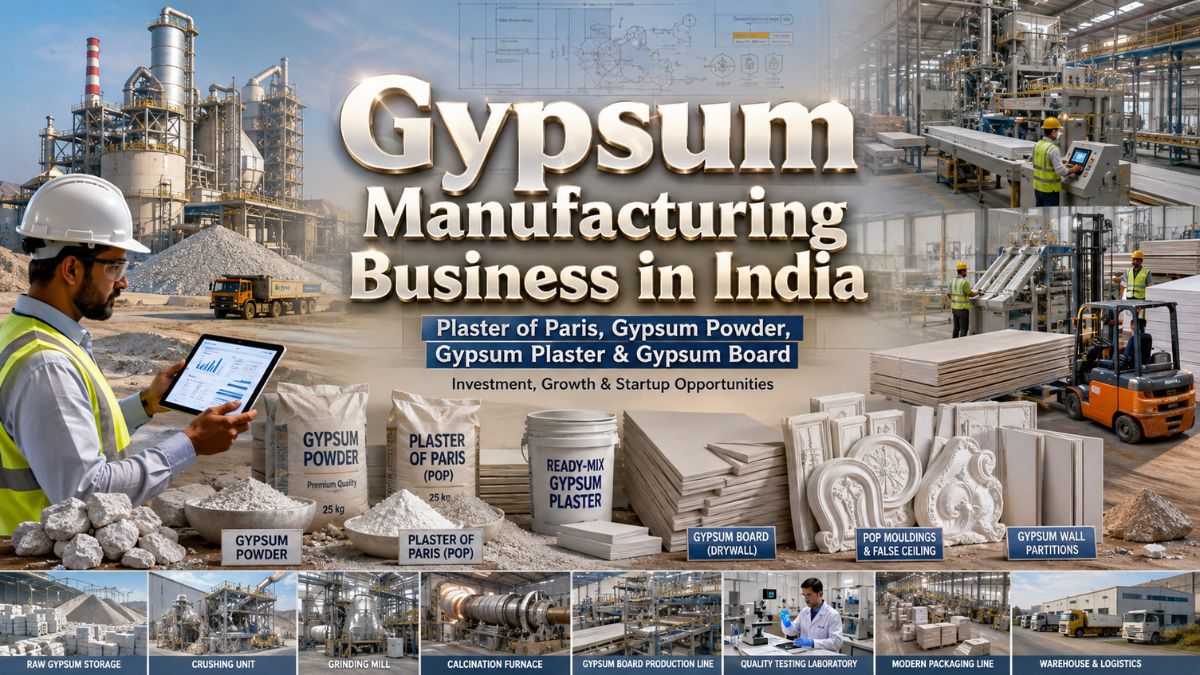
This is the core of one of the hottest manufacturing corridors in India today, where plaster of Paris, gypsum powder, gypsum plaster and gypsum board are at the heart of it. The use of gypsum-based systems is replacing wet cement plaster as it offers time savings, labour savings and provides a smoother finish. Gypsum manufacturing has everything that anyone with a business idea in the building materials industry can dream of.
Rajasthan, Gujarat and Jammu & Kashmir have high concentration of raw materials near the surface. Every housing scheme the government enacts, there is constant demand for more. And the processing technology, ranging from a small Plaster of Paris unit to a complete gypsum board line, can be scaled to any-sized investment.
It outlines the market rationale, policy assistance available, and a series of concrete, commercially viable business concepts in the gypsum value chain, and it provides a few examples of real MSMEs who’ve turned what many still consider a blank slate mineral into viable businesses.
Get Detailed Insights from This Book: Handbook on Gypsum and Gypsum Based Products
Why the Gypsum Manufacturing Sector Is Growing Fast
Gypsum has moved into a phase of the construction industry that is favouring it against almost all the traditional wall-finishing materials available in India. Cement plaster requires days to cure, curing water, experienced masons and multiple coats. Gypsum plaster, on the other hand, sets rapidly and requires no curing and provides a surface ready for painting. That one is the major benefit, and with it the demand has risen steadily in both the residential and commercial sector projects.
The figures support this. According to industry researchers, the India gypsum board market is valued at approximately USD 1,036 million, while is projected to increase to USD 1,576 million in the next 10 years, with a growth rate of nearly 4.8% annually. Supporting this market demand are rapid urbanization, increasing residential and commercial construction, and the demand for fire-resistant, lightweight, and cost-effective building materials. Slightly higher estimates put the market at USD 3.87 billion initially, shooting up to more than USD 6 billion by 2030 with compound annual growth rate of about 7.7%.
There is also demand for infrastructure from the government. The National Infrastructure Pipeline is an initiative for infrastructure development that will cost USD 1.4 trillion for the next five years in India. The interior wall and ceiling systems market most of these installations at the new metro stations, airport terminals, schools and office campuses, and gypsum products are the clear choice for cost and speed.
Exports matter too. Indian manufacturers can take the advantage of the lower cost of raw material and the opportunity to compete in nearby export markets as Indian Rajasthan alone is the home of more than 80% of the gypsum resources in India. Like all other sectors, the reason the “business ideas” in this sector are worth considering is because of the low-cost local raw materials, high demand, and export interest.
A Sector Built on Practical Advantages
Beyond being a simple wall plaster, gypsum products are lightweight, fire resistant and easy to mould. The material used in false ceiling, decorative cornices, partition boards, soil conditioners (agricultural), and even orthopaedic casting powder comes from the same source. A new company doesn’t have to risk losing the entire enterprise on a single product line. A single gypsum calcination unit can serve three to four categories of products that are fed downstream, thus diversifying risks in three sectors of construction and agriculture, as well as healthcare demand.
Get Detailed Project Report (DPR): GYPSUM PLASTER BOARDS Manufacturing Project Report
Government Policies and Incentives Supporting New Entrants
Anyone starting a gypsum factory would not have to construct the factory alone. There are various schemes both at the central and state level specifically aimed to alleviate the capital cost for new manufacturing units.
The Ministry of MSME’s Prime Minister’s Employment Generation Programme (PMEGP) provides capital subsidy funding to new micro enterprises like mineral processing and building material enterprises, subject to the scheme’s eligibility criteria. For a first-time manufacturer, who is not willing to sell their family land for a loan to purchase a calciner and a pulverising mill, the Credit Guarantee Fund Trust for Micro and Small Enterprises (CGTMSE) is a big deal for them.
The Udyam Registration process was introduced in the place of the earlier MSME registration system, and therefore, after registering the unit as an Udyam, the gypsum unit can avail benefits of financing in the priority sector, no delayed payment, and reduced fees for trademark/patent registration. In between, state industrial policies in the two largest states of gypsum in India, Rajasthan and Gujarat provide their gypsum manufacturing units with further capital subsidies, exemption from stamp duty and concessions on electricity duty if they establish near the gypsum mining belt.
Make in India has also continued to promote value addition of building material within the country, which is an added advantage for the gypsum board and gypsum plaster manufacturers compared to the imported ones in the trade side. As affordable house-building projects become more and more stringent on the use of gypsum plaster and gypsum board to complete the project within a predictable timeframe, government housing schemes too generate a predictable large-scale market.
GST and Compliance Considerations
Raw input costs are kept low for downstream manufacturers since the GST rates on gypsum powder and Plaster of Paris are generally lower than the finished construction materials. Newcomers, however, should still register under GST when turnover breaches the thresholds, keep all mining/purchase records of raw gypsum and get the environmental clearance from the state pollution control board, if the unit is close to reserved forest or mining areas, before the plant is commissioned.
Multiple Business Ideas for Startups in the Gypsum Sector
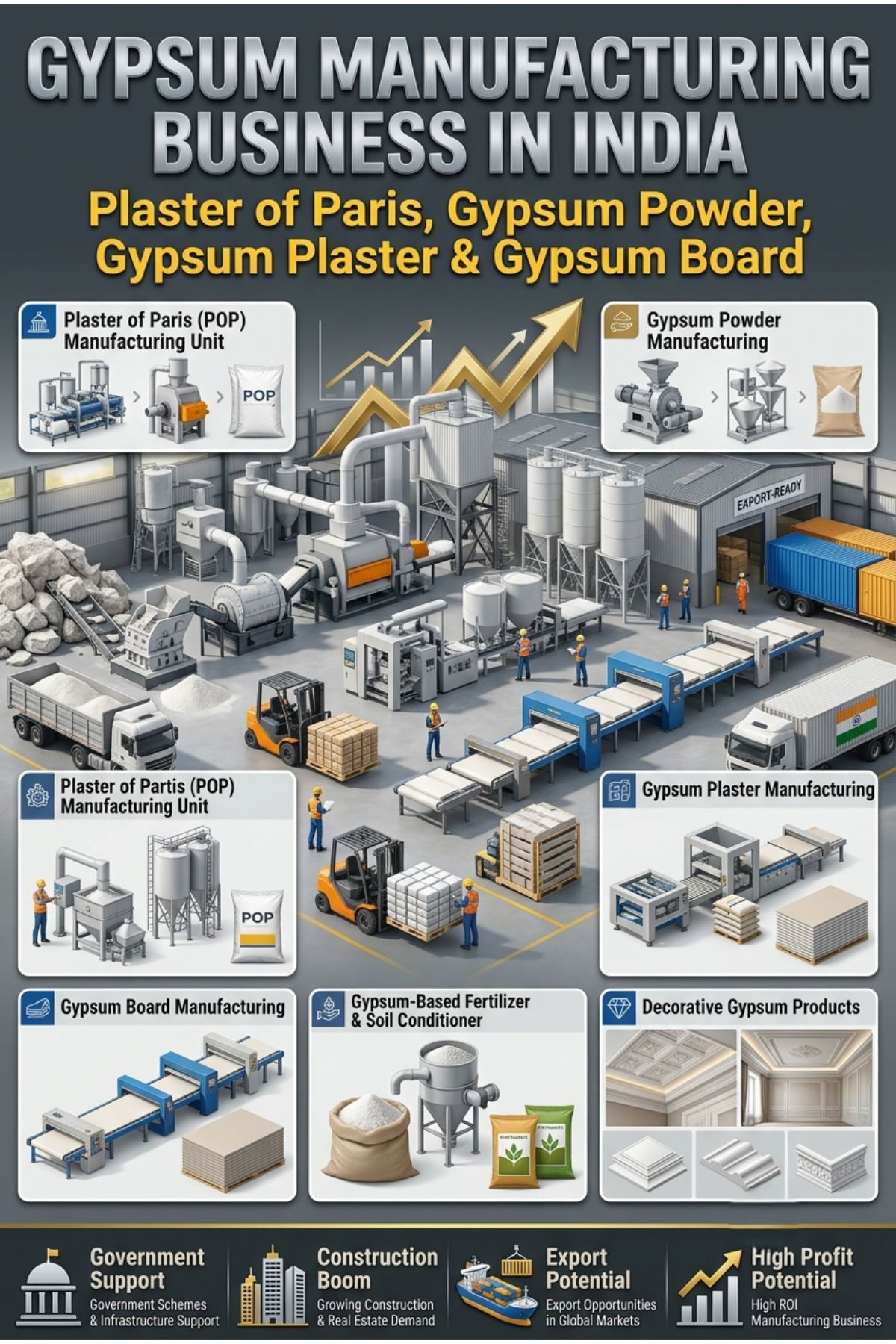
Plaster of Paris (POP) Manufacturing Unit
A Plaster of Paris unit is typically the initial market where brand-new manufacturers access. And for a great reason. It includes calcining raw gypsum at a controlled temperature to drive away about three-quarters of the water contained in it and grinding it finely to a white powder. There is a short list of machinery – rotary or kettle calciner, ball mill or pulveriser, screening unit and packing machinery. A single unit can be sold to four different demand pools and the core process remains the same in this case because construction, interior decoration, art and craft and medical bandage are all different segments of the market.
The working capital needs remain moderate due to the low cost of raw gypsum in the mining belt, and the premium margin for the final product after packing it into retail ready bags. Rajasthan and Gujarat based entrepreneurs can also come into this business by procuring calcined gypsum lumps and operate only grinding and packing works in their respective areas as it will reduce the amount of capital investment of machinery significantly.
Gypsum Powder Manufacturing for Construction and Agriculture
The difference between gypsum powder and POP is the degree of processing and the end use of the product. Raw or lightly processed gypsum powder is used as soil conditioner in agriculture and is used to correct sodic and saline soils in vast areas of Punjab, Haryana and Uttar Pradesh. Because of this the demand for the gypsum powder unit is stable. Agricultural demand for soil conditioning often increases on a seasonal basis during periods of low construction activity, which buffers seasonal fluctuations in business for pure construction-materials companies.
A simple crushing, drying and screening line is a simple to start line, and the production can be naturally expanded by adding a calcination stage later to enter the more valuable POP or plaster production later.
Gypsum Plaster (Ready-Mix Wall Plaster) Manufacturing
The growth in the cement sector is most notable in the gypsum plaster category, which has grown at the fastest rate, partly due to the large-scale builders’ requirements for gypsum plaster over conventional cement-sand plaster on the interior walls. Calcined gypsum is mixed with additives that regulate the setting time, workability, and bond strength of the gypsum, and the mix is put in moisture-proof bags during the manufacturing process. Gypsum plaster is designed specifically for wall application and quality control on setting time and surface finish is the real competitive differentiator, as opposed to POP.
A new unit in this segment requires a little more investment than what a simple POP unit requires due to the additive-dosing and quality-testing equipment for the unit, but the payoff can be seen fast: It’s better to sign a supply contract for a year with a reliable plaster manufacturer than trying to sell into the retail market as a single unit as a result it will have predictable, high-volume offtake.
Related Article: Top 25 Gypsum Business Ideas
Gypsum Board and False Ceiling Panel Manufacturing
The businesses in the gypsum board category are not as capital intensive as the powder-based ones and have a greater margin. The process is undertaken by placing a gypsum core between two layers of special paper, drying the board under controlled heat conditions and cutting it to standard sizes. This requires a continuous line of board forming, a multi deck dryer, and cutting and stacking equipment, which makes it a more capital intensive than a POP unit. The return is proportionate, however, to the investment. The interior fit-out sector is directly influenced by gypsum boards, in the form of false ceilings, partition walls and acoustic panels in offices, malls, hospitals, and hotels.
A mid-sized board line is well-suited to a regional market and can tailor the base business to moisture-resistant or fire-resistant board types once the line is established to allow for pricing flexibility above standard board prices.
Gypsum-Based Fertilizer and Soil Conditioner Unit
Many of the raw gypsum extracted in India is used to enhance farmlands instead of constructing walls. Fertilizer grade gypsum can be used to reclaim sodic soils, provide calcium and sulphur for crops and to remove excess salinity from soil. The process to set up a soil-conditioner unit is relatively simple, consisting of crushing, screening to a specified particle size and bagging for agricultural application. This business is aimed at farmer cooperatives, fertilizer distributors, and state agriculture department, which means its sales cycle differs greatly from the other ideas on this list, which are geared toward construction contractors, so this is a good ancillary business for those already in the gypsum mining and crushing business.
Decorative Gypsum Products: Cornices, Moulds and Ceiling Tiles
Gypsum can also be used for decorative purposes. POP or fine gypsum plaster is cast into silicone or fibreglass moulds and finished by hand for the use in cornices, ceiling roses, wall panels and moulded tiles. The level of investment needed in machines is much less than in board or plaster industry and it is suitable for a person who wants to establish a business in his/her shed and has to sell the product directly to interior designers or contractors within one particular city.
There is a premium price to be charged for the margins on decorative items compared to bulk plaster, as the customer is not only paying for the weight of the plaster, but also what they are purchasing is the design and the finish quality, and a small team with some skill at the job can quickly distinguish a local brand by cataloguing the various types of plaster.
Import-Export Opportunity Analysis
The geopolitical situation of India is special as it has some of the largest reserves of natural gypsum in Asia and has to import processed gypsum board and plaster in its processed form from Thailand, Oman, Iran etc. for the time of peak demand in the western and south regions. That is the place where a new manufacturer can make it in terms of cost as domestic manufacturers pay a much less price to transport the raw gypsum from Rajasthan than the importers pay to ship the finished board across the sea.
Indian exports of gypsum and plaster grew by nearly 69% from around 65,645 tonnes to more than 110,000 tonnes in one year, primarily in response to the demand from the construction market in the Gulf and South Asian countries. India’s gypsum powder, POP and plaster products are exported in regular supply to the neighbouring countries like Bangladesh, Nepal and Sri-Lanka which don’t have sufficient natural sources of gypsum, as the freight rate remains low and quality remains stable. A manufacturer who starts to acquire a degree of export documentation competence, from IEC Registration to a quality certification to basic packaging for sea freight, opens a second revenue stream which many only exporting competitors do not consider at all.
The bigger opportunity, though, lies in import substitution. Every tonne of gypsum board or ready-mix plaster currently imported represents a customer who would switch to a domestic supplier offering comparable quality at a lower landed cost. As more Indian units adopt the paper-faced board technology used globally, that substitution will accelerate, and early movers stand to capture distributor relationships before multinational board makers expand their own domestic capacity further.
Choose the right startup backed by real market demand
Indian MSME Success Stories in Gypsum Manufacturing
Real businesses built on gypsum offer the clearest proof that this sector rewards focused execution rather than just access to capital.
Modi Group of Industries, headquartered in Bikaner, Rajasthan, built its reputation around the “Diamond Gypsum Plaster” brand along with soil-conditioner-grade gypsum for agriculture. The company’s decision to serve both construction and farming markets from the same raw material base gave it revenue stability that pure construction suppliers rarely enjoy, and it remains one of the recognised names entrepreneurs study when they research this sector.
Global Gypsum Pvt Ltd, also rooted in Bikaner with additional units across Surat, Bharuch, and Ankaleshwar in Gujarat, grew into one of India’s largest gypsum plaster manufacturers and importers within roughly a decade of starting operations. The company backed its growth with automation and quality consistency across seven manufacturing units, a decision that let it compete for large contractor accounts rather than relying only on scattered retail demand. Its expansion into allied processing units abroad shows how a domestic gypsum business can eventually build an international supply footprint once the core manufacturing process is standardised.
Garg Brothers Plaster Industries, set up in Rajasthan by Shankar Lal Garg, and sold under the “Gypsona” brand, shows an alternative way to build large scale. It began as a smaller, regional player using quality in plaster powder, POP, wall putty and lime to establish its reputation, and expanded into national distribution over some two decades. If a entrepreneur founders believe in product consistency and gain initial trust in their backyard, it does lead to the former, which didn’t need outside capital.
Each of these examples started with the same raw material every reader of this article has access to. What separated them was disciplined process control, a willingness to diversify across construction and agricultural buyers, and patience in building distributor trust before chasing volume.
How NPCS Supports New Entrants in the Gypsum Sector
Turning any of these business ideas into an operating factory requires more than enthusiasm. It needs an accurate read on machinery costs, raw material logistics, manpower planning, and realistic revenue projections before a single rupee gets committed. That is exactly where a structured feasibility study earns its cost.
At Niir Project Consultancy Services (NPCS), we prepare Market Survey cum Detailed Techno-Economic Feasibility Reports for entrepreneurs setting up new industries, including gypsum powder, Plaster of Paris, gypsum plaster, and gypsum board units. Our reports span all manufacturing stages, market research and demand analysis of the applicant target region, process flow diagrams, product-mix and capacity planning, Machinery and raw materials’ specifications, and overall plant economics inclusive of a thorough Profitability Analysis. Our goal for each report remains the same; assist the Entrepreneur in objectively deciding if a Project is technically feasible, financially profitable and commercially sustainable prior to its inception.
Gypsum Sector Snapshot: Key Data Points
| Parameter | Data Point |
| India gypsum board market size (current) | Approx. USD 1,036 million to USD 3.87 billion (varies by research source and segment scope) |
| Projected India gypsum board market | USD 1,576 million to over USD 6 billion, depending on forecast horizon |
| India’s share of global gypsum board revenue | Around 1.5% |
| Rajasthan’s share of India’s gypsum resources | Approximately 81% |
| Jammu & Kashmir’s share of India’s gypsum resources | Approximately 14% |
| Retail gypsum board price range | Roughly ₹35 to ₹120 per square metre, depending on type and thickness |
| Growth in India’s gypsum and plaster exports (single-year comparison) | Nearly 69% increase |
| Wallboard share of product segment revenue | Roughly 49% |
Frequently Asked Questions
Q1. How much investment does a small Plaster of Paris manufacturing unit need?
A smaller POP unit – covering a single calciner, a grinding mill and packing plant – begins in the order of a few lakh rupees (on a machinery and working capital basis alone), with actual costs varying greatly according to the production unit size, place and whether you mine your gypsum locally or purchase it from outside parties.
Q2. Is gypsum board manufacturing more profitable than POP manufacturing?
Gypsum board offers better unit profit margins because they are for the interior fit-out market, but also requires high investment of Rs 15–20 Lakhs in board forming machines and drying equipment. It is ideal to begin with POP or gypsum powder, build up your cash flow then gradually scale your business to gypsum board.
Q3. Where is raw gypsum available in India, and does location affect project cost?
Rajasthan holds the largest share of India’s gypsum reserves, followed by Jammu & Kashmir and Gujarat. Setting up close to these belts reduces raw material transport cost substantially, which is one of the biggest single variables in overall project profitability.
Q4. Do I need environmental clearance to start a gypsum processing unit?
The state pollution control board requires consent from mines engaged in excavation of gypsum, as also those which operate proximity to ecologically sensitive zones. While processing units producing pure products out of purchased materials often don’t have stringent norms, it’s mandatory for it to assess local norms.
Q5. Can a gypsum manufacturing business sell into both construction and agriculture markets?
Yes, and many successful units do exactly this. Calcined gypsum serves construction, while raw or lightly processed gypsum serves as a soil conditioner for agriculture, giving the business two independent demand cycles instead of one.
Q6. What government support is available for a first-generation entrepreneur entering this sector?
These include PMEGP (which provide interest free margin loan up to 25% on investment with working capital), the collateral-free credit guarantee of the CGTMSE, and state-specific industrial subsidies in Rajasthan and Gujarat-which significantly ease the financing constraints of new gypsum-based manufacturing units.
The Bottom Line
Gypsum products offer solid returns to the entrepreneur that takes it seriously as a business, not a commodity cash-grab. Good supply lines, government support, constant construction – they’re all there, waiting to meet the steady global appetite for gypsum. Plus, you can get started at almost any scale, from a mould-making shed turning out decorative items to a complex gypsum-board plant. Those who will triumph – just as Modi Group, Global Gypsum and Garg Brothers have done – will be those prepared to instill process and build loyalty before chasing size.
Sources & References
- Ministry of Micro, Small & Medium Enterprises, Government of India – https://msme.gov.in
- Department for Promotion of Industry and Internal Trade (DPIIT), Government of India – https://dpiit.gov.in
- Make in India, Government of India – https://www.makeinindia.com
- Indian Bureau of Mines, Ministry of Mines, Government of India – https://ibm.gov.in
- India Brand Equity Foundation (IBEF) – https://www.ibef.org
- Federation of Indian Chambers of Commerce & Industry (FICCI) – https://ficci.in


