






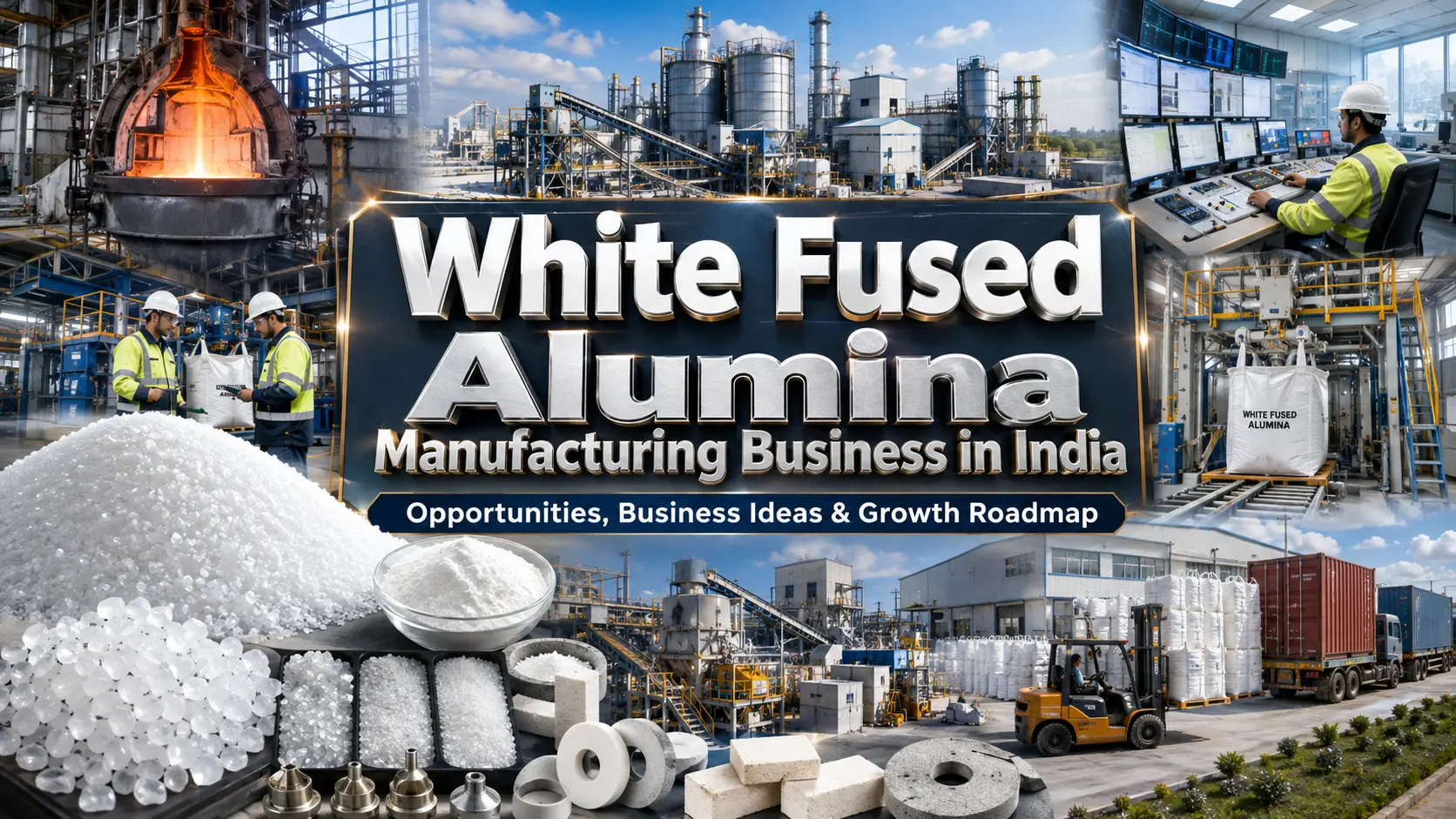
The advanced materials industry in India is presenting some extraordinary business opportunities for the future. Of those, the White Fused Alumina (WFA) manufacturing business is amongst the most technically sound and commercially attractive industrial business opportunities available today. Manufactured through the melting of calcined alumina in an electric arc furnace, this specialty abrasive and refractory material is the foundation of several high growth sectors such as steel, ceramics, precision grinding and engineered coatings. WFA production is an attractive opportunity for startup founders and MSME investors seeking to establish scalable manufacturing ventures, given the firm backing from the local market, persistent export momentum, and proactive government measures to foster innovation in the industry.
Why the White Fused Alumina Manufacturing Sector Is Growing Fast
Structurally, WFA demand is related to India’s infrastructure and industrial growth. Refractory-grade WFA is used in huge amounts in the steel industry for the production of furnace lining, casting nozzles and ladle bricks. With the implementation of the Make in India scheme and the National Steel Policy, the demand for refractory products of good quality or WFA in the downstream is steadily increasing in India with the aim of achieving it as a global manufacturing hub.
Furthermore, the global abrasives market is moving towards more purity in synthetic abrasives. White Fused Alumina has a high purity which is above 99% Al₂O₃, it is just what this requirement needs. Such imports by countries such as Germany, Japan, South Korea and the United States indicate that there is a huge export market for WFA, which India can expand, particularly as the manufacturing infrastructure in the country is improving and its energy costs in some industrial clusters are low.
Further, the electronics and semiconductor sector is becoming a new market for the use of ultra-fine WFA grades in polishing and lapping. This means that users’ demand for these products becomes more diversified, thus reducing the risk of the business model and providing multiple revenue streams for new players.
Related Article: Top 3 Profitable MSME Business Ideas in India: Chemicals & Construction Materials
Government Policies and Incentives Supporting WFA Manufacturing
The policy environment for WFA manufacturing has significantly improved over the last few years. There are various schemes at central and state level which directly support the entrepreneurs who are entering into this field.
The Credit Guarantee Fund Scheme (CGTMSE) under the Ministry of Micro-Small and Micro and Medium Enterprises (MSME) provides collateral free loans to new manufacturing units up to ₹2 crore, significantly helping first generation entrepreneurs to mitigate financial risk.
For WFA units, capital investment is a major part of the project cost, and this is covered by the Technology Upgradation Fund Scheme (TUFS) under the MSME Ministry. MSME Cluster Development Programme can be availed in parallel to this support the entrepreneurs.
Industrial development boards in Rajasthan, Gujarat, Odisha and Jharkhand provide power tariff concessions, industrial rates of land and exemption of stamp duty, with states having good alumina raw material linkages. The details are available in the Make in India portal which brings together the investment incentives provided by the states, on a sectoral basis.
In addition, tax exemptions and expedient regulatory clearances are also extended to eligible manufacturing startups under the DPIIT Startup India initiative under the specified criteria. This can be a major compliance savings for new players in the WFA arena.
Manufacturing Business Ideas Within the White Fused Alumina Segment
1. Standard WFA Production for Refractory and Abrasive Applications
This is the business model and the most evident path of entry for businessmen who have money from ₹3 crore to 6 crores. The industrial line consists of an electric arc furnace, crushing and screening line and a quality testing laboratory. The production output of the coarse and fine WFA grits is used for refractory manufacturers, abrasive grain blenders and bonded abrasive wheel manufacturers. The demand for refractory-grade WFA in the domestic market is significant, and medium sized steel manufacturers, foundries and cement factories are always in need of stable domestic suppliers.
Consistent purity of > 99% Al₂O₃, reliable grit size and quick lead time are the main competitive advantages. Entrepreneurs that develop good quality documentation from the beginning like ISO 9001 certification and material test report will get easier to replace costly imports and develop long term supply contracts with industrial consumers.
Get Detailed Insights from This Book: Books
2. Micro-Powder and Ultra-Fine WFA for Precision Industries
A more specialised concept would be to establish a downstream processing unit which would receive standard WFA and further process it into micro-powder in the D50 size range (0.5 to 45 microns). The ultra-fine grades are used in the electronics industry for substrates; in the optical industry for grinding lenses; and advanced ceramics manufacturers. The capital investment needed in this model is comparatively low (the range is between ₹1.5 crore to 3 crore) because the furnace process is not an arc furnace, which is considered an energy-intensive process.
It requires accurate milling and classification equipment, such as air classifiers and wet ball mills, however, and close particle size analysis. The margins on this segment are far higher than standard abrasive grit as precision grade WFA has a premium of 40-60% over commodity grade.
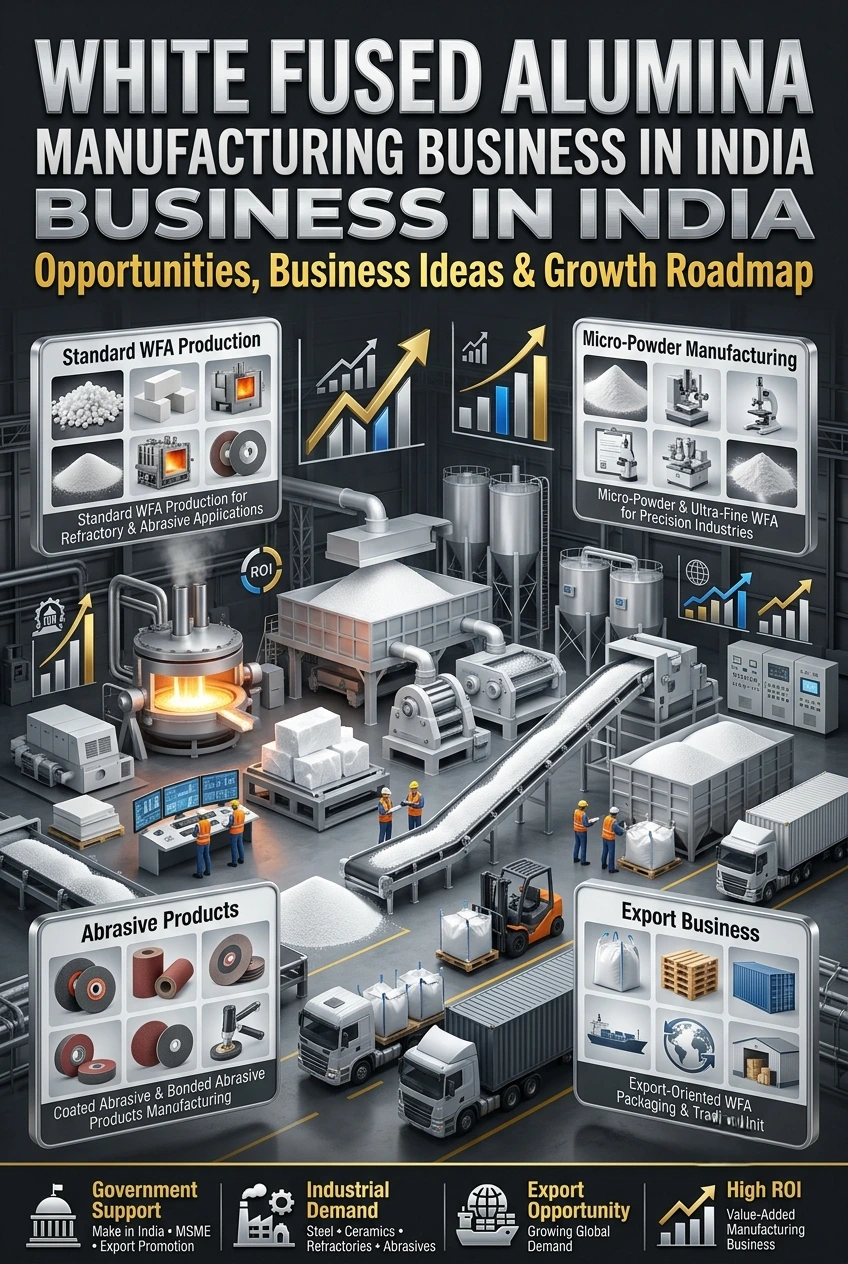
3. Coated Abrasive and Bonded Abrasive Products Manufacturing
Those entrepreneurs who wish to venture further on the value chain can consider the manufacturing of abrasive products like sandpaper, grinding wheels, cut off wheels and polishing discs from WFA. It is basically a factory which is downstream and is the main mineral input is WFA. There is steady growth in the Indian abrasive products market, with the automotive, fabrication, and construction industries being the key applications. Installing a coated abrasives unit or a bonded abrasives plant turns into significantly better margins than selling raw mineral as it is now branded and sold directly to end users such as workshops, fabrication units and tool rooms.
The investment amount of a small scale bonded abrasive unit is in the range of ₹2 to 4 crore and with the proper network of dealers, a new business can achieve the breakeven point in 24 to 30 months.
4. Export-Oriented WFA Packaging and Trading Unit
Entrepreneurs can look at Export focused WFA consolidating and packing centre. Entrepreneurs should have good trade relations and adequate capital for establishing a business on this model can be lucrative. In this model the trader can obtain quality checked raw material like WFA from the domestic Indian manufacturers, prepare customised export worthy packed quantity, and then export it to the overseas buyers who are in need of smaller, customised packing. There are many of small and medium buyers in Middle East, Southeast Asia, Africa who look at intermediary traders to cater to the need of customized quantities, and need for documentation services, and also custom-made blends of grade.
This business can start with a warehouse facility, quality testing equipment, and working capital of ₹50 lakh to 1 crore. The key success factor is developing a reliable domestic supplier base and maintaining consistent quality certifications that international buyers trust.
Import–Export Opportunity Analysis for WFA Entrepreneurs
India currently imports WFA from China in significant quantities, primarily because domestic production has not kept pace with industrial demand. Trade data available from the Ministry of Commerce and Industry shows that synthetic corundum and fused alumina imports represent a meaningful foreign exchange outflow each year. This import dependency creates a clear import substitution opportunity for domestic manufacturers who can match quality benchmarks.
On the export front, Indian WFA makers that meet global quality standards can access German, Turkish, UAE and US markets, among others. FIEO extends assistance to manufacturers who want to access export markets and government’s RoDTEP (Remission of Duties and Taxes on Exported Products) scheme offers benefit through duty remission which directly boost their export performance.
WFA can command an export price of USD 600 to USD 1,200/MT depending on particle size and purity. In an environment of low production cost, such as India, a run at an optimal pace of a domestic WFA manufacturing facility has the potential to yield net margins between 25% to 35% on its exports, net of logistics and quality certification.
Get Detailed Project Report (DPR): Activated Alumina Manufacturing Project Report
Indian MSME Success Stories in Speciality Minerals and Abrasives
Carborundum Universal Limited (CUMI) – Murugappa Group
CUMI is among the leading and most reputed entities in the abrasives and industrial minerals industry in India. Built under the stewardship of the Murugappa Group, CUMI etched a competitive presence through a strategic backwards integration in to minerals – inclusive of fused minerals- alongside development of a leading brand in the domain of abrasive products. The lesson for new entrepreneurs is clear: building vertical integration from raw mineral to finished product dramatically improves margin control and customer stickiness. CUMI’s journey from a regional abrasive products company to a globally competitive manufacturer demonstrates what disciplined capital allocation and consistent quality investment can achieve over the long term.
Grindwell Norton Limited – Saint-Gobain India
While Grindwell Norton is backed by the Saint-Gobain group, its India operations have grown significantly through local manufacturing expansion and technology development. The company sources fused minerals domestically and converts them into precision abrasive products for automotive, aerospace, and general engineering applications. For MSMEs, Grindwell’s approach of focusing on specific niche applications — rather than competing across all abrasive grades — offers a practical template. New entrepreneurs can similarly identify two or three high-margin niche markets and build a focused, defensible business rather than competing broadly on price.
Harsiddh Minerals – An MSME Export Success
Harsiddh minerals is a story of a humble Indian MSME growing into a prominent export enterprise in the industrial minerals sector by staying hyper focused on document quality, delivery punctuality, and customer belief. It began as a small trading firm and soon grew into adding value through a few well-invested qualities testing facilities and achieving internationally accredited certificates for its products and processes. The take-away for aspiring WFA entrepreneurs is very clear: ‘Foreign buyers are not necessarily looking for the cheapest available seller, but a trusted one. The small manufacturer that is able to give consistent quality through immaculate documentation is sure to build lasting customer relations, assuring continuous revenue through exports.
How NPCS Can Help You Evaluate This Business Opportunity
We at Niir Project Consultancy Services (NPCS) provide professional consulting for the preparation of Market Survey cum Detailed Techno-Economic Feasibility Reports (DPRs) for setting up new industries or businesses. Our reports include detailed manufacturing processes, market research and demand analysis, process flow diagrams, product mix and capacity planning, machinery and raw material details, and complete project financials with profitability analysis. If you are considering entering the White Fused Alumina manufacturing business, our feasibility advisory can help you evaluate investment viability, identify the right technology vendors, benchmark production costs, and build a credible project report for bank financing. Our objective is to help entrepreneurs assess feasibility, profitability, and long-term scalability before committing capital.
For industry benchmarks and technical quality standards, entrepreneurs can refer to the Bureau of Indian Standards (BIS) for WFA product specifications applicable to both domestic sales and export markets. BIS certification also serves as a credibility signal for industrial buyers.
Networking & market intelligence Both play roles in new market entry, though arguably not the same depth that’s crucial to many of us in building a consumer business in India. Several trade associations such as the CII are a great source of sector insights in the form of industry outlooks and play a role in matchmaking for manufacturers that are trying to identify buyers both here, and overseas
Find the most profitable startup for your investment range
White Fused Alumina Manufacturing – Key Business Parameters at a Glance
| Parameter | Details |
| Raw Material (Calcined Alumina) | ₹35–45/kg (bulk purchase) |
| Electricity Consumption per Tonne | 2,000–2,200 kWh |
| Installed Capacity (Small Unit) | 500–1,000 MT/year |
| Estimated Project Cost (Small Scale) | ₹3–5 Crore |
| Estimated Revenue (@ ₹80–120/kg) | ₹4–12 Crore/year |
| Gross Margin (Approximate) | 30–40% |
| Export Price (FOB) | USD 600–1,200/MT |
| Key Export Markets | UAE, Germany, USA, Japan, South Korea |
| Primary End-Use Industries | Refractories, Abrasives, Ceramics, Steel |
| Lead Time to Market (Setup) | 12–18 months |
Frequently Asked Questions (FAQ)
Q1. What is the minimum investment required to start a White Fused Alumina manufacturing unit in India?
The minimum project size needed for small scale unit on WFA manufacturing is of about 3-5 crores (land, civil, construction works, electric arc furnace, crushing and screening machinery, working capital) and a unit based on downstream processing for producing micro-powder can be installed within 1.5-3 crores.
Q2. Is WFA manufacturing technically complex for first-generation entrepreneurs?
The arc furnace process stage demands technical skills and specialized man-power. However, entrepreneurs can overcome this requirement through associating with plant-engineers, buying turnkey packages from reliable manufacturers and appoint ng a qualified production-head. It is advisable to prepare the project for at least with a feasibility report.
Q3. Which industries in India buy White Fused Alumina?
Main industrial customers comprise: Manufacturer Refractory, Abrasive Product manufacturer, precision ceramics companies, steel plant consumables suppliers, Specialty Coating Company. Apart from above. Fine-grade WFA has been used by electronics industry and optics industry to do the polishing work.
Q4. Can a WFA manufacturing business qualify for MSME benefits and government schemes?
Yes. A WFA manufacturing unit falls under the MSME definition if it meets the prescribed investment and turnover thresholds. Eligible units can access CGTMSE collateral-free loans, MSME cluster support, technology upgradation subsidies, and state-level industrial incentives including power tariff concessions and capital subsidy.
Q5. What are the key challenges in the WFA manufacturing business?
Major problems are massive power consumption and sourcing of quality materials consistently, as Chinese imports pose major competitive challenge, apart from, the gestation period for gaining buyer trust in such sensitive industrial quality-based market, Entrepreneurs have to plan out for energy cost management and for achieving ISO quality standards from the day one.
Q6. Is there a strong export market for Indian WFA producers?
Yes. Several international markets — including the UAE, Germany, Turkey, Japan, and the United States — import WFA regularly. Indian producers who demonstrate consistent purity, proper grit sizing, and reliable delivery are well-positioned to build export revenue. The government’s RoDTEP scheme and FIEO’s export promotion support further improve export economics.
Conclusion
The White Fused Alumina manufacturing business in India is far more than a niche industrial venture — it is a structurally sound, export-viable, and government-supported manufacturing opportunity. As India accelerates its industrial growth across steel, electronics, ceramics, and precision engineering, the demand for high-purity WFA will only intensify. Entrepreneurs who enter this space with the right technical preparation, quality focus, and market development mindset will find themselves in a business with strong long-term fundamentals. Whether you pursue standard abrasive grit production, downstream micro-powder processing, or finished abrasive product manufacturing, the multiple business ideas within the WFA ecosystem offer meaningful pathways to profitable growth. The window is open — and smart entrepreneurs should evaluate it before domestic capacity fills in.


