





Ethanol Manufacturing Business
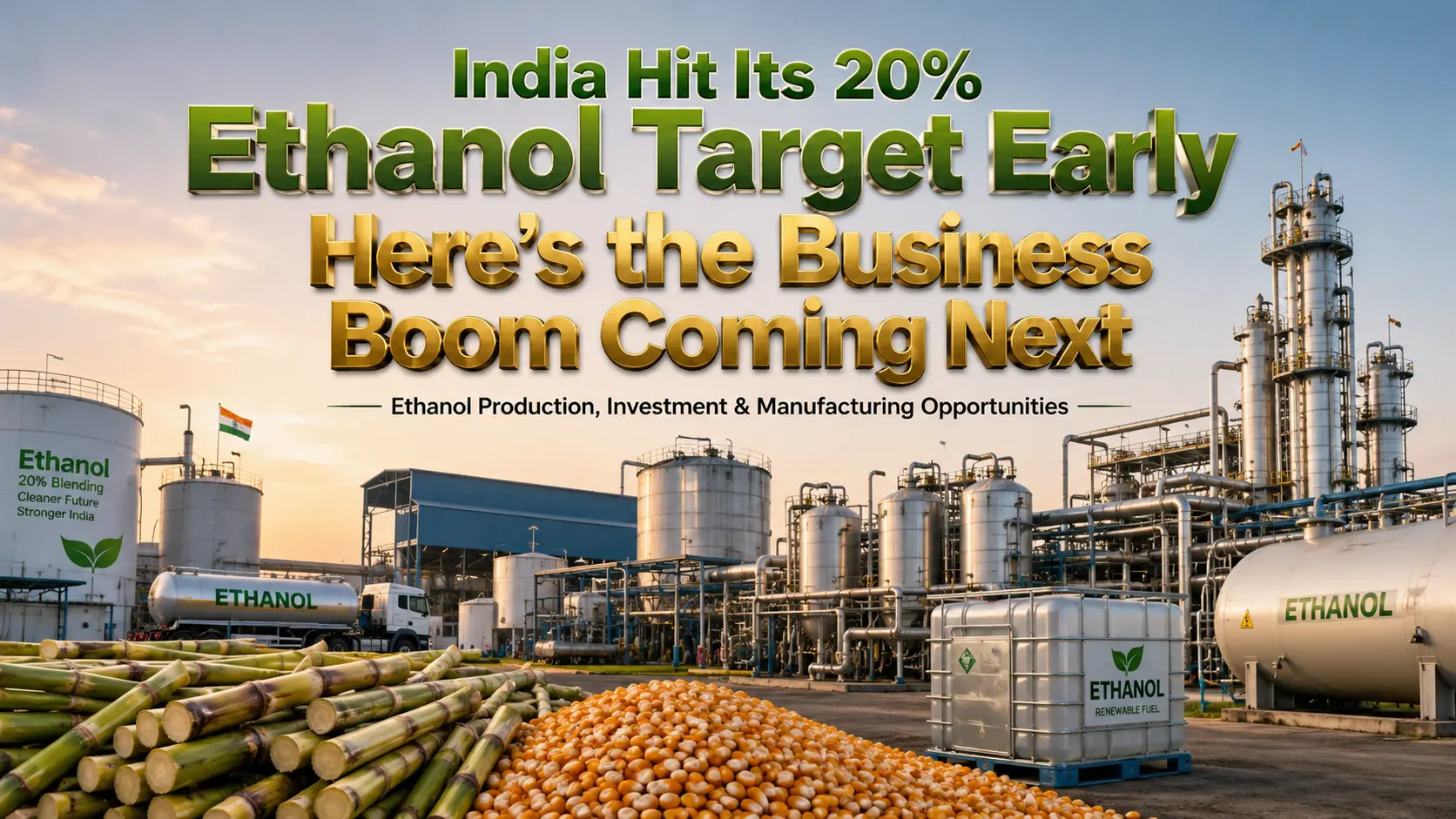
In November 2025, India subtly surpassed an objective that nobody realized was on its way: 20% blending in petrol, which was accomplished approximately five years earlier than the initial 2030 mark. E20 fuel was made mandatory in all the states and UTs from April 1, 2026. The scope of the change was brought into focus by this Petroleum and Natural Gas Minister Hardeep Singh Puri:
It is set to grow by almost 13 times in the next 11 years, from 1.5% in 2014 to 20% in 2025. Most entrepreneurs saw that as a policy success story and they moved on. The more useful reading is different: the government has already announced to the market where blending goes next and production capacity for that does not exist yet.
Explore This Book: Handbook on Biofuel, Ethanol and Bioenergy Based Products
The Numbers Behind the Milestone
The demand for ethanol increased from about 380 million liters in 2013-14 to an estimated of 12 billion litres in 2025-26, and the production capacity expanded by nearly 5 times from 4.21 billion litres to around 20 billion litres over the same period. The figures suggest that the programme has saved India over ₹1.90 lakh crore in foreign exchange since 2014-15, replaced more than 310 lakh metric tonnes of crude oil imports and reduced carbon dioxide emissions by approximately 930 lakh metric tonnes, which is why it is expected to continue to receive political backing in the same vein as a ‘bipartisan’ policy — irrespective of which issues feature in the news cycle during each month.
All of that was not a coincidence. It’s happened as a result of government policy creating certain, long-term demand, and certainty is what a capital-intensive manufacturing business requires before it will commit to constructing a distillery.
Why E20 Being ‘Done’ Is Actually the Opportunity
The following is the part that most coverage of the E20 milestone missed: The ethanol sector in India has the capacity to produce more than the country requires. The offers from the individual companies in the E20 group totalled about 10,500 million litres whereas the industry offers stood at 17,760 million litres, which is far in excess of the current industry demand. Don’t mistake that idle capacity as a red flag. It’s the market’s reaction to what is already known; that both the mandate and the price are going up.
The next number being discussed in the industry is E22 – 22% blending – which is planned to be implemented in India from 2028 to 2030. Each incremental increase in the mandate equates to a 1-to-1 increase in tomorrow’s secured procurement volume, while each new distillery that is built along the way puts itself in the queue for that next step into procurement volume.
Flex-Fuel Vehicles Open a Second Demand Curve
The Ministry of Road Transport and Highways issued a draft notification to acknowledge E85 and E100 flex-fuel vehicles in April 2026, and about 48 retail outlets started offering E85 fuel in June 2026. This isn’t a blending-ratio modification, however, as existing E20-ready vehicles are unable to be easily converted to E100, this is merely the beginning of a new demand curve for E100 as a stand-alone transport fuel on top of the current blending mandate.
India’s ethanol demand is expected to rise to over 1,600 crore litres in 2028 from about 1,016 crore litres in 2025, if E20 blending continues and flex-fuel vehicles account for only 20% of new vehicles sold by 2028, according to analysis by the Council on Energy, Environment and Water. That is an unprecedented demand trend for most manufacturing industries and it is coming on top of an already legislated policy floor.
View Full Project Details: Ethanol as Biofuel: Complete Manufacturing & Business Guide
What This Means for a New Entrant
| Metric | Detail |
| Typical project scale | Grain-based distillery: 30–100 KLPD (kilolitres per day); molasses-based: varies by sugar mill integration |
| Feedstock options | Sugarcane juice/molasses, damaged food grains, maize, and (under 2G policy) agricultural residues like stubble and bamboo |
| Key policy support | GST on ethanol cut from 18% to 5%; 6% interest subvention on distillery loans; viability gap funding for 2G bio-refineries |
| Primary buyer | Oil Marketing Companies (OMCs) under long-term ethanol supply agreements |
| Key licences | State excise licence, Pollution Control Board consent, GST/Udyam registration, OMC empanelment |
| Demand trajectory | E20 (current) → E22 (under discussion) → E30 targeted 2028–2030; flex-fuel (E85/E100) demand layered on top |
The Feedstock Decision That Actually Matters
Much of the capacity expansion in the recent past has been in grain-based distilleries based on maize or damaged food grains, as compared to sugarcane-molasses-based distilleries, which are less seasonal in nature. However, the increasing preference for policy support for diversification can be seen from the modified National Policy on Biofuels that explicitly mentions second generation (2G) ethanol projects based on cellulosic biomass and crop residues such as bamboo and stubble, which are eligible for viability gap funding, in view of the fact that it avoids the competition between biofuel production and food grain production.
As a new entrant, the question of committing to one of the three technologies – grain, molasses or 2G cellulosic – should be less about which is the newest and more about which is truly secure in terms of both volume and price, and is able to be economically transported within a known distance of the distillery site over a 20 year period – a distillery is, essentially, a 20 year capital commitment that must be built around a policy target that continually rises.
The Risk Worth Naming Honestly
Ultimately, ethanol demand will depend on petrol demand, which will peak and then slowly decrease as EV adoption increases in the 2030s. A long-term item indeed, for all who are playing a 15–20 year investment in a distillery. But, for the near-to-medium future, the increase in blending rates is not going to balance out any petrol demand reduction from early EV adoption and the CEEW’s 50%-demand-growth-by-2028 estimate is already reflective of this. The truth is this is a decade-plus time period with a longer time horizon that will eventually need producers to diversify their ethanol business into more uses of ethanol than it will eventually be, including chemicals, pharmaceuticals, and industrial solvents.
Where the Ancillary Opportunities Sit
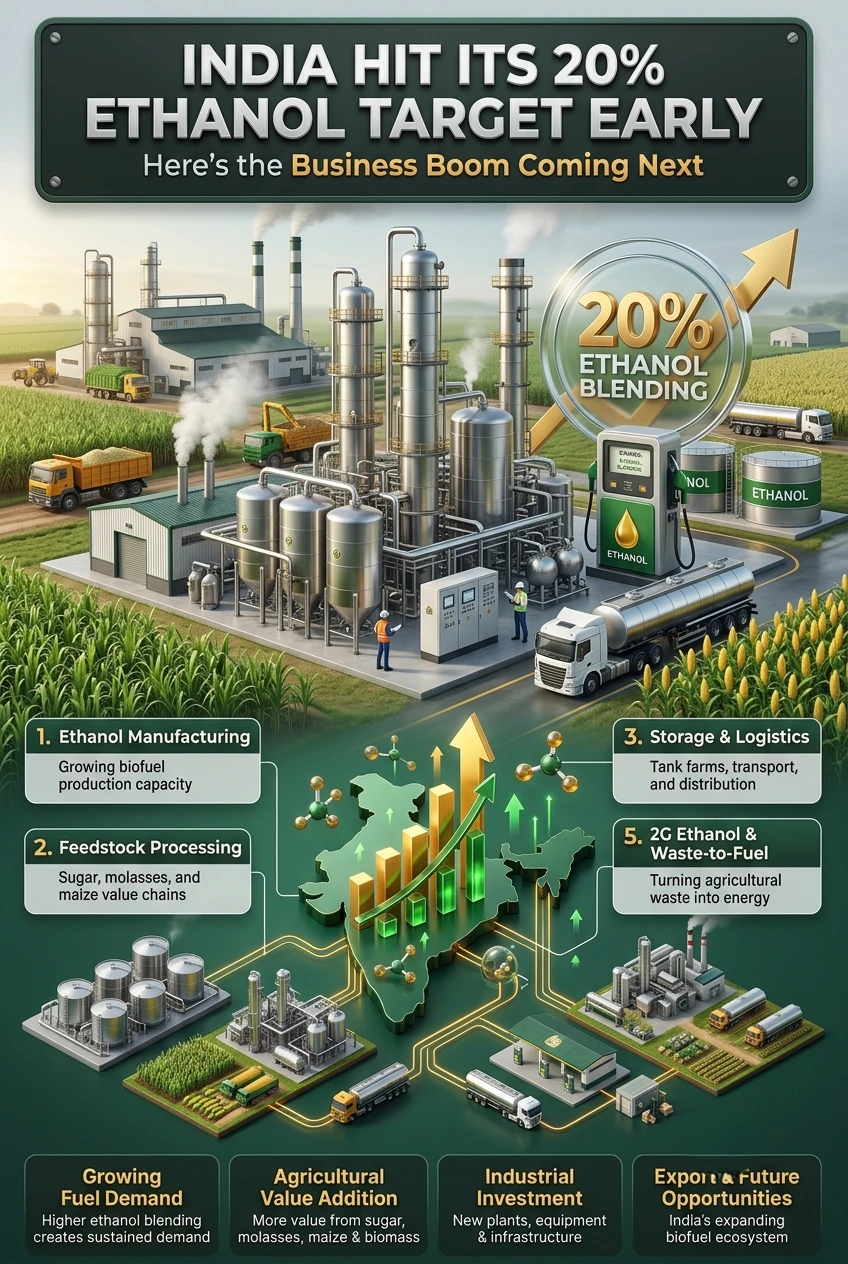
Like other industries which require a lot of capital, the largest capital investment is not the only real money- maker. A surrounding supply chain is required for a working distillery, such as enzyme and yeast culture suppliers, boiler and effluent treatment equipment manufacturers, molasses and grain logistics and storage operators, and waste-to-value processors, who use stillage from ethanol plants to produce concentrated animal feed or biogas. These all have lower capital requirements than the distillery itself, and are directly proportional to the number of new distilleries commissioned to pursue the next blending objective.
Sugar mills already running molasses-based ethanol units also increasingly need dedicated logistics partners for ethanol transport and storage, since the fuel’s handling and safety requirements differ meaningfully from those for sugar or standard chemical cargo. For an entrepreneur without the capital for a full distillery, building a specialised logistics or storage operation around an existing ethanol cluster is often a faster, lower-risk way into the sector.
The government’s own review of the programme’s early years, summarised in a policy explainer covering ethanol blending’s economic and environmental issues, notes that interstate ethanol movement was specifically eased through amendments to the Industries (Development & Regulation) Act — a detail that matters for ancillary logistics operators, since it directly expanded the addressable market for ethanol transport and storage services beyond a single state’s distillery output.
Related Article: Ethanol Blending and Beyond: A New Era of Manufacturing Opportunities in India (2026)
What the Government’s Own Roadmap Signals
The PIB factsheet on the Ethanol Blended Petrol Programme is clear that the next phase of the programme is already being planned with increased blending levels and increased flex-fuel infrastructure, with no intent to regard the programme as complete. It’s a significantly stronger signal than most government programmes provide when the headline target is reached – it’s saying that the demand floor isn’t even declining, it’s still rising.
For whatever projects are being planned around ethanol capacity, that distinction has a direct impact on how much to size a new distillery — if E22 turns up on the timeline that’s being discussed in the industry, a plant sized to meet only E20 demand could prove to be undersized in 3-4 years.
India’s Global Positioning on Biofuels
India’s push to get to E20 was not happening in a vacuum and was done as a diplomatic leader in the matter. Meanwhile, India was also updating national policies to broaden the types of feedstocks that can be used to produce ethanol, and to simplify ethanol transportation to and from state-to-state, a policy change that significantly affected plants situated away from coastlines or from large fuel-blending terminals, as part of the G20’s Global Biofuels Alliance in 2023.
A homegrown approach to capacity development and an international approach to alliance building is a good indicator of a structural policy, not a single political proclamation. It is highly unusual for governments to sink diplomatic resources into a global alliance of their own around a programme they plan to quietly abandon as soon as a headline goal is achieved.
Your investment deserves the right opportunity
How NPCS Can Help You Get Started
A distillery is a very long-term capital project which is sized to a policy target that is continually being raised, so the feasibility study is also of a special importance. NPCS develops Detailed Project Reports related to ethanol production that include feedstock options (grain based, molasses based or 2G Cellulosic), realistic offtake agreements for OMC, effluent and stillage management planning, and a complete financial modelling of the project, including the interest subvention and the benefits of GST under the existing policy.
Other business opportunities of interest: Distillery effluent-to-biogas or concentrated animal feed conversion units (CACs) (byproduct valorisation for existing distilleries); enzyme and yeast culture supply for fermentation; specialised ethanol logistics and storage services; maize and damaged grain aggregation and drying facilities to serve the maize distilleries; and 2G cellulosic ethanol projects using agricultural residues, which have dedicated viability gap funding support.
The Bigger Pattern
The ethanol business in India is a good case in point of how policy-driven manufacturing opportunities actually materialize: government sets a lofty target; industry initially falls short; capacity ramps up to meet the target; government meets its target early; and — the part that entrepreneurs don’t realize — once the target is met, the government raises it again, because the infrastructure and will necessary to meet E20 are not gone once E20 is achieved. It turns into the basis of E22 and then E30.
But even those who are critical of the pace of rollout on the Ministry’s FAQ answering public concerns do not deny that there is an underlying positive trend, it is simply a matter of pace and feedstock trade-offs. It’s not the businesses that wait for the next mandate that make the money. They’re the ones that are on the run when it lands.


