





Iron Ore Business Opportunities
The world’s iron ore output is transitioning from its current growth phase to a new one. The world’s production of iron ore, which has been modest at 1.2% per year over the last five years, is expected to grow at an average of 2.2% per year until 2030 when the total output is projected to exceed 3.04 billion tonnes. The supply of raw material is changing with major increases in Australia, Brazil and the appearance of large new projects in West Africa and the implications for the downstream industries of steelmaking, construction and capital goods is significant.
The shift in global supply is a double-edged sword for India, which is already one of the world’s largest producers of iron ore, and where steel demand is rising, in tandem with the growth of infrastructure investment and manufacturing. It is important for the entrepreneurs, MSME manufacturers, investors, and startups in the steel industry, allied metal processing, construction materials, and industrial equipment sectors to be aware of the impact this realignment will have on raw material prices, market opportunities, and strategic positioning for the coming decade.
What This Development Means for Indian Businesses
Global iron ore production growth is in a way changing the equation of supply and demand of one of the most crucial industrial raw materials in the world. With more commodities, the more the price was put under pressure when global demand exceeded supply, which posed a set of challenges and opportunities for businesses across the entire value chain.
If achieved in a sustained manner, the new lower cost of iron ore input can be helpful to the modestly lower margins and expansion of capacity for primary steel producers in India. Iron ore production in India is expected to reach 290 million tonnes by 2026 and further rise to 375 million tonnes by 2034, with National Mineral Development Corporation (NMDC) playing a crucial role. The domestic supply expansion, coupled with the global expansion, may help keep input prices for domestic steel mills from the steel mills at bay.
The greater business opportunity lies in secondary and downstream manufacturing. Iron ore is a bulk raw material that is better for the large integrated producers. The true opportunity for the MSMEs and entrepreneurs is the industries that use steel such as Fabrication, Construction Equipment, Industrial components, Material handling systems, Storage infrastructure and Value-added steel products which all benefit when steel is competitive in price and a reliable source of supply.
If the domestic steel price moderates, exporters of steel, engineering goods, and fabricated metal products in India will also benefit. A competitive price compared to international counterparts may also create new export opportunities, especially for small and medium-sized manufacturers wanting to access the construction industry in Southeast Asian and African countries.
Why This Industry Could See Stronger Growth
It is important to note that India’s steel demand is structurally related with the cycle of infrastructure investments. Continuous capital expenditure in the road, rail, port and urban infrastructure sectors, along with the affordable housing sector, ensures strong demand for steel. The domestic absorption of steel is likely to continue to be strong despite increase in the supply of steel in the global market due to various heavy-duty infrastructure projects under the programmes like PM Gati Shakti and National Infrastructure Pipeline.
The annual investment on infrastructure in India is in the tens of lakh crore rupees. Metro rail, bridges, industrial corridors and rural connectivity projects, which are built using steel, provide a reliable pull of demand.
Construction and Real Estate: The ongoing rapid urbanisation is pushing residential and commercial construction. Structural steel, TMT bars and flat steel products are still being in demand in Tier-2 and Tier-3 cities.
Export Competitiveness: With domestic steel price competitiveness becoming either equal to or below the global benchmark price, the exporters of engineering products, especially in sectors such as forgings, castings, pipes and structural products, have margin headroom.
Electric Arc Furnace Expansion: It is an interesting development to note that global steel production is making a shift towards electric arc furnace (EAF) technology and in India, this trend is gaining pace as a result of using scrap metal instead of iron ore as a raw material. This is a second opportunity – the collection, processing and trading of scrap for cleaner steelmaking will become more significant in the next decade.
The demand of local steel for manufacturing in various sectors such as defence, railways, capital equipment and so on is growing due to manufacturing Indigenisation (MI) in India which is an import substitution policy. Manufacturing Indigenisation (MI) in India, which is an import substitution policy, is creating manufacturing opportunities for MSME in various sectors including defence, railways, capital equipment etc. in India due to the growth of the demand for local steel.
Government Policies and Incentives
Indian entrepreneurs looking to enter or expand in steel-adjacent and metal manufacturing businesses have access to a well-developed ecosystem of government support:
The National Steel Policy provides a broad framework for expanding domestic steel capacity, targeting 300 million tonnes per annum by 2030. Entrepreneurs can align their businesses with this direction through the Ministry of Steel, Government of India.
Under the Production Linked Incentive (PLI) Scheme, specialty steel is a priority sector. Manufacturers of value-added steel products—high-strength alloys, coated steel, electrical steel—can access production-linked incentives through the PLI Scheme portal, Ministry of Steel.
MSMEs in manufacturing can access credit support, technology upgradation funds, and cluster development assistance through the Ministry of MSME, which administers the Credit Guarantee Fund Trust for Micro and Small Enterprises (CGTMSE), enabling collateral-free lending for eligible businesses.
The Startup India portal offers recognition, tax benefits under Section 80-IAC, and access to the Fund of Funds for metal-sector technology startups.
For export-oriented manufacturers, EXIM Bank of India provides financial support for export-linked working capital, buyer’s credit, and project export financing—critical for MSMEs entering global markets.
Steel processing and downstream manufacturing units located in designated industrial zones can benefit from the National Industrial Corridor Development Corporation (NICDC), which provides plug-and-play industrial infrastructure across major corridors including Delhi-Mumbai and Chennai-Bengaluru.
The Odisha Industrial Infrastructure Development Corporation (IDCO) and similar state-level bodies offer land allocation, power infrastructure, and investment facilitation support for metal-sector manufacturers setting up in iron ore-rich states such as Odisha, Jharkhand, and Chhattisgarh.
Trade and tariff data, export incentives, and market intelligence on steel and metal products can be accessed through the Directorate General of Foreign Trade (DGFT).
For quality certification and compliance in steel and metal products, the Bureau of Indian Standards (BIS) administers mandatory quality standards essential for domestic and export sales.
Manufacturing Business Opportunities Emerging From This Development
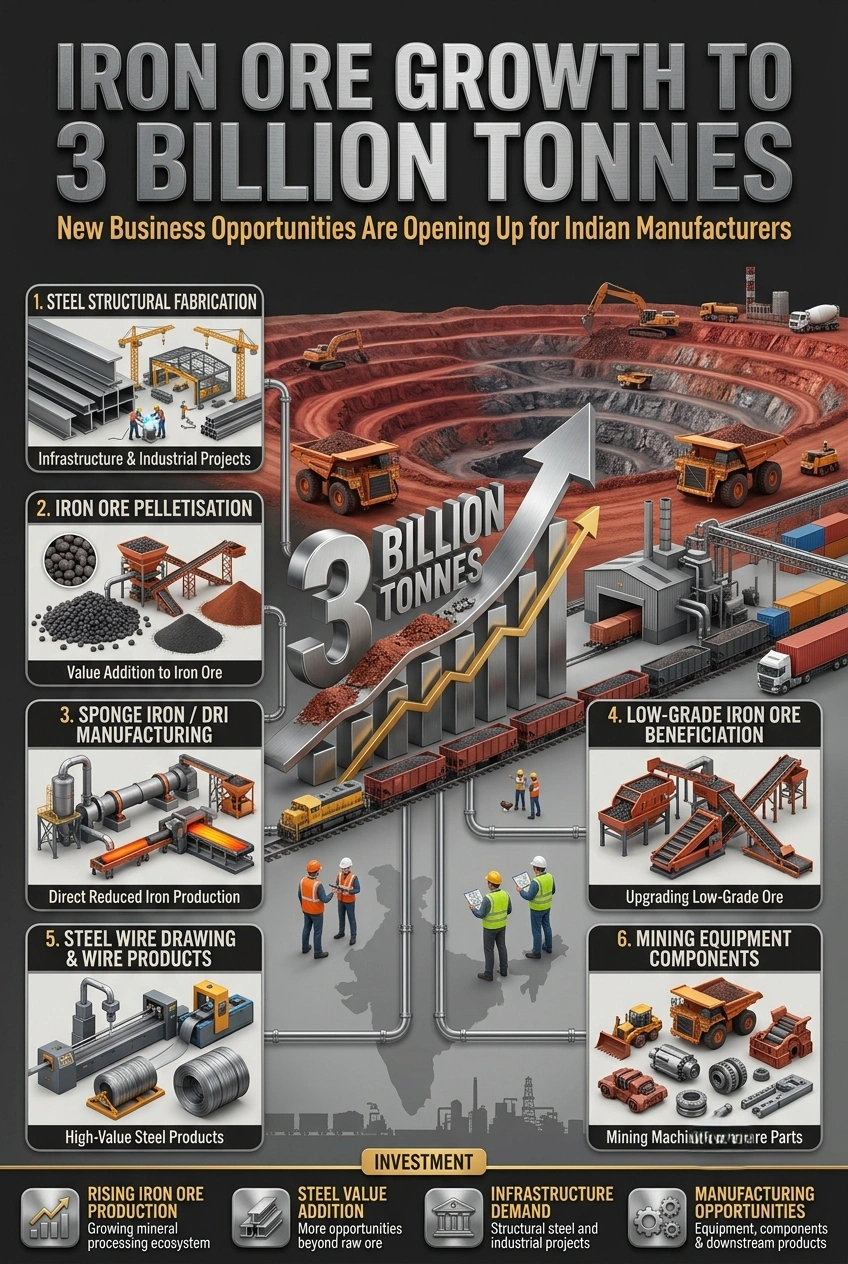
1. Steel Structural Fabrication for Infrastructure Projects
Structural steel fabrication involves the manufacturing of steel beams, columns, trusses, purlins, and gusset plates for bridges, warehouses, industrial sheds, and metro rail structures, making it a high-demand business activity for MSMEs with the potential of scaling up production. Domestic steel prices are now stabilising and Government infrastructure projects are continuing, creating a sustained demand for fabricated structural steel. It is targeted to EPC contractors, real estate developers, industrial or government construction companies. Moderate capital requirement: Mid-scale fabrication unit can be set up with ₹1.5 to 3.5 crore depending on the capacity and automation level. Southeast Asia and East Africa have high export potential as infrastructure investment is being boosted.
The margins are sensitive to the volatility of HR coil (hot-rolled steel) prices directly. Order discipline and pricing discipline based on contracts are all-important.
Related Article: How to Start a Steel Fabrication Unit in India: Investment, Machinery & Export Potential
2. Iron Ore Pelletisation Plant
Pelletisation is a process that converts the low-grade iron ore fines which are a by-product in iron ore mining into high-grade pellet, which can be used as a raw material in blast furnace and in direct reduced iron (DRI) plant. India has ample opportunities for pelletisation as NMDC and state mining companies generate a substantial amount of ore fines and the government has imposed an export ban on raw ore fines, which is generating a processing need at home.
In India, NMDC and state mining companies are generating substantial amount of fines and government’s restriction on export of raw ore fines are creating a processing need at home, which makes the opportunity of pelletisation commercially viable and policy friendly. Capital investment required in a small pelletisation plant (0.3-0.5 MTPA capacity) is around ₹ 40-80 crore. Major markets are domestic sponge iron producers, and exporting customers in Southeast Asia.
Risk: Close to ore sources and power cost are important for the project economics.
Get Detailed Project Report (DPR): Iron Ore Mining Project Report
3. Sponge Iron (Direct Reduced Iron) Manufacturing
The sponge iron is an intermediate product, which is produced by reduction of iron ore in rotary kiln by using coal, and then fed to electric arc furnace and induction furnace to get finished steel. India is the largest producer of sponge iron in the world and the demand for sponge iron in the country is still increasing. Standardized technology can be used to start or grow DRI factories in States of abundant coal and iron ore, like Odisha, Chhattisgarh and Jharkhand. The capital expenditure of a 100 TPD rotary kiln unit is around ₹12-18 crore and the market is ready to be served by rolling mills and secondary steel producers.
Risk: these are potentially high coal costs and power costs can lead to a narrow margin, coal quality and availability are important variables.
View Full Project Details: Sponge Iron Manufacturing: Complete Business Guide
4. Beneficiation of Low-Grade Iron Ore
With global competition in iron ore supply intensifying and quality preferences among steelmakers rising, beneficiation—upgrading low-grade ore through crushing, washing, and magnetic or gravity separation—is becoming an investable business in India. Indian iron ore deposits in Goa and Karnataka include significant low-grade stocks that are commercially underutilised. A beneficiation plant with a capacity of 100,000–300,000 TPA requires ₹8–20 crore depending on process configuration. Output serves both domestic and export markets.
Risk: Mining policy and environmental clearance requirements must be carefully evaluated before investment.
5. Steel Wire Drawing and Wire Products Manufacturing
Steel wire drawing is a tried and tested MSME level manufacturing process where steel rods are transformed into wire of different sizes and gauges used in construction (binding wire, PC wire), agriculture fencing, general engineering and consumer goods. This is a segment with stable demand and capital requirements (₹1-₹4 crore for basic to mid-scale unit) as construction activity remains strong and demand for wire products is on the rise downstream. There is a potential market for barbed wire, high tensile wire and spring steel wire in the Middle East and African regions.
Risk: Rod price is volatile, require operation discipline to keep thin conversion margins.
Read the Complete Book Here: Handbook on Steel Bars, Wires, Tubes, Pipes, S.S. Sheets Production with Ferrous Metal Casting & Processing
6. Mining Equipment Components and Spare Parts Manufacturing
The demand for mining equipment, components, wear parts and maintenance spares also increases as the world and domestic iron ore production increase. Mining sites use massive amounts of items like crusher liners, screen meshes, parts of conveyors, drilling rods and pump impellers. A wide variety are now imported or produced by a few major domestic companies. It is a space open for MSMEs that can do machining, fabrication or casting requiring medium capital investment and a good order lead from the mining companies and equipment OEMs.
Risk: Quality certification and metallurgical specifications are strict and technical expertise is required.
Import-Export and International Market Opportunity
Export Opportunity
The export opportunities for downstream manufacturers are real, stemming from India’s comparative advantages in steel and metal product production – the size and quality of its workforce, the cost of energy in certain states, geographical proximity to the expanding markets in Asia as well as Africa and the improving logistics infrastructure.
The value-added steel products, including forgings, castings, structural steel sections, stainless steel strips and precision tubes, have found export markets in Europe, Middle East, Southeast Asia, and more recently in Africa. Steel plants in Southeast Asia and MENA that have DRI kilns are also a niche market for the beneficiation and pelletisation units in India to supply them with iron ore pellets.
Import Substitution
India continues to import specialty steel products such as silicon steel (electrical grade), high-speed tool steel, bearing steel and some of the grades of alloy steel. With a maturing domestic production capacity and a policy push for specialty steel, entrepreneurs who can access the right technology partnerships can create import substitution manufacturing ventures in such niches.
As domestic mining activity grows, the production of consumables such as high-quality drill bits, grinding media, wire rope and precision castings are other areas where import substitution is possible. Local production of such products for local mines helps to save foreign currency and help to establish long-term B2B supply partnerships.
Indian MSMEs and Startups in Related Industries
- Godawari Power & Ispat Limited, Raipur, Chhattisgarh: It is a fully backward integrated steel company in one corporate body, with iron ore mining, pelletisation, sponge iron production, and finished steel production. For entrepreneurs looking at the possibilities of entering into the pelletisation or sponge iron business, GPIL’s model demonstrates the extent of integration in the supply chain that leads to lower volatility of input prices and helps create competitive strength during commodity price cycles.
- Sarda Energy & Minerals Limited, a mid-size integrated manufacturer which grew its operations from Sponge Iron to Wire Rod and Ferro Alloy. Their path is an example of how MSMEs can access the value chain through a gradual process of adding additional processing capacity with time, and progressively improving their margins and product mix without beginning from full scale.
- Kalyani Steels Limited, Pune: Expert provider of value-added alloy & special steel products to the automotive and engineering industries. Entrepreneurs who have technical skills and niche market connections can make greater margins and have less commodity price exposure in specialty steel processing than commodity steel manufacturing.
What Entrepreneurs Should Evaluate Before Investing
Any business that is looking to invest in a steel-sector or iron ore downstream business should perform a proper pre-investment analysis on:
Market Demand: Does there exist a definite market (local rolling mills, construction contractors, export customers or industrial customers) which will take the product at market prices? DO NOT PRODUCE UNLESS THERE IS CONFIDENCE OF OFFTAKES.
Raw Material Access: Iron ore, coal, scrap, and energy are the main materials used in most steel-related industries. Close proximity to the source of supply, transport cost and price risk management strategies need to be considered carefully.
Technology and Machinery: The technology of most of the processes including pelletisation, DRI, wire drawing, structural fabrication is well established and available from the domestic machinery supplier. The machinery sourcing, installation timelines and energy consumption benchmarks are other parts of a techno-economic assessment.
States with natural Ore Proximate advantages such as Odisha, Chhattisgarh, Jharkhand and Karnataka. For the downstream steel products, location to the steel product fabrication markets (NCR, Mumbai, Chennai) could be more significant.
Capital and Working Capital: At large sizes, steel and iron ore companies are capital intensive. The realistic cost estimates, financing inputs, and working capital buffers are important – especially to deal with cycles of rising input prices.
Regulatory Requirements – Environmental clearances, MSME registration, BIS certification, GST compliance and factory licensing are all applicable and need to be incorporated into the project timelines.
The Break-Even Analysis is the understanding of the level of capacity utilisation needed to achieve the break-even point and the time it takes to get there, which is basic financial planning.
Discover scalable startups tailored to your goals
How NPCS Can Help Entrepreneurs Evaluate the Opportunity
For more than 30 years, NPCS – Niir Project Consultancy Services has been providing technical consultancy services to entrepreneurs, MSMEs and investors in India and 85 countries around the world. NPCS has over 150,000 project reports completed in various manufacturing sectors such as metals, mining, engineering, and chemicals and has applied this experience to feasibility and investment assessment in this area.
The NPCS services, applicable to entrepreneurs seeking opportunities in the iron ore and steel related industries include:
Detailed Project Reports (DPRs): In-depth techno-economic reports elaborating the manufacturing process, plant layout, specifications of various types of machinery, raw materials required, cost estimate for the project, probable profits and financial ratios.
Market Research: Downstream Products Market Sector Demand Analysis, Market Competitive Analysis, Price Trend Analysis, Market Sizing of Iron Ore Downstream products.
Business Opportunity Snapshot
| Industry | Iron Ore, Steel Manufacturing, Metal Processing, Mining Equipment |
| Market Driver | Accelerating global iron ore production; India domestic steel demand growth; infrastructure capex |
| Key Development | Global iron ore output projected to reach 3.04 billion tonnes by 2030 at 2.2% annual growth |
| MSME Opportunity | Steel fabrication, wire products, sponge iron, pelletisation, beneficiation, mining consumables |
| Manufacturing Potential | High — multiple scalable entry points from ₹1 crore to ₹80 crore+ |
| Export Potential | Significant — value-added steel products, pellets, engineering components for SE Asia, Middle East, Africa |
| Import Substitution | Specialty steel, high-quality mining consumables, engineering alloy components |
| Government Support | National Steel Policy, PLI Specialty Steel, CGTMSE, MSME schemes, Startup India, NICDC corridors |
| Investment Consideration | Capital-intensive; energy costs and raw material proximity are critical; commodity price risk management essential |
| Risk Level | Medium to High — commodity price cycles, coal/energy cost volatility, environmental compliance |
| Growth Outlook | Positive through 2030; domestic consumption growth underpins demand despite global supply expansion |
Conclusion
The structural expansion of global iron ore production to 3.04 billion tonnes by 2030 is not just a mining industry headline—it is a signal of the underlying pace of industrial and infrastructure investment worldwide. For India, which sits simultaneously as a major iron ore producer, a rapidly growing steel consumer, and an increasingly competitive exporter of steel products, the implications are layered and commercially significant.
The direct opportunity—iron ore pelletisation, sponge iron production, ore beneficiation—is real but capital-intensive. The broader and more accessible opportunity for Indian MSMEs and startup founders lies in downstream steel processing, fabricated products, mining equipment components, wire and tube manufacturing, and the growing scrap-to-steel recycling ecosystem.
Government policy through the National Steel Policy, PLI incentives, MSME credit schemes, and industrial corridor infrastructure is actively supportive of manufacturing entry in this sector. Market fundamentals—domestic infrastructure demand, import substitution imperatives, and expanding export windows—provide commercial rationale for well-planned investment.
Entrepreneurs are encouraged to begin with rigorous market research, commission a detailed feasibility study, and develop a project-specific Detailed Project Report before committing capital. Sound investment planning—not speculative entry—is the foundation for sustainable business in this sector.


