





Technical Textiles Manufacturing Business
The world of advanced manufacturing is being quietly transformed by technical textiles – textiles that are engineered for function rather than fashion. The sector’s value in India is estimated to be around ₹38,000 crore and its component materials are widely used across the defence, aerospace, healthcare, agriculture, infrastructure and automotive sectors, and the demand for these is growing fast. Technical textiles are engineered components that have a structural, protective or functional function in the products and systems that are the backbone of modern economies, compared to traditional textiles.
This development is commercially important nowadays due to a confluence of international and national factors — such as increased defence spending, localisation of supply chains, import substitution policy requirements, and government programs with a specific focus on promoting domestic technical textile production. Technical Textiles is already identified as one of the priority sectors in India, and Union Government has provided dedicated financial support through production linked incentive schemes and National Technical Textiles Mission. The time is not just ripe, but being actively encouraged, as policy architecture is being designed to support the MSMEs, Indian entrepreneurs, manufacturers and investors in this high-value, high-growth industrial sector almost more favourably.
Get Detailed Insights from This Book: The Complete Technology Book on Textile Spinning, Weaving, Finishing and Printing
What This Development Means for Indian Businesses
Technical textiles have 12 wide-ranging application areas: agrotech, buildtech, clothtech, geotech, hometech, indutech, meditech, mobiltech, oekotech, packtech, protech and sporttech. All of these segments are different supply chains, different customers and different manufacturing possibilities. The common denominator is the global changing demand, as customers in all sectors are shifting from basic materials to engineered solutions for performance in the realm of textiles.
For Indian companies, this means a direct opportunity to replace imports, meet the growing domestic demand at a compound rate much higher than conventional textiles and develop manufacturing capabilities to export to Asia, Middle East and Africa, where Indian manufacturers have a natural cost and geographical advantage.
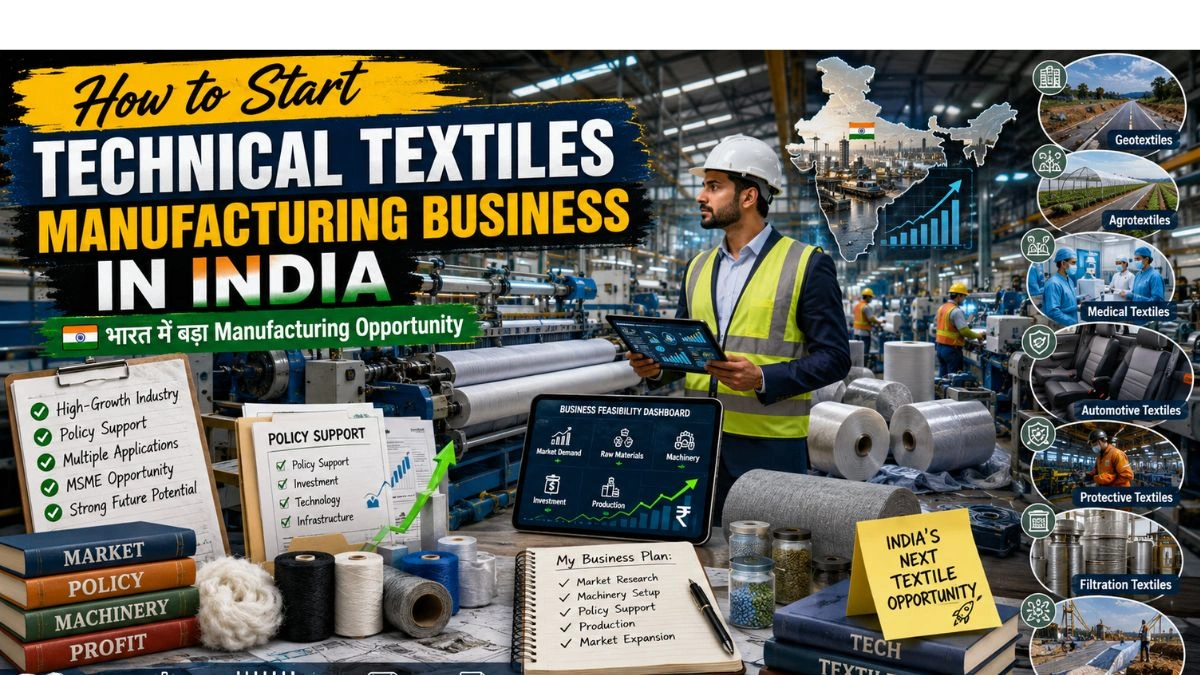
The primary applications are in the defence and paramilitary sector (body armour, ballistic protection, special uniforms); healthcare (surgical drapes, wound care textiles, implantable fabrics); construction and infrastructure (geotextiles, roofing membranes, insulation fabrics); agriculture (shade nets, crop covers, mulch films); and automotive (seating, filtration, noise reduction components). All of these sectors are expanding at home and provide good visibility of demand for manufacturers willing to invest in capability and quality.
The impact on the supply-chain is also significant to the entrepreneur. Strong domestic demand for technical textiles also provides parallel opportunities in raw material supply (specialty fibres like aramid, carbon fibre and polypropylene), supply of machinery and equipment, finishing and coating, testing of quality, and logistics. The ecosystem opportunity is much bigger than the headline manufacturing number implies.
Why This Industry Could See Stronger Growth
The technical textile demand in India is on the rise and this momentum is continuing because of a number of structural factors.
Defence and Security Modernisation: India’s capital expenditure has increased significantly on defence in successive budget and a considerable amount of it is spent on the technical textile-based equipment ranging from ballistic helmet and body armour to parachutes, protective tents, camouflage system etc. There are direct and long-term opportunities for Indian manufacturers to meet military-grade standards with indigenous procurement policy increasingly being upheld in the field of domestic defence.
Infrastructure Growth: Geotextiles are crucial for soil stabilization and erosion management, as well as for drainage in India’s extensive road, rail, port, and waterway construction initiatives. The amount of geotextiles used is likely to expand in direct relation with the infrastructure investment programme, which will take several years and will involve several ministries.
Healthcare Demand: India being a country that is heavily reliant on medical textiles imports, this was a post pandemic acknowledgment that drove investment in medically relevant textiles in the country. Healthcare Demand: This was a post pandemic recognition of India’s reliance on imports for medical textiles, which led to investments in medically relevant textiles. Surgical textiles, infection-control textiles, wound care textiles, and hospital linen are an example of markets where, besides price, quality, reliability, and supply-chain security are critical — the very factors that Indian manufacturers can excel at.
Agricultural Modernisation: Technical textile application such as shade nets, crop protection covers, anti-hail nets, mulch films etc are being introduced in the farming industry in India to boost yield, lower down input cost and prolong growing seasons. The benefits of micro-irrigation and protected horticulture schemes are indirectly creating demand for agrotech at scale from the government.
Even as the automotive industry starts its EV transition, the number of technical textiles used per car is rising instead of falling. The production of batteries, insulators, interior fabrics, lightweight parts, sound-dampening materials and filters all demand engineered textile inputs, while the volume of vehicles produced in India has created significant demand for the local market.
Government Policies & Incentives
India’s policy ecosystem for technical textiles is among the most comprehensively structured in the country’s recent industrial history. The National Technical Textiles Mission (NTTM), administered by the Ministry of Textiles, provides dedicated funding for research, market development, and technology upgradation across the twelve technical textile segments. With an outlay structured to support both early-stage innovation and scaling-stage manufacturing, NTTM represents a direct entry point for entrepreneurs seeking government-backed project support.
The Production Linked Incentive (PLI) Scheme for Textiles extends to technical textile product categories, offering performance-linked financial incentives to manufacturers achieving defined production thresholds. This scheme reduces the effective capital cost of entry and improves return profiles for investors targeting this segment. Eligible manufacturers should evaluate their qualification criteria carefully before project planning.
For MSMEs, the MSME Development and Facilitation Office provides access to credit guarantee schemes, technology upgradation funds, and cluster development support. The Startup India programme provides additional pathways for innovative technical textile ventures through DPIIT recognition, tax exemptions, and regulatory facilitation.
State industrial investment authorities, including bodies such as the Invest Tamil Nadu platform, offer sector-specific incentive packages for textile manufacturing investments including capital subsidies, electricity tariff concessions, and land allocation support within designated industrial parks. Entrepreneurs should evaluate state-level packages alongside central schemes when conducting project location analysis.
For export-oriented manufacturers, the Apparel Export Promotion Council (AEPC) and the Textile Export Promotion Council (Texprocil) provide market development support, buyer-seller meet facilitation, and access to international trade fair participation funding that can significantly reduce market entry costs for new exporters.
Manufacturing Business Opportunities Emerging From This Development
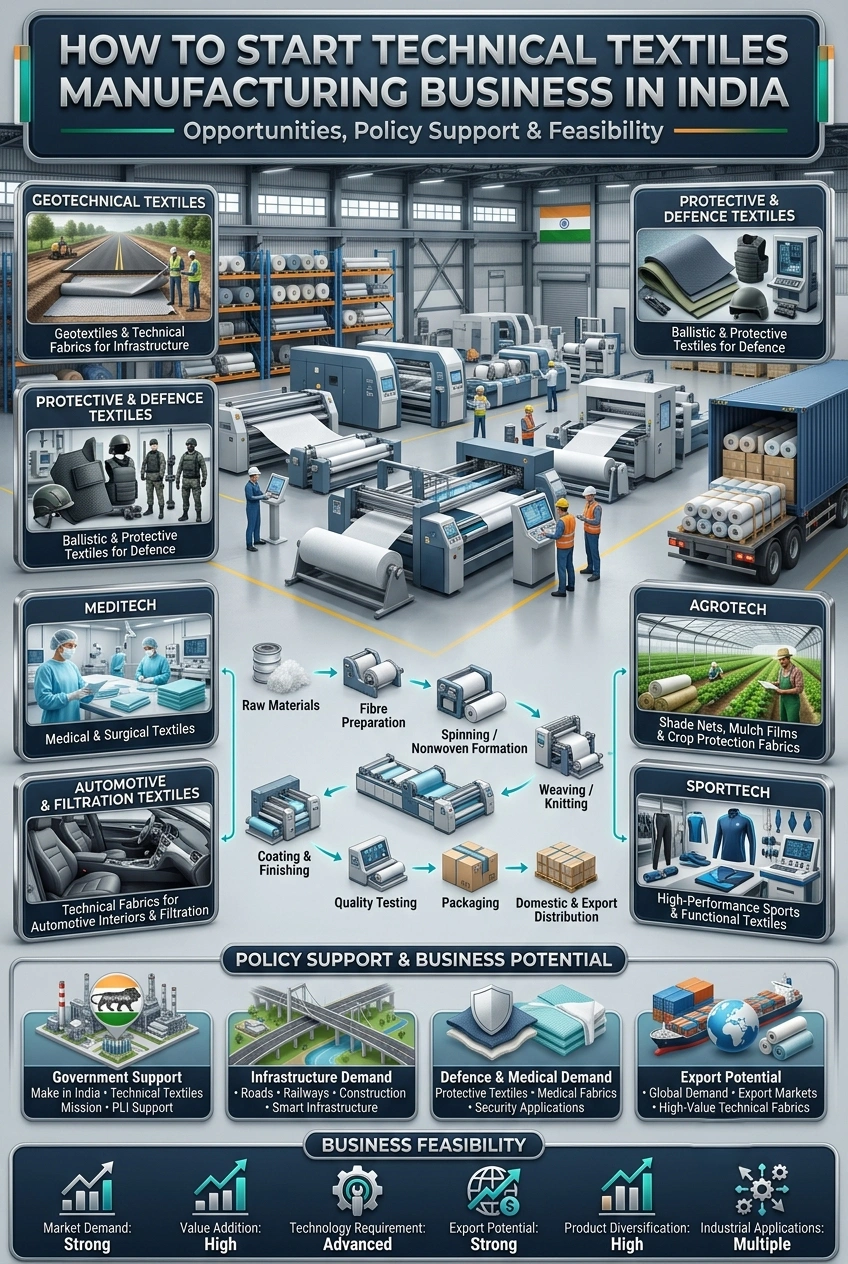
1. Geotextiles and Technical Fabrics for Infrastructure
Among the largest volume segments in technical textiles are geotextiles, which are used in construction and civil engineering applications for soil stabilisation, drainage, filtration, and erosion control, and are woven, nonwoven and knitted fabrics. The use of geotextiles is large in the road and highway construction industry, railway construction industry, coastal protection industry and city flood management infrastructure.
Technically, it is possible to manufacture geotextiles by MSMEs who have the necessary equipment for investment. Domestically available raw materials are polypropylene (PP) fibres and polyester (PET) fibres. The target customers are the EPC contractors, State Public Works Department projects, NHAI projects, and irrigation departments. There are opportunities for export in the South and South East Asian markets. The challenges are competition from established players and a requirement for BIS certification when it comes to supply for the government-project.
Access Complete Business Plan: Geotextiles for Road Construction – Manufacturing Business Guide
2. Ballistic and Protective Textiles for Defence and Security
Indigenisation policies are seen to be very supportive of body armour, ballistic helmets, stab-resistant vests, blast-protective panels and special protective garments for paramilitary and police forces, which form a key opportunity in defence manufacturing. This segment gives India manufacturers a competitive edge over foreign manufacturers as per the Atmanirbhar Bharat procurement preferences of the Ministry of Defence.
High-performance fibres include aramid (para-aramid and meta-aramid), and ultra-high-molecular-weight polyethylene (UHMWPE), the latter of which is mainly imported, but can be sourced from established distributors. Quality control and quality certification according to DGQA specifications are mandatory. The level of investment is medium compared to the industry and the government offtake gives the visibility of the demand. MSME suitability is considered moderate as it is not only about price competition but also about technical specialization.
3. Medical and Surgical Textiles (Meditech)
The meditech segment in India includes surgical drapes, gowns, wound dressings, non-woven face masks, compression stockings and orthopaedic support textiles, and grew appreciably during and after the pandemic. The escalating private hospital segment in India, rising government hospital insurance coverage and rising volumes of surgical procedures sustain domestic demand in India, while export opportunities to regulated markets like the EU and US provide premium pricing.
The production of non-woven fabric in the medical field is one of the easier markets for new companies to enter. The key raw materials are SMS (spunbond-meltblown-spunbond) fabrics, viscose and special polyester fibres. In the context of the supply in hospitals, quality standards such as IS and ISO are crucial. The segment is scalable and has a high export potential if manufacturers get regulatory approvals at the early stage.
4. Agrotech: Shade Nets, Mulch Films, and Crop Protection Fabrics
The agriculture sector in India is slowly adapting to protected farming, precision farming and technologies for yield improvement. Technical textiles have a crucial enabling function: shade nets shield high value crops from too much sun, mulch films keep soil moisture and weed-free, anti-hail nets keep orchards safe, and insect-proof nets diminish the need for pesticides. Micro irrigation and horticultural development is being promoted by Government and this is generating demand at the bottom end for small and medium scale farmers.
One of the segments that is more accessible for new MSMEs is the Agrotech manufacturing sector. The capital demand is relatively low, raw materials (polypropylene and polyethylene) are available in the country and distribution networks can be tapped through the existing agriculture input networks. There is potential for export to South Asia and Africa. Monsoon seasonality in demand and price sensitivity for farm-gate sales are key risk factors.
5. Technical Fabrics for Automotive Interiors and Filtration
Technical textiles are used in the automotive manufacturing base in India which is one of the largest in the world in terms of volume in applications as seats, headliners, door panels, boot liners, filtration, battery enclosure and many more. The market potential of the domestic technical textiles suppliers is huge and has a strong potential for expansion, as the localisation ratios and the number of technical textiles used per vehicle are rising as the premium segment expands.
An investment in weaving or nonwoven machinery, coating and finishing capacity, as well as quality management systems that meet automotive industry standards, IATF 16949, are necessary to automotive interior fabrics and filtration media manufacturing. Automotive supplier relationships (Tier 1 and Tier 2) are significant market access routes. The segment values accuracy, consistency and reliability of supply more than price, offering manufacturers a defensive position which prioritises quality.
Related Article: Technical Textile Manufacturing: The Export Opportunity Indian MSMEs Are Still Missing
6. Sporttech and High-Performance Apparel Textiles
The sports and outdoor recreation sector in India are growing as a result of urbanisation and awareness about fitness. High-performance sportswear fabrics are moisture wicking, UV protection, compression, temperature regulation and are a burgeoning domestic market, where the majority of the need is currently met by imported fabric. Fabrics for functional sports with a local twist are manufactured domestically both for the country’s export saree and sports brands that are gaining popularity.
Investment in the sporttech fabric manufacturing can be made at the basic level of functional finishing of conventional base fabrics, which can then be expanded to speciality fibre weaving. The segment is also advantageous due to its compatibility with the increasing apparel export market in India and can be considered as a substitute of high value fabric imports from countries such as South Korea, Taiwan and China which can be manufactured domestically in the country.
Import-Export and International Market Opportunity
Export Opportunity
There is a huge scope for technical textile exports from India. Labour is competitive, the manufacturing infrastructure is in place and the quality certification is becoming more prevalent, giving the country true price competitive advantages in export markets in Asia, Middle East and Africa. The product categories with export potential are geotextiles, agrotech fabrics, medical and industrial filtration media. Value-added technical textile products, which are more design-oriented, engineering based and performance-oriented, get premium export prices, such as in the EU, UK and North America, where Indian suppliers are different.
Exports oriented manufacturers should start early contact with Texprocil and the export promotion councils to avail the facilities for participation in trade fairs, Buyer-seller meets and export credit assistance. Frequently, achieving certification to international standards, such as ISO, CE or Reach, is a prerequisite for a sustainable growth of export markets, especially for products intended for the medical sector or the European Union market.
Get Detailed Project Report (DPR): Textile & Garment Industry: Complete Manufacturing Guide
Import Substitution
India is currently dependent on large import quantities of high-quality technical textile materials like aramid fibres, carbon fibres, special purpose nonwovens and technical fabrics that are used in defence and aerospace field. All these product categories are areas of domestic manufacturing, and government policy, in these cases NTTM funding of R&D is actively promoting localisation. There’s a lot of government assistance and local demand out there for entrepreneurs who can come up with or license technology to process fibres at high quality and make technical fabrics.
The import-substitution opportunity is particularly pronounced in meditech (hospital textiles), protech (personal protective equipment), and geotech (infrastructure fabrics), where domestic supply has historically been insufficient to meet growing institutional demand, resulting in procurement from Southeast Asian and Chinese suppliers. Building domestic capacity in these categories serves both the commercial opportunity and the national supply-chain resilience objective.
Indian MSMEs and Startups in Related Industries
Kusumgar Corporates
Kusumgar Corporates, based in Mumbai, is one of India’s established technical textile manufacturers with operations spanning multiple segments including coated fabrics, industrial textiles, and military-grade specialty fabrics. The company demonstrates how Indian manufacturers can build multi-decade technical capability in engineered textiles by focusing on quality compliance and defence sector relationships. Entrepreneurs can take from this example the importance of early investment in quality management systems and the long-term value of government and institutional customer relationships in technical textiles.
Himatsingka Seide
Himatsingka Seide, headquartered in Bengaluru, operates an integrated technical textile and home textile manufacturing platform with significant export revenues. The company’s ability to combine domestic manufacturing capability with export market development — particularly in the US and European markets — illustrates the scale that Indian technical textile manufacturers can achieve when they invest in both production technology and international market development simultaneously. Startups in technical textiles can study this model for the sequencing of domestic capability building before export market entry.
Supreme Non Wovens Industries
Supreme Non Wovens Industries represents the growing segment of Indian MSME manufacturers who have built nonwoven fabric manufacturing capability serving healthcare, hygiene, and industrial applications. The company’s growth trajectory illustrates how a focused product specialisation in a high-demand technical textile category can generate sustainable business scale without requiring the capital intensity of multi-segment operations. New entrants in meditech and hygiene textiles can benchmark against this operational model.
Your investment deserves the right opportunity
How NPCS Can Help Entrepreneurs Evaluate the Opportunity
NPCS – Niir Project Consultancy Services is a leading industrial consulting organisation that has supported thousands of manufacturing entrepreneurs, MSMEs, investors, and startup founders across India and internationally with project planning, feasibility analysis, and investment evaluation.
For entrepreneurs evaluating the technical textiles opportunity, NPCS can assist with:
- Detailed Project Report (DPR) preparation covering manufacturing processes, machinery specifications, raw material sourcing, plant layout, utility requirements, and financial projections.
- Market research and demand assessment for specific technical textile product categories including segment sizing, competitive landscape analysis, and customer identification.
- Feasibility studies evaluating investment requirements, operating cost structures, revenue projections, break-even analysis, and return on investment timelines.
- Technology consultancy identifying appropriate manufacturing processes and machinery for specific technical textile applications.
- Plant and machinery assessment evaluating equipment options, vendor sources, installation requirements, and capacity planning.
NPCS project reports for technical textile manufacturing provide entrepreneurs with the structured analysis needed to approach financial institutions, government scheme applications, and investor discussions with credible, well-documented business cases.
Business Opportunity Snapshot
| Industry | Technical Textiles Manufacturing |
| Market Driver | Defence modernisation, infrastructure expansion, healthcare demand, agricultural technology adoption, automotive localisation, import substitution policy |
| Key Development | Global and domestic convergence of demand growth in engineered textile applications across defence, healthcare, infrastructure, and agriculture |
| MSME Opportunity | High – geotextiles, agrotech fabrics, medical nonwovens, automotive textiles, protective wear all accessible at MSME investment scale |
| Manufacturing Potential | Broad – 12 technical textile segments covering hundreds of product categories across industrial, institutional, and consumer supply chains |
| Export Potential | Moderate to High – geotextiles, agrotech, meditech, and industrial textiles have established export markets in Asia, Africa, and the Middle East |
| Import Substitution | High – aramid fibres, specialty nonwovens, defence textiles, medical textiles currently imported in significant volumes |
| Government Support | National Technical Textiles Mission, PLI Scheme for Textiles, MSME Technology Upgradation Fund, Startup India, state industrial investment incentives |
| Investment Consideration | Varies by segment – agrotech and medical nonwovens relatively low; ballistic textiles and carbon fibre products require higher capital and specialisation |
| Risk Level | Moderate – technical quality requirements are high; certification and compliance costs must be factored into business planning |
| Growth Outlook | Positive – domestic market growing at above-average rate supported by policy, infrastructure investment, and defence indigenisation mandates |
Conclusion
Technical textiles represent one of India’s most clearly defined — and most under-exploited — industrial opportunities of the current decade. The sector combines policy support, demand growth, import-substitution imperative, and export potential in a combination that is genuinely unusual in Indian manufacturing. The National Technical Textiles Mission, PLI scheme support, defence indigenisation mandates, and infrastructure investment programme collectively constitute a policy environment that is actively designed to accelerate domestic technical textile manufacturing capacity.
For entrepreneurs, MSMEs, and investors, the opportunity is not theoretical — it is grounded in identifiable product segments, quantifiable demand, and accessible manufacturing processes. Whether the entry point is geotextiles for highways, medical nonwovens for hospitals, agrotech fabrics for farmers, or ballistic textiles for defence, the common thread is engineering performance over price competition. That is a race Indian manufacturer can win.
The practical path forward requires disciplined preparation: market research to validate the chosen segment, a detailed feasibility study to establish the financial viability of the investment, a comprehensive DPR to support bank financing and government scheme applications, and a clear technology and quality plan to meet the specification requirements of target customers. Entrepreneurs who invest in this preparation before committing capital will be substantially better positioned to build sustainable, scalable businesses in this high-growth sector.


