






Ghana manufacturing hub
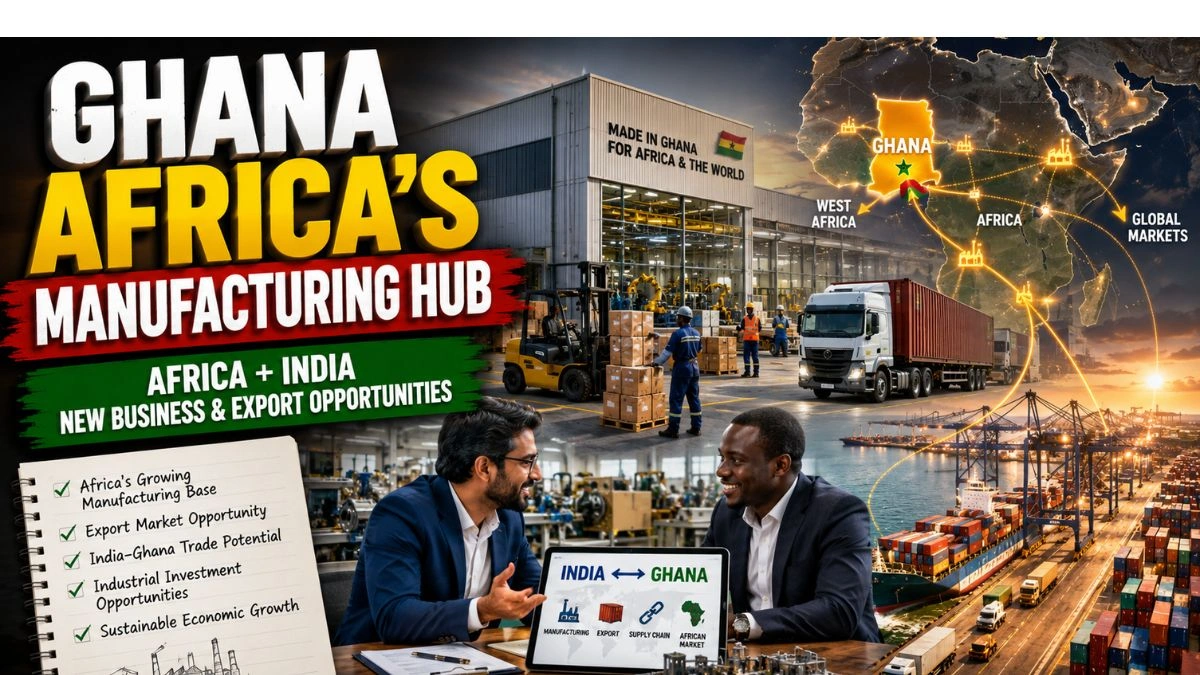
Since time immemorial, Africa has had a dubious relationship with world trade: while the continent is abundantly endowed with natural resources, it has been very much reliant on goods it has been importing from the outside. Over the past decades, raw materials have been exported and finished products imported, everything at a higher price. That structural imbalance is now being challenged more than ever before, and Ghana is becoming a centre for a continentally transforming shift towards value added manufacturing and export-oriented industrialisation.
This agenda came to the fore in a high-level business forum in late August 2026. Industry leaders and policy makers discussed explicitly the need for Ghana to become a hub for manufacturing and export even with its special status as host to the Secretariat of the African Continental Free Trade Area (AfCFTA) which represents one of the most ambitious trade frameworks ever put together on the African continent. The AfCFTA has 54 countries and a population of more than 1.4 billion consumers.
This signifies a real commercial cue for Indian entrepreneurs, manufacturers, and MSMEs and investors. Africa’s industrialisation drive, along with the untapped manufacturing power on the continent and its abundant raw material resources, presents near-term opportunities in a range of businesses, particularly given the downturn in other parts of the world. With the current downturn in other parts of the world, Africa is set to provide practical, near-term business opportunities in virtually every sector, especially when combined with the under-served manufacturing capacity and raw material resources on the continent.
What This Development Means for Indian Businesses
The ambition of Ghana to become the prospective manufacturing hub of Africa is not just a political goal. It has many clear commercial implications that extend beyond those of West Africa – for Indian companies already operating on the continent and for those considering their first time on the continent.
Ghana being host to the Secretariat of the AfCFTA, now provides institutional credibility to the country as a trade hub. As soon as the AfCFTA’s operational frameworks are fully realised, any manufacturer that sets up production in Ghana will enjoy preferential access to a tariff-free market for 54 African countries. It is a structural characteristic that other markets in the world do not have.
Indian manufacturers and MSMEs now have an urgent need to consider Ghana and West Africa as their manufacturing and export base. India’s own Make in India initiative has made them competent in manufacturing in various sectors and their competency can be directly transferred to the African market where similar products are currently being imported from Asia and Europe.
The business rationale is simple: Set up manufacturing facilities in or near Ghana, buy raw materials locally at lower costs, make finished products and ship them out under the AfCFTA import-export arrangements — thereby competing with higher cost imports. This model is suitable for textile products, processed foods, construction materials, light engineering, pharmaceuticals and consumer goods, etc.
Industries that are especially suited to this opportunity are agro-processing, fast-moving consumer goods (FMCG) manufacturing, light industrial products, packaging materials and construction inputs, which are currently being imported by Africa in good quantities despite the availability of raw materials for the manufacture of these goods here.
Why This Industry Could See Stronger Growth
The continent is on a fast track to industrialisation, driven by several intersecting structural factors that all strengthen the business case for manufacturers who are looking at it.
The most notable aspect of the AfCFTA’s operational expansion is perhaps the fact that its scope has been expanded to include the whole of West Africa. The framework begins to make manufacturing on the continent a more viable option, as tariffs are phased out between member countries. In theory, a Ghanaian producer can supply a Senegalese market to South Africa, at better and better terms of trade, than was economically feasible a decade ago.
The rate of urbanisation in Africa is one of the highest in the world. The consumption of processed foods, packaged consumer goods, quality textiles and durable manufactured products is being fueled by a growing urban middle class that local industries are not yet able to serve on a large enough scale. This demand gap is now being met with imports, mostly coming from Asia and Europe, but it is one that can be taken from manufacturers willing to invest in local production.
Another long-term manufacturing competitiveness argument comes from the continent’s demographic profile. In many markets the population is the youngest in the world with median age below 20 in Africa. This will result in a growing and increasingly highly qualified workforce, leading to progressively more attractive manufacturing economics as the productivity of the workforce improves.
Continent-wide infrastructure investment, through development bank programmes, sovereign funds and bilateral partnerships, is making logistics easier and making manufacturing operations more cost-efficient. Indian involvement in African infrastructure, for instance via the Export-Import Bank of India, has facilitated financing, thereby creating a better commercial landscape for Indian companies on the continent.
Also, Africa’s raw material abundance in agro-commodities (cocoa, shea, cassava, timber, cotton), minerals and energy resources allow for lower input costs for many manufacturing categories compared to Asian markets, if supply chains are well organised.
Government Policies and Incentives
Indian entrepreneurs considering manufacturing investments linked to the Africa opportunity — whether through direct investment on the continent or through producing goods in India for African export — can access a range of government support mechanisms.
The Ministry of Micro, Small and Medium Enterprises offers multiple schemes supporting investment, technology upgradation, and export readiness for Indian MSMEs. The Credit Guarantee Fund Trust for Micro and Small Enterprises (CGTMSE) reduces collateral barriers for businesses investing in manufacturing expansion.
The Production Linked Incentive (PLI) scheme provides financial incentives for manufacturers across 14 key sectors, supporting scale-up of domestic manufacturing capacity that can serve export markets, including Africa.
Exporters can access trade promotion, market intelligence, and financial support through the Directorate General of Foreign Trade (DGFT), which administers export promotion schemes and bilateral trade facilitation programmes relevant to African markets.
The Agricultural and Processed Food Products Export Development Authority (APEDA) specifically supports agro-processing exporters — a category directly relevant to the manufacturing opportunities emerging from Africa’s food processing gap.
For investors evaluating direct manufacturing projects in Africa, Invest India provides guidance on bilateral investment frameworks and can connect businesses with relevant government departments. India maintains bilateral investment treaties with several African nations, providing an additional layer of commercial protection.
State-level industrial development authorities — such as the Maharashtra Industrial Development Corporation (MIDC) — also provide infrastructure support, plug-and-play manufacturing facilities, and export-oriented unit (EOU) frameworks that can help businesses build production capacity targeted at African markets.
The MSME Technology Development Centre network under the Ministry of MSME offers technical assistance, product quality support, and testing facilities — critical for businesses aiming to meet international quality standards required in African export markets.
Start-ups developing solutions for the Africa-linked manufacturing opportunity can access the Startup India portal for recognition, tax benefits, and access to the Fund of Funds — which can provide early-stage capital for businesses in manufacturing, agro-processing, and trade technology.
Finally, the Federation of Indian Export Organisations (FIEO) provides market intelligence, buyer-seller meet facilitation, and export documentation support specifically relevant for businesses entering new African markets.
Manufacturing Business Opportunities Emerging From This Development
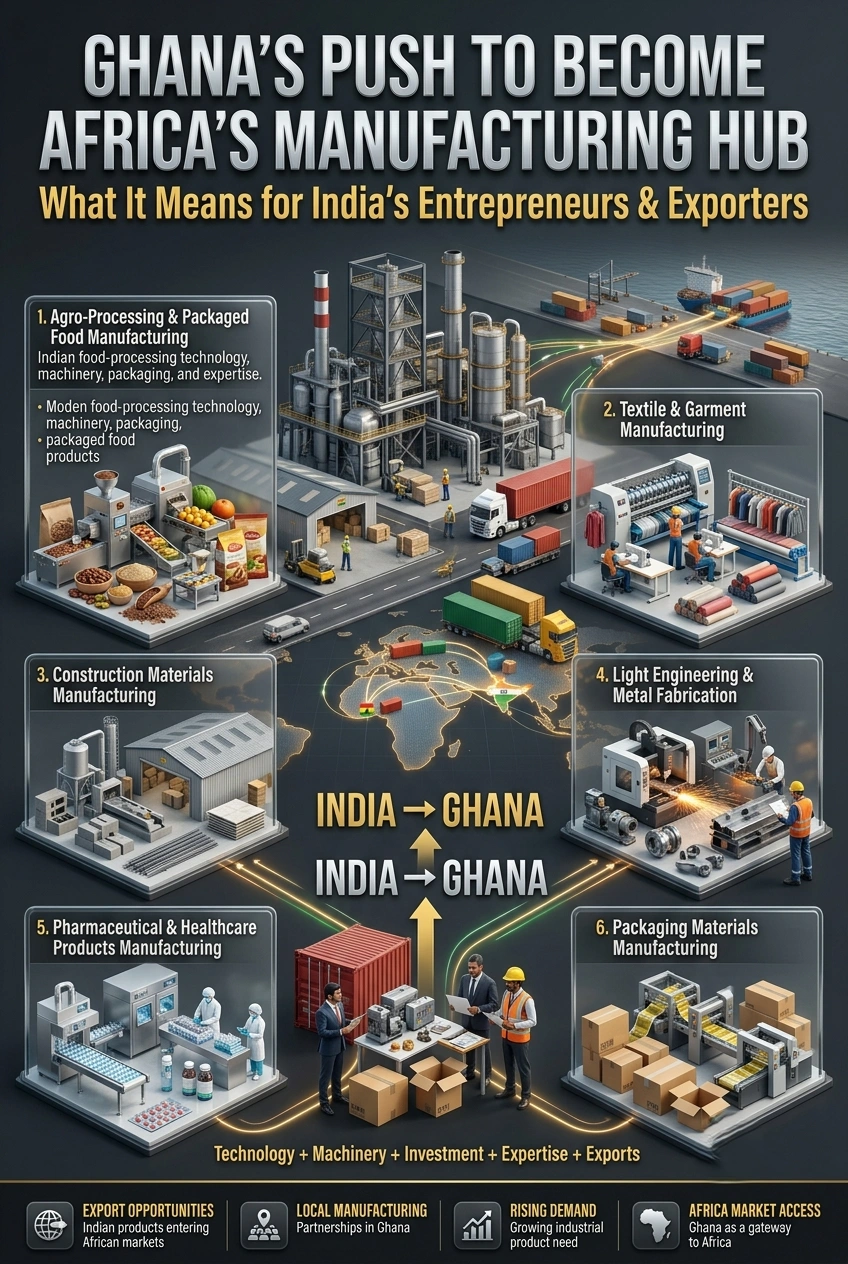
The imperative of import substitution in Africa, alongside the trade facilitation provisions of the AfCFTA is enabling entrepreneurs and micro small and medium enterprises to identify manufacturing opportunities to move early. The following is a list of the most commercially viable opportunities directly related to this structural change.
1. Agro-Processing and Packaged Food Manufacturing
Despite being one of the world’s major suppliers of raw agricultural commodities, Africa is importing vast quantities of processed food products. Scale production of cocoa, shea, cassava, plantain, tomatoes, and a variety of tropical fruits, but mostly exported raw or not used to the fullest. Turning these into value added products such as chocolates, shea-based cosmetics, cassava flour, tomato paste, fruit concentrates and packaged snacks is an enormous opportunity for import substitution.
Indian entrepreneurs who have good knowledge on food processing technology, packaging and quality systems are in a good position to launch food processing companies either in Africa or in their own country catering to the export of food to Africa. Investment threshold is manageable at a small scale of industrial production and MSME suitability is high. There are export opportunities within AfCFTA and export markets across the world for the Diaspora.
Read the Complete Book Here: Food Packaging Technology Handbook
2. Textile and Garment Manufacturing
Cotton is a crop with a long history in West Africa, and Ghana in particular, and the region has a long history of textile craftsmanship. But most of the textiles used and garments produced in the area are imported from Asia. A plant that imports African cotton and converts it into fabric would process the raw material into finished clothing for use by local and regional consumers would directly combat this import reliance. As for the rules of origin, the AfCFTA has made African textiles more competitive in intra-African trade.
Indian Textile MSMEs, already well equipped with world class manufacturing capability, technology & quality have scope to look at joint ventures or technology transfer or direct manufacturing investment in this. Deliver Africa-origin textiles to international markets as will be export potential, especially where there is an interest in sustainability and ethical sourcing.
Get Detailed Project Report (DPR): Textile & Garment Industry Handbook
3. Construction Materials Manufacturing
Urbanisation in Africa has created a huge demand for construction materials, many of which are currently not being produced on the continent at the required quality and quantity. Under AfCFTA, a manufacturing plant that makes construction materials in a strategic place on the African market can supply various African countries. The building material manufacturing industry is already equipped with the relevant technological skills, cost effective production processes and product range, which is appropriate to the tropical climate and to the dominant building type in most African markets, which is entry level urban housing. Availability of raw materials for critical inputs varies from place to place but is generally good in Sub-Saharan Africa.
Explore This Book: The Complete Book on Construction Materials
4. Light Engineering and Metal Fabrication
Agro machinery, hand tools, irrigation parts, storage systems and industrial parts are in chronic shortage on the market in Africa, being virtually all imported. For a light engineering and metal fabrication facility which supplies the African small industrial and agricultural market, good profit margins are possible by replacing high-cost imported products with locally produced items. The precision manufacturing and production of small orders is a key asset of MSMEs in India, especially in the engineering industry which is globally competitive and directly applicable to this market. Key success factors will be quality certification and after-sales service infrastructure.
Related Article: How to Start a Steel Fabrication Unit in India: Investment, Machinery & Export Potential
5. Pharmaceutical and Healthcare Products Manufacturing
Each year Africa imports billions of dollars of pharmaceutical products, medical consumables and health supplies, which has the raw material base and human resources to produce many of these products in Africa. With the outbreak of COVID-19, the continent’s fragile reliance on global pharmaceutical supply chains was highlighted, and this provided a political and institutional push for the production of pharmaceuticals at home. Indian pharmaceutical companies, which are already among the biggest exporters of generic drugs to Africa, can consider greenfield investments in manufacturing, contract manufacturing or technology licensing in order to enable local production in Ghana and neighbouring markets. AfCFTA is helping to drive the rapid evolution of regulatory frameworks to support domestic pharmaceutical manufacturing.
View Full Project Details: Healthcare and Medical Businesses
6. Packaging Materials Manufacturing
There’s a need for packaging materials in every manufacturing industry in Africa and the existing packaging supply chain is largely dependent on imports. An African-based packaging materials company, that produced cartons, flexible packaging, labels, bottles and industrial packaging, would be a basic infrastructure play, serving all other manufacturing sectors at the same time. The opportunity is specially high in areas close to agro-processing and FMCG manufacturing centres. Indian packaging manufacturers with modern and up-to-the-mark facilities on various substrates are ideally positioned for this opportunity. Investment profile is scalable and revenue visibility is high with captive demand from co-located manufacturing clients.
Access Complete Business Plan: Packaging & Printing Business Projects
Import-Export and International Market Opportunity
Export Opportunity for Indian Manufacturers
Indian manufacturers are already exporting substantial amounts of products to the African markets, such as pharmaceuticals, textiles, machines, auto components and consumer electronics, among others. With industrialisation on the African continent, there is a new opportunity for Africa to export more – and it’s a more strategic one. The need for inputs, such as capital goods, industrial equipment and technical services, in manufacturing and for technical services will significantly rise as industries expand in Africa. Indian exporters of machinery, industrial components, packaging equipment, food processing technology and technical consultancy services are poised to cater this demand.
The simplified border-crossing procedures and the common external tariff (CET) under the AfCFTA will also make it more cost effective and easier to access multiple markets from a single origin, enhancing the economics of African market entry for Indian exporters that serve multiple markets at once.
Import Substitution Opportunity
This is the situation in Africa today where finished items are imported that are made out of African raw materials and exported at a higher price. It is both economically inefficient and, more recently, politically unsustainable in post-colonial Africa. As a result of the well-planned transition to domestic manufacturing, there are opportunities for entrepreneurs to start producing items that are imported into the country, especially processed food, textiles, construction materials, consumer goods, and industrial raw materials.
For Indian businesses, this requires analysing the products which they are already exporting competitively from India into Africa and determining whether it makes better business sense for them to produce the products in Africa or export directly from India through the AfCFTA aligned bilateral agreements.
Indian MSMEs and Startups in Related Industries
Jain Irrigation Systems
Jain Irrigation Systems, Jalgaon, Maharashtra, is one of the biggest agro-technology firms in India with products such as food processing machines, packaged foods and drip irrigation systems. The company has been present in the African market for a long time and has provided irrigation facilities in various countries in Sub Saharan Africa. Jain Irrigation’s model of bringing technology supply, technical training and market development to the local level is directly relevant to the agro-processing opportunity in Ghana and West Africa, and highlights how to realize it.
Alkem Laboratories
Alkem Laboratories is one of the top generic drug manufacturers in India and their exports business to Africa is expanding. The company’s track record of compliance with the WHO prequalification standards which is most relevant to exports to Africa and its experience in the development of affordable generic formulations for tropical disease categories provides a good indicator of the commercial viability of a pharmaceutical export from India at MSME investment levels. Indian generic drug manufacturers have found an effective way to penetrate the African market and this should be studied by startups in the pharmaceutical manufacturing sector with respect to regulatory pathway, product-selection strategy and distribution model.
Greaves Cotton
Greaves Cotton is an Indian diversified engineering company producing light machinery, small engines, and agricultural equipment targeted at emerging and rural markets. The company’s product design philosophy — durable, affordable, easy to maintain, suited to low-infrastructure environments — is directly applicable to African agricultural and light industrial markets where similar durability and affordability requirements apply. Indian engineering MSMEs developing products for African markets can use Greaves Cotton’s design and distribution approach as a practical template for market entry.
What Entrepreneurs Should Evaluate Before Investing
Any serious evaluation of the manufacturing opportunity linked to Africa’s industrialisation should begin with structured market research and feasibility analysis. The opportunity is real, but execution quality is the differentiating factor.
Market demand validation is the critical starting point. Entrepreneurs should map which specific products are currently being imported into target African markets, at what volumes, from which sources, and at what landed costs — then assess whether local manufacturing can compete on price and quality. Demand data at the product category level is available from trade databases and government trade statistics, but primary market research in-country will be essential for robust demand estimation.
Raw material assessment must follow. Africa’s raw material endowments are extensive, but supply chain reliability, quality consistency, and logistics cost from source to factory vary considerably by commodity and geography. A viable manufacturing business model must account for realistic input costs, not theoretical ones.
Technology and machinery selection should prioritise proven, adaptable, and locally maintainable equipment. The import and maintenance cost of sophisticated machinery in African markets can significantly affect operating economics. Indian machinery manufacturers who already design for emerging market conditions have a natural advantage here.
Regulatory compliance — including product registration, import duty structures, export licensing, and quality certification requirements — varies significantly across African markets and must be mapped specifically for each target country. Engaging local legal and regulatory advisors early is strongly recommended.
Quality standards are non-negotiable. The consensus emerging from industry leaders across the continent is unambiguous: African consumers and industrial buyers are increasingly sophisticated, and locally produced goods that do not meet international quality standards will not displace imports at meaningful scale. Quality systems investment must be built into the business model from day one.
Working capital requirements in African markets can be higher than in developed markets, reflecting longer payment cycles, infrastructure costs, and currency management needs. Conservative cash-flow modelling with realistic receivables assumptions is essential. Distribution and market access — the last-mile problem — is often underestimated by first-time African market entrants and deserves dedicated planning.
Start with clarity—choose the best business idea
How NPCS Can Help Entrepreneurs Evaluate the Opportunity
NPCS – Niir Project Consultancy Services has supported thousands of Indian entrepreneurs, MSMEs, startups, and investors in evaluating manufacturing and industrial business opportunities through rigorous, practically grounded analysis.
For entrepreneurs considering manufacturing opportunities connected to the Africa trade story — whether by expanding production in India for African export, or by evaluating direct manufacturing investment in African markets — NPCS provides the analytical foundation required to make informed investment decisions.
NPCS services relevant to this opportunity include Detailed Project Reports (DPRs) covering capital expenditure, operating economics, break-even analysis, and financial projections; Market Research covering demand analysis, competitive landscape, and pricing benchmarks; Feasibility Studies evaluating the commercial and technical viability of proposed manufacturing investments; Plant and Machinery Assessment identifying appropriate technology, suppliers, and equipment specifications; and Manufacturing Project Planning covering facility layout, utilities, manpower, and regulatory compliance.
Before committing capital to any manufacturing venture — domestic or international — a properly structured feasibility study and DPR are among the most cost-effective investments a business can make.
Business Opportunity Snapshot
| Industry | Manufacturing & Export — Sub-Saharan Africa (Ghana Focus) |
| Market Driver | AfCFTA integration, import substitution drive, shift from raw material exports to value-added manufacturing |
| Key Development | Strategic push to position Ghana as Africa’s primary manufacturing and export hub under AfCFTA framework |
| MSME Opportunity | Food processing, agro-processing, textiles, construction materials, light engineering, packaging |
| Manufacturing Potential | High — vast untapped raw material base, young labour force, improving infrastructure |
| Export Potential | Strong — AfCFTA opens a 1.4 billion-consumer market across 54 African countries |
| Import Substitution | Significant — Africa currently imports finished goods that could be manufactured locally from domestic raw materials |
| Government Support | India: Make in India, MSME schemes, PLI; AfCFTA: trade facilitation; Invest India, EXIM Bank of India |
| Investment Consideration | Medium — sector-specific; requires quality compliance, logistics planning, and market-entry strategy |
| Risk Level | Moderate — infrastructure variability, currency fluctuation, regulatory differences across markets |
| Growth Outlook | Positive — AfCFTA’s full operationalisation, rising African middle class, and industrialisation drive all support long-term growth |
Conclusion
Africa’s structural shift from raw material exporter to finished goods manufacturer is not a distant aspiration — it is an active policy and commercial priority with institutional frameworks now in place to support it. Ghana’s positioning as a prospective continental manufacturing hub, anchored by the AfCFTA Secretariat, gives concrete shape to an opportunity that is opening across multiple sectors simultaneously.
For Indian entrepreneurs, manufacturers, MSMEs, investors, and exporters, this represents a rare window. The manufacturing capability, quality systems, technology access, and competitive cost structures that Indian industry has developed over decades are directly transferable to the product categories Africa most urgently needs to produce domestically. From agro-processing to pharmaceuticals, from textiles to construction materials, the gap between what Africa currently imports and what could be produced locally — using African raw materials and Indian manufacturing expertise — defines the commercial opportunity.
The window for early movers is open. Markets that are currently import-dependent will progressively develop domestic and regional suppliers as AfCFTA matures and African industrialisation accelerates. Businesses that establish their market presence, supply relationships, and quality credentials now will be significantly better positioned than those who wait.
The recommended path forward is disciplined: begin with structured Market Research to validate specific product opportunities; commission a Feasibility Study to confirm commercial and technical viability; develop a Detailed Project Report (DPR) to anchor investment planning; and build an Africa Market Entry Strategy with appropriate regulatory and logistics planning. The opportunity is real. The preparation is what separates successful market entrants from those who arrive too late or underprepared.


