




Sanitary Pad Manufacturing Business
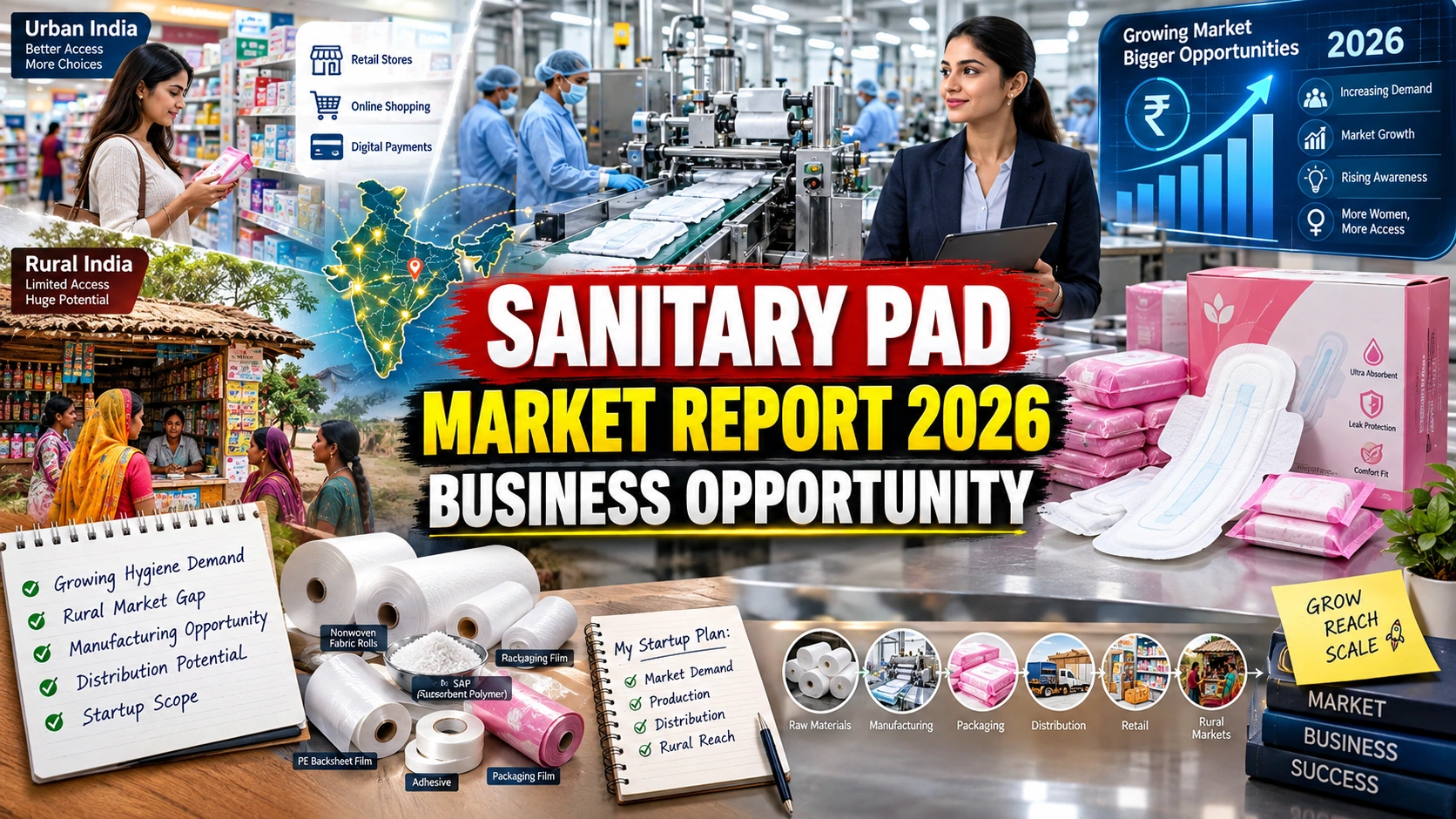
In urban India, the penetration rate for sanitary pads is around 60-65% while the rate for rural India, along with urban, is only about 35-40%. The one clear cut opportunity in this category is tens of millions of women in rural and semi-urban India who are still using cloth, rags or nothing at all, in a market that has seen double-digit growth and no taxes on the product. Few consumer manufacturing categories offer such a social impact and unmet quantifiable demand as this for an entrepreneur.
Access Complete Business Plan: Explore the Sanitary Napkin Manufacturing Business
What Is a Sanitary Pad?
A sanitary pad (sanitary napkin) is an absorbent hygiene product used by women to absorb menstrual blood, which is made principally from a multi-layer construction consisting of an absorbent top sheet (usually a non-woven fabric), absorbent core (usually fluff pulp and/or super absorbent polymer SAP), leak proof back sheet (usually polyethylene film), and an adhesive for attaching the pad to a garment (usually adhesive strip). The category spans:
- Disposable menstrual pads – the major product category (72% of the market by 2025) were sold using fluff pulp and SAP cores varying in absorbency: ultra-thin, regular, and overnight
- Reusable/washable cloth pads: A smaller but fast-growing category (projected ~12% CAGR) that is attractive to consumers who want to do their part to save the environment and will save them money in the long run
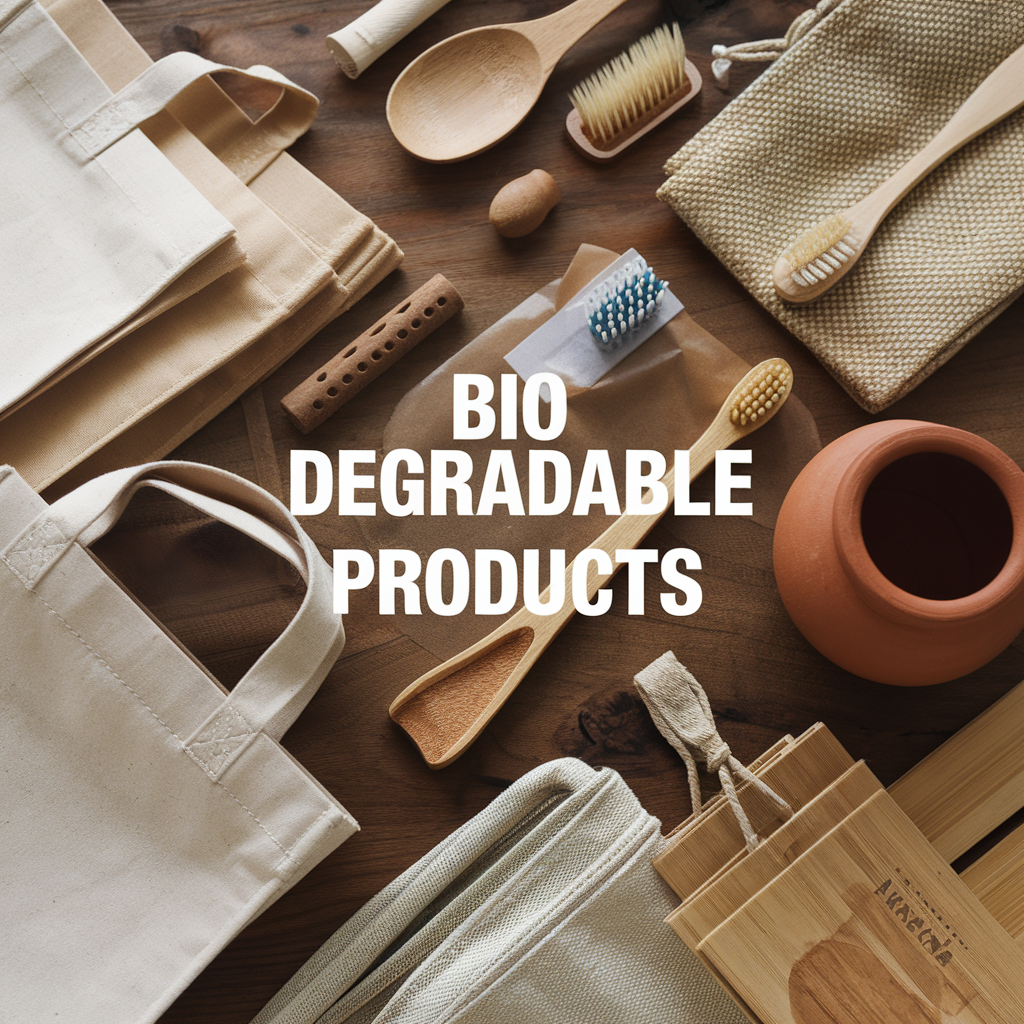
- Biodegradable/organic pads – eco-friendly products that address environmental concerns (conventional pads take 500-800 years to biodegrade) as well as the consumer’s preference for chemical free pads, are made from bamboo fibre, corn starch or organic cotton.
- Alternative period underwear – an emerging category (Whisper’s period underwear line was launched in January 2026) that is a non-pad alternative to the period underwear format
Manufacturing is done either on a large scale with fully automated production lines (used by multinational brands) or on a smaller scale, either semi-automated or manual, where local manufacturing is coupled with grassroots distribution and employment, including a small segment in India which develops and operates production lines by women in rural areas.
Global and India Sanitary Pad Market Size and Growth
The definition of sanitary pads may also differ from market to market, as the global sanitary pads market is estimated to be valued at USD 20.5 billion in 2024, rising to USD 36.33 billion by 2037 at a rate greater than 4.5% CAGR.
The sanitary napkin/pad market is estimated at USD 828.65-894.49 million for 2024-25 with the forecast to range from USD 1.21 billion to USD 1.79 billion by 2030-2034 at CAGRs of around 6.3% to 9%. The Indian feminine hygiene market, which includes pads, tampons, panty liners, and menstrual cups, is expanding at a much higher rate (around 14.43% CAGR) and will reach USD 3.83 billion by 2034 due to both the growth of additional product types and increased penetration.
Note on figures: Market studies can be based on sanitary pads alone or on the total feminine hygiene (femhyg) market (which includes tampons, panty liners and menstrual cups). NPCS can design an investor grade analysis of the techno-economic feasibility of your target product type (disposable, biodegradable or reusable) and region.
The Rural-Urban Penetration Gap
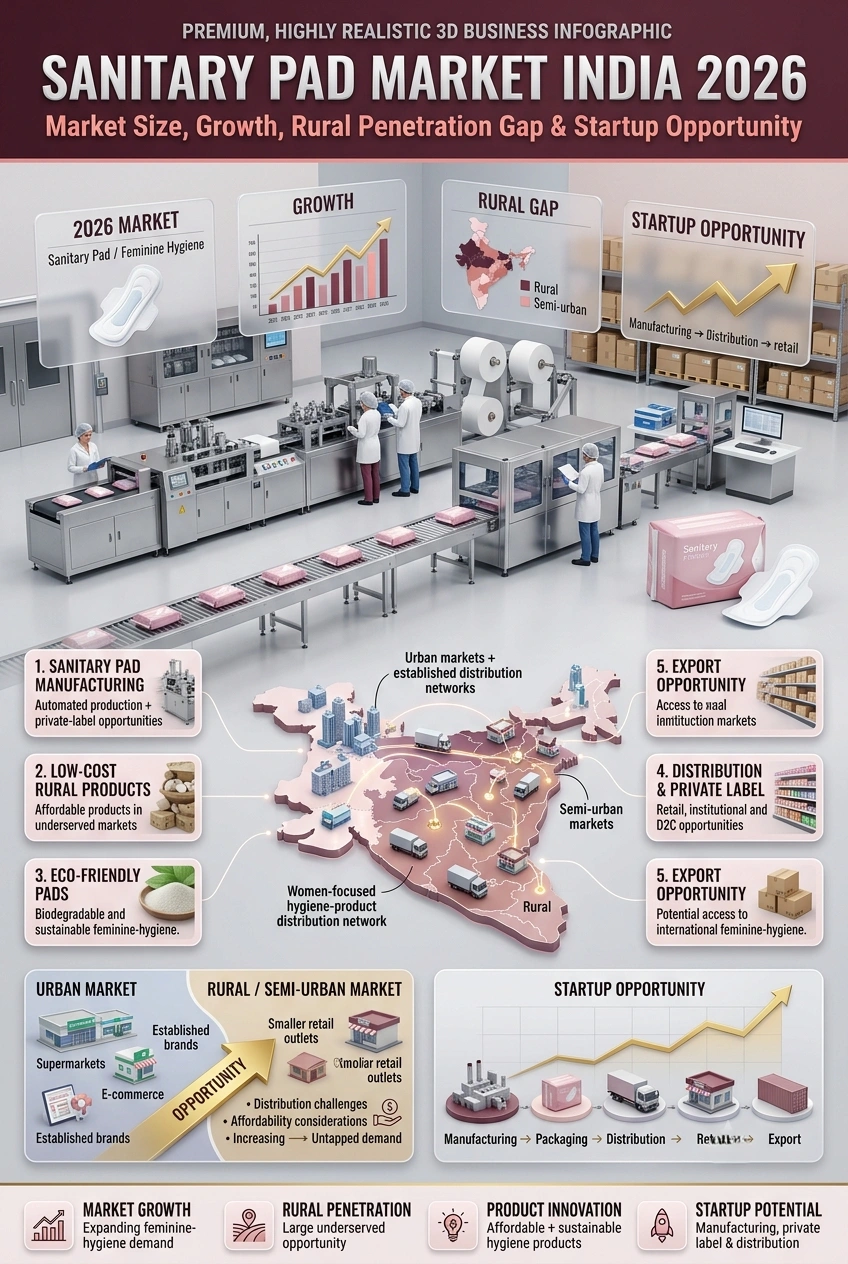
The structural characteristics of India’s sanitary pad market is this: Sanitary pad penetration in urban India is around 60-65%, but in the country, it’s only about 35-40%. This means that penetration in rural India is very low, compared to urban India. The situation is more severe in urban areas, as approximately 90% of urban women used hygienic menstrual products as compared to only 73% of rural women, according to NFHS-5 data, which is higher based on education: 90% of women with 12+ years of education used hygienic menstrual product, while 44% of women with no education used it.
This is not just a problem of awareness; there is also a problem of affordability and availability of distribution system. Many rural and low-income women still use cloth, rags or other unsanitary options are not available to them at a relevant retail price or distribution point – that’s why these options are still dangerous for their health.
Policy Tailwinds
- Zero GST on Sanitary Napkins: The decision of the GST Council on 18th July 2018 to exempt sanitary napkins from the earlier rate of 12% GST on them directly impacted the end user, and continues to be a major enabler of market expansion, resulting in pricing transparency where the cost of input content (cost, not tax) has become the most important cost differentiator between Indian-made and imported/MNC sanitary napkins.
- Menstrual Hygiene Scheme (2010) and state-level distribution programmes: India’s national Menstrual Hygiene Scheme, alongside state initiatives like Uttar Pradesh’s 2024 school distribution programme (₹300 per girl for classes 6-8) and free/subsidised distribution through Anganwadi centres, directly funds and drives commercial and near-commercial pad distribution into underserved communities.
- Ministry of Health & Family Welfare adolescent hygiene scheme: A dedicated scheme for promoting menstrual hygiene among adolescent girls (ages 10-19) in rural areas, launched in 2022, provides both awareness and distribution infrastructure. UNICEF India has also partnered with state governments on menstrual hygiene management programmes in schools, reinforcing distribution and awareness infrastructure in underserved districts.
- Reduced import duty structure: Following the removal of GST on imports (leaving only a 10% basic customs duty, down from an earlier combined 22% tax incidence), international brands have found it easier to expand in India — a dynamic that also implicitly benefits well-run domestic manufacturers competing on manufacturing cost and distribution reach rather than tax arbitrage.
- SHG and rural women’s employment linkage: Many Indian sanitary pad manufacturers deliberately establish production units in remote/rural locations specifically to provide employment for previously marginalised women — a model actively supported by government rural livelihood and self-help group (SHG) promotion schemes.
Read the Complete Book Here: Book
India Demand-Supply/Penetration Gap: Sanitary Pads
| Parameter | Current Position |
| Urban penetration | ~60-65% |
| National (rural + urban) penetration | ~35-40% |
| Rural access to hygienic products (NFHS-5) | 73%, versus 90% in urban areas |
| Access by education level (NFHS-5) | 90% among women with 12+ years schooling vs. 44% among women with no formal education |
| GST on sanitary pads | 0% (exempted since July 2018) |
| Nature of the gap | A large, quantified rural and low-income penetration gap — not an import-dependency or raw material scarcity issue, but a distribution, affordability, and awareness gap that leaves tens of millions of menstruating women without regular access to hygienic products |
| Distribution infrastructure gap | Rural retail penetration (pharmacies, kirana stores) remains considerably thinner than urban modern trade and pharmacy networks that dominate current distribution (pharmacies alone account for 31% of distribution) |
| Opportunity for new entrants | Very strong in rural/semi-urban distribution-linked manufacturing — small-scale, locally-positioned production combined with last-mile distribution addresses the gap more directly than competing with national brands in the already-well-served urban segment |
Reading the gap: Unlike most categories in this report series, the constraint here isn’t underdeveloped domestic manufacturing capability — India has strong, well-established sanitary pad manufacturers, both multinational and domestic. The gap is a market access and affordability gap: tens of millions of rural and low-income women remain outside the commercial market entirely. This creates a genuinely distinctive opportunity structure — small-scale, locally-embedded manufacturing units (often women-run, following a proven Indian model) that combine production with grassroots awareness and distribution can address this gap more effectively than a large centralised factory competing purely on national brand marketing.
Major Sanitary Pad Manufacturers Serving India
| Company | Type | Notes |
| Procter & Gamble (Whisper) | Multinational, India operations | India’s leading sanitary napkin brand for over two decades; strong urban and rural presence via extensive retail, pharmacy, and e-commerce distribution; launched period panties in January 2026 |
| Johnson & Johnson (Stayfree/Carefree) | Multinational, India operations | Major established player; partnered with local NGOs in November 2025 to promote menstrual health education in rural areas |
| Kimberly-Clark India | Multinational, India operations | Established player; unveiled a digital customisation platform for sanitary napkin orders in October 2025 |
| Seventh Generation | International (entered India 2015) | Eco-friendly, organic and biodegradable sanitary product specialist |
| Aditya Birla Fashion & Retail / Niine | Indian | Established Indian brand with strong rural distribution focus |
| Sirona Hygiene | Indian | Established Indian feminine hygiene brand with a diversified product portfolio including biodegradable options |
| Saathi Pads | Indian (social enterprise) | Recognised for manufacturing 100% biodegradable, compostable sanitary pads made from banana fibre |
| Goonj (social enterprise) | Indian | Recognised for its low-cost, socially-driven sanitary pad initiative addressing rural affordability |
| Numerous SHG-linked rural micro-manufacturing units | Distributed across rural India | Small-scale, often women-run production units established with government/NGO support, representing the segment most directly addressing the rural penetration gap and providing local employment |
Global Feminine Hygiene Industry Context
| Region | Notes |
| United States | Mature market (~USD 6.17 billion, 2026), growth driven by premiumisation and organic material adoption; “Tampon Tax” removal and subsidised school distribution programmes have expanded reach among low-income populations |
| Europe | Strong regulatory push toward sustainable, biodegradable products, alongside established tax exemption policies for menstrual products |
| Asia-Pacific | Dominates the global market due to population scale and rising menstrual hygiene awareness; India and China represent the largest growth opportunities given still-developing rural penetration |
| Global biodegradable segment | Growing at over 14% CAGR globally, driven by consumer willingness to pay a premium for plastic-free, compostable products as awareness of conventional pads’ 500-800 year biodegradation timeline spreads |
Market Segmentation
By Product Type
- Disposable menstrual pads — dominant (72% share in India, 2025)
- Reusable/washable cloth pads — smaller but fastest-growing (~12% CAGR)
- Biodegradable/organic pads (bamboo, corn starch, organic cotton) — fastest-growing sub-segment globally
- Panty liners and period panties — emerging alternative formats
By Distribution Channel
- Pharmacies — leading channel in India (31% share), reflecting cultural preference for discreet purchase
- Supermarkets/hypermarkets and modern retail
- Kirana/general stores — critical for rural and semi-urban reach
- E-commerce — fast-growing, offering anonymous/discreet purchasing that overcomes social stigma barriers
- Government/NGO distribution (schools, Anganwadi centres) — critical channel for rural penetration expansion
By End User
- Urban working women — highest per-capita spend, best-served segment
- Semi-urban and rural women — largest unmet demand pool
- Adolescent girls (school distribution programmes)
By Region (India)
- North India — currently dominant, driven by Delhi-NCR’s retail density and active state government distribution programmes (UP, Delhi, Punjab)
- Rural and semi-urban markets — the primary growth frontier for the coming decade
Related Article: Sanitary Napkin Manufacturing Business in India: PMBJP Government Market, BIS IS:5405 and Investment Guide
Key Growth Drivers
- The large, quantified rural penetration gap. With national penetration at just 35-40% versus 60-65% in urban areas, closing even a fraction of this gap represents enormous absolute volume growth potential.
- No GST or tax avoidance. The GST exemption directly reduces the end consumer price of the product, thus making it more accessible, and at the same time levels the playing field and lets competitiveness be based on manufacturing efficiency and the distribution of the product (not the tax structure).
- An increasing number of women in the workforce. The working status of women has increased from 23.3% in 2017-18 to 41.7% in 2023-24, and working women have much higher rates of using commercial hygiene products.
- Distribution programmes under the auspices of government and companies (CSR). School distribution schemes are being rolled out at the state level, the national Menstrual Hygiene Scheme is working hard to raise awareness and awareness-raising infrastructure in previously inaccessible areas, and corporate schemes such as Oil India’s Project OIL Shakti (launching in Assam and Arunachal Pradesh in January 2026) are developing awareness and awareness-raising infrastructure in previously unreached areas.
- Discreet and broad-reaching buying with the help of e-commerce. Social stigma issues which limit in-store buying in more conservative areas are being addressed online, allowing efficient market reach without the need to have a retail store.
- Demands for biodegradable and sustainable products. As environmental consciousness increases, and awareness of the extremely long biodegradation period of conventional pads grows, a separate growth segment is developing with a premium positioning.
Challenges and Restraints
- Affordability is still a very real obstacle even if there is no GST. Despite being tax-free, branded products can still be out of reach of the poorest rural households who might need to have access to locally produced, lower cost products instead of national branded product.
- Poorly developed distribution network in remote areas. Last mile distribution systems that national brands often struggle to justify at scale are essential to get to the rural population that is most in need of better access.
- Persistent cultural stigma. While there has been good progress, the subject of menstruation is still taboo in many communities, and substantial education will be needed at the community level, combined with access to products, to bring menstruation out of the taboo.
- Environmental disposal infrastructure. Poor municipal waste management for non-biodegradable menstrual products increases environmental concern, especially in high-density urban areas, putting pressure on the need for biodegradable products.
- Exposure to the cost of raw materials. The major raw materials – fluff pulp, super absorbent polymer (SAP) and non-woven fabric – are linked to the pulp and petrochemical price fluctuations in the global market.
Competitive Landscape
The Indian sanitary pad market is dominated by established multinational brands (Procter & Gamble’s Whisper, Johnson & Johnson’s Stayfree/Carefree and Kimberly-Clark) who have a strong presence in urban areas and have created awareness of their product, as well as a growing segment of Indian brands (Niine, Sirona Hygiene) and mission-driven social enterprises (Saathi Pads, Goonj) that prioritize affordability and sustainability.
This is differentiated from this organised tier and is an important part of the Indian market in its true sense that is small-scale, often led by women, has a strong link with SHG, and the local manufacture, combined with an important function in the grassroot level of distribution and creation of jobs, is not always possible to be matched with large-scale, centrally organised manufacturing (efficient though it may be) at the last mile.
Explore proven business ideas with high success potential
Sanitary Pad Manufacturing: Business Opportunity for Startups and MSMEs
- Small manufacturing unit located in rural/semi-urban areas. One of the most impactful and accessible pockets in this report series is a direct localised and semi-automated approach to production and grassroots distribution and employment of local women — a model that has been successfully adopted in India but yet to be adopted in Europe.
- Biodegradable/eco-friendly pad manufacturing. Making pads from materials like bamboo, corn starch, organic cotton etc. provides a premium positioning and differentiation from conventional plastic-based pads, especially in the Indian context where the consumer has become more environmental conscious at the same time as the market is projected to grow at a CAGR of about 14% across the globe.
- Institutional/government scheme supply. Being a qualified and affordable provider to state government school distribution programmes and the national Menstrual Hygiene Scheme provides a solid and predictable income stream, which is different from open retail sales.
- low cost, brand product for price conscious customers. Cultivating a low cost, quality consistent brand aimed at filling the affordability gap in rural and low-income urban markets, not directly against premium multinational brands, is an approach to market a genuine low-cost brand that meets the unmet demand of the biggest market.
- Reusable cloth pad making. This is an alternative to disposable pad production, and with the ~12% CAGR in reusables, and the long-term cost-benefit of being more budget friendly for customers, this has to be a lower raw material cost, more sustainable option.
Assumption flag: Investment and machinery for sanitary pad production ranges greatly depending on the nature and size of production from small sized semi-automated unit to large sized fully-automated line as of multinational pad producing company. NPCS develops comprehensive Project Reports, including scale appropriate machinery lists, raw material sourcing strategy and financial projections based on the distribution channels specific to your target market segment and capacity.
How NPCS Supports Entrepreneurs Entering This Space
The first step for any entrepreneur considering a sanitary pad manufacturing business is to draft a Detailed Project Report (DPR) that covers various aspects like plant capacity, production scale, whether it will be semi-automated or fully automated, sourcing of raw materials, manpower planning, cost of the project, and financial viability based on the product and targeted segment.
About NPCS (Niir Project Consultancy Services)
NPCS is an ISO 9001:2015 certified Organisation with over 30 year’s experience in Techno-economic and Project consultancy which is established in New Delhi since the year 1994. In the past 30 years, NPCS has provided over 150,000 project reports and profiles in 85 countries, spanning nearly every manufacturing and process industry, such as hygiene products, non-woven fabrics and consumer health manufacturing.
The key outputs of NPCS that are relevant to a sanitary pad business are:
- Detailed Project Reports (DPRs) that include plant capacity, machinery specification and plant layout.
- Techno-economic feasibility studies (including quality standards and safety compliance guidance)
- Financial modelling — project cost, profitability analysis, ROI, break-even calculations
- Regional raw material & market analysis as per Indian distribution channels
- Documentation of support for MSME loan applications, subsidy schemes and bank funding requirements.
Government and Institutional Reference Links
Entrepreneurs can also connect with FICCI Ladies Organisation (FLO) and the CII Foundation Women Exemplar Programme for mentorship, market access, and funding support specific to women-led and hygiene-focused manufacturing ventures.
- Ministry of Health & Family Welfare — Menstrual Hygiene Scheme
- Central Board of Indirect Taxes and Customs (CBIC) — GST
- Ministry of Micro, Small and Medium Enterprises (MSME)
- Development Commissioner, MSME (DCMSME)
- Ministry of Rural Development — Self Help Group/DAY-NRLM
- Bureau of Indian Standards (BIS)
- Press Information Bureau (PIB), Government of India
- Startup India
- Invest India (National Investment Promotion and Facilitation Agency)
Entrepreneurs are advised to verify the latest Menstrual Hygiene Scheme guidelines, GST/customs duty updates, and MSME/rural livelihood scheme eligibility directly on these portals, as regulatory provisions are periodically revised.
Conclusion
Sanitary pad manufacturing offers a distinctive opportunity profile: not a scarce raw material or import-dependency gap, but a large, well-documented rural and low-income penetration gap — national coverage at just 35-40% against 60-65% in urban India — combined with zero GST, active government distribution support, and a proven Indian model of small-scale, community-embedded manufacturing that genuinely addresses the last-mile access problem better than centralised production alone. For an entrepreneur motivated by both commercial opportunity and social impact, few categories in Indian manufacturing offer this combination as clearly.
For entrepreneurs and MSMEs evaluating consumer hygiene manufacturing investments, sanitary pad production — particularly at the rural/semi-urban, affordability-focused, or biodegradable-specialty level — offers a rare combination of quantified unmet demand, government policy support, and genuine social impact.


