





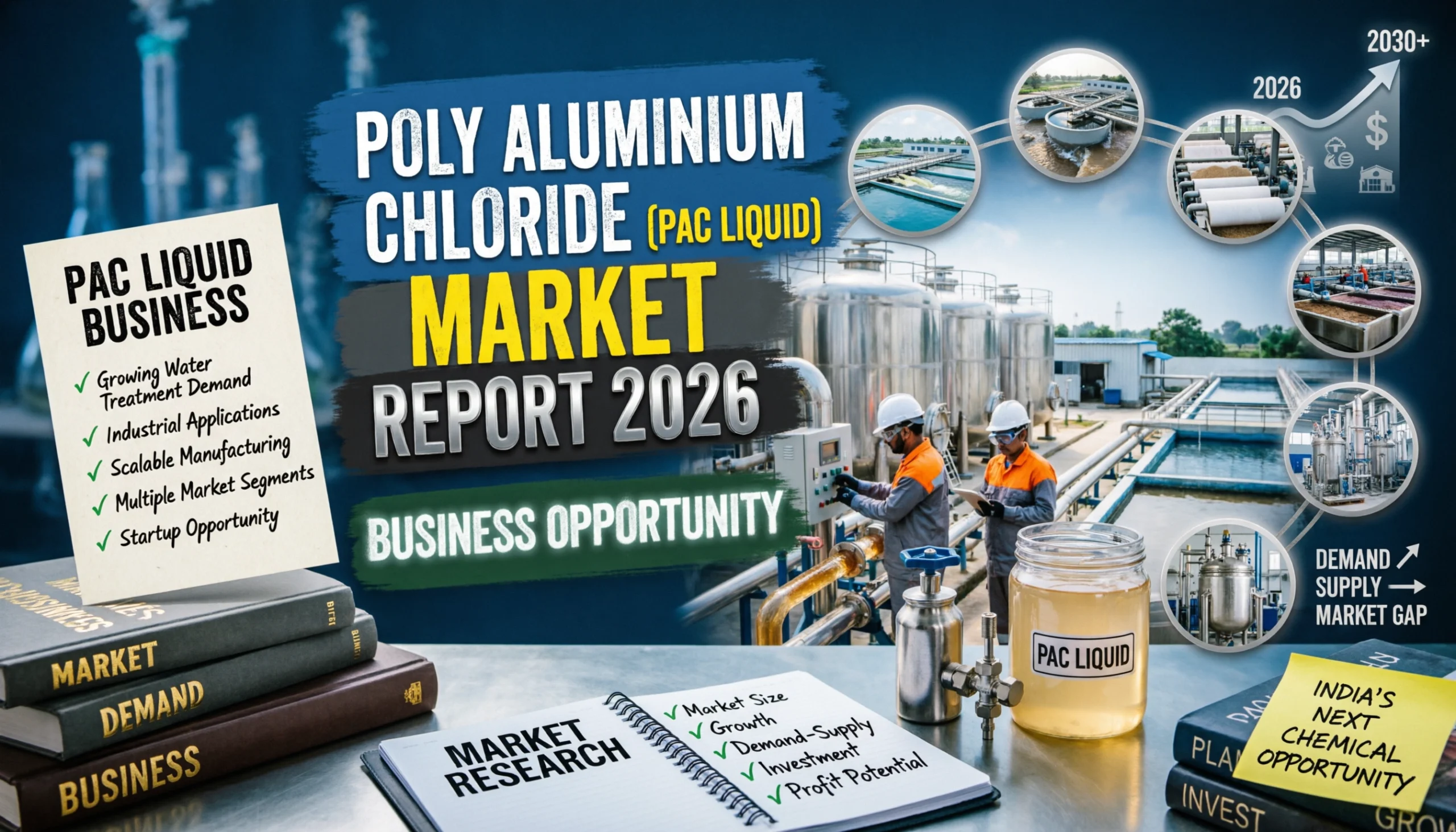
Poly Aluminium Chloride Market
In India, every water treatment plant, effluent treatment plant and every paper mill is dependent on a coagulant to make water “clean” by denuding its turbidity level and removing the suspended solids. In fact, Poly Aluminium Chloride (PAC) is the preferred choice – accounting for about 70% of all inorganic coagulant use worldwide – because it does this at a lower dosage, lower sludge level than alum.
As water treatment infrastructure continues to scale in India driven by Jal Jeevan Mission, Namami Gange, and AMRUT, along with the recent strict enforcement of effluent norms by both CPCB and SPCB in the water chemicals segment, PAC is at the heart of one of the most policy-driven demand stories in the water chemicals industry in a relatively fragmented domestic supply chain.
Get Detailed Project Report (DPR): Explore the Poly Aluminium Chloride Manufacturing Guide
What Is Poly Aluminium Chloride (PAC)?
Poly Aluminium Chloride is prepared by reacting high purity Aluminium Hydroxide (or Bauxite) with Hydro Chloric Acid (HCl) at controlled temperatures and pressures in a specially designed reactor which results in the polymerisation of the aluminium to form a higher level of cationic charge than simple Aluminium salts can provide. This increased cationic charge is the reason PAC is able to remove the desired turbidity at 20-40% less than the amount of aluminium sulphate (alum) needed; PAC forms much less sludge and is effective over a wider range of pH levels than alum.
PAC is available in both physical forms:
- PAC Powder – a dry, free-flowing form offering easier storage and transport, widely used where automated dosing infrastructure is less developed
- PAC Liquid – a liquid form ideal for automated dosing systems, offering fast dissolution and immediate reaction in treatment processes, increasingly preferred at larger municipal and industrial installations
The grades of PAC are dependent on the amount of aluminium oxide (Al2O3) added to the grade and its basicity for each application, ranging from 10-17% Al2O3 for municipal water and wastewater treatment, to 17-19% Al2O3 (low basicity) in paper industry retention and drainage applications, and there are specialised high basicity grades (Aluminium Chlorohydrate, ACH) used for advanced drinking water treatment applications.
Global and India PAC Market Size and Growth
The estimates for the global market value differ from one to another report, ranging from approximately USD 1.83 billion to USD 2.14 billion in 2025-26, and between USD 2.62 billion to USD 4.46 billion by 2030-2035, an average of 4% to 9.5% growth per year. The biggest inorganic coagulant is Poly Aluminium Chloride which accounts for around 70% of all coagulant end-use volume and is steadily replacing alum as the industry standard.
The major share of the total global PAC revenue is expected to come from Asia Pacific, due to the significant industrialisation, urbanisation and water treatment infrastructure investment in China and India. India’s niche market size was earlier forecasted to exceed USD 1,662.9 million by 2029, according to the previous estimates, and further industry speculations have suggested that the market will witness further strong growth in India due to the government initiatives such as Namami Gange.
Note on figures: Market studies by PAC can differ as to whether or not any aluminium-based coagulants (ACH, non-ferric alum) are included in the study. NPCS is able to develop an investor-grade (considered grade 4.1 or higher) techno-economic feasibility study that is based on your target grade level (municipal, industrial, paper industry) and form (liquid, powder).
A Fragmented Domestic Supply Chain Behind Strong Demand Growth
While it is well established and policy anchored that India’s demand for PAC is on the rise, the supply side is a more complicated picture. The domestic supply chain for PAC is highly fragmented, comprising of several small and medium manufacturers and distributors, as India’s domestic demand for PAC is constant and is rapidly rising, however, the quality and consistency of product from the suppliers can be erratic: buyers constantly complain about inconsistent product purity, supply chain disruptions, and poor technical support. There are also global manufacturer directories that list almost 1,000 manufacturers across the globe, and local players that hold significant market shares in most of the individual manufacturers’ markets — including India.
It’s the opportunity for the fragmentation: PAC in India is a market where there is enough space for a well-capitalised new company to differentiate successfully against a large number of smaller and less consistent companies — a space that established companies such as GACL’s recent capacity expansion seem to be filling.
Policy Tailwinds
- Jal Jeevan Mission and India’s potable water commitment of ₹60 lakh crore (~USD 7.27 billion) in the Union Budget – One of the largest single drivers of water treatment chemicals demand in India as it requires use of coagulant chemicals at scale such as PACs.
- Namami Gange programme: India launched a river rejuvenation programme, which is clearly mentioned as driving the growth of PAC market with its huge infrastructure of municipal and industrial wastewater treatment plants (WWTPs) built along the Ganga basin.
- CPCB and State Pollution Control Board effluent norms: Increasingly stringent wastewater quality standards, with heavy penalties for non-compliance, have made high-quality coagulants like PAC indispensable for regulated sectors including textiles, pulp and paper, chemicals, and leather processing.
- Smart Cities Mission water infrastructure: India’s Smart Cities are dependent on high basis PAC for providing stable floc formation in the municipal water treatment trains, directly impacting the demand for PAC in urban infrastructure investments.
- Domestic capacity expansion momentum: Gujarat Alkalies and Chemicals Limited (GACL) dispatched its first consignment of PAC-30 (Powder) in February 2025 from a newly commissioned 9,900 MTPA plant at its Coelho Complex, Vadodara, signalling active large-player investment in this space.
Get Detailed Insights from This Book: Modern Technology of Industrial Chemicals
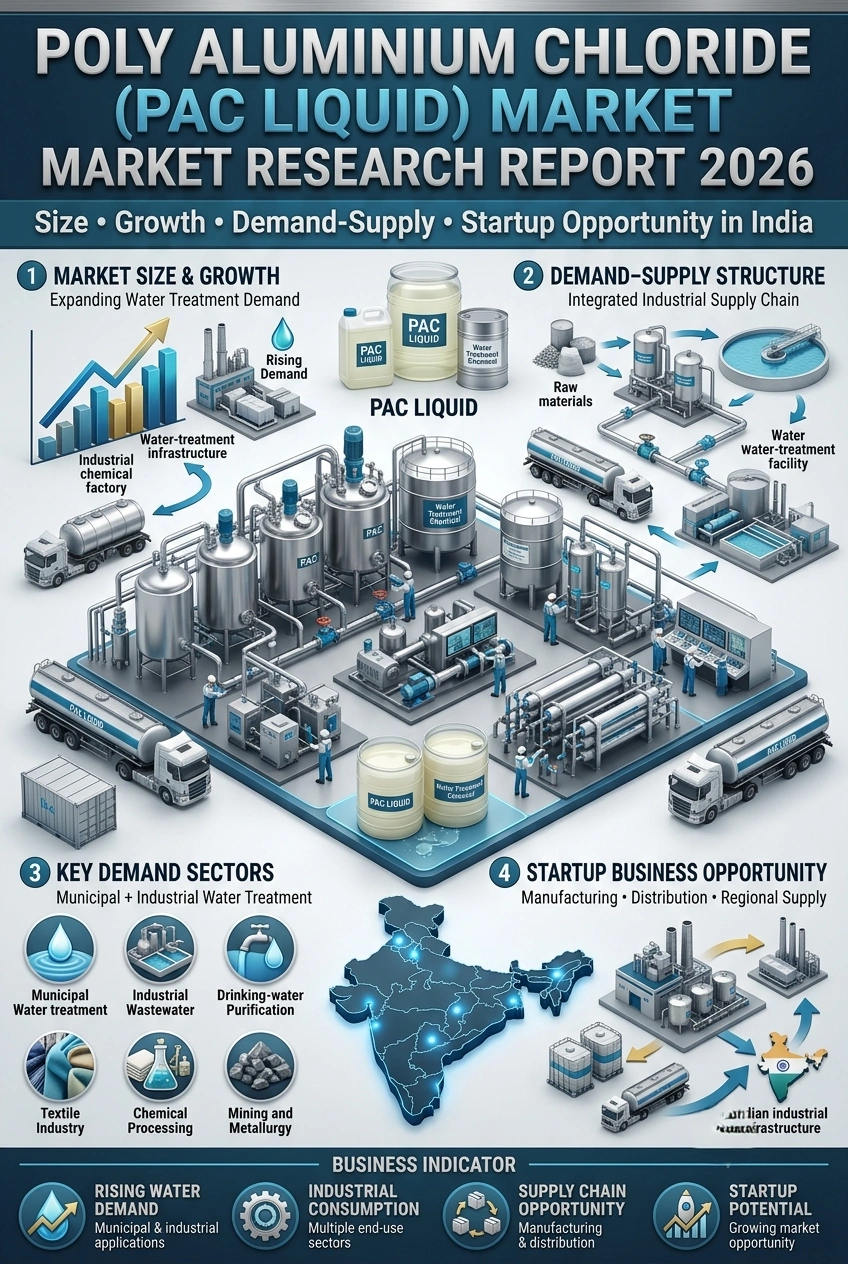
India Demand-Supply Structure: Poly Aluminium Chloride
| Parameter | Current Position |
| Global PAC dominance | ~70% share of all global inorganic coagulant end-use volume, reflecting steady displacement of alum |
| India demand drivers | Jal Jeevan Mission (~₹60 lakh crore potable water commitment), Namami Gange, AMRUT, Smart Cities Mission, and tightening CPCB/SPCB effluent norms |
| Domestic supply chain structure | Highly fragmented — numerous small-to-medium manufacturers and distributors, with inconsistent product purity and technical support cited as recurring buyer pain points |
| Recent large-scale domestic investment | GACL’s 9,900 MTPA PAC-30 plant at Vadodara, commissioned and dispatching product from February 2025 |
| Nature of the gap | A quality-consistency and reliability gap within a fragmented, high-growth domestic market — not primarily an import-substitution story, but an opportunity to out-execute a large field of inconsistent regional suppliers |
| Import context | Some Indian suppliers explicitly import high-purity PAC from China and other markets to serve customers demanding stricter specifications, indicating a segment where domestic quality-grade production still has room to substitute for imports |
| Opportunity for new entrants | Strong for a quality-focused, ISO-certified manufacturer able to serve municipal and industrial buyers who currently face inconsistent supply from the fragmented existing base |
Reading the market: PAC demand in India is not in question — it’s structurally anchored to some of the largest ongoing government infrastructure programmes in the country. The genuine opportunity for a new entrant lies in the gap between strong, policy-driven demand growth and a domestic supply chain that industry sources themselves describe as inconsistent. A manufacturer that can guarantee consistent purity, provide genuine technical support, and meet ISO/BIS quality standards is positioned to win share from the large tail of smaller, less reliable regional producers — a dynamic closer to construction chemicals or paint thinner than to the clean import-substitution stories elsewhere in this report series.
Major Indian PAC Manufacturers
| Company | Base/Region | Notes |
| Gujarat Alkalies and Chemicals Limited (GACL) | Vadodara, Gujarat | Major Gujarat government-promoted chemicals company; commissioned a new 9,900 MTPA PAC-30 (Powder) plant at its Coelho Complex, with first dispatch in February 2025, alongside expanded Aluminium Chlorohydrate (ACH) capacity for drinking water treatment |
| SNDB | India | Recognised Indian PAC manufacturer and exporter, supplying to more than 20 countries with a stated focus on sustainable water treatment practices |
| Innova Corporate (India) | New Delhi | Manufacturer and exporter of both PAC Powder and PAC Liquid, ISO-certified, serving municipal and industrial water treatment customers globally |
| PETRA (PAClean) | India | Established Indian manufacturer, exporter, and distributor of PAC for drinking water and industrial applications |
| Acuro Organics Limited | India | Recognised Indian PAC manufacturer serving water treatment, industrial wastewater, and paper industry applications |
| Chemtradeasia International | India | Recognised Indian PAC supplier catering to diverse industrial needs, cited for quality and customer service focus |
| Nanyang Chemical (India operations) | India | PAC manufacturer positioning on consistent purity and quality control, explicitly addressing the fragmentation and inconsistency challenges noted across India’s domestic supply chain |
| Numerous regional manufacturers (Vapi, Navi Mumbai, and other industrial clusters) | Gujarat, Maharashtra | The long tail of small-to-medium PAC producers and distributors representing the dominant structural feature of India’s domestic supply chain |
Major International PAC Players (Global Context)
| Company | Country | Notes |
| Kemira | Finland | Major global player across European, US, and broader international PAC markets |
| Feralco Group | Sweden | Major European PAC and water treatment chemicals producer |
| Venator | United Kingdom/United States | Major global specialty chemicals company active in the European PAC market |
| Jianheng Industry | China | Leading Asia-Pacific PAC producer |
| PT Lautan Luas Tbk | Indonesia | Leading Asia-Pacific PAC producer and distributor |
| Taki Chemical | Japan | Leading Asia-Pacific PAC producer |
| USALCO | United States | Major US-market PAC producer |
| GEO Specialty Chemicals | United States | Major US-market PAC and specialty chemicals producer |
Market Segmentation
By Form
- PAC Liquid — preferred for automated dosing systems at larger municipal and industrial installations, offering fast dissolution
- PAC Powder — easier storage and transport, widely used where automated dosing infrastructure is less developed
By Basicity/Grade
- Standard basicity (10-17% Al₂O₃) — municipal water and wastewater treatment
- Low basicity (17-19% Al₂O₃) — paper industry retention and drainage applications
- High basicity (Aluminium Chlorohydrate/ACH) — advanced/premium drinking water treatment
By Application
- Municipal drinking water purification — largest end-use segment
- Municipal wastewater/sewage treatment
- Industrial wastewater treatment (textiles, chemicals, food processing, leather)
- Paper and pulp manufacturing (retention and drainage aid)
- Desalination and industrial water reuse (emerging, high-basicity applications)
By End User
- Municipal water utilities and treatment authorities
- Industrial effluent treatment operators
- Paper and pulp manufacturers
- Textile processors
Key Growth Drivers
- The extremely large-scale water projects in India funded by the government. The potable water demand from Jal Jeevan Mission, ~₹60 lakh crore Namami Gange, AMRUT and Smart Cities Mission is one of the biggest continuous sources of coagulant growth in Indian industrial chemicals.
- Reducing the volume of industrial effluents. Requirements of CPCB or State Pollution Control Board, coupled with effective enforcement, are forcing the use of high-quality coagulants in the textile, paper, chemicals and leather processing sectors.
- Cost and performance benefits over alum. With only 20-40% lower dosing compared to aluminium sulphate to reach the targeted turbidity removal and the dramatically smaller amount of sludge produced, PAC is continuing to gain in popularity for achieving the same water quality as aluminium sulphate.
- Rising industrial water reuse and desalination investment. High-basicity PAC formulations are increasingly specified for stable floc formation in saline feedwater treatment trains, an emerging application as water reuse and desalination investment grows across Asia-Pacific.
- Growing adoption of automated dosing systems. As municipal and industrial facilities modernise, PAC Liquid’s compatibility with automated dosing infrastructure is driving a gradual shift in form-factor preference.
- Technology innovation in nano-PAC and composite formulations. Manufacturers investing in higher-performance, application-specific PAC formulations are creating new value-added segments within the broader commodity coagulant market.
Related Article: Explore the Indian Chemicals Market Report
Challenges and Restraints
- Fragmented, inconsistent domestic supply chain. As directly noted by industry sources, India’s PAC market includes numerous small-to-medium manufacturers with variable product purity and technical support quality — a genuine buyer pain point that also represents the core opportunity for a quality-focused new entrant.
- Raw material price volatility. Aluminium hydroxide/bauxite and hydrochloric acid feedstock costs are subject to broader chemical and metals market fluctuations, directly affecting production economics.
- Residual aluminium concerns. Regulatory and public health scrutiny of residual aluminium content in treated water represents an ongoing compliance consideration for manufacturers and treatment plant operators alike.
- Price sensitivity among industrial buyers. Industrial buyers, as distinct from municipal utilities, tend to purchase on shorter contracts or spot arrangements with high price sensitivity, making customer retention more challenging than with longer-term municipal supply relationships.
- Competition from alternative coagulants. While PAC continues to gain share, established alternatives (alum, ferric chloride, polyelectrolytes) remain in use, particularly where cost considerations outweigh PAC’s dosage-efficiency advantages.
Competitive Landscape
Integrated chemical manufacturers, such as GACL, which has recently added capacity specifically for ACH/high-basic drinking water treatment segment, and a large number of small-to-medium chemical manufacturers, distributors and sometimes importers of Chinese sourced product form the two segments of the PAC industry in India. The result is a unique competitive scenario: unlike categories where a few dominant actors dominate most of the market, PAC in India is open for the next competitive player to establish a consistent quality and reliable supply as inconsistency is a well-known and actual customer concern, not solved and not a solved problem.
PAC Liquid Manufacturing: Business Opportunity for Startups and MSMEs
- Manufacturing using PAC Liquid is ISO certified and of quality consistency. A manufacturer who can ensure consistency and purity throughout the entire chain and can offer a true, technical support is well placed to stand out from the many smaller manufacturers available in India.
- Regional supply for Jal Jeevan Mission/AMRUT projects of municipalities. Situating a manufacturing unit nearer to already existing and functioning government water infrastructure project clusters has a logistics benefit and a demand base that can be anchored by policy.
- Supply related to effluent treatment in industries. Establishing direct contacts with textile, paper, chemical and leather processing clusters with CPCB/SPCB compliance issues create a unique B2B demand with the Municipal Sector.
- High basicity/ACH-grade production for high-quality drinking water treatment. High-basicity PAC/ACH production for advanced municipal treatment is a higher value opportunity than the commodity grade PAC.
- Export-oriented manufacturing. A quality consistent Indian PAC manufacturer can tap into regional export markets in South & South East Asia with similar water treatment infrastructure growth, similar to the established exporters such as SNDB (supplying 20+ countries).
It should be noted that the investment and margin figures for PAC manufacturing can be different depending on the target grade (standard vs. high basicity ACH vs. paper industry) and form (liquid vs. powder). NPCS can develop Project Reports for you in detail, specific to the technology of the reactor, sourcing of raw materials and guidance for a pathway to quality certification for your capacity and grade.
Turn your budget into a successful business plan
How NPCS Supports Entrepreneurs Entering This Space
To any entrepreneur considering a PAC manufacturing enterprise, the first step is to prepare a suitable Detailed Project Report (DPR) which covers plant capacity, process selection and reactor technology, raw material procurement, certification pathway, manpower planning, project cost and financial viability for the selected grades and target market.
About NPCS (Niir Project Consultancy Services)
Founded in 1994, NPCS is a ISO 9001:2015 certified organisation based in New Delhi and having more than 30 years of experience in the field of Techno-economic and Project Consultancy. In 30+ years, NPCS has provided over 150,000 project reports and profiles to 85 countries, covering virtually every manufacturing and process industry; water treatment chemicals, inorganic coagulants, industrial effluent treatment products, etc.
At the heart of the work of NPCS for a PAC venture are the following:
- Detailed Project Reports (DPRs) including plant capacity, machinery specifications and layout.
- Techno-economic feasibility studies (including quality certification and compliance guidance)
- Financial modelling — project cost, profitability analysis, ROI and break-even calculations
- Clearly understand the associated raw material and market information specific to Indian government water infrastructure pipeline projects.
- Advise for MSME loan applications, subsidy schemes and bank funding requirements
Government and Institutional Reference Links
Entrepreneurs can also connect with the FICCI Water Mission and the Confederation of Indian Industry (CII) Water Institute for industry networking, technical guidance, and policy updates specific to India’s water and wastewater treatment chemicals sector.
- Jal Shakti Ministry / Jal Jeevan Mission
- National Mission for Clean Ganga (Namami Gange)
- Central Pollution Control Board (CPCB)
- Ministry of Housing & Urban Affairs (AMRUT/Smart Cities Mission)
- Ministry of Micro, Small and Medium Enterprises (MSME)
- Development Commissioner, MSME (DCMSME)
- Bureau of Indian Standards (BIS)
- Startup India
- Invest India (National Investment Promotion and Facilitation Agency)
Entrepreneurs are advised to verify the latest CPCB/SPCB effluent norms, Jal Jeevan Mission/Namami Gange procurement guidelines, and MSME subsidy norms directly on these portals, as regulatory provisions are periodically revised.
Conclusion
Poly Aluminium Chloride is at the crossroads of some of the biggest water infrastructure programmes in India and an industry that industry sources themselves say has a “fragmented and inconsistent” supply chain. The opportunity here is not about the absence of an import substitution gap, it is about the execution; it is a well-capitalised, quality consistent manufacturer entering into the space, and not against a few known players, but against a large field of smaller, variable quality competitors, with the demand itself essentially guaranteed by the scale of India’s Jal Jeevan Mission, Namami Gange and industrial effluent compliance requirements.
A combination of a policy-driven demand with essentially non-cyclical demand and a proper value-adding opportunity for quality differentiation in a complex existing supply chain makes the PAC production a unique area of consideration for entrepreneurs and MSMEs.


