




Rice Husk Based Manufacturing Business
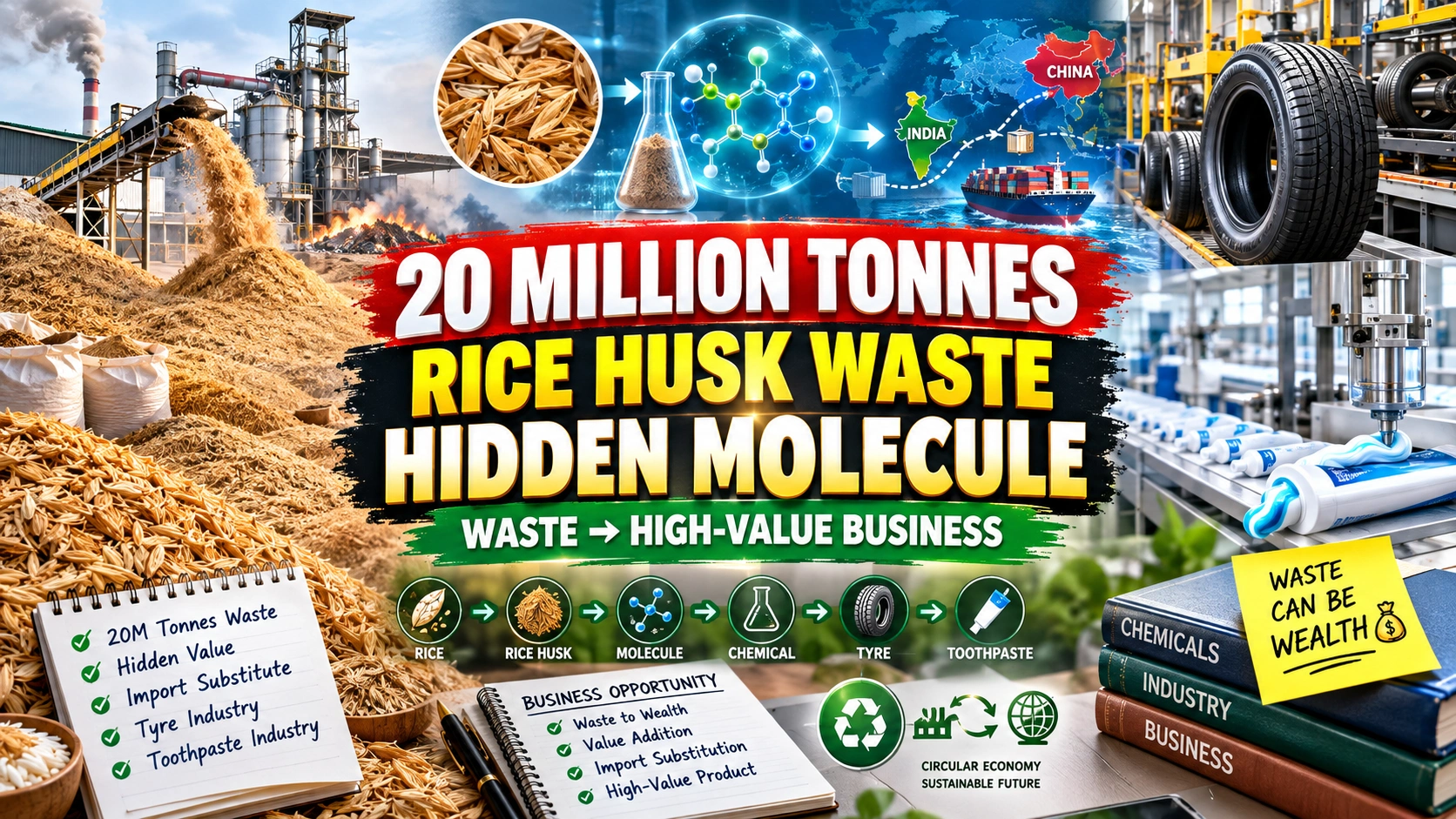
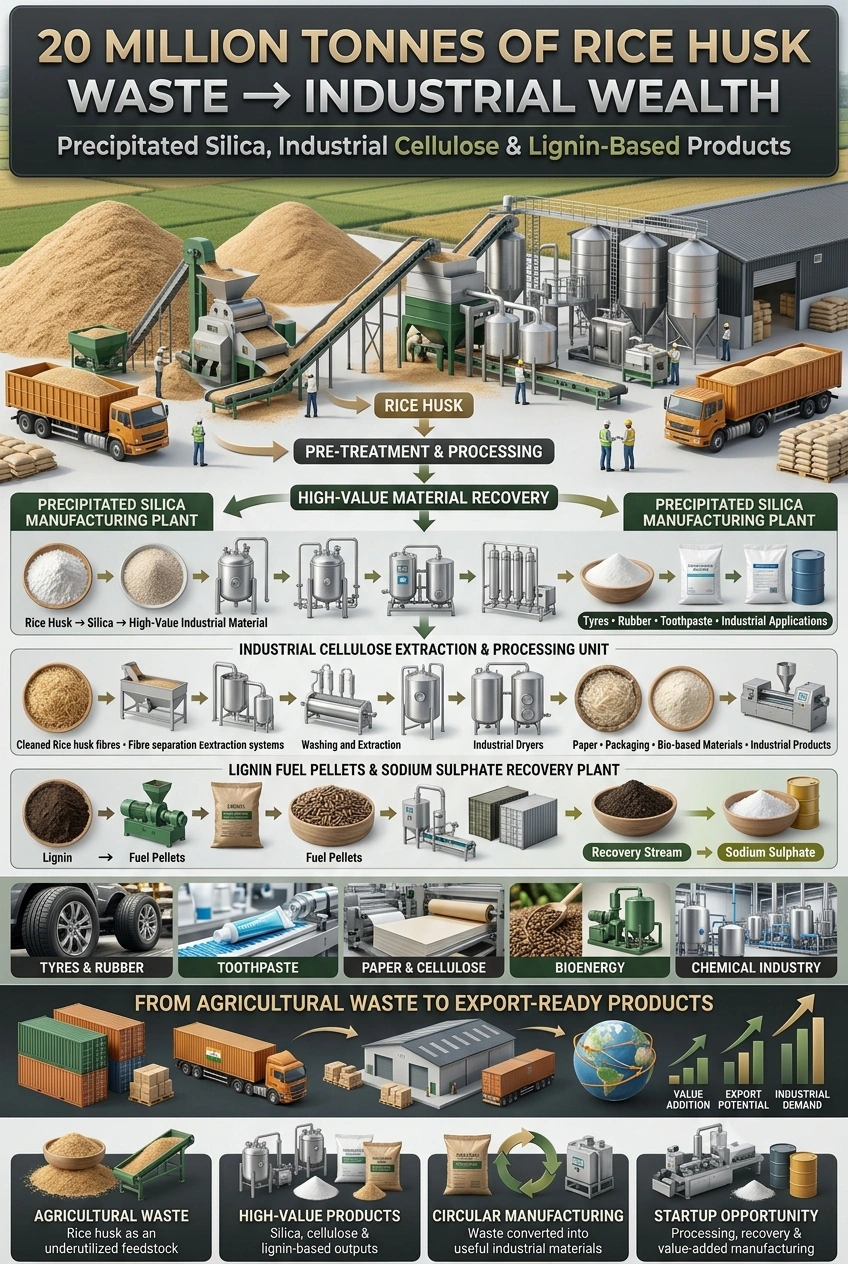
The transformation of rice husk into high value industrial chemicals is one of the most underutilized business ideas in Indian manufacturing industry today. India has a rice-husk production of more than 20 million tonnes per year of which the majority is either burnt in the field or burnt as low-quality fuel. But there exists a molecule in this agricultural waste, which has a commercial strength, called amorphous silica. With proper processing, rice husk can be processed to produce Precipitated Silica, Industrial Cellulose, Lignin Fuel Pellets and Sodium Sulphate which have strong demand in the domestic and international market.
It is an attractive industry for startup founders, MSME investors and first-generation entrepreneurs looking for capital efficient and export ready manufacturing opportunities as it has seen an abundance of raw materials, policy support and market pull.
Why the Rice Husk Value Chain Is Growing Fast
India’s agrochemical/ specialty chemical sector is silently changing. The global Precipitated Silica market size is estimated to be worth several billion dollars and is increasing at a steady rate owing to the demand from tyre manufacturers, rubber compounders, personal care formulations, and specialty coatings. Even though India has one of the largest stocks of rice husks in the world, it imports a significant amount of high purity silica for use in the manufacturing of tyres and consumer goods.
In a similar manner, Industrial Cellulose used in the silica separation process is sold for pharmaceutical excipients, food grade thickeners and paper additives. The organic polymer (lignin) recovered with cellulose is also compressed into high-calorific fuel pellets, with the increasing demand from biomass energy plants and industrial boilers. The fourth by-product of this process is Sodium Sulphate, which is used extensively in detergent production, the glass industry and kraft paper mills.
This value chain converts a waste material of ₹1-2 per kg into a final product worth of ₹80-400 per kg. That difference, by itself, is a good profitability story. Furthermore, import substitution in industrial chemicals is now a national priority, given the government’s drive towards Make in India and the Atmanirbhar Bharat policy.
Read the Complete Book Here: Manufacture of Value Added Products from Rice Husk (Hull) and Rice Husk Ash (RHA)
Government Policies and Incentives Supporting This Sector
The Indian policy has veered 180 degrees toward agro-waste manufacturing. Collateral free credit facility up to ₹2 crore has been introduced by the Ministry of MSME through Credit Guarantee Fund Trust for Micro and Small Enterprises (CGTMSE), which enables first generation promoters to set up their plants. The MSME Development Act and the Udyam registration portal grants benefits to registered MSMEs, such as priority sector lending, duty concessions for electricity use, and preference in Government tenders.
The Department for Promotion of Industry and Internal Trade (DPIIT) provides a framework for recognition of startups, enabling qualifying manufacturers to enjoy a 3-year income tax holiday and access to the Fund of Funds for expansion in the venture stage. Besides this, the National Bank for Agriculture and Rural Development (NABARD) actively supports agro-processing business through Rural Infrastructure Development Fund and Agri Business Finance schemes.
Rice husk-based businesses are also eligible for the incentive programmes of the Ministry of New and Renewable Energy (MNRE) for biomass energy, especially if they are Lignin Fuel Pellet producers supplying to captive power or biomass plants connected to the grid. The advocacy momentum is strong at the sector level with Chemicals and Petrochemicals Manufacturers’ Association (CPMA) lobbying for reduction in GST on specialty silica and intermediates.
Multiple Manufacturing Business Ideas for Startups
1. Precipitated Silica Manufacturing Plant
Precipitated Silica plant from rice husk ash (RHA) is one of the most scalable and defensible business ideas in the agro-chemical space. The first step in the process is the controlled burning of rice husk in a rotary kiln at temperatures in the range of 600–700°C to generate high purity rice husk ash (RHA) of 90–98% amorphous silica. This ash is then acid leached and then precipitated with sodium silicate and sulphuric acid under controlled pH. The precipitated silica slurry is filtered, washed, spray dried and milled to the required particle size and surface area. End products are supplied in quality grades (rubber grade, dental grade and food grade) with varying price premiums.
Natural anchor buyers for long-term off-take agreements include tyre manufacturers such as Apollo Tyres and MRF, among others, the FMCG producers of toothpaste. The installation cost of a 2 tonne/day plant is about ₹2.5–3.5 crore all-in, and expected annual revenue is over ₹10–12 crore when it is fully utilised. One of the best things about this business is that raw material is almost cheap in the paddy belts of Punjab, Haryana, UP and West Bengal which definitely reduces the input and helps to enhance operating margins.
Get Detailed Project Report (DPR): Explore the Complete Precipitated Silica Manufacturing Guide
2. Industrial Cellulose Extraction and Processing Unit
Rice husk is made up of structural polymer called Industrial Cellulose and has fibers as its backbone. The cellulose portion can be separated from lignin and hemicellulose by treating rice husk with sodium hydroxide (alkali pre-treatment) followed by bleaching. The product formed is microcrystalline cellulose (MCC) or cellulose pulp, which can be used in the pharmaceutical tablet binding, food thickening agents, paint rheology modification and specialties paper grades. India currently imports MCC from Europe & South East Asia at a high forex cost, thus making the domestic production a viable import substitution play.
The capital cost of an Industrial Cellulose unit producing 1.5 tonnes/day is in the range of ₹1.8–2.5 crore, and the revenue from such an investment is in the range of ₹6–8 crore per annum, depending on the grade mix of the product. Moreover, this unit can be utilized as a back-streaming unit with a Precipitated Silica plant, where the ash generated during cellulose production is rich in silica, and the entrepreneurs can hence generate revenue from both streams and significantly boost the project ROI.
3. Lignin Fuel Pellets and Sodium Sulphate Recovery Plant
Lignin is the second most abundant natural polymer on earth, which is usually regarded as a waste during cellulose extraction processes. However, upon drying and compressing it into standardised fuel pellets (6–8mm diameter and calorific value 4,000–4,500kcal/kg), lignin turns into a commercially available biomass fuel. The Central Pollution Control Board (CPCB) is putting pressure on industrial boiler operators in India — such as textile mills, food processing plants, and ceramic kilns — to gradually phase out coal and move towards using biomass. This is giving rise to a rapidly expanding market for the lignin pellets at ₹8 to ₹12 per kg with the requirement of bulk supply, which matches well with the logistics.
The sodium sulphate produced as a by-product in the silica precipitation process can also be recovered, purified and sold to detergent and glass manufacturers at ₹18-25 per kg along with lignin recovery. Sodium Sulphate can be considered as a small revenue item, but adds value to the unit economics at a large silica plant of 5+ tonnes/day production capacity. As a natural third leg of the integrated rice husk value chain, a Lignin Pellet and Sodium Sulphate recovery unit contributes ₹1.5–3 crore per annum to the topline without substantial capital investment.
Import–Export Opportunity Analysis
The trade balance of specialty silica is a telling example for India. The country has to import high purity Precipitated Silica from China, Germany and the Netherlands at landed cost well over the domestic production cost. It is observed that the trade of silicon dioxide (HS-2811.22) from these sources has been consistently high and rising, giving a direct opportunity of substitution for domestic manufacturers. The export side, Vietnam, Bangladesh and Indonesia (with a sizeable rubber and tyre industry) are active buyers of Precipitated Silica from overseas. With the availability of huge rice husk in India, the Indian manufacturers can go after these markets.
One of the other high-value opportunities is exports to the European Union of Industrial Cellulose. With the EU turning green towards bio-based, agri-based raw material in areas of pharmaceutical and food industry, there is a niche for certified Indian MCC. Agricultural and Processed Food Products Export Development Authority (APEDA) offers market development assistance and export facilitation for agro processed products including cellulose derivatives. Lignin Fuel Pellets also have good export market in Japan and South Korea where biomass energy mandates lead to institutional buying programmes. New exporters can get support from Federation of Indian Export Organisations (FIEO) in documentation, ECGC cover, identification of buyer etc. in these markets.
Related Article: From Rice Husk Waste to a Multi-Billion-Dollar Silica Market
Indian MSME Success Stories Worth Learning From
Mr. Rajesh Agarwal of KSSL Energy Pvt. Ltd., promoted in Chhattisgarh, constructed a rice husk-based silica plant which is now supplying the same to the rubber compounders and toothpaste manufacturers in the region. His breakthrough was to use a different method for introducing a controlled amount of combustion of husk instead of buying ash from third parties, and this gave him a higher level of raw material purity as well as an advantage in plant cost in comparison to his competitors who were buying RHA from the open market. His advice to new business owners: Vertical integration in agro-waste processing isn’t an option — it’s the moat.
Mr. Sarvesh Chemicals, a Pune based MSME, started its journey in Industrial Cellulose market by providing MCC to a local pharmaceutical excipient distributor. She intentionally went for a niche segment – that of manufacturers of Ayurvedic formulation which had the maximum pressure of import substitution and minimum quality probing for a start-up. This enabled her to develop these GMP processes over time without making too much initial investment. Her model shows that the approach of segmenting the first customer base according to the complexity of regulation is a good idea for the beginning in this industry.
Mr. Harinder Singh, founder of GreenFuel Biomass Solutions, an agri-waste startup in Ludhiana, Punjab, started the Lignin Pellet supply to the local dyeing mills which began to replace furnace oil. He was able to lock in 3-year off take contracts with 3 anchor customers before he commissioned the plant and also obtained project finance from a regional cooperative bank. His example serves as a reminder that pre-selling production is more important than optimizing production processes in the early days of any biomass start-up or agro-chemical start-up.
Discover business ideas that actually make money
How NPCS Helps Entrepreneurs Evaluate This Opportunity
The set up of a Precipitated Silica, Cellulose, or Lignin Pellet manufacturing unit is a complicated engineering selection, exact raw material planning and monetary modelling. At Niir Project Consultancy Services (NPCS) we are professional consultants in the preparation of Market Survey cum Detailed Techno-Economic Feasibility Reports (DPRs) for setting up new industries or business. Our reports come with complete manufacturing processes, market research and demand analysis, process flow diagrams, product mix and capacity planning, details about the machines/equipment needed, details about the raw materials etc., and the complete financials of the project with a profitability analysis.
We want to make sure that you’re considering feasibility, profitability and long-term scalability before you invest, because it’s not about wishing, it’s about data. As well, check the industry standards and buyer connect programmes by the Indian Chemical Council (ICC) for specialty chemicals.
Market Overview: Rice Husk Value Chain Products
| Product | Key Application | Market Price (₹/kg) | Demand Trend | Est. Project Cost |
| Precipitated Silica | Tyres, Toothpaste, Rubber | 80–250 | Strong (Import Substitution) | ₹2.5–3.5 Cr |
| Industrial Cellulose (MCC) | Pharma, Food, Paper | 120–400 | Growing (EU Export Potential) | ₹1.8–2.5 Cr |
| Lignin Fuel Pellets | Industrial Boilers, Energy | 8–12 | High (Coal Replacement) | ₹0.8–1.2 Cr (add-on) |
| Sodium Sulphate | Detergents, Glass, Kraft Paper | 18–25 | Stable (By-product Revenue) | Recovered from Silica process |
Conclusion: A Waste-to-Wealth Opportunity Worth Acting On
The excess of rice husk in India is not an issue, but a business opportunity to be developed. A fully integrated precipitated silica processing unit is a ₹100+ crore opportunity for annual revenue generation, which can be achieved by processing all the above raw materials. In addition, all the factors of import substitution, policy incentives, abundant natural resources, and expanding domestic and export markets are aligned in favour of this investment, which has never been more opportune.
If you’re a serious startup founder or an MSME investor, you don’t have to wonder if this space has potential — you just need to understand which entry point and where you’ll fit in your space, time and access would work best for you.
They’re entrepreneurial units that will be built by entrepreneurs who will be able to bring them to the market and who will be selling to industries that simply can’t do without them — and that’s what structural demand is. Call NPCS to work with them to develop a detailed feasibility analysis based on your project parameters, to make this an opportunity a bankable, investable plan.
References & Useful Links
- Ministry of MSME, Government of India
- DPIIT – Startup India Portal
- NABARD – Agri Business Finance
- APEDA – Agricultural Export Promotion
- Ministry of New and Renewable Energy (MNRE)
- Central Pollution Control Board (CPCB)
- Make in India – Official Portal


