





A feasibility-led look at where import substitution meets real profitability in Indian chemicals.
Chemical Business Ideas in India
The fundamental nature of the Indian chemical story is import substitution. As a result, chemical business ideas are among the most promising any consultant can propose. India imports billions of dollars of specialty and intermediate chemicals annually despite the presence of talent and demand within the country. For founders with the resolve and discipline to develop the right processes, this is a lucrative opportunity
This article analyses the sector from a feasibility perspective. We consider why demand is durable, what policies are supportive, and 5 manufacturing routes that balance capital, risk, and margin.
Why the Chemical Sector Rewards Serious Founders
Demand Runs Through Every Industry
Chemicals are typically inputs – this is why demand is so durable. Paints, textiles, pharma, agriculture, and construction consume them daily. As a result, no single industry downturn can impact the market as a whole. Therefore, a well-chosen chemical manufacturing unit can benefit from demand spanning multiple verticals simultaneously.
India’s push for manufacturing adds further tailwinds. As downstream factories scale, they consume more intermediates and specialty inputs. A founder supplying this chain locally will capture value that would have gone overseas.
Import Substitution Is the Real Opportunity
The best entry point for founders is importing substitution. Many specialty chemicals are still imported despite steady domestic demand. Therefore, a reliable local source can capture customers through shorter lead times and consistent supply. Trade and production data from the Department of Chemicals and Petrochemicals and DGFT can help founders identify which molecules to target.
Government Policies and Incentives
Policies in India strongly incentivize domestic chemical manufacturing. The PLI Scheme for Bulk Drugs and related intermediates support key starting materials, while dedicated PCPIR petrochemical regions offer clustering advantages that reduce the heavy upfront costs new players face.
MSME founders should register on Udyam to access collateral-free credit and priority lending. Pollution and safety clearances fall under the purview of the Central Pollution Control Board, and early planning can prevent unnecessary delays. Several states aggressively woo chemical investment – the Gujarat Industries portal is a good example of state-level support and land facilitation available to founders.
5 Chemical Business Ideas for Startups
Idea 1 — Industrial and Institutional Cleaning Chemicals
Cleaning chemicals enjoy widespread demand across hospitals, hotels, factories, and offices. Their formulations are fairly standard, and capital needs are modest – these factors reduce the entry barrier. Since buyers reorder frequently, a founder generates recurring revenue rather than one-off sales. Quality and safety handling are more important than chemistry complexity here. A new unit can start offering a range of surface cleaning and disinfectants and later branch out into specialty industrial degreasers. Additionally, institutional buyers reward reliability, so a disciplined supplier can secure steady volumes that insulate the business from seasonal fluctuations.
Idea 2 — Specialty Adhesives and Sealants
Adhesives are embedded in furniture, packaging, footwear, and construction – this gives them broad industrial reach. Demand rises as these downstream sectors grow, so the timing favours new entrants. As different applications dictate varying performance characteristics, a focused producer can carve out a niche and defend it. Founders should aim to target a specific end-use, such as woodworking or packaging, and then expand their footprint. Local production ensures shorter delivery times, which industrial buyers heavily value. Over time, the unit can build out higher margin specialty grades. Consistent bonding quality becomes the brand’s differentiator, and this reputation can drive repeat sales across the customer base.
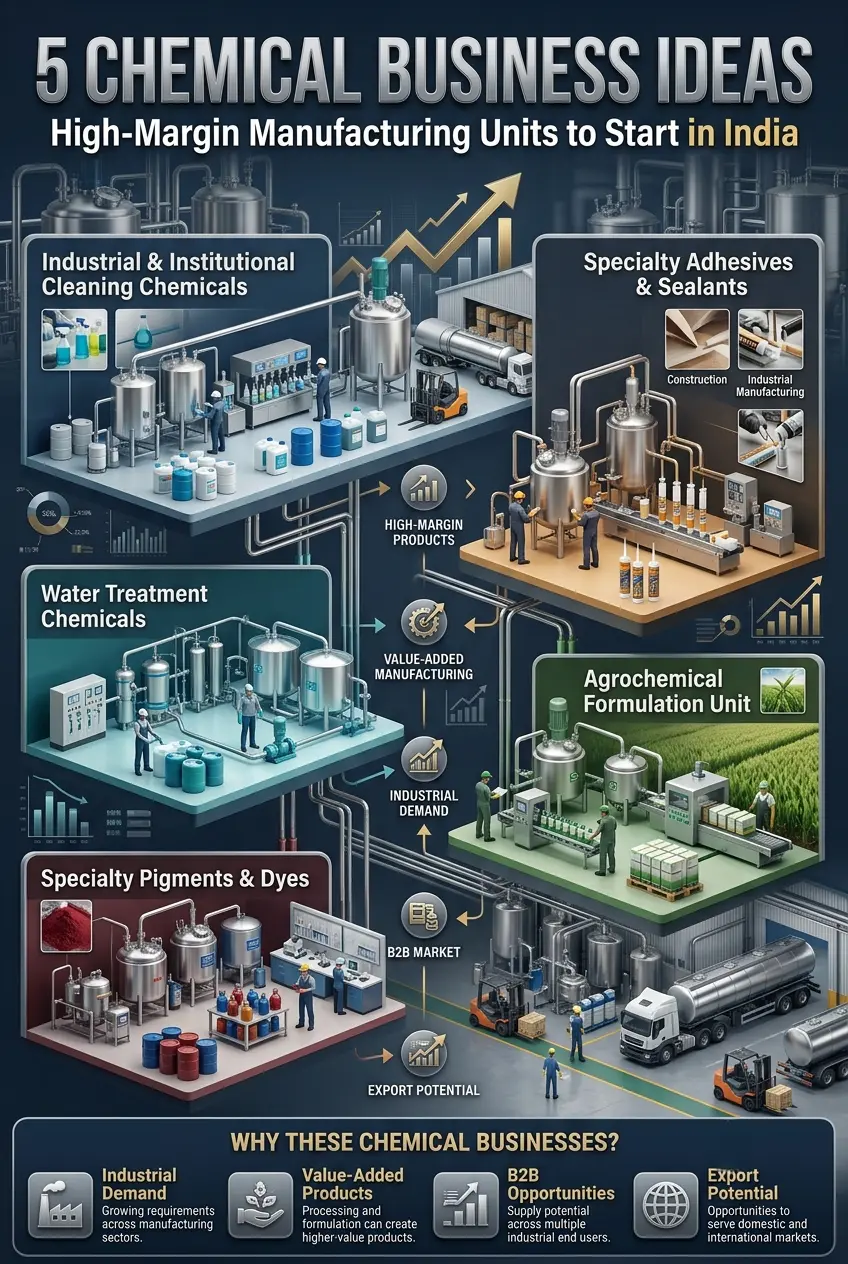
Idea 3 — Water Treatment Chemicals
Water treatment chemicals enjoy steady demand, both from manufacturing and municipal authorities. As environmental regulations continue to tighten, buyers cannot procrastinate on these purchases. A founder supplying reliable treatment chemicals benefits from a regulatory tailwind rather than a passing trend. The product range accommodates both large plants and smaller effluent units – this widens the customer base. Additional technical service creates strong loyalty since clients rely on consistently good results. A unit that combines dependable chemistry with technical support will grow steadily alongside the country’s expanding water treatment infrastructure.
Idea 4 — Agrochemical Formulation Unit
Agriculture fuels Indian demand, and crop protection inputs are integral to every season. A formulation unit that blends and packages approved actives serves a huge farming market. Since formulation needs less capital than basic manufacturing, it suits founders looking to enter with a lighter touch. Regulatory registration is vital but it also acts as a barrier – a compliant player can enjoy monopoly-like conditions. Local packaging and distribution shorten the buyer journey for rural customers. Moreover, the demand recurs with every cropping cycle, bringing a predictable rhythm to the business. A founder who respects safety and quality norms can build durable relationships with dealers and farmers.
Idea 5 — Specialty Pigments and Dyes
India is a global hub for dyes and pigments, and specialty grades garner premium pricing. A unit that focuses on high-purity or application-specific colours can serve textiles, plastics, inks, and coatings. Since buyers demand consistency, a producer who controls quality will enjoy lasting relationships. Export potential is significant as well – global brands seek reliable, compliant Indian supply. Founders should target a defined application and perfect the shade consistency that customers prize. Cleaner production methods now enable access to environmentally conscious buyers. This combination of quality and compliance allows a focused unit to compete well beyond the domestic market.
Import–Export Opportunity Analysis
The trade reality strongly favours new manufacturers. India still imports many intermediates and specialty chemicals – a local producer can capture demand that would have gone overseas. Domestic dyes, pigments, and agrochemicals enjoy good export potential as well.
Export success depends on adhering to international safety and quality norms, and DGFT guidance can help founders align early on. Consequently, a unit geared towards both substitution and export finds itself more resilient. When domestic demand wanes, overseas orders plug the gap, and vice versa, balancing cash flow through the cycle.
Indian MSME Success Stories Worth Studying
Aarti Industries started small but grew into a respected specialty chemicals producer by focusing on quality and exporting. Its promoters’ commitment to backward integration and consistent quality built enduring customer relationships. The lesson for new entrants is that process discipline builds a moat.
Vinati Organics, led by Vinati Saraf Mutreja, turned a narrow specialty niche into global leadership by dominating a few molecules rather than spreading out. Similarly, Alkyl Amines built strength through steady, focused expansion. For new founders, the common thread is that depth trumps breadth – mastering a particular chemistry and serving it reliably builds a sustainable foundation.
About NPCS
We at Niir Project Consultancy Services (NPCS) provide professional help in preparing the Market Survey cum Detailed Techno-Economic Feasibility Report (DPR) for any new industry or business setup. We offer detailed reports including detailed manufacturing processes, market studies and demand analysis, process flow diagrams, product mix and capacity planning, machinery and raw material details, and complete project financials with profitability analysis. Our objective is to help entrepreneurs to evaluate the feasibility of the project, the profitability of the project and to study the long-term sustainability of the project.
NPCS has published a comprehensive printed reference book on chemical manufacturing providing in-depth coverage of technology, market analysis, investment parameters and manufacturing processes — the printed book: The Complete Technology Book on Chemical Industries
A detailed project report – techno-economics on setting up a manufacturing business in this sector to include plant economics, machineries list, projections of financials and applicable government incentives — the NPCS Project Report: Projects on Chemicals (Organic, Inorganic, Industrial) — Manufacturing Plant, Detailed Project Report, Market Research, Survey, Manufacturing Process, Machinery, Raw Materials, Feasibility Study, Investment Opportunities
Indicative Project Snapshot
| Business Idea | Approx. Investment (₹) | Demand Outlook | Export Scope |
| Cleaning & Sanitation Chemicals | 20–60 lakh | High | Low–Moderate |
| Adhesives & Sealants | 40 lakh–1.5 crore | High | Moderate |
| Water Treatment Chemicals | 30 lakh–1 crore | Very High | Moderate |
| Agrochemical Formulation | 40 lakh–2 crore | High | Moderate |
| Specialty Pigments & Dyes | 50 lakh–3 crore | High | Strong |
Figures are indicative planning ranges and shift with scale, location, and compliance requirements.
Conclusion
The chemical sector rewards founders who respect process, compliance, and focus. Import substitution offers a clear, fundable entry point, while exports add durability. Therefore, the winners are those who master a defined chemistry and supply it reliably. A rigorous feasibility report is essential here, because it maps demand, cost, safety, and profitability before a single reactor is bought.
Your Investment Deserves the Right Opportunity
Every serious investment begins with choosing the right sector and the right business model. With hundreds of industrial opportunities available across India’s manufacturing and clean-energy landscape, making the most informed choice is critical. Niir’s Startup Selector tool helps entrepreneurs, MSMEs, and investors identify the most suitable business opportunities based on their investment capacity, location, and interests — so your capital is directed toward a venture with the strongest fit and potential. Explore your best-fit business opportunity today.


