





Solar Business Ideas in India
Consultant’s perspective on which solar business ideas are at the same time policy and demand driven, therefore more attractive for first-time-founders. Few industries enjoy the luxury of certainty as the solar industry does at this moment. And this is precisely the reason why solar business ideas appear among the most prominent options for ambitious founders. India has pledged to make considerable efforts towards embracing clean energy. Coupled by a conducive policy and demand environment, money is flowing towards solar at a considerable pace. For a first-time founder, solar business ideas represent a unique convergence of factors that contribute to long-term success and profitability. This article takes a consultant’s view of the solar industry, identifying the key demand drivers that affect the solar business landscape. We will highlight five distinct solar business ideas for a founder looking to make their mark, explore trade-linkage opportunities, and take a look at some successful Indian MSMEs in the solar space.
Why Solar Is a Generational Opportunity
Policy and Demand Moving Together
Solar is one of those few industries where the confluence of policy and demand is both evident and enduring. The push from policymakers translates to demand creation among both residential and commercial consumers for clean and sustainable electricity. As a result, the market for solar technologies enjoys an upward thrust that is virtually impervious to cyclical downfalls. With falling prices, the affordability of solar technology makes it even more attractive for the end-users. So, a founder who wants to take advantage of this environment can benefit from both – a favorable policy environment as well as an ever-growing demand base.
A Value Chain Full of Entry Points
Solar business ideas span the entire value chain of the industry. From manufacturing to installations and services, the solar industry covers various entry-level opportunities. Consequently, a founder who is just getting started can explore options that require relatively lower capital outlay such as solar installation businesses. Founders can rely on the guidance provided by the Ministry of New and Renewable Energy as well as Solar Energy Corporation of India to identify the most promising areas of the solar industry.
Government Policies and Incentives
Support here is unusually strong. The PM Surya Ghar Muft Bijli Yojana subsidises rooftop solar for households, creating a massive installation market. Additionally, the PLI Scheme for High-Efficiency Solar Modules backs domestic manufacturing at scale.
Founders should register on Udyam for MSME credit and priority lending. Net-metering and state solar policies add further pull; for example, Rajasthan’s renewable energy corporation actively promotes solar projects. Financing support also flows through the Indian Renewable Energy Development Agency (IREDA), which funds clean-energy ventures.
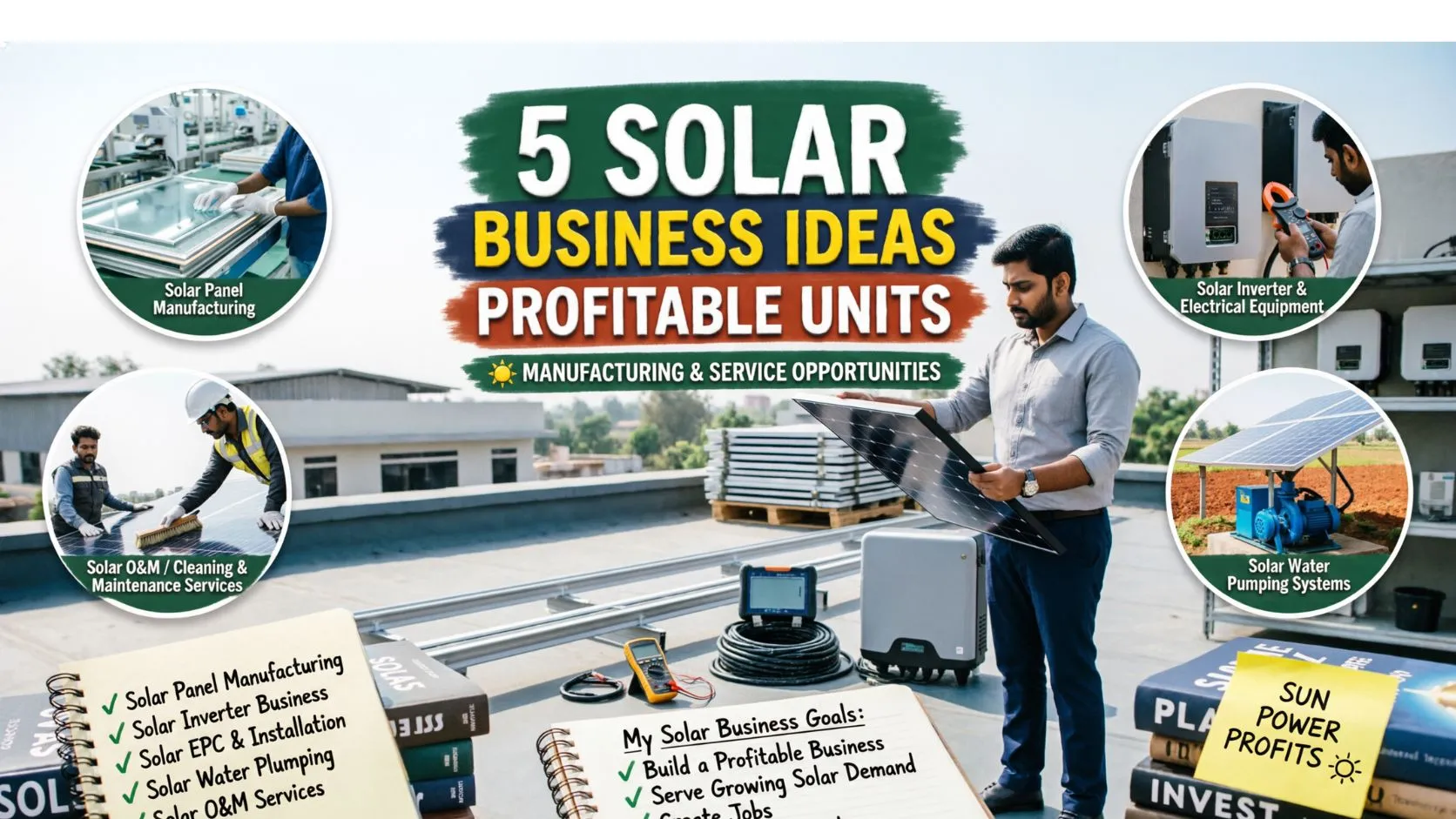
5 Solar Business Ideas for Startups
Idea 1 — Rooftop Solar Installation Service
Installing solar panels on residential and commercial rooftops represents the most accessible entry-level solar business idea. Rooftop solar installation services currently enjoy a pent-up demand that is only going to increase as the government continues to promote and incentivize such initiatives. A founder only needs a small capital investment in terms of skilled labor and equipment. In addition, this particular segment relies less on the perceived value sold to the customer and more on the actual work done. Reputations are earned at the local level and can be leveraged to gain greater visibility. In addition to installation, businesses can offer recurring cleaning and maintenance services as additional revenue streams. This solar business idea is ideal for those wishing to minimize their capital outlay and operate as a service provider. With hard work and smart marketing, such a business can scale exponentially by targeting residential as well as commercial rooftops.
Idea 2 — Solar Panel Assembly Unit
Solar panel manufacturing can be approached in multiple ways ranging from assembling panels using locally manufactured cells to setting up a large-scale manufacturing facility for cells and modules. A relatively smaller initial investment is required to set up a solar panel assembly unit that can utilize locally manufactured cells. Given the strong policy tailwinds for solar, there is a huge demand for solar panels that a founder can tap into. This particular business idea requires consistency and commitment to quality in order to build a strong clientele base. Starting small and working with standard sizes can help such businesses gain credibility and scale in due course. Higher efficiency panels should be considered as an option for increasing profit margins. In addition, solar panel manufacturing is a great long-term business plan given the consistent policy-driven demand on the horizon.
Idea 3 — Solar Water Heaters and Pumps
Solar water heaters and pumps can be used in residential, commercial, and agricultural settings. They represent an innovative way of reducing electricity expenses as well as fuel costs in the case of pumps. As a result, the market for such products is highly competitive. Founders can take advantage of the demand and subsidies on offer for solar water heaters and pumps to build a profitable business. A strong reputation for reliability and performance will ensure word-of-mouth publicity and lead to long-term contracts. In addition, agricultural pumps can be marketed with relatively greater ease to rural customers. This solar business idea is ideally suited for a founder who is looking to provide a product-based service leveraging on the demand as well as the subsidies on offer. Solar water heaters and pumps can also help such a business target urban and rural customers with equal ease.
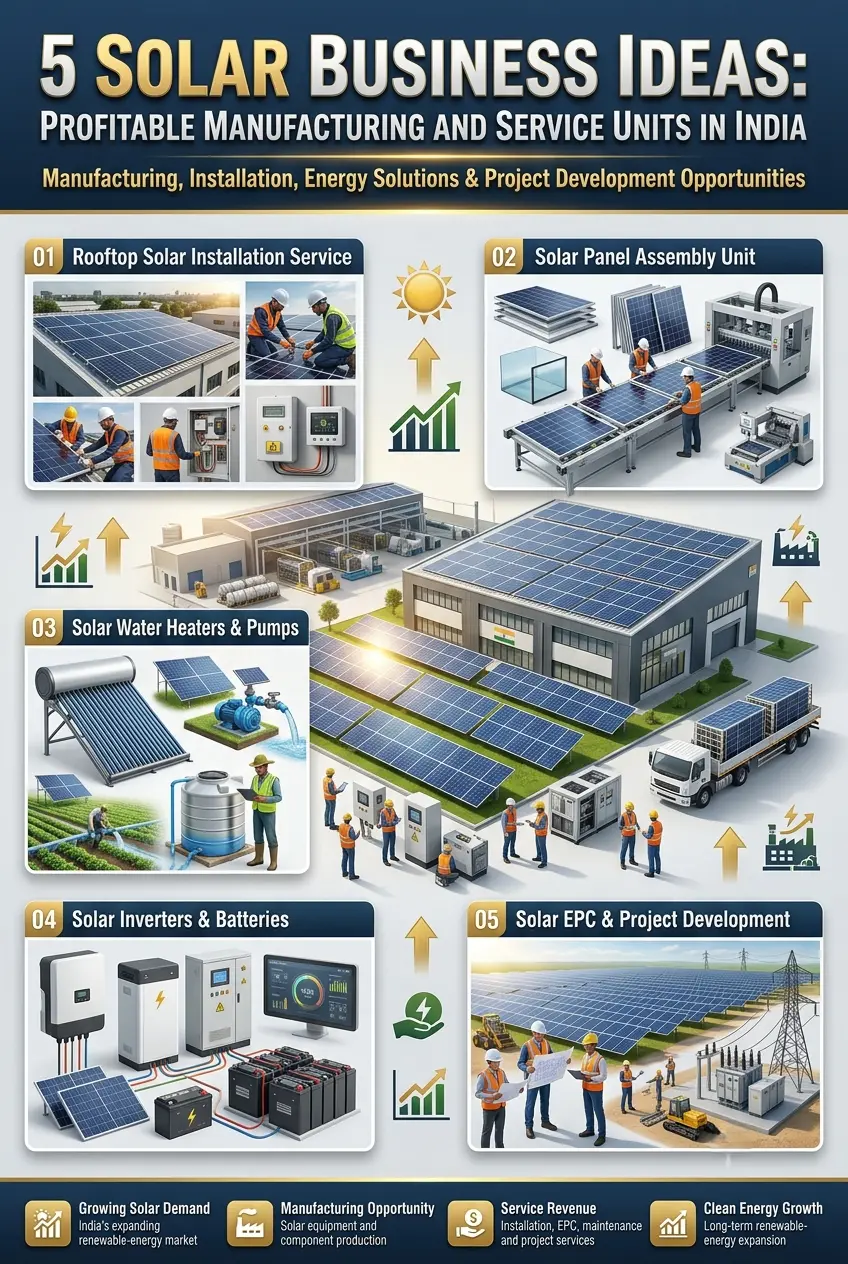
Idea 4 — Solar Inverters and Batteries
Solar inverters and batteries are integral elements of any solar power system. As a result, as the solar industry grows, so will the demand for these related products. Given the emphasis on quality and reliability, founders considering this solar business idea need to focus on these two aspects. Starting with relatively smaller battery sizes and standard inverters can help such businesses target a larger customer base. With time, higher efficiency and larger sizes can be introduced to capitalize on the growing demand as well as the relatively higher profit margins. Energy storage is set to become a hot topic in the solar industry for years to come. A founder with the right skill set and capital can benefit immensely from the growing demand for inverters and batteries. Moreover, import substitution represents a significant opportunity for solar-related businesses given the current reliance on foreign imports for these components.
Idea 5 — Solar EPC and Project Development
The solar project development and EPC (engineering, procurement, construction) segment represents an excellent area for a founder looking to become a part of the solar industry. EPCs play a crucial role in bringing solar projects to fruition. In addition, this segment has witnessed a surge in demand as businesses and organizations become increasingly inclined to go the captive solar route. For a founder, this business idea is particularly attractive given the fact that a substantial initial investment is not required. With relatively greater emphasis on reliability, safety, and performance, solar EPCs have the potential to scale exponentially. Starting small with commercial rooftop solar projects can provide valuable experience while laying the groundwork for bigger solar farms in the future. In addition, EPCs can also provide operation and maintenance services to generate additional revenues.
Import–Export Opportunity Analysis
When it comes to India, the majority of solar cells and modules are imported, which creates exceptional opportunities for manufacturers and assemblers. A founder who is considering setting up a manufacturing unit can take advantage of the import substitution opportunities. In addition, with the guidance provided by the Directorate General of Foreign Trade (DGFT), it should be relatively easier to navigate the complexities of export markets. Consequently, a founder can simultaneously focus on meeting the local demand while also tapping into foreign markets. For the solar business ideas listed above, an equal emphasis should be placed on exploring import substitution opportunities as well as evaluating the potential for exports.
Indian MSME Success Stories Worth Studying
Vikram Solar is a great example of an MSME that got its fair share of success by identifying the demand-supply window and committing to quality and capacity enhancement as key pillars of growth. Vikram Solar’s management seems to have taken the lead as soon as favorable policy conditions emerged for the renewable energy sector in general and solar energy, in particular. Waaree Energy is another prominent MSME that rose to prominence by targeting the solar energy space. It began its journey as a relatively small-time player but is today counted among the leading solar companies in the country. Similarly, there are various EPC MSMEs that enjoy a considerable reputation for executing solar projects for commercial and government clients. The common lesson for first-time founders willing to enter the solar space is to get in early and build on the existing demand-supply dynamics while focusing on quality.
About NPCS
We at Niir Project Consultancy Services (NPCS) offer consultancy services for preparing Market Survey cum Detailed Techno-Economic Feasibility Reports (DPR) for establishing new industries/businesses.
Our reports contain extensive information on manufacturing processes, market survey/demand estimation, process flow diagrams, process description, product mix and capacity, machinery and raw materials, and detailed project financials with profitability analysis. Our aim is to guide the entrepreneurs for assessing the feasibility of the project, profitability, and potential for raising funds for a proposed business.
NPCS has published a comprehensive printed reference book on solar energy, which is an extensive repository containing detailed technical, market-related, and investment information on solar photovoltaic power and solar products manufacturing processes and is titled Solar PV Power and Solar Products Handbook.
For techno-economic Project Report on manufacturing business in this sector, including detailed plant economics, machinery list, financial analysis, and government subsidies details, refer to NPCS Project Report: Projects on Renewable Energy Sector, Green Power, Solar Energy, Biofuel, Hydroelectric, Wind, Geothermal, Biomass, Non-conventional Energy, New and Renewable Energy Projects.
Indicative Project Snapshot
| Business Idea | Approx. Investment (₹) | Demand Outlook | Export Scope |
| Rooftop Installation Service | 10–50 lakh | Very High | Low |
| Solar Panel Assembly | 1–5 crore | Very High | Rising |
| Solar Water Heaters & Pumps | 30 lakh–1.5 crore | High | Low–Moderate |
| Solar Inverters & Batteries | 50 lakh–3 crore | Very High | Moderate |
| Solar EPC & Projects | 25 lakh–1 crore | Very High | Low |
Figures are indicative planning ranges and vary with capacity, model, and project scale.
Conclusion
Solar business ideas represent an unparalleled blend of policy and demand. These factors can greatly benefit ambitious first-time founders seeking to build a profitable business. A founder can enter the solar space at multiple levels, starting with relatively low capital. As a result, the solar space offers tremendous opportunities, which can be rewarding for an entrepreneur who is considering the right business idea at the right time. A detailed feasibility report will provide valuable inputs for turning this opportunity into reality, including the required funding.
Your Investment Deserves the Right Opportunity
Every serious investment begins with choosing the right sector and the right business model. With hundreds of industrial opportunities available across India’s manufacturing and clean-energy landscape, making the most informed choice is critical. Niir’s Startup Selector tool helps entrepreneurs, MSMEs, and investors identify the most suitable business opportunities based on their investment capacity, location, and interests — so your capital is directed toward a venture with the strongest fit and potential. Explore your best-fit business opportunity today.


