





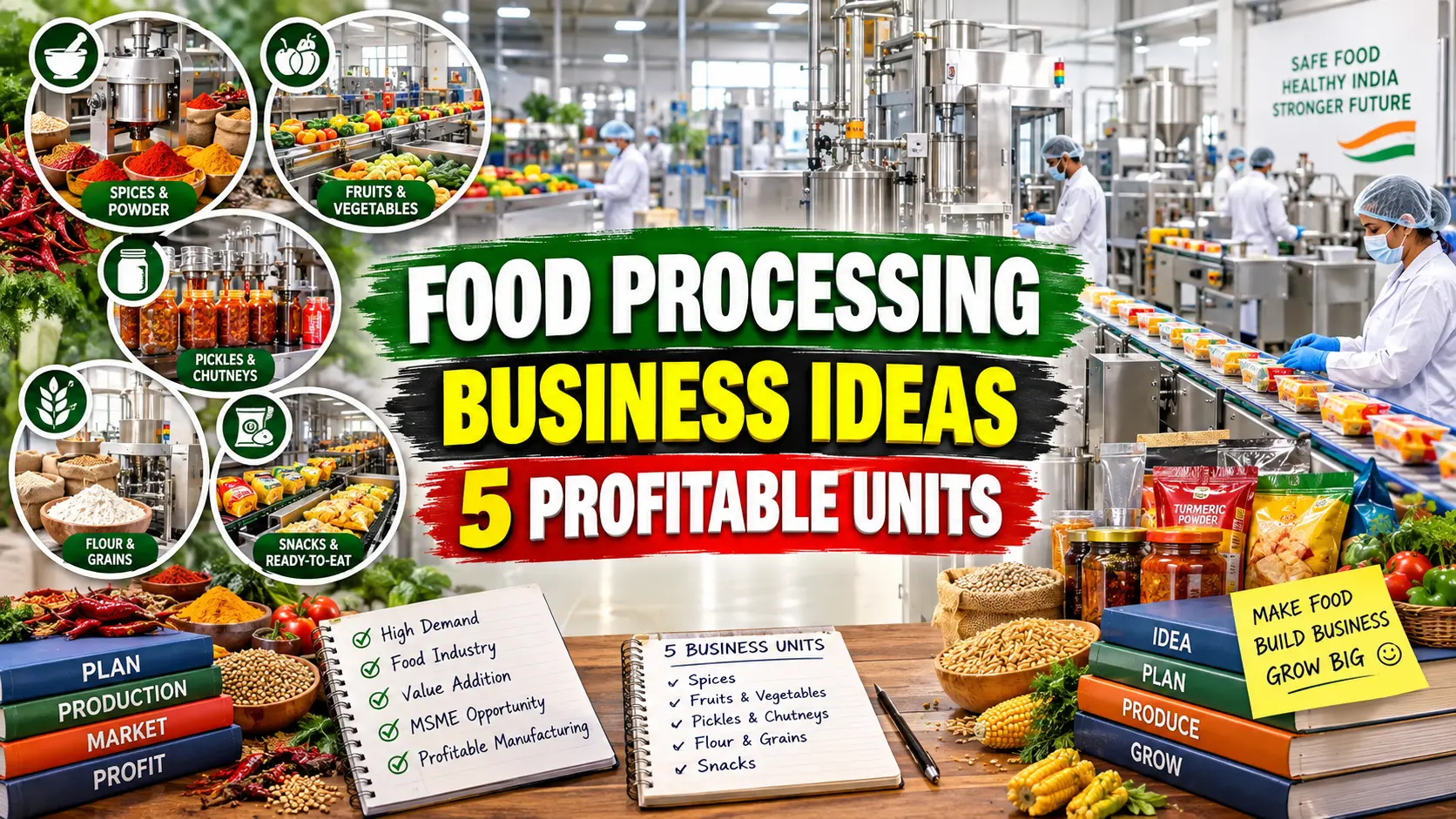
A consultant-style feasibility view of where the real money sits in Indian food processing.
India produces more food than most countries on earth, but surprisingly, much of it does not see the finished shelf. This gap is where the smartest food processing business ideas are born. For a first-generation founder, the sector offers something rare: steady domestic demand, strong export pull, and government money waiting to be claimed. When I sit with new promoters during feasibility discussions, I keep returning to one point. Food will always be bought, so the question is never whether to enter, but which processed product gives the best margin for the capital involved.
This article looks at that question as a project consultant would. We will weigh demand, policy support, and practical unit models, then map out real trade opportunities and lessons from Indian founders who built serious businesses from modest beginnings.
Why Food Processing Is a Smart Sector to Enter
Demand That Rarely Slows Down
Food processing sits on a base of unshakeable demand. Urban households buy more packaged, ready, and semi-cooked food every year. Meanwhile, rural incomes are slowly shifting spending towards branded staples. Because of this dual pull, even a small unit can find buyers quickly.
India also processes only a modest fraction of its produce compared to developed markets. Therefore, the headroom is enormous. A founder who converts perishable raw material into a longer-life product captures value that would otherwise rot in the field. This single conversion, from farm surplus to shelf-ready goods, is the heart of the business case.
Export Potential Adds a Second Engine
Beyond the home market, Indian spices, snacks, frozen vegetables, and ready meals travel well. Global buyers increasingly want traceable, competitively priced supply, and India fits this brief. As a result, a well-run unit can serve both local retail and export orders, smoothing seasonal dips. You can review sector data through the Ministry of Food Processing Industries and export figures via APEDA.
Government Policies and Incentives You Can Actually Use
Policy support here is unusually generous, and many founders leave it unclaimed simply as they don’t check. The Pradhan Mantri Kisan SAMPADA Yojana funds cold chains, food parks, and processing infrastructure. Additionally, the Production Linked Incentive scheme for food processing rewards scale and branded exports.
Smaller promoters should look at the PM Formalisation of Micro Food Processing Enterprises (PMFME) scheme which offers credit-linked subsidy and hand-holding for micro units. General MSME benefits apply too and registration through Udyam unlocks collateral-free loans and priority lending. For agri-cluster support, several states run their own portals, such as Maharashtra Industry, Trade and Investment.
5 Food Processing Business Ideas for Startups
Idea 1 — Fruit and Vegetable Dehydration Unit
Dehydration turns a glut of tomatoes, onions, or bananas into powders and flakes which sell all year. The logic is simple and powerful. Fresh produce crashes in price during harvest, but dried products command stable, premium rates. Because dried goods weigh less and store longer, both transport and spoilage costs fall. A founder can start with a modest tray or spray dryer and scale as orders grow. Buyers include snack makers, spice blenders, and restaurants, so the customer base is wide. Also, export demand for onion and garlic powder is consistent, giving the unit a reliable second channel from the outset.
Idea 2 — Ready-to-Cook and Ready-to-Eat Meals
Time-pressed urban families now treat ready meals as a staple, not a treat. A unit producing frozen parathas, curry bases, or heat-and-eat rice bowls taps a fast-growing habit. Margins reward good branding and consistent taste, far more than heavy machinery. Therefore, a founder with strong recipes and clean processing can outcompete larger, slower rivals. The trick lies in shelf life and cold-chain discipline, where SAMPADA funded cold storage pays for itself. Over time, a small line can expand into regional cuisines, catering packs, and private-label orders for retail chains, adding volume in each step.
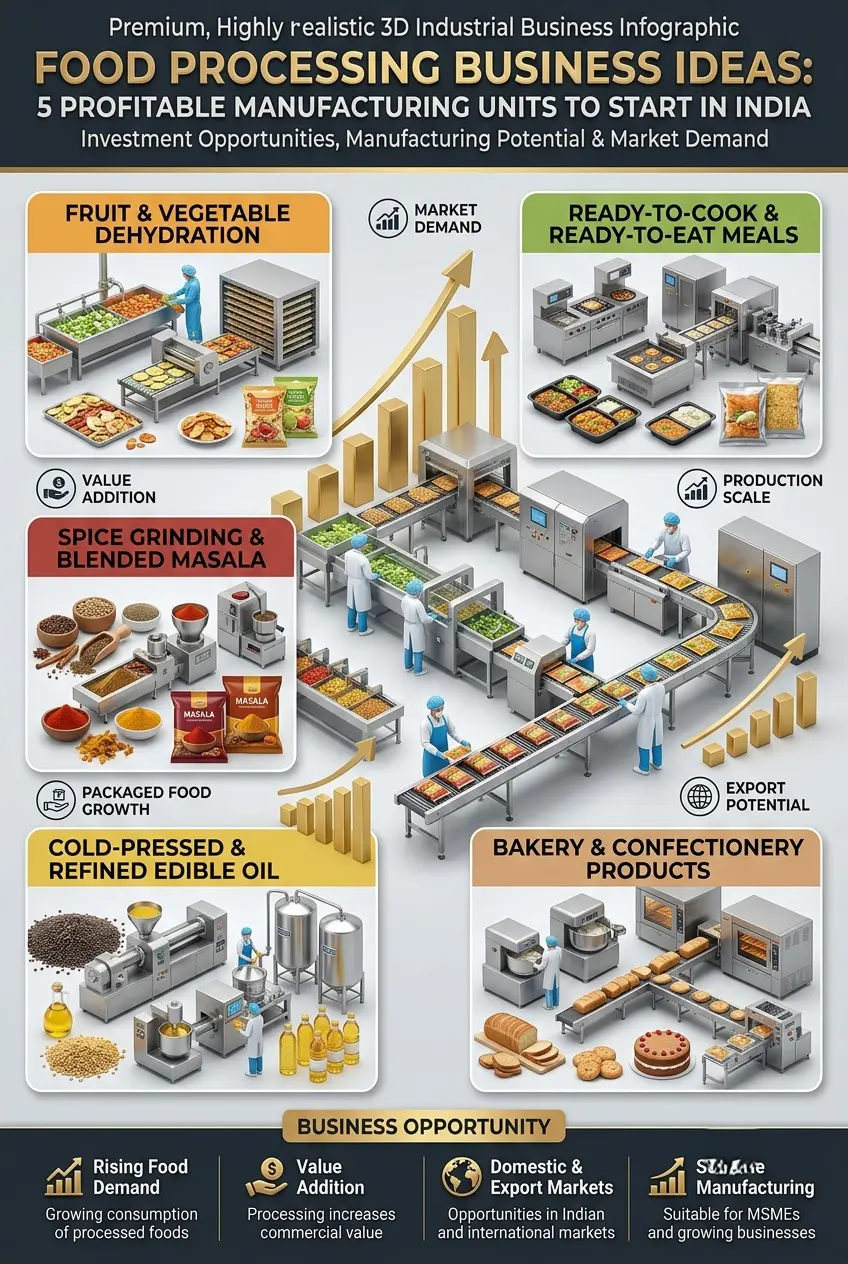
Idea 3 — Spice Grinding and Blended Masala
India runs on spice, and branded masala remains one of the most trusted routes to a durable food business. A grinding and blending unit need manageable capital but enjoys deep, repeat demand. Because taste loyalty is strong, a consistent blend builds a customer base that rarely switches. Hygienic packaging and honest labelling matter more than flashy marketing here. Founders can begin with regional signature blends and then widen the range as trust grows. Furthermore, spice exports open premium markets abroad, and clean sourcing lets small brand claim quality credentials which command better prices.
Idea 4 — Cold-Pressed and Refined Edible Oil
Edible oil sits in every kitchen, making it one of the steadiest food categories to manufacture. A cold-pressed unit for groundnut, mustard, or coconut oil appeals to health-conscious buyers willing to pay more. The product is a daily essential, with stable sales through economic ups and downs. Local sourcing of oilseeds keeps raw material costs predictable and supports nearby farmers. Founders should focus on purity claims and clean bottling as these drive repeat purchase. As the brand matures, byproducts like oil cake sell to the animal feed trade, adding a revenue stream.
Idea 5 — Bakery and Confectionery Products
Bakery demand keeps climbing as snacking habits spread across towns and cities. A unit making cookies, rusks, or packed cakes can start small and grow steadily on local distribution. The category rewards taste, freshness and reliable supply to shops. Because ingredients are widely available, a founder can control quality tightly. Consistent output and attractive, affordable packs help a new brand gain shelf space quickly. In addition, festival and gifting seasons deliver sharp demand spikes, and a nimble unit which plans production well can lift margins significantly during peak months.
Import–Export Opportunity Analysis
Trade flows shape the smartest entry points. India exports spices, processed fruit, and snacks in rising volumes, but also imports high-value ingredients and specialty additives. A founder can position a unit to ride the export wave and sometimes substitute costly imports with local production. For example, dried and frozen vegetables face strong overseas demand, giving small exporters a foothold.
Export readiness does require discipline on standards and documentation. Certification through the Food Safety and Standards Authority of India (FSSAI) and market intelligence from APEDA help a new brand meet buyer expectation. Consequently, a unit built with export norms in mind from day one avoids costly retrofits later.
Indian MSME Success Stories Worth Studying
Consider Haldiram’s, built by the Agarwal family from a single Bikaner shop into a snack empire. Their model rested on consistent taste and relentless distribution, not chasing every trend. The lesson is clear: a narrow, well-made product range can beat a scattered menu.
MTR Foods, founded in Bengaluru, turned restaurant recipes into ready-mix and ready-to-eat products. Its promoters read the shift towards convenience early and built trust through quality. Similarly, ID Fresh Food, started by P.C. Musthafa with a tiny batter unit, scaled by keeping the product fresh, honest and preservative-free. The shared thread for new founders is focus, quality, and patient distribution rather than quick expansion.
About NPCS
We at Niir Project Consultancy Services (NPCS) provide professional consulting for the preparation of Market Survey cum Detailed Techno-Economic Feasibility Reports (DPRs) for setting up new industries or businesses. Our reports include detailed manufacturing processes, market research and demand analysis, process flow diagrams, product mix and capacity planning, machinery and raw material details, and complete project financials with profitability analysis. Our objective is to help entrepreneurs evaluate feasibility, profitability and long-term scalability before investing.
NPCS has published a comprehensive printed reference book on food processing, covering technology, market analysis, investment parameters, and manufacturing processes in depth — the printed book: 55 Most Profitable Micro, Small and Medium Scale Food Processing (Processed Food) Projects and Agriculture Based Business Ideas for Startup (2nd Edition)
For a detailed techno-economic Project Report on setting up a manufacturing business in this sector — including plant economics, machinery lists, financial projections, and government incentives — the NPCS Project Report: Explore the Complete Pulses & Dates Food Processing Guide
Indicative Project Snapshot
| Business Idea | Approx. Investment (₹) | Demand Outlook | Export Scope |
| Fruit & Vegetable Dehydration | 20–60 lakh | High | Strong |
| Ready-to-Cook / Ready-to-Eat | 40 lakh–1.5 crore | Very High | Moderate |
| Spice Grinding & Blending | 15–50 lakh | High | Strong |
| Cold-Pressed Edible Oil | 25–75 lakh | Steady | Moderate |
| Bakery & Confectionery | 10–40 lakh | High | Low–Moderate |
Figures are indicative planning ranges and vary with capacity, location, and automation level.
Conclusion
Food processing rewards founders who combine practical recipes with disciplined operations and smart use of policy. The demand is durable, the schemes are real, and the export door is open. Therefore, the entrepreneurs who win are those who pick one strong product, master its quality, and build distribution patiently. A well-prepared feasibility report turns this into a fundable, bankable plan.
Your Investment Deserves the Right Opportunity
Every serious investment begins with choosing the right sector and a right business model. With hundreds of industrial opportunities available across India’s manufacturing and clean-energy landscape, making the most informed choice is critical. Niir’s Startup Selector tool helps entrepreneurs, MSMEs, and investors identify the most suitable business opportunities for their investment, location, and interests — directing your capital towards a venture with the strongest fit and potential. Explore your best-fit business opportunity today.


