

• Latest
  • Trending
  • All
GRC Manufacturing Business in India: Investment, Market.

GRC Manufacturing Business in India: Facade Panels, Decorative Products, Investment and Market Opportunities

September 20, 2026
Maize Starch Manufacturing: Business, Plant Cost

Why Maize Starch Is Becoming a High-Potential Manufacturing Business

September 20, 2026
गांव में Business Ideas और ग्रामीण उद्यमिता के अवसर

गांव में शुरू करें ये 7 Business Ideas और हर महीने कमाएं ₹50,000 — कम निवेश, ज़्यादा मुनाफा

September 19, 2026
Project & Profile
Solar Business Ideas in India: 5 Profitable Manufacturing

5 Solar Business Ideas: Profitable Manufacturing and Service Units in India

September 19, 2026
Food Processing Business Ideas: 5 Profitable Units

Food Processing Business Ideas: 5 Profitable Manufacturing Units to Start in India

September 19, 2026
Chemical Business Ideas in India: 5 High Manufacturing Units

5 Chemical Business Ideas: High-Margin Manufacturing Units to Start in India

September 19, 2026
Ferro Alloy Manufacturing Business in India: Opportunities

India’s Steel Surge Is Creating a New Wave of Opportunities for the Ferro Alloy Sector

September 18, 2026
बिना किसी गारंटी के सरकार दे रही ₹50 लाख

बिना किसी गारंटी के सरकार दे रही ₹50 लाख तक का बिज़नेस लोन, जानिए कैसे करें क्लेम?

September 18, 2026
2027 में कभी न बंद होने वाले 5 बिज़नेस आइडियाज

2027 में कभी न बंद होने वाले 5 बिज़नेस आइडियाज: कम लागत में शुरू करके बनाएं बड़ी कंपनी

September 18, 2026
Compressed Biogas CBG Plant in India: Government Schemes

India’s Compressed Biogas Revolution: Why Animal and Agricultural Waste Could Fuel the Next Wave of Rural Manufacturing Opportunities

September 17, 2026
Goat Farming Business Loan Detail

बकरी पालन बिज़नेस लोन कैसे ले | Goat Farming Business Loan Detail

September 15, 2026
Biomass Gasification Business in India: Syngas, Methanol

Business Ideas in Biomass-Derived Syngas, Methanol, Hydrogen & DME: From Farm Waste to Clean Fuel

September 13, 2026
OFC Copper Rod Manufacturing: Business Ideas & Investment

OFC Copper Rod (Oxygen-Free Copper Grade): Business Ideas, Manufacturing Opportunity & Investment Guide for Indian Entrepreneurs

September 13, 2026
  • About
  • Advertise
  • Privacy & Policy
  • Contact
Sunday, September 20, 2026
  • Login
Entrepreneur India Blog
  • Home
  • About
  • Books
  • Business Ideas
  • Contact
No Result
View All Result
Entrepreneur India Blog
No Result
View All Result
Home Manufacturing Business Ideas for Startups

GRC Manufacturing Business in India: Facade Panels, Decorative Products, Investment and Market Opportunities

by P.K. Chattopadhyay
September 20, 2026
in Manufacturing Business Ideas for Startups, Industrial Project Reports Business Guide
0
GRC Manufacturing Business in India: Investment, Market.

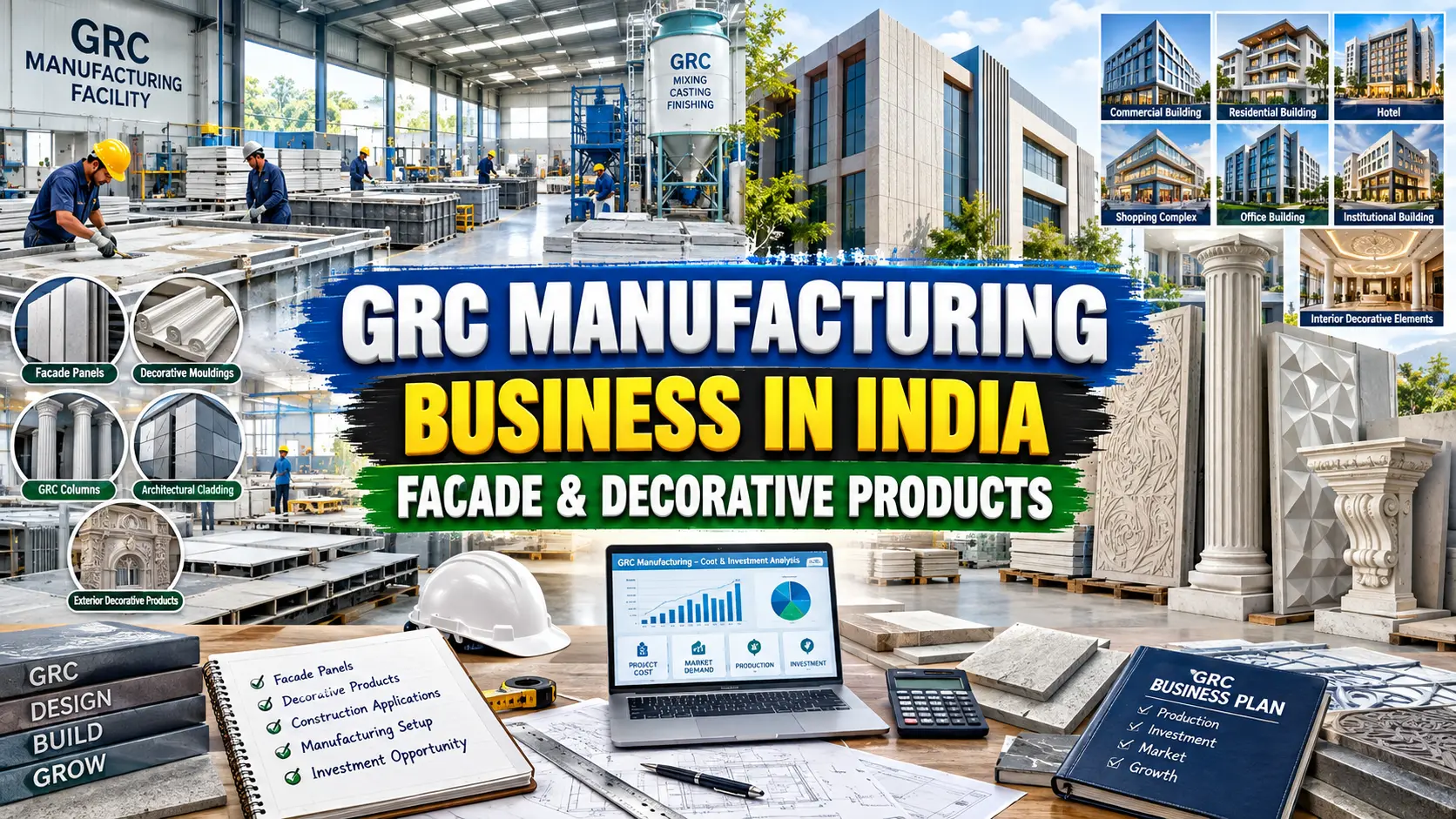
GRC facade panels and decorative products manufacturing opportunities in India

492
SHARES
1.4k
VIEWS
Share on FacebookShare on Twitter

GRC Manufacturing Business in India

India’s construction boom has created a lucrative opportunity for Glass Reinforced Concrete manufacturers, an emerging business that is relatively underserved in the construction materials space. Architects are specifying it for light-weighted facades, Jaali’s, cladding panels and decorative elements as it blends the ductility of concrete with significantly reduced weight compared to cast concrete. With a background in construction materials and precast fabrication, GRC manufacturing provides healthy margins to entrepreneurs who can secure clients across large developers and premium villa builders.

Table of Contents

Toggle
  • Why Glass Reinforced Concrete Is a Smart Business Idea Right Now
  • Government Policies & Incentives
  • Multiple Manufacturing Business Ideas for Startups
  • Import–Export Opportunity Analysis
    • Market Outlook & Scaling Roadmap
    • Skills, Manpower & Quality Control
  • Indian MSME Success Stories
    • RDC Concrete (India) — Raja Seetharaman
    • Pidilite Industries — Balvant Parekh
  • How NPCS Can Help Entrepreneurs Evaluate the Opportunity
  • Common Pitfalls to Avoid
  • Conclusion
  • Your Investment Deserves the Right Opportunity
    • Frequently Asked Questions

Why Glass Reinforced Concrete Is a Smart Business Idea Right Now

Urban construction has gravitated towards faster and lighter building methods, and GRC fits this trend as it can be moulded into intricate architectural shapes while remaining significantly lighter than solid concrete. Developers opt for it for high-rise facades where structural load is a concern, and for heritage-style projects, it is utilised for ornamental jaalis and cornices that would otherwise use prohibitively expensive natural stone. With very few organised GRC manufacturers outside of a few metro clusters, regional players can capture a market simply by offering faster turnaround and reduced freight cost than distant suppliers.

Government Policies & Incentives

GRC manufacturing qualifies for standard MSME manufacturing incentives, including collateral-free credit guaranteed through schemes coordinated by the Ministry of MSME, and technical guidance on mix design and testing from the Central Building Research Institute. As affordable and mass housing missions continue to lean towards prefabricated and lightweight construction systems, state housing boards are increasingly preferring vendors who can supply certified precast components, which favours GRC units willing to invest in BIS-aligned quality testing from the outset. Several state industrial policies also classify GRC and precast building material manufacturing under priority sectors for MSME land allotment, which can significantly reduce upfront land acquisition cost in designated industrial estates.

Multiple Manufacturing Business Ideas for Startups

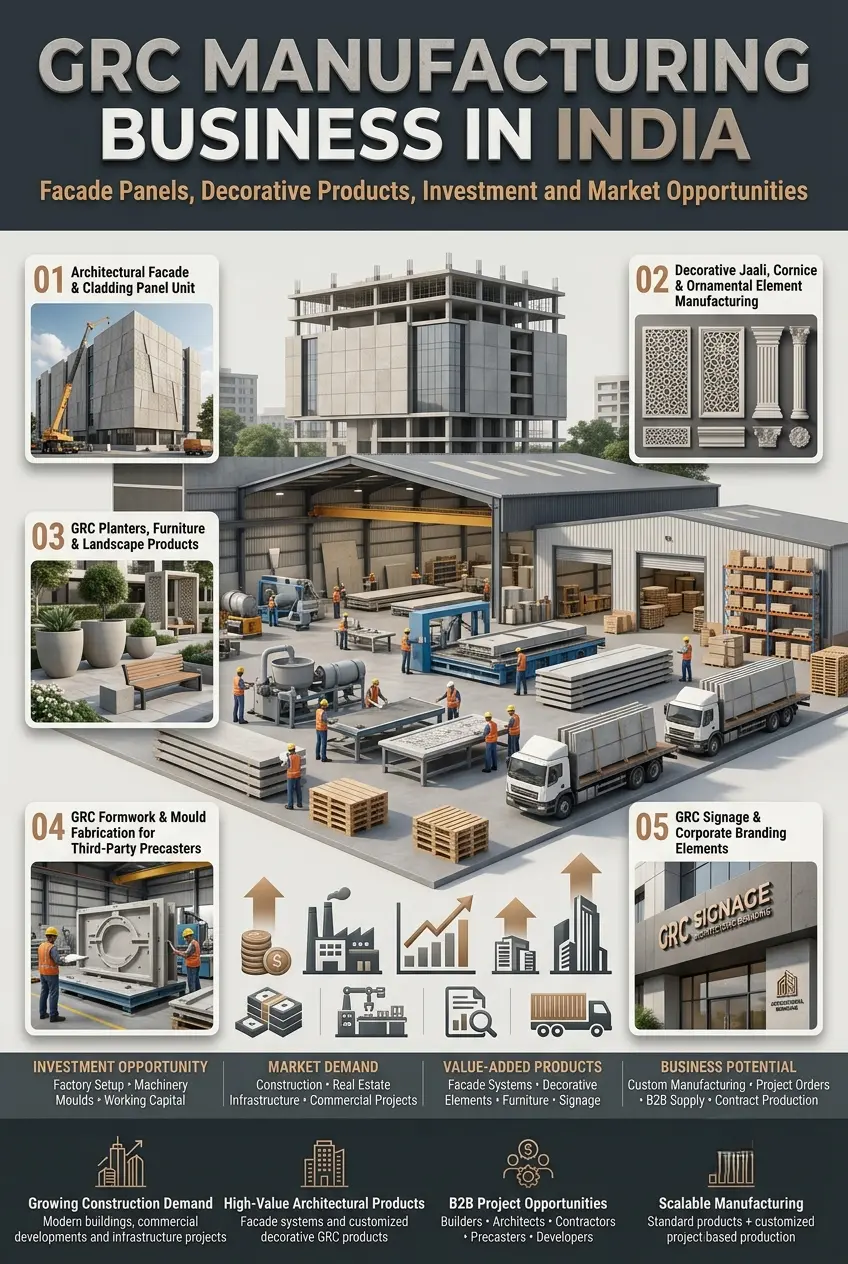
Architectural Facade & Cladding Panel Unit

Facade cladding is the single largest demand driver for GRC today, as commercial towers and premium residential projects are seeking lightweight and weather-resistant exteriors that can be moulded into custom architectural patterns. With an investment in a good mould-making workshop, a manufacturer can serve multiple projects from the same base moulds with variations, and unit economics remains attractive when a client base of architects and contractors is established.

Decorative Jaali, Cornice & Ornamental Element Manufacturing

Heritage-influenced and Indo-Islamic architectural styles continue to dominate residential and hospitality projects, and GRC replicates carved stone jaalis and cornices at a fraction of natural stone’s cost and weight. This niche rewards founders who build a design catalogue and work closely with architects during the design stage, as ornamental orders tend to carry better margins than plain structural panels.
GRC Manufacturing Business in India with Facade Panels
GRC facade panels and decorative products manufacturing opportunities in India

GRC Planters, Furniture & Landscape Products

Outside of building facades, GRC’s light weight and moulding flexibility are suitable for outdoor planters, benches and landscape features for hotels, corporate campuses and public spaces. This segment allows for smaller-batch production with lower mould investment than large facade panels, making it a practical starting point for entrepreneurs to test the category before committing to full architectural-scale manufacturing.

GRC Formwork & Mould Fabrication for Third-Party Precasters

As custom mould-making is the single biggest bottleneck for most GRC manufacturers, a business specialised in fabricating reusable fibreglass and silicone moulds for other precasters can leverage a steady, high-margin service line. This model is suited for founders with a design or pattern-making background who prefer serving the industry’s production backbone rather than directly competing on finished panels.

GRC Signage & Corporate Branding Elements

Beyond building components, GRC’s mouldability is suitable for large-format corporate signage, monument markers and decorative branding elements for commercial campuses and public infrastructure projects. This niche offers smaller, faster-turnaround orders that complement larger architectural facade contracts, helping a manufacturer stay busy between big project cycles.

Import–Export Opportunity Analysis

GRC’s raw material base is largely domestic, so this business has limited import dependence except for speciality fibre in some cases. Export opportunity exists mainly through supplying prefabricated components to Gulf and Southeast Asian construction markets, where Indian precast manufacturers have already built credibility, facilitated in part through trade facilitation by the Federation of Indian Chambers of Commerce and Industry.

Market Outlook & Scaling Roadmap

Facade cladding demand in India’s commercial and high-rise residential segments continues to grow steadily as developers seek lighter, faster-to-install alternatives to conventional precast concrete. A regional GRC manufacturer who starts with a strong architect network in one metro or tier-two city can typically expand into adjacent cities within two to three years by utilising its mould library and applying it to new project geometries, rather than starting mould development from zero each time.

Skills, Manpower & Quality Control

GRC manufacturing is rewarding hands-on craftsmanship as much as engineering knowledge, given that mould-making and spray-lay-up application quality directly determine whether panels crack or hold their shape over decades. Skilled mould-makers are relatively scarce, so early investment in training or recruiting from adjacent industries like fibreglass boat-building or precast concrete can be worthwhile. A small unit typically needs 12 to 18 workers spanning mixing, spraying, curing and finishing, with one experienced supervisor overseeing mix consistency and cure timing across all active moulds.

Indian MSME Success Stories

RDC Concrete (India) — Raja Seetharaman

Raja Seetharaman built RDC into a serious ready-mix and precast concrete player by focussing relentlessly on consistent quality control, an approach directly transferable to GRC manufacturing where mix consistency determines whether panels crack or perform for decades.

Pidilite Industries — Balvant Parekh

Balvant Parekh’s decades-long focus on construction chemistry and adhesives at Pidilite demonstrates a lesson relevant to GRC founders — investing in material science credibility, not merely production capacity, wins large institutional contracts.

How NPCS Can Help Entrepreneurs Evaluate the Opportunity

We at Niir Project Consultancy Services (NPCS) offer professional consulting for the preparation of Market Survey cum Detailed Techno-Economic Feasibility Reports (DPRs) for setting up new industries or businesses. Our reports include manufacturing processes, market research and demand analysis, process flow diagrams, product mix and capacity planning, machinery and raw material details, and complete project financials with profitability analysis. Entrepreneurs use these reports to evaluate a feasibility, profitability and scalability prior to investing, reducing guesswork at the most capital-intensive stage of a new venture.

For anyone evaluating Glass Reinforced Concrete, this groundwork is paramount prior to any capital commitment: NPCS studies work through machinery selection, raw material sourcing, plant layout, manpower planning and a complete financial model that covers capital cost, working capital, revenue projections and return on investment. Entrepreneurs approaching banks, NBFCs or state MSME schemes for financing typically need exactly this type of documented feasibility study, as lenders rarely fund a project on an idea alone. Working with an established consultancy also significantly shortens the learning curve, letting a first-time promoter benefit from patterns observed across hundreds of similar manufacturing projects by NPCS.

NPCS has published a comprehensive printed reference book on Glass Reinforced Concrete, covering technology and market analysis, investment parameters and manufacturing processes in detail — the printed book: The Complete Book on Cement & Concrete Products Manufacturing.

For a detailed techno-economic Project Report on setting up a manufacturing business in this sector — including plant economics, machinery lists, financial projections and government incentives — the NPCS Project Report: Glass Reinforced Concrete – Manufacturing Plant, Detailed Project Report.

Common Pitfalls to Avoid

Many new GRC manufacturers underinvest in mould-making capability, assuming that a single generic mould can serve multiple projects, only to find that architects consistently want custom geometry that generic moulds cannot deliver. Another common error is rushing curing schedules to speed up delivery, causing cracking that damages reputation far more than a slightly longer lead time would have.

Conclusion

GRC manufacturing rewards entrepreneurs who treat mould design and quality testing as core competencies rather than back-office tasks. As states such as Tamil Nadu Guidance Bureau are pushing prefabricated construction, regional GRC units that build strong architect relationships are well positioned for steady, recurring project work.

Your Investment Deserves the Right Opportunity

Every serious investment begins with choosing the right sector and the right business model. With hundreds of industrial opportunities available across India’s manufacturing and clean-energy landscape, making the most informed choice is critical. NPCS Startup Selector tool helps entrepreneurs, MSMEs, and investors identify the most suitable business opportunities based on their investment capacity, location, and interests — so your capital is directed toward a venture with the strongest fit and potential.

Frequently Asked Questions

What raw materials are needed for GRC manufacturing? +
A: Cement, alkali-resistant glass fibre, fine silica sand, water-reducing admixtures, and moulds form the core raw material and equipment base.
How much investment is needed to start a small GRC unit? +
A: A basic manufacturing setup with moulding and curing facilities typically starts around ₹1–1.5 crore.
Who are the main customers for GRC products? +
A: Real estate developers, architects, hospitality projects, and government housing schemes are the primary customer base.
Is GRC manufacturing eligible for MSME loans? +
A: Yes, it qualifies under standard MSME manufacturing credit schemes, including collateral-free loan guarantees.
What skills does a GRC business require? +
A: Mould-making expertise, mix-design knowledge, and quality-control discipline are the most important operational skills.
Can GRC replace natural stone in ornamental work? +
A: Yes, GRC replicates carved stone finishes at significantly lower weight and cost, making it popular for facades and jaalis.
How long does it take to set up a GRC unit? +
A: A small unit can typically be operational within four to six months, including mould fabrication and curing yard setup.
Is there export demand for GRC components? +
A: Yes, particularly for Gulf and Southeast Asian construction markets seeking cost-competitive prefabricated cladding.
What is the typical profit margin in GRC manufacturing? +
A: Margins vary by product complexity, but ornamental and custom facade work generally earns higher margins than plain structural panels.
Does GRC require special curing facilities? +
A: Yes, controlled curing conditions are essential to prevent cracking and to ensure long-term durability of finished panels.
How many times can a GRC mould be reused? +
A: A well-maintained fibreglass mould can typically produce several hundred castings before it needs refurbishment, depending on design complexity and release-agent practice.
Is GRC suitable for exterior use in all climates? +
A: Yes, properly cured GRC with correct fibre content performs well across most Indian climate zones, though coastal installations need additional corrosion-resistant detailing.
What is the shelf life of alkali-resistant glass fibre? +
A: Stored correctly in a dry environment, AR-glass fibre rovings generally remain usable for one to two years without significant degradation.
Can GRC panels be painted or textured after casting? +
A: Yes, GRC accepts most masonry paints and can also be cast with integral surface texture or pigment for a finished look without additional coating.
How does GRC compare in cost to natural stone cladding? +
A: GRC is typically significantly cheaper than natural stone cladding of comparable visual complexity, while also being far lighter and faster to install.
What is the typical lead time for a custom facade order? +
A: Custom facade orders typically take six to ten weeks from mould finalisation to delivery, depending on panel complexity and quantity.
Where can skilled GRC mould-makers be recruited from? +
A: Fibreglass boat-building, precast concrete, and sculpture or pattern-making backgrounds all transfer well into GRC mould-making roles.
How many workers does a small GRC unit typically employ? +
A: A small unit typically employs 12 to 18 workers across mixing, spraying, curing, and finishing operations.
Does curing temperature affect panel quality significantly? +
A: Yes, inconsistent curing temperature and humidity are among the most common causes of cracking and warping in finished GRC panels.
Are land incentives available specifically for this sector? +
A: Some states classify precast building material manufacturing as a priority sector for MSME industrial land allotment, improving access and pricing.
Is it a mistake to rely on generic, non-custom moulds? +
A: Yes, since architects consistently specify custom geometry, and a manufacturer without flexible mould-making capability loses these higher-value projects.
What happens if curing time is rushed to meet deadlines? +
A: Rushed curing is a leading cause of cracking and warping, which damages reputation more severely than a modestly longer delivery timeline.
How important is architect relationship-building for a new entrant? +
A: Very important, since architects specify materials early in a project and repeat business depends heavily on trust built through prior work.
Tags: Glass Reinforced ConcreteGRC Facade PanelsGRC ManufacturingGRC Manufacturing BusinessGRC Manufacturing PlantGRC Project Report
Share197Tweet123
Previous Post

गांव में शुरू करें ये 7 Business Ideas और हर महीने कमाएं ₹50,000 — कम निवेश, ज़्यादा मुनाफा

Next Post

Why Maize Starch Is Becoming a High-Potential Manufacturing Business

P.K. Chattopadhyay

P.K. Chattopadhyay

P. K. Chattopadhyay is a seasoned Project Consultant with over 45 years of hands-on experience in project consultancy across diverse industries. He has guided hundreds of companies and entrepreneurs through project planning, feasibility studies, and industrial setup — turning business ideas into practical, scalable ventures. A prolific author of business and startup-focused books, P. K. Chattopadhyay brings together real-world industry data, actionable insights, and proven execution strategies tailored for entrepreneurs and investors at every stage of their journey. His core expertise spans manufacturing projects, market analysis, and business viability assessment — making his work an indispensable resource for anyone building a sustainable and profitable business from the ground up.

Next Post
Maize Starch Manufacturing: Business, Plant Cost

Why Maize Starch Is Becoming a High-Potential Manufacturing Business

Leave a Reply Cancel reply

Your email address will not be published. Required fields are marked *

Contact Us

    Categories

    • Agri Business Opportunities
    • Business Ideas
    • Chemical Industry Business Opportunities
    • Cosmetics and Personal Care Business
    • Eco Friendly Sustainable Business
    • Entrepreneurship Leadership and Startup Growth
    • FMCG Consumer Products Business
    • Food Processing Business Industry
    • Future & Emerging Industries
    • Government Schemes Policies for Business
    • Import Export Business Opportunities
    • Industrial Project Reports Business Guide
    • Investment Funding for Startups
    • Manufacturing Business Ideas for Startups
    • Market Research Trends for Business
    • MSME & Small-Scale Industries
    • Paper Pulp Industry Business
    • Pharmaceutical Industry Business
    • Plastic & Packaging Business
    • Renewable Energy Startups
    • Startup Business Opportunities
    • Startup Business Planning and Strategy
    • Technology & Automation Business
    • Textile Industry Business
    • Uncategorized
    • Waste Management & Recycling Business
    • Water & Environmental Business
    Entrepreneur India Blog

    Copyright © 2026 Entrepreneur India

    Navigate Site

    • About
    • Advertise
    • Privacy & Policy
    • Contact

    Follow Us

    Welcome Back!

    Login to your account below

    Forgotten Password?

    Retrieve your password

    Please enter your username or email address to reset your password.

    Log In
    No Result
    View All Result
    • Home

    Copyright © 2026 Entrepreneur India

    Not enough quota to unlock this post
    Unlock left : 0
    Are you sure want to cancel subscription?