





Agro Processing Business Ideas
India has one of the most untapped business opportunities in the country, where the farming community is involved. A lot of farmers sell raw produce in the field for a low price, and many are finding the money they can make isn’t in the field — it’s in the processing unit right beside it. These business ideas are practical and not theoretical. They are practical examples and backed by the government, increasing domestic demand and India’s growing appetite for exports.
These are the costliest inputs for any agro-processing manufacturing business; if you are an agricultural land owner, you have the most expensive of all raw materials in your hands: location, raw material proximity and space. You need the right processing venture that is right for your crop, your area, and your investment dollars.
Why Agro-Processing Manufacturing Is the Smartest Move for Farmers Today
In the Indian context, it is estimated that 16-18% of the agricultural produce is lost due to the post-harvest inefficiencies each year. That number is not only food waste; it’s huge unrealised value. This is an area that the government has acknowledged. The Ministry of Food Processing Industries has allocated thousands of crores for the construction of agro processing clusters, cold chains and value addition units in rural areas under Pradhan Mantri Kisan Sampada Yojana (PMKSY).
Farmers that set up processing units close to the raw material supply have an inherent cost advantage over the manufacturing units in cities. On-farm processing is very competitive due to reduced logistical costs, farm sourcing and availability of farm labour. Furthermore, agri-products, when processed, have much higher margins, sometimes 3-5 times the farm-gate price.
Government Policies and Incentives Supporting Farm-Based Manufacturing
The Indian Government has laid a robust policy framework to promote farm-based processing industries. Credit Linked Subsidy Scheme for Micro Food Processing Enterprises (PM Formalisation of Micro Food Processing Enterprises) is a credit linked subsidy scheme for the individual micro food processing units, capped at ₹ 10 lakh per unit. Farmer Producer Organisations (FPOs) and Self Help Groups (SHGs) are supported with extra grant funds.
This is because the Ministry of MSME has set up the Credit Guarantee Fund Trust for Micro and Small Enterprises (CGTMSE) which allows loans without collateral for small processing units. PLI Scheme for Food Processing provides production-linked incentives to larger units as well. The Pradhan Mantri Kisan Sampada Yojana, which includes the development of cold chain and agro-processing clusters, and integrated cold chain support, are all directly relevant for the farmers who would like to add value in their own farms.
This is an industry with structural long-term demand as confirmed by IBEF data where India’s food processing industry is one of the largest by volume in the world, irrespective of short-term market cycles. Invest India’s agriculture and food processing sector of the brief outlines the huge potential of value addition, especially in cereals, pulses, oilseeds and horticultural crops.
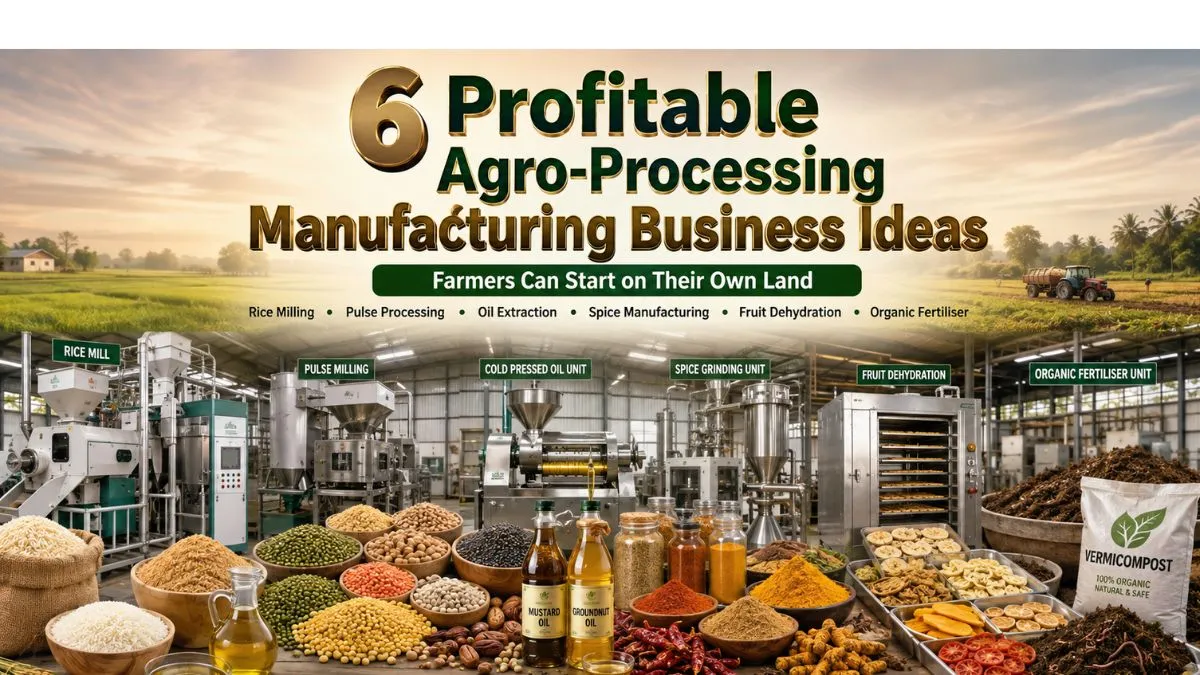
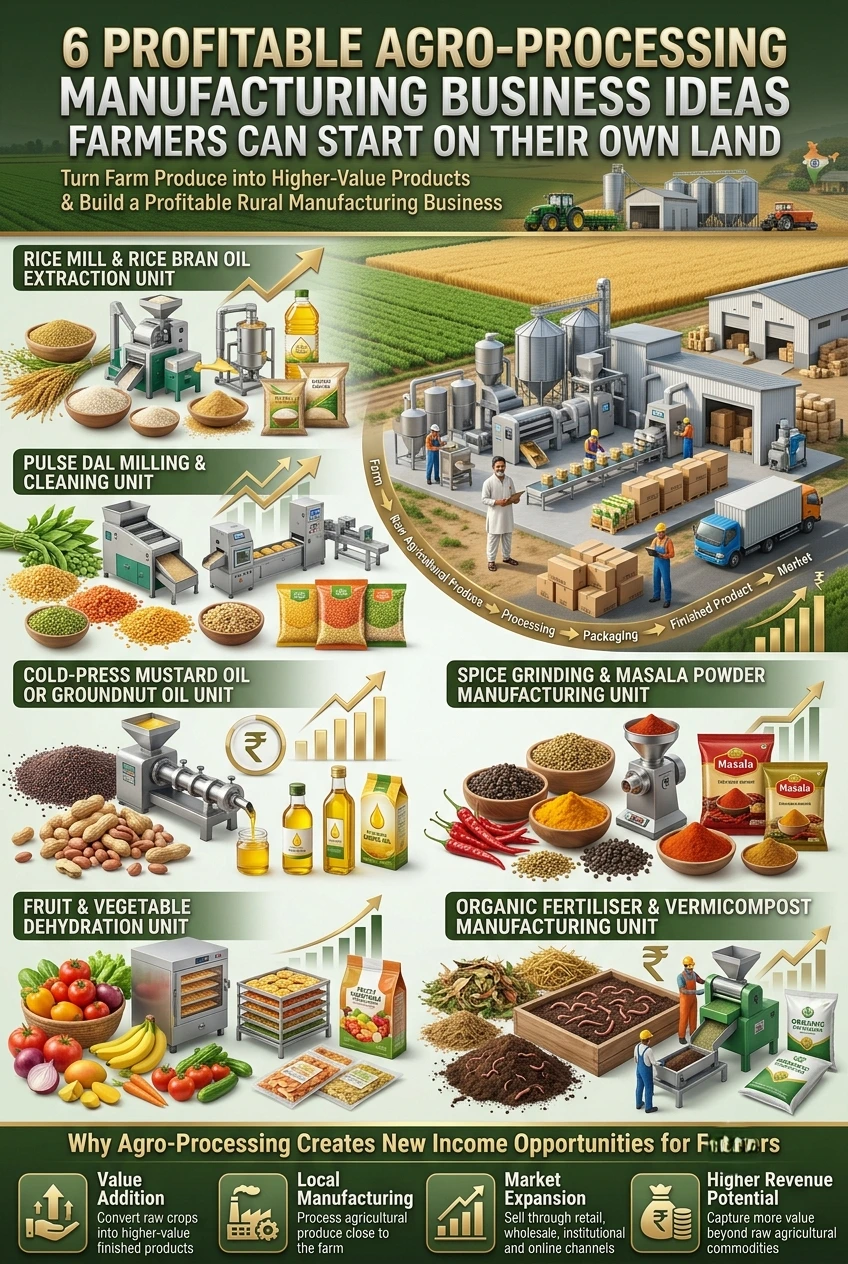
6 Manufacturing Business Ideas Farmers Can Start on Their Own Land
1. Rice Mill and Rice Bran Oil Extraction Unit
Notably, the most natural point for the paddy farmers is the rice milling. A modern rice mills not only dehusk rice, it can also process parboiled rice, broken rice for industrial purposes, rice bran for extracting oil, and husk for fuel and silica production. The true business intelligence is in the value chain. Rice bran, a by-product of the milling process, is easily sold in the small mills and is 15-22% oil. The domestic and export demand for this rice bran oil is high because it is a healthy and high smoke point cooking oil.
A farmer can set a rice bran oil extraction unit, which can be a small one, along with his paddy field and rice mill to tap rice bran oil that could otherwise be lost. The investment is moderate; the technology is proven and the market for rice bran oil is expanding rapidly both in retail and food service applications. In addition, de-oiled bran is used as a high protein cattle feed, thus generating a further income from the same raw material.
Get Detailed Project Report (DPR): Rice Mill & Rice Bran Oil Integrated Unit – Complete Project Report
2. Pulse Dal Milling and Cleaning Unit
India is the largest producer and consumer of pulses in the world. However, a large proportion of the area for production of pulses is located in areas where no local milling facility is available. The farmers who cultivate tur, chana, moong and urad dal are unable to get dal mills and so they sell raw grain at a low price. A pulse milling and cleaning plant on the farmland addresses this supply chain gap at the source. A modern dal mill dehusks, splits, polishes and packages dal pulses with added value at every stage. Processed split dal is sold at a premium than raw grain.
Also the by-products of the pulse husks are fed to cattle, thus providing extra income. The preference of protein-rich diet among the Indian populace is increasing and the Government’s initiative to promote pulses cultivation and processing under the National Food Security Mission also makes this a business with a stable demand for a food of prime necessity.
View Full Project Details: Dall Mill Manufacturing Business Guide
3. Cold Press Mustard Oil or Groundnut Oil Unit
Edible oil processing is one of the most promising agro-processing enterprises for oilseed growers in Rajasthan, Madhya Pradesh, Haryana, Gujarat and Maharashtra. A cold press extraction unit extracts a traditionally extracted oil which fetches premium prices, especially from the health-conscious people, living in urban and semi-urban areas, who prefer oils that are extracted in traditional ways like wood pressing or cold pressing than refined oils. Here’s a perfect business model for a farmer that grows the oilseed, presses it direct on farm, sells the oil in branded, cold-pressed state, and sells the oil cake as high value animal feed, or organic fertiliser.
The one thing that really makes the difference is branding. There are 30-50% premiums available for farmers investing in basic packaging and building a regional brand. APEDA’s export promotion for edible oil products also provides export market access for registered processors.
Access Complete Business Plan: Mustard Oil
4. Spice Grinding and Masala Powder Manufacturing Unit
India produces nearly 70% of the world’s spices. Yet, a huge number of spices reach the farm gate as raw form that accounts for only a portion of the MRP. An on-farm unit on spice grinding and masala powder making for growing states like Kerala, Rajasthan, Andhra Pradesh, and Karnataka enable farmers to cash on to the processing value added at their farm gate itself. Cleaning, drying, grinding, mixing and finally packaging in the form of masalas are main works in the unit, the finished goods like chili powder, turmeric, coriander could be packed and the masalas can be blended and packed with special names on its use.
The Spices Board of India provides grading, certification, and export facilitation services. A small grinder-packer operation has low capital requirements and high price realization once branded and distributed properly. This is one manufacturing business where the farm’s raw material advantage directly translates into processing profitability.
Get Detailed Insights from This Book: Handbook on Spices
5. Fruit and Vegetable Dehydration Unit
Post-harvest losses in fruits and vegetables in India are among the highest in the food industry. Dehydration is a scientifically proven, commercially viable solution. A dehydration unit removes moisture from produce, extending shelf life from days to months and reducing volume by 70–80% — dramatically cutting storage and transport costs. Dehydrated onion, garlic, tomato, green chilli, mango powder (amchur), and banana chips are all high-demand products with strong domestic and export markets. For a farmer growing vegetables or fruit on their land, a dehydration unit converts perishable surplus into shelf-stable, exportable products.
Dehydrated vegetables and spices have strong export demand in the Middle East, USA, and Europe. The APEDA commodity page for dehydrated products provides export market intelligence and buyer linkages. The technology is scalable — from a small solar dehydrator to a cabinet or tunnel dryer — making it accessible even for small farm holdings.
Read the Complete Book Here: Handbook on Fruits, Vegetables & Food Processing with Canning & Preservation
6. Organic Fertiliser and Vermicompost Manufacturing Unit
Every farm generates organic waste — crop residue, animal manure, kitchen waste, and agricultural by-products. To convert waste to good quality organic manure/vermicompost is a manufacturing type of business requiring very less capital, having waste product from farm as the raw-material, and selling of produced material back to the agriculture, having a good profit margin. Because there is a high growing demand for organic manure, due to Govt’s natural farming scheme – PKVY and PM Pranam, the certified organic compost sells at premium price by farmers to organic farming and horticulture farmers and nurseries in urban areas. The technical support is being provided by NCONF.
A vermicompost unit requires land (which the farmer already has), earthworm culture, and organic input material. With the right certification and packaging, vermicompost sells at 3x–5x the price of conventional chemical fertiliser per kilogram of nutrient equivalent.
Related Article: Setting Up a Fermented Organic Manure (FOM) Production Plant: A ₹2-Billion Import Substitution Opportunity
Import–Export Opportunity Analysis for Farm-Based Processors
India’s agro-processing sector has significant export headroom. Exports from the country include spices, vegetables (processed), rice, edible oils and organics products and sent to 150+ countries. Value addition to these items is still comparatively less than world norms. Farm based processors who are registered with APEDA with required export standards and who obtain the required FSSAI certification can have access to Government backed export promotion and facilitation activities like, participation in trade fair, buyer-seller meeting- buyer-exporter matching.
Export development and promotion programme undertaken by APEDA allows for finance provision against expenses on packing and branding and getting the certification required for the purpose of export to different countries. Countries in the Middle East, Southeast Asia, and Africa represent large markets for Indian processed agri-products — particularly organic and traditionally processed food products that carry a premium in global health-conscious markets.
Indian MSME Success Stories From Farm-Based Processing
Lijjat Papad started as a home-based food processing cooperative in Mumbai with seven women making papads on a rooftop. Today it is a ₹1,600 crore enterprise with thousands of worker-members across India. The lesson for farmers is clear: food processing at the grassroots level, with discipline, quality, and a co-operative model, can scale far beyond imagination. Patanjali’s rural procurement network demonstrates how agri-processing at source — buying raw herbs, spices, and grain directly from farmers and processing them into branded consumer products — creates enormous value at both ends.
Many of Patanjali’s processing units are located near agricultural clusters. Dharampal Satyapal Group’s Rajnigandha success in pan masala processing began with sourcing raw betel nuts and processing them with value addition — a model now replicated by dozens of small agri-processors across Maharashtra and Gujarat.
Discover scalable startups tailored to your goals
How NPCS Can Help You Set Up Your Farm-Based Processing Business
We at Niir Project Consultancy Services (NPCS) provide professional consulting for the preparation of Market Survey cum Detailed Techno-Economic Feasibility Reports (DPRs) for setting up new industries or businesses. Our reports include detailed manufacturing processes, market research and demand analysis, process flow diagrams, product mix and capacity planning, machinery and raw material details, and complete project financials with profitability analysis. Our objective is to help entrepreneurs evaluate feasibility, profitability, and long-term scalability before investing. For farmers planning to set up agro-processing units, our DPRs can be the critical differentiator between a viable, funded project and a failed idea.
Market Overview — Agro-Processing Sector Data Table
| Agro-Processing Business | Key Raw Material | Primary Market | Export Potential |
| Rice Mill + Bran Oil | Paddy | Domestic + Export | High (rice bran oil) |
| Dal Milling Unit | Raw Pulses | Domestic staple | Moderate |
| Cold Press Oil Unit | Mustard/Groundnut | Domestic premium | Moderate |
| Spice Grinding Unit | Raw Spices | Domestic + Export | Very High |
| Dehydration Unit | Vegetables/Fruits | Domestic + Export | High |
| Vermicompost Unit | Farm Waste | Domestic organic | Low-Moderate |
Conclusion — Turn Your Farm Into a Manufacturing Powerhouse
The transformation from farmer to agro-processor is not a leap of faith. It is a calculated business decision backed by government policy, market data, and proven success models across India. The six manufacturing business ideas covered in this article — rice milling, dal processing, edible oil extraction, spice grinding, dehydration, and organic fertiliser production — all use raw materials already available on or near your farmland. They all benefit from active government support. And they all address real, growing market needs.
The time to act is now. Land prices are rising, input costs are climbing, and farm incomes from raw crop sales alone are becoming increasingly uncertain. Processing adds certainty — through higher margins, longer selling seasons, and access to markets that raw produce can never reach. If you own agricultural land, you are already ahead of most entrepreneurs in India. The next step is to choose the right processing business and build it properly — with the right feasibility study, the right machinery, and the right market strategy. Start today.


