





Chemical Manufacturing Business Opportunities
Market Insight
The Indian chemical industry is currently estimated to have a value of US$ 250 billion and is the sixth largest chemical industry and third largest in Asia by production capacity. It has a diversified basket with over 80,000 commercial products, ranging from simple chemicals, specialty chemicals, agrochemicals, petrochemicals, dyes, construction chemicals through to pharma intermediates and personal care ingredients. The market for chemical products is expected to reach more than US$ 450 billion by 2033, with a compound annual growth rate (CAGR) of more than 8%.
Demand–Supply Gap
India is the eighth largest importer of chemicals in the world, importing US$ 13,895 million worth of organic chemicals in April-February FY26, and exporting US$ 6,891 million worth of the same in the same period – a structural trade deficit of nearly US$ 7,000 million in one category alone. In the specialty chemicals category, import dependence varies from 55% to 80% for agrochemical intermediates, performance polymers, electronic chemicals and specialty dyes, respectively, and is one of the most commercially actionable demand-supply gaps in Indian industry today.
Choose the right startup backed by real market demand
A Sector That Underpins Everything
No factory in India is without chemistry, be it a pharmaceutical factory at Hyderabad, a textile mill at Surat, a paint factory at Hosur or a plastic components factory at Pune. Several of those chemicals are produced in the country. Many are imported (mainly from China) and the percentage of imports continues to rise. The commercial opportunity for the next decade of chemical manufacturing investment is the gap between India’s consumption and its local production.
There are over 80,000 commercial products available in the Indian chemical industry and the industry accounts for around 7% of total national export and 9.8% of the manufacturing GVA at current prices. It supports tens of millions of downstream industrial jobs, and employs more than two million people directly. Although large, the sector has failed to invest in specialty and performance chemical production, the higher-margin, import-dependent segments of the value chain.
That is changing. Informed observers have identified a structural inflection point – the China Plus One supply chain reconfiguration, the environment for government policies and a burgeoning domestic demand that is outpacing installed production capacity – has established it. That’s where the 2026-2033 timeframe becomes especially intriguing to entrepreneurs, MSMEs, and project investors interested in new manufacturing opportunities.
According to IBEF (India Brand Equity Foundation), the sector, which is worth US$ 250 billion and is poised to become US$ 300 billion by 2028 and a US$ 1 trillion by 2040, is expected to create 10 million jobs by 2040, confirmed the Secretary of the Department of Chemicals and Petrochemicals (DCPC).
Market Overview and Size: Reading the Numbers Right
India is the sixth largest chemical producer in the world, second largest producer and exporter of dyes and third largest consumer of polymers in the world and fourth largest producer of agrochemicals in the world. These are widely recognised rankings. The difference between the production ranking and the consumption ranking — and that’s where the business opportunity lies — is less often analysed.
The major chemical production in India was 1,051 thousand metric tonnes in January 2026, as against production of 1,933.9 thousand metric tonnes of petrochemicals during the same period. Total production of chemicals and petrochemicals for a recent full year exceeded 58.6 million metric tonnes which is 28% higher than the previous year, but the per-capita consumption of petrochemicals in India is still 25-30 million metric tonnes per year, which is far lower than the averages of developed countries of the world on the scale of the population and the level of industrialization.
The specialty chemicals segment is the most closely watched growth area—and quite rightly so. Specialty chemicals make up 47% of the Indian domestic chemical market and expand at a CAGR of almost 11% in the medium term, according to the data compiled by Invest India. Specialty chemicals industry is expected to grow at a CAGR of 3.8% and reach US$ 92.6 billion by 2033, owing to the demand from the agriculture, construction, automotive, pharmaceuticals, and electronics.
By 2033, the agrochemicals segment alone (worth US$ 15.5 billion in 2024) will be worth US$ 23.3 billion. The segment is also the most export-intensive, and is expected to be responsible for nearly 40% of the total chemical exports from India by 2040.
| Segment | Value (2024) | Projected Value (2033) | CAGR |
| Specialty Chemicals | US$ 64.5 Bn | US$ 92.6 Bn | 3.8% |
| Agrochemicals | US$ 15.5 Bn | US$ 23.3 Bn | ~5% |
| Commodity Chemicals | US$ 132.7 Bn | ~US$ 198 Bn | 8.4% |
| Overall Chemical Products | US$ 250 Bn | US$ 450+ Bn | 8.3% |
$2.75 billion is the total FDI in the Indian chemicals industry (excluding fertilizers). The global investors have given their confidence to the 1,48,744 crore (US$ 23.9 billion) from April 2000 till December 2025 which is something that the domestic commentators have discounted. It is one of the most open industrial sectors for foreign and joint-venture investment with 100% FDI allowed under the automatic route for manufacturing and trading of chemicals.
Demand–Supply Gap: The Structural Case for New Manufacturing
Entrepreneurs looking to establish new chemical business ventures should consider the import-export balance in India as the topmost data set as it quantifies in real trade the difference between consumption and production in the country.
In FY26 (April–February), the trade data reveals:
- Organic chemicals: Exports US$ 6,891 million and Imports US$ 13,895 million, with a deficit of US$ 7,004 million
- Inorganic chemicals: Exports US$ 2,203 million and Imports US$ 6,790 million, which is a deficit of US$ 4,587 million
- In April–July period, a near total import dependence for dye intermediates: Imports US$ 1,378 million, exports US$ 59.51 million
- One of the few trade balanced chemical categories: Agrochemicals, US$ 1,420 million (imports) against US$ 1,433 million (exports)
The result is not confused. India has a chemical trade deficit of several billions of dollars annually, which has been skewed towards higher value, technically more demanding areas, which are consistently undersized relative to demand growth.
Import dependency ratios are even higher in certain categories: agrochemical intermediates (55%), performance polymers (60%), electronic chemicals (69%) and specialty dyes (80%). This implies that for Rs. Of the specialty chemicals consumed in these categories, 100 are used in India. 55–80 comes from outside the country — mostly China.
What has been the cause of this gap? Firstly, domestic R&D investment in the chemical sector is low compared to international benchmarks, which constrains indigenous process chemistry. Three structural reasons: Firstly, there is low investment in R&D in the chemical sector when compared against international benchmarks, limiting indigenous process chemistry. Second, the availability of fragmented logistic networks for chemical raw material producers and high environmental compliance costs have always been limiting factors for MSME scale producers. Third, China manufacturers have enjoyed cost and size benefit, which made import as a business choice simpler for the industrial buyers in India.
Now all three of these are changing — via policy incentives, infrastructure investments and a reshaping of global supply chains. The import gap that was there prior to is no longer only a commercial opportunity validated by experience but is also a government-driven import substitution mandate.
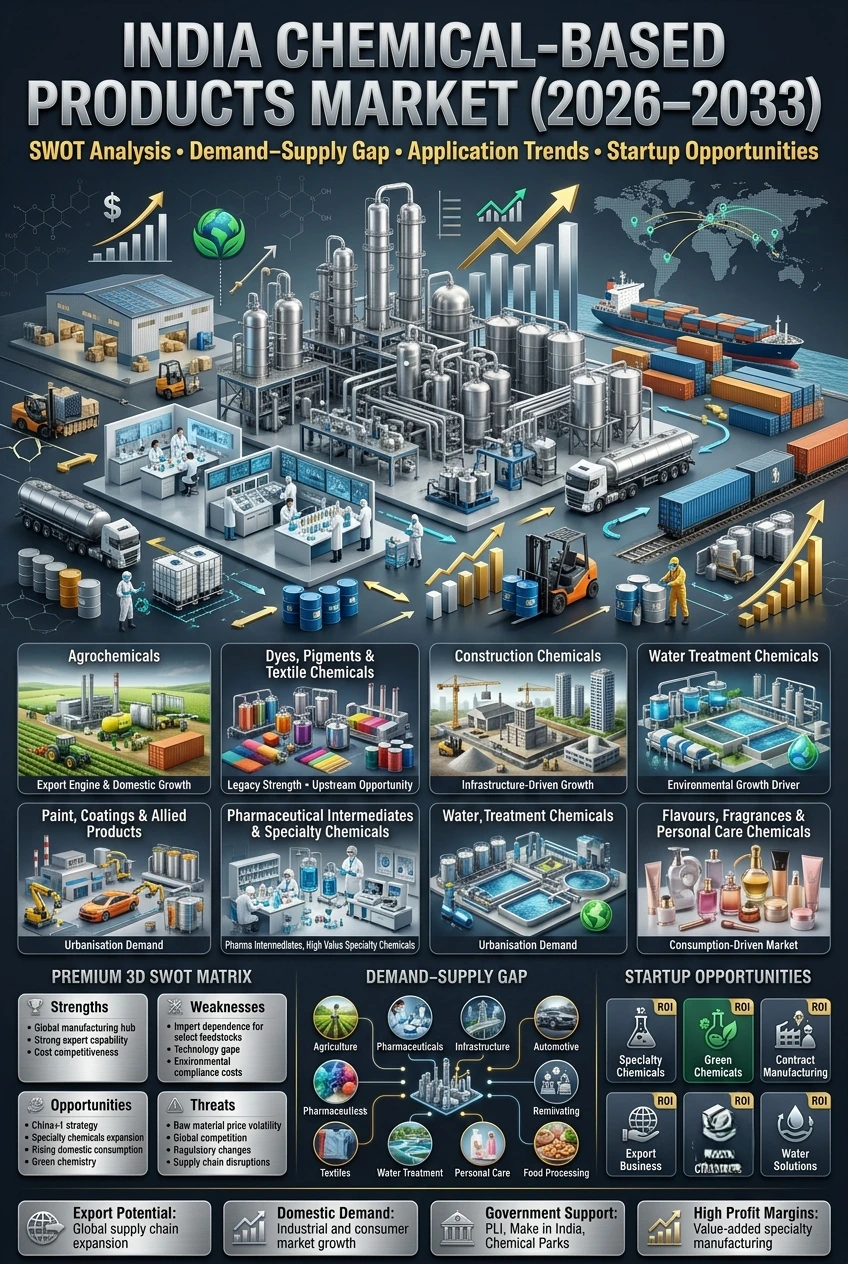
By Application: Segment-by-Segment Analysis
1. Agrochemicals — The Export Engine and Domestic Growth Story
The agrochemical industry is undergoing a fascinating transformation in India, as it is a leading exporter, but also a leading importer in various segments of the value chain. India is the fourth largest producer of formulated agrochemical products in the world with exports exceeding US$ 5 billion per year, mainly in the form of pesticides, herbicides and insecticides. It is also importing agrochemical intermediates and technical grade active ingredients and proprietary molecules valued almost equally.
The domestic agrochemical market is expanding at a compound annual growth rate (CAGR) of 15-17% and is supported by a 10% growth in farm income, irrigation coverage growth, and a greater awareness of crop protection economics among smallholder farmers. Invest India data shows agrochemicals will make up about 40% of India’s total chemical exports by 2040.
While the opportunity is in the branded formulated products with well-established MNCs and large Indian companies, MSME entrepreneurs need to focus on producing technical-grade intermediates, which are currently imports from China. Domestic use of agrochemicals will be directly encouraged by the upcoming PLI scheme, which will provide 10-20% production subsidy.
Get Detailed Insights from This Book: The Complete Technology Book on Agrochemicals
2. Dyes, Pigments and Textile Chemicals — Legacy Strength, Upstream Weakness
India is the second largest producer and exporter of dyes in the world accounting for about 16% of the world production. This is a long-standing competitive position, which has evolved over many years in areas such as clusters of Ankleshwar, Vapi and Ahmedabad in Gujarat.
However, the trade information shows a weakness in structure that is immediately upstream. In FY26 (April – February), trade deficit in dye intermediates was $1,378 million compared to roughly $59 million worth of imports from India (April – July period), indicating a significant reliance on imports from China for chemical intermediates used in India’s dye production.
There is also a high dependence on importing textile chemicals (levelling agent, silicone softener, optical brightener, desizing agent, fixing agent) as domestic manufacturers have not been able to provide chemicals consistently with a level of performance that meets international certification standards (OEKO-TEX, GOTS, ZDHC). International buyers are increasingly probing Indian exporters regarding their compliance with chemicals, and they are actively searching for suppliers that can ensure quality uniformity and compliance with the standards. This is an authentic commercial gateway for technically sound MSME manufacturers.
Explore This Book: Modern Technology of Textile Dyes & Pigments
3. Construction Chemicals — Infrastructure-Driven Secular Demand
With India’s push towards infrastructure investments, the construction chemicals—concrete admixtures, waterproofing compounds, repair mortars, grouts, adhesive mortars, sealants, protective coatings and flooring compounds—are among the highly sought-after specialty chemical applications. The National Infrastructure Pipeline, PM Gati Shakti, AMRUT 2.0, Pradhan Mantri Awas Yojana, and the dedicated freight corridor projects are all part of a multi-faceted infrastructure spending spree of unparalleled length and scope, keeping demand for advanced formulations of construction chemicals high.
The construction chemicals market in India is split between organized and unorganized players, with Pidilite Industries, BASF India, Fosroc, MYK Laticrete and Sika India accounting for major market share in the organized sector. The market is still niche, with pockets of growth in Tier 2 and Tier 3 towns/ cities and particularly in the north-east states which offer a regional opportunity for MSME formulators to be familiar with local construction methods and be able to support applications.
The southern region has the highest share of 33% of India’s cement production followed by the northern, eastern and western regions with the largest share of 22%, 19% and 13% of cement production respectively, whereas the consumption of construction chemicals broadly follows the cement production shares with the highest consumption in the southern region and the lowest in the western region. The low-competition areas in the east and central part of the country are new opportunities for builders of construction chemicals.
6. Pharmaceutical Intermediates and Specialty Chemicals — The API Upstream
India is the biggest generics manufacturer in the world producing more than 50% of vaccines for the world and is dominant in the generic APIs in all therapeutic categories. The pharmaceutical base creates a tremendous downstream demand for chemical intermediates, solvents, excipients and active pharmaceutical ingredients.
The government’s PLI Scheme for Bulk Drug Parks, which involves an investment of Rs. 250 crores, has been approved. The government’s PLI Scheme for Bulk Drug Parks, that involves an investment of Rs. 250 crores, has been approved. 1,629 crore is particularly aimed at decreasing reliance on China’s API precursors. Under this scheme, support is being provided for 41 critical bulk drugs, comprising key starting materials (KSMs) and drug intermediates, and with a total outlay of PLI of Rs. 6,940 crores over 2020–2030.
For MSME chemical manufacturers, pharmaceutical intermediates represent a technically demanding but commercially defensible niche. Contract manufacturing for generics API supply chains — particularly for molecules that have gone off-patent — offers multi-year contracts, quality-compliant customer relationships, and pricing that reflects technical capability rather than commodity competition.
View Full Project Details: Pharmaceutical Drugs & Fine Chemicals Directory
5. Paints, Coatings and Allied Products — Growing with Urbanisation
India’s paints and coatings market is fuelled by residential construction, automobile manufacturing (India is the fourth-largest automotive manufacturing hub in the world) and industrial infrastructure maintenance. The sector is a large user of titanium dioxide (primarily imported), alkyd resins, acrylic polymers, pigments, and specialty additives.
The expanding domestic automotive industry, especially with the electric vehicle trend, is creating demand for specific surface coatings, underbody protection compounds, battery pack sealants, and thermal management adhesives. OEMs and Tier 1 chemical suppliers in India are in a race with each other to grow the domestic chemical suppliers who can supply them chemicals of consistent quality at commercial scale instead of depending on imported specialty materials.
6. Water Treatment Chemicals — Environmental Regulation as a Growth Driver
As the industrial effluent treatment requirements in India are becoming stringent and investment in the municipal water treatment infrastructure is increasing in line with the Jal Jeevan Mission, water treatment chemicals are also gaining momentum with the introduction of new products such as coagulants, flocculants, corrosion inhibitors, scale inhibitors, biocides and membrane antiscalants.
Industrial water treatment is especially important for the chemicals, power, pharmaceuticals, textiles and food processing industries which are subject to increasingly strict regulations under the Water (Prevention and Control of Pollution) Act and associated regulations. MSMEs of water treatment chemical formulations can establish defensible market base in the industrial clusters of the region without competing directly with the big national chemical companies.
Related Article: Water Treatment Chemical Manufacturing Business in India: Profitable MSME Opportunities in Power & Industrial Sector
7. Flavours, Fragrances and Personal Care Chemicals — The Consumption Story
Personal care, home care and food-grade chemicals are being consumed as a result of rising disposable incomes, a young median-age population, the rapid pace of urbanisation and the formalisation of retail distribution channels. The value of fragrance ingredient imports, essential oil trade and cosmetics and toiletries exports, at US$ 1,446 million in FY26 (April-July), portrays a market that is growing beyond mere domestic demand.
India is naturally endowed with castor oil and other agricultural raw materials, which give it an edge in bio-based flavour and fragrance intermediates. The specialty chemicals that can be obtained from castor include hydroxy fatty acids, sebacic acid, undecylenic acid and its derivatives which are traded worldwide, used in cosmetics, pharmaceuticals and industrial lubricants. This is a segment where the availability of feedstock, cost competitiveness and export demand meet.
By Region: Where the Demand and Production Are
West and Central India — The Chemical Manufacturing Core
Gujarat is the leading state in India for production of dyes, pigments, pharmaceutical intermediates and petrochemicals. The industrial estates of Ankleshwar, Vapi, Bharuch, Dahej and Hazira have one of the highest agglomerations of chemical manufacturing capacities in Asia.
One of the three government approved PCPIRs, Dahej PCPIR, has seen Rs. investments in it till date. 73,518 crore and generated 40,000 direct jobs. Shivtek Spechemi Industries has commissioned a new chemical plant with an area of more than 1 million square feet, which is expected to start producing 2,50,000 MTPA by 2027–28. Reliance Industries has pledged to invest Rs. The company is expanding its Oil-to-Chemicals (O2C) business at its Jamnagar unit with an investment of Rs 75,000 crore.
Maharashtra is a strong partner to Gujarat in the domain of pharmaceutical chemicals, agrochemical formulations and specialty polymers. Industrial clusters are located in Pune, Nashik, Navi Mumbai, Taloja and Lote Parshuram, to support the Auto, Pharma & FMCG industries in the western state.
Gujarat and Maharashtra have a lower cost of land and operation than other emerging clusters, and with a strong chemical ecosystem (skilled labor, chemical logistics, contract testing laboratories and thick cluster of chemical trading companies), Gujarat and Maharashtra are great options for new MSMEs.
South India — The Emerging Specialty Chemicals Belt
The Tamilnadu, Karnataka, Andhra Pradesh and Telangana states are a fast-emerging specialty chemicals demand zone. Specialty coatings, adhesives, sealants and polymer compounds are all used in significant automotive manufacturing clusters in Tamil Nadu and Karnataka, including manufacturers such as Hyundai, Kia and Toyota, as well as specialty companies such as Bosch and Honda. The electronics manufacturing thrust under PLI will drive further demand for ultra-high purity electronic chemicals to states like Gujarat and Karnataka with the semiconductor fab investments.
The state of Andhra Pradesh has implemented several measures to ensure the successful implementation of its PCPIR. The state of Andhra Pradesh is actively promoting chemical investment and the planned investment by BPCL is worth Rs. The 1,00,000-crore greenfield refinery and petrochemical facility in the state will have a material impact on the availability of feedstocks to the South Indian chemical industry in the coming decade.
South India presents an opportunity for entrepreneurs because it’s where large, technically advanced industrial OEMs are based and look for quality and reliability in supply more than low price.South India has its own advantage for entrepreneurs as it is close to large, technically well-groomed industrial OEMs where reliable and quality suppliers are rewarded with long-term contracts rather than just price.
The region of north India is termed as Large Consumption Zone and Underdeveloped Production Zone.
North India — Large Consumption Zone, Underdeveloped Production
The Rajasthan Refinery Limited (RRL) at Barmer, which was put into operation with capital investment of Rs. The transformative 52,877 crore project producing more than 35,000 direct jobs is a piece of feedstock infrastructure vital to chemical manufacturing dreams in North India. With its commissioning, the raw material scenario for chemical projects in the state and adjoining states in Rajasthan is going to change.
With the economy of the Gangetic plain, North India is also the biggest agrochemical consuming region of the country. MSME agrochemicals formulating business in this region would have a huge domestic market for consuming and would not have to face the logistics hassle of reaching farmers in west.
East India — Untapped Potential, Government-Backed Investment
The chemical investment zone at Paradeep with Odisha is the third such zone set up by the government and is gradually coming up with the facilities to manufacture fertilizer, polymer and chemicals. The PCPIR has been able to draw investments worth of Rs. It has 73,518 crores and provides jobs for the expanding industrial workforce.
West Bengal’s existing chemical manufacturing infrastructure and ready availability of skilled manpower can be leveraged and coupled with the raw materials available in the North-Eastern states for manufacturing bio-based chemicals. Additionally, the land prices in East India are lower and the state provides good packages for industrial incentives for investors who are willing to invest in less saturated areas led by MSMEs.
SWOT Analysis of India’s Chemical-Based Products Sector
Strengths
Market Scale and Diversity: Indian chemical industry is manufacturing >80,000 products in the market which gives the natural security across the sectors. Since there are so many applications served, a slowdown in any one end-use industry is unlikely to cause a sector-wide slowdown.
India is at a dominant position in India and globally in dyes (2nd in the world), agrochemicals (4th in the world), pharmaceuticals Generics (Largest in the world by volume). These roles are the ones that have themselves demonstrated export competitiveness, and are benchmarks for other chemical sectors who wish to emulate them to establish a comparable export posture.
India generates more than 1.50 lakh engineering graduates every year, and a significant number of chemical engineers from various engineering institutes, like IIT, NITs, and universities in the various regions. It is this talent base that is the basis for technical differentiation in specialty chemical manufacturing.
Established Export Network: India exports its chemical products to more than 175 countries, the USA being the largest import market (US$ 3.05 billion in FY25), followed by Brazil (US$ 1.59 billion) and China (US$ 1.48 billion). This existing export infrastructure reduces the market development cost for new manufacturers.
India is also well placed geographically with the Middle East being the main source of petrochemical feedstock and the ports of Kandla, Mundra, JNPT and Paradip in the state provide the country a competitive edge from feedstock sourcing and logistics logistics point of view in the global chemical supply chain.
The most comprehensive support system of the Indian chemical sector in post-independence era can be seen through the Government policy initiatives, such as the PCPIR framework, PLI schemes, 100% automatic-route FDI, RoDTEP benefits and the Chemical Promotion and Development Scheme (CPDS). The government has already identified 915 chemical start-ups, as confirmed by DPIIT, which is an innovation ecosystem which is starting to institutionalise.
Weaknesses
Low R&D Investment – India’s chemical sector invests a small amount of money in research as compared to Europe, Japan and South Korea chemical companies. The result is a restricted proprietary process chemistry, i.e., products manufactured by Indian companies and usually at lower margins.
Infrastructure Constraints: Specialized chemical logistics – such as ISO tankers, temperature-controlled storage, chemical pipelines, dedicated chemical rail wagons, etc. – are underdeveloped outside the core Gujarat-Maharashtra belt. This increases the supply chain costs and restricts the location of new chemical production.
Raw Material Import Dependency: Some of the raw materials for chemical products are highly dependent on imports; others depend on domestic production of the raw material from the refinery, but historically have not been produced in adequate amounts. High volatilities of raw materials and reliance on imports squeeze margins in manufacturing.
Large chemical plants are of category-A environmental clearance, which involves conducting a full Environmental Impact Assessment study and public hearing, and can extend the project commissioning time by 18–36 months, in addition to increasing the capital expenditure of greenfield projects. With less stringent requirements, the smaller the MSME facility the bigger the compliance burden in proportion.
Opportunities
The one most prominent structural tailwind for chemical manufacturers in India is China Plus One. Such dual-source or alternative-source suppliers to China are being actively qualified by global chemical buyers, mainly from Europe, North America and Japan. Indian manufacturers with proven quality certification (ISO, REACH, GMP), supply reliability and transparent supply chain are getting multi-year contracts that were not available 5 years ago.
The Ministry of Chemicals and Fertilizers is actively developing a PLI for agrochemicals, which provides 10-20% production incentives. Once implemented, this scheme will kick-start investments in agrochemical intermediate manufacturing, a sector which is one of the most import-dependent chemical segments in India.
Shared-infrastructure industrial areas with single-window clearance, common effluent treatment plant and proximity of feedstocks; PCs and PCPIRs: Plastic Parks and PCPIRs. The zones offer a real benefit to new chemical companies that would otherwise have to install their own utilities. The new PCPIR policy 2020-35 is to encourage investment in the amount of Rs. As reported by the chemicals.gov.in, it has reached a figure of 18.6 trillion by the year 2030.
Natural feedstocks opportunities in Green Chemistry and Bio-Based Chemicals: India has significant natural feedstock opportunities for bio-based specialty chemicals such as castor oil (India is the largest producer of castor oil), neem derivatives, turmeric based antimicrobials, coconut oil-based derivatives and agro-residue based bio-chemicals. The buyer in Europe and North America is willing to pay premiums for sustainability options for bio alternatives to petrochemical products. This will be an opportunity for exportation and a differentiation strategy at home for new players.
UK-India Free Trade Agreement: The recently finalised UK-India FTA paves the way for preferential tariff access for Indian chemical exports to the United Kingdom—and indirectly to the broader industrial supply chain of the European Union. This agreement boosts the commercial terms for specialty chemical manufacturing companies that are export-oriented.
Threats
Chinese Competitive Intensity: Chinese chemical manufacturing is well capitalised, very efficient and often subsidised through preferential energy and raw material pricing. Indian companies in commodity and semi-commodity chemicals can only compete on price with Chinese companies and will have to deal with margin compression in the long term.
Multiple safety incidents were reported in the last few years across the chemical manufacturing belt in India and this is leading to a more thorough investigation of chemical accidents, the Hazardous Waste Management Rules and factory safety rules, among other things, under the Environmental and Safety Regulatory Tightening category. This is essential, but it can lead to rising compliance costs that are disproportionately high for smaller manufacturing companies.
Global Economic Sensitivity: Global demand for chemicals is highly volatile in response to global economic cycles. During a downturn, end-use companies such as automotive, construction, electronics, and consumer goods all contract at the same time, resulting in dramatic volume declines for chemicals. Some manufacturers are more likely to be particularly affected by cyclical declines in demand, as a result of their “concentrated” customer or end-market exposure.
Geopolitical and supply disruption pricing volatility is present for crude oil and natural gas, which are the raw materials for many of the chemical industry’s raw material chains. Chemical manufacturers in India are at risk if they do not have raw material supply contracts that are hedged.
Import–Export Analysis: What the Trade Data Is Really Saying
Import – export data from FY26 (April – February) is a composite picture which every chemical entrepreneur must keep in the mind before determining what to produce.
Categories where India runs a trade surplus (export > import):
- US$ 1,446 million of exports for Castor oil, essential oils and cosmetic chemicals compared to US$ 987 million of imports (April-July FY26).
- Other chemicals such as agrochemical formulations (export surplus of about US$ 13 million, structural growth);
- Finished dyes: Exports US$ 765 million and imports US$ 276 million.
Categories where India runs a trade deficit (import > export):
- The trade balance of organic chemicals fell by ~US$ 7,004 million. Trade balance in organic chemicals decreased by ~US$ 7,004 million.
- Inorganic chemicals: Deficit of ~US$ 4,587 million
- The dye intermediates is an example of near total dependence on imports, as there are approximately US$ 1.378 million in imports compared to approximately US$ 59 million in exports.
The strategic read of the entrepreneur is very clear that India has already proven to be competitive in the end products of formulated materials (dyes, castor derivatives, agrochemical formulations). The missing link is the intermediate chemistry upstream, the stuff that is currently imported from China. The commercial opportunity and the government policy are all linked to building manufacturing capacity in the intermediate tiers, which is where the import substitution rationale is also found.
Major Indian Players: The Organised Sector Landscape
The organised Indian chemical manufacturing industry comprises of large conglomerates as well as small specialty companies. The following are prominent players in each segment:
Aarti Industries Ltd., a large specialty chemical company in India, is backward-integrated with benzene to intermediates used in agro-chemicals, pharmaceuticals and dyes. Aarti is the quintessential Indian specialty chemical success story – a very integrated business, export-oriented and a product line that is technically sophisticated enough to command pricing power.
Atul Ltd. (Lalbhai Group): A diversified specialty chemical company with operations in life sciences, performance chemicals and aromatics. Atul’s diverse product line and long history of exports to chemical firms around the world provide a temperature check for the Indian specialty chemical industry.
Deepak Nitrite Ltd. is India’s largest manufacturer of nitro-aromatics, phenol and acetone. Its backward integration into phenol and acetone has given it better margin protection from raw material price fluctuations and is a strategy that other Indian specialty chemical manufacturers are following.
India’s leading fluorochemical company, Navin Fluorine International Ltd. has a diversified portfolio of high-performance specialty fluorinated compounds in the agro, pharma, and advanced materials industry. Navin Fluorine’s dominance in the niche of specialty chemicals in India is one of the highest barriers to entry category and is the result of the company investing in decades of process chemistry.
Balaji Amines Ltd. is a specialized company dealing in Aliphatic Amines, Morpholine and its derivatives for the Rubber, Water treatment, Crop protection and Pharma markets. It is a company that has created a sustainable competitive advantage through its very narrow technical niche in a well-defined product space, at a relatively small company size.
SRF Ltd. — Chemicals (refrigerants, fluorochemicals and specialty chemicals), Technical textiles and films for packaging. SRF’s chemical business is a strong contributor in the global refrigerant and specialty fluorinated chemistry market, and is making substantive investments in carbon intensity reduction.
Other key companies: Gujarat Fluorochemicals, Privi Speciality Chemicals, Rossari Biotech, Anupam Rasayan, Tata Chemicals, Pidilite Industries, Coromandel International, Rallis India, Sudarshan Chemical and UPL, who play in differentiated segments of the overall chemical value chain.
Startup and MSME Opportunity: Specific Entry Points for First-Generation Entrepreneurs
Contrary to popular perception, the chemical industry can be an easier sector for MSME entrepreneurs to enter, provided that they make sure to choose their products after thorough feasibility studies, and not general market assumptions. The next sections are the most promising MSME entry points:
Using commercially available polymer and additive inputs, specialty construction chemical formulations (such as waterproofing compounds, crack repair mortars, non-shrink grouts, concrete admixtures, and tile adhesives can be formulated at capital expenditures within MSME range. It is not about large-scale chemical syntheses, but about well-formulated value-add, consistent quality and technical application support. India’s multi-year infrastructure cycle provides for demand visibility.
Domestic suppliers have failed to provide clusters with performance-grade material, hence Indian textile clusters are importing textile auxiliary chemicals – levelling agents, fixing agents, silicone softeners, optical brighteners, desizing agents in large quantities. An MSME with a focus on quality management systems, application skills and even establishing a few relationships with export-oriented textile mills has the potential of creating a significant amount of repeat-purchase revenue.
The industrial water treatment market in India is served by water treatment chemicals like coagulants, flocculants, anti-scalants, biocides and corrosion inhibitors. Regulatory tightening on industrial effluent is non-discretionary demand – meaning that regulated industries cannot choose not to use these chemicals. The regional MSME formulators can cultivate the market from local MSME clusters which are not efficiently served by large national companies.
There are a few areas where India has feedstock advantage and also has an increasing demand for exporting products internationally: Bio-Based and Green Specialty Chemicals (castor oil derivatives, fatty acid esters, surfactants from coconut feedstock, natural fragrance ingredients, etc.). European and American buyers have been actively looking for supply chain transparency and bio-based credentials which India’s natural chemistry can offer.
Agrochemical Intermediate Manufacturing: The PLI scheme is specifically available for agrochemical intermediates, and import reliance in this segment is highly high so MSME manufacturers with technical grade agrochemical products manufacturing capacities have a vibrant domestic captive market with a strong demand for import substitution.
Indian manufacturers, who invest in a quality system and regulatory compliance, rather than just a competition based on spot price, receive long-term contract value far greater than the return of spot price competition, according to FICCI’s Chemicals and Petrochemicals Committee. The same principle is more applicable to the MSME manufacturers where differentiation on technical service is more feasible and more useful compared to differentiation on cost.
Government Policy Framework: The Enabling Environment
The policy framework supporting India’s chemical manufacturing industry in 2026 is fundamentally shaped from any other time in the industry’s history.
Petroleum, Chemicals and Petrochemicals Investment Regions (PCPIRs): Three approved PCPIRs at Dahej (Gujarat), Paradeep (Odisha) and Visakhapatnam (Andhra Pradesh) provide a combination of shared utilities, common effluent treatment, single window clearance and feedstock proximity. The collective attraction of the PCPIRs is realised in the form of PCPIRs. The total investment is Rs 3.4 lakh crore in 2,246 units. The new PCPIR Policy 2020–35 aims at investments worth Rs. 18.6 trillion by 2030 and Rs. 24.8 trillion by 2035.
Doors will open at Rs. on the PLI Scheme for Bulk Drug Parks. In addition to the overall investment of Rs. 2,500 crores in the medical sector, 1,629 crores have been allocated for pharmaceutical chemical manufacturing in the shared-infrastructure parks. 6,940 crore PLI for critical bulk drugs over 2020–2030.
Chemical Promotion and Development Scheme (CPDS): Supports research, surveys, data banks and chemical promotion, including the India Chem international event, to lower information asymmetry for new market entrants, and link Indian manufacturers with global buyers.
Foreign investors are allowed to set up chemical manufacturing units in India without any prior approval by the government for most of the chemical categories and only reporting after investment. This applies equally to specialty chemicals, petrochemicals and basic chemicals.
Capital subsidies (15-25%) and stamp duty exemptions, electricity duty waivers, interest subsidy on term loans for chemical manufacturing projects – state-level incentives in addition to central government incentives.
The Ministry of Chemicals and Fertilizers has published India’s 2034 Chemical Sector Roadmap with goals of improving domestic production, minimising dependence on imports, and boosting FDI. The roadmap also outlines four more PCPIRs, an enlarged network of Plastic Parks and a standalone PLI scheme for chemicals and petrochemicals that are in a formulation stage.
Forecast 2026–2033: The Investment Case in Summary
Over the next 7 years (2026-2033), the forecast will be influenced by four growth drivers that will be compounding.
Driver 1 — Per Capita Consumption Convergence: India’s per capita consumption of petrochemical and specialty chemicals is significantly lower than that of other Asian countries and is far behind developed countries. The trend of convergence for per-capita chemical consumption will be towards higher values as income increases; manufacturing intensity increases and construction in urban areas increases. According to McKinley, India’s incremental chemical demand in the next two decades is more than 20 percent of the global chemical market, which alone calls for new capacity in various chemical types.
Driver 2 — Specialty-to-Commodity Mix Shift: Specialty to Commodity Chemical Mix Shift in India will materially change during 2026-2033. Specialty chemical capacity growth is being driven by government incentives, increased technical capability and the China Plus One commercial pull, well higher than commodity chemical growth. Specialty chemicals will require additional capacity of US$ 28 billion, or from US$ 64.5 billion to US$ 92.6 billion, and most of the increased capacity is still imported.
Driver 3 — Export Market Deepening: The UK-India FTA, China Plus One and the quality compliance record of India are all generating export demand, and these all stand independent from any domestic demand side dynamics. Indian Specialty Chemical Manufacturers who are ISO, REACH and GMP certified are moving into a global qualification/purchasing process resulting in multi-year supply contracts.
Driver 4 — Sustainability Transition: Green chemistry transitioning from Marketing to Procurement. The Indian chemical industry consumes about 13% of total energy consumed by the industrial sector and has large GHG emissions, according to the Department of Chemicals and Petrochemicals. The regulatory requirements are just as important as the opportunity to reach the increasing number of buyers willing to pay potentially a higher price in international markets for cleaner production processes or bio-based product development.
The government knows that the chemical industry will create 10 million jobs by 2040, direct and indirect, as confirmed by DCPC’s secretary, highlighting the significance of the industry in India’s industrial future.
About NPCS: From Market Research to Bankable Project Reports
Niir Project Consultancy Services (NPCS) is a professional consulting service organization having more than 30 years of experience in preparing Market Survey cum Detailed Techno-Economic Feasibility Reports (DPRs) for manufacturing projects in the chemical industry.
NPCS prepares detailed project reports for entrepreneurs considering any venture in the manufacturing of chemicals whether it is a specialty construction chemical project, an agrochemical intermediate project, a textile auxiliary manufacturing project, a water treatment chemical business or a pharmaceutical intermediate project, covering all the aspects that an investor, banker or a regulatory body would look into.
- The manufacturing process has been explained in detail along with Process Flow Diagrams (PFD/BFD) specific to the target product.
- Actual consumption data, import–export trends and competitive landscape mapping for market research and demand analysis.
- Specifications of raw material and machines with the specifications of the supplier and cost benchmarking.
- Product mix and capacity planning that are based on realistic market entry scale.
- The commercial rationale for the domestic production is calculated using import–export dependency analysis.
- Test and report on the financial aspects of the project and its profitability — Capital cost estimation, working capital requirements, revenue projections, break-even analysis, IRR, NPV modelling
Every NPCS interaction is designed to assist entrepreneurs evaluate the technical practicability, monetary feasibility, market demand and scalability of a new project before committing funds, and thus improve the quality of investment decisions and lower the risk of commercially misaligned endeavors.
Market Insight Summary, Demand–Supply Gap, Major Players & Startup Opportunity
Market Insight
Domestic demand growth in agriculture, construction, pharmaceutical, textiles, automotive and personal care is structural underpinning the market for chemical-based products in India valued at US$ 250 billion and expanding at more than 8% annually. The specialty chemicals market is growing at 11% CAGR, with the specialty chemicals alone accounting for US$ 64.5 billion. The overall market is expected to surpass US$ 450 billion by 2033, driven by government policies, the cumulative amount of FDI inflows to exceed US$ 23.9 billion, and a reshaping global supply chain.
Demand–Supply Gap
India imports organic chemicals worth nearly US$ 14 billion per year while exporting barely US$ 7 billion — a structural chemical trade deficit that is most acute in dye intermediates (55–80% import dependency), performance polymers, agrochemical precursors, and electronic chemicals. Domestic capacity utilisation gaps in inorganic chemicals confirm this is a demand-side opportunity, not a supply glut. Every billion dollars of import substitution in specialty chemicals represents a viable, government-policy-supported business opportunity for domestic manufacturers.
Major Indian Players
Aarti Industries Ltd. (benzene derivatives, agrochemical intermediates), Deepak Nitrite Ltd. (nitro-aromatics, phenol, acetone), Navin Fluorine International Ltd. (fluorochemicals), Balaji Amines Ltd. (aliphatic amines), SRF Ltd. (fluorochemicals, refrigerants), and Atul Ltd. (diversified specialty chemicals) are the principal organised sector players defining the specialty chemical landscape.
Startup Opportunity
The 2026–2033 period represents the most strategically favourable window for MSME entrepreneurs to enter chemical-based products manufacturing in India. The combination of structural import gaps (validated commercial demand), government PLI and PCPIR support (financial and infrastructure enablement), China Plus One supply chain realignment (export opportunity), and a large, technically diverse domestic market creates conditions for new entrants who invest in quality compliance and technical differentiation to build scalable, profitable manufacturing businesses.
Frequently Asked Questions (FAQs)
Q1. What is the current market size of India’s chemical-based products sector, and what is the forecast for 2033?
The Indian chemical industry is currently valued at approximately US$ 250 billion, ranked sixth globally in production. The broader chemical products industry has a projected compound annual growth rate of over 8 percent to cross US$450 billion in 2033. Meanwhile, specialty chemical segment – of US$64.5 billion in 2023 – is seen growing to US$92.6 billion in 2033.
Q2. What is India’s most significant demand–supply gap in chemical products?
The most acute gap is in organic chemical intermediates and specialty chemicals. India’s annual imports for general organic chemicals stand at US$ 14 billion whereas exports stand at just US$ 7 billion resulting in a net deficit of nearly US$ 7 billion from one product segment alone. For specialty chemicals, which includes segments such as dye intermediates, performance polymers, electronic chemicals, agro-chemical building blocks, import dependence varies between 55 and 80 percent.
Q3. Which application segments offer the strongest growth opportunities in the 2026–2033 period?
The highest opportunity application segments for new manufacturing investment are the agrochemicals (CAGR 15-17%), pharmaceutical intermediates (due to PLI in bulk drugs), construction chemicals (driven by infra spending), water treatment chemicals (driven by env regulation), and specialty textile chemicals (due to export compliance needs of global brand names).
Q4. What government schemes support chemical manufacturing in India?
Some of the major Central government schemes in place are: • Chemical and Petrochemical Investment Regions (PCPIRs) in Dahej, Paradeep and Visakhapatnam, PLI Scheme for Bulk Drug Parks (worth Rs 1,629 crore) and PLI for agrochemicals (to be launched), Chemical Promotion and Development Scheme (CPDS) and RoDTEPexport incentives. • These schemes are supplemented by capital subsidy (15-25%) from State governments, stamp duty waiver and Electricity Duty waiver.
Q5. Which regions of India are best positioned for new chemical manufacturing units?
Gujarat (Ankleshwar, Dahej, Vapi, Hazira) and Maharashtra (Taloja, Lote Parshuram, Nashik) are the most mature with relatively strong and established clusters and ecosystems. Andhra Pradesh (Visakhapatnam PCPIR), Tamil Nadu (due to demand tied to Automotive sector), and Rajasthan (access to feedstocks from post-Barmer refinery) are leading emerging cluster investment destinations that provide attractive state level incentives.
Q6. Can MSME-scale entrepreneurs profitably enter chemical manufacturing?
Yes — particularly in formulation-based specialty chemicals. The listed chemical products can be produced commercially on an MSME scale. However, this depends on the strict and precise product selection in the light of thorough technical-economic feasibility study instead of common market assumptions.
Q7. How is the China Plus One strategy affecting India’s chemical sector?
Worldwide buyers of chemicals have been busy certifying Indian makers as back-up or dual source options to China. Indian manufacturers with a quality certification such as ISO, REACH or GMP have signed long-term supply agreements to sell to Chinese market in specialty chemicals, intermediates in pharmaceuticals and agrochemicals, dye intermediates and others. This has always been China’s domain globally.
Q8. What is NPCS and how does it support chemical manufacturing entrepreneurs?
Niir Project Consultancy Services (NPCS) prepares Market Survey cum Detailed Techno-Economic Feasibility Reports for manufacturing projects across the chemical sector. NPCS reports cover manufacturing process, market demand analysis, process flow diagrams, raw material and machinery specifications, import–export dependency analysis, and full project financial modelling — providing the technical and commercial foundation needed to make sound investment decisions and satisfy project lenders.
Key data sources for this article: IBEF — Indian Chemicals Industry | Invest India — Chemicals | Ministry of Chemicals and Fertilizers / chemicals.gov.in | FICCI Chemicals & Petrochemicals Committee | DPIIT — Department for Promotion of Industry and Internal Trade


