





cocoa and chocolate export business
The cocoa and chocolate business is one of the most promising and unexploited business ideas in the field of food exports in India. India has been a cocoa producer for decades, mostly in Kerala, Karnataka and Andhra Pradesh, but has recently started to appear in the high value global craft chocolate economy. The “bean-to-bar” and single-origin chocolate market is taking off around the world, as consumers now demand ethically sourced and delicious chocolate with a unique flavour profile.
The complex flavours of Indian coffee, especially from India, stand out as a key differentiator, giving Indian entrepreneurs a real chance at joining the global premium chocolate economy. Cocoa and chocolate products are covered under the scheduled product mandate of APEDA and are given export support for this emerging sector.
Why Indian Cocoa and Chocolate Export Is a Compelling Opportunity
The market of premium chocolate is expanding at 8% to 12% per year globally, as compared to the commodity chocolate market, and consumers are willing to pay ₹500 to ₹3,000 for a 100g bar of single-origin, craft-made chocolate. The premium segment is dominated by small to mid-sized artisan chocolate producers from Europe and North America and Indian craft chocolate producers are slowly making an impact in this segment using locally grown cocoa from Kerala and Karnataka.
The Indian craft chocolate narrative is very interesting. Kerala’s cocoa is cultivated in multi-crop farms where it is cultivated with arecanut, coconut and banana, which gives a unique cocoa flavour that cannot be achieved in the mono-crop cocoa of Ghana or Ecuador. The unique origin story of Indian craft chocolate, along with the country’s rich tropical terroir and craftsmanship traditions ensures that Indian chocolate exporters have an origin story that premium chocolate buyers all over the world are looking for.
Get Detailed Insights from This Book: The Complete Technology Book on Cocoa, Chocolate, Ice cream and other Milk Products
APEDA and Government Policy Framework
Cocoa and its products like cocoa bean, cocoa butter, cocoa powder and chocolate preparations, fall under the scheduled products mandate of the Agricultural and Processed Food Products Export Development Authority (APEDA). Exporters of these products need to get APEDA registration for accessing financial assistance for processing equipment, quality certification, packaging and market development.
Coconut Development Board and Spices Board also assist APEDA in the cocoa growing states by offering agronomic support to the cocoa farmers and quality improvement programmes. The Spices Board has specific programmes for cocoa development in the South Indian states which supplement APEDA’s processing and export support programmes.
The Ministry of Food Processing Industries (MoFPI) provides capital subsidy for chocolate and cocoa processing unit creation under PM KISAN SAMPADA offers capital subsidy for the establishment of Chocolate and Cocoa Processing Units which includes subsidy for machinery, equipment for bean to bar chocolate and cocoa butter extraction and cocoa powder processing equipment.
Cocoa and Chocolate product exports under the DGFT RoDTEP Scheme, along with e-commerce export scheme specifically helps and facilitates small Indian chocolate brands to export their products in the USA, UK and European countries via the e-commerce platforms such as Amazon Global Selling and specialty food online retailers.
Business Ideas in Cocoa and Chocolate Export
1. Indian Single-Origin Craft Chocolate Export
The most profitable and fastest-growing part of the world chocolate market is bean-to-bar, the chocolate that is produced from the Indian-grown cocoa beans using artisanal chocolate making processes. If a small craft chocolate shop manufacturing Indian single origin chocolate bar wants to start, the investments required are ₹20 lakh to ₹60 lakh for roasters, melangers, tempering machines, moulding equipment and quality packaging.
In US / EU specialty food retail, Kerala-origin / Karnataka-origin single-origin bars can fetch bar prices from ₹800 / 100g to ₹2500 / 100g with authentic stories of the farm. The main first market entry channel is e-commerce export via the brand’s website and through Amazon Global Selling. A few Indian craft chocolate brands have proven that it is a viable and global model, including Manam, Mason & Co and Paul & Mike.
Related Article: How to Set Up a Cocoa Processing Unit: Business Ideas, Market Opportunity, and Investment Guide for Indian Entrepreneurs
2. Cocoa Bean and Fermented Cocoa Export
International craft chocolate makers are increasingly going to the trouble of finding and paying for this type of Indian cocoa beans (especially those from Kerala’s multi-crop farms) that retain the Indian terroir chocolate flavours, and it is expected that the demand will continue to grow. The cost of investment for an export trade in fermentation, drying and grading of Indian cocoa beans ranges from ₹15 lakh to ₹40 lakh which is required for setting up fermentation infrastructure, drying infrastructure, grading equipment and export packaging.
Market premiums accrue from certifications such as Rainforest Alliance, Fair Trade or organic. Key export markets are the US, UK, France, Germany and Japan with craft chocolate makers actively looking for new and unique coffee origins. It is a good business proposition for farmers who have direct farmer network in Kerala and Karnataka.
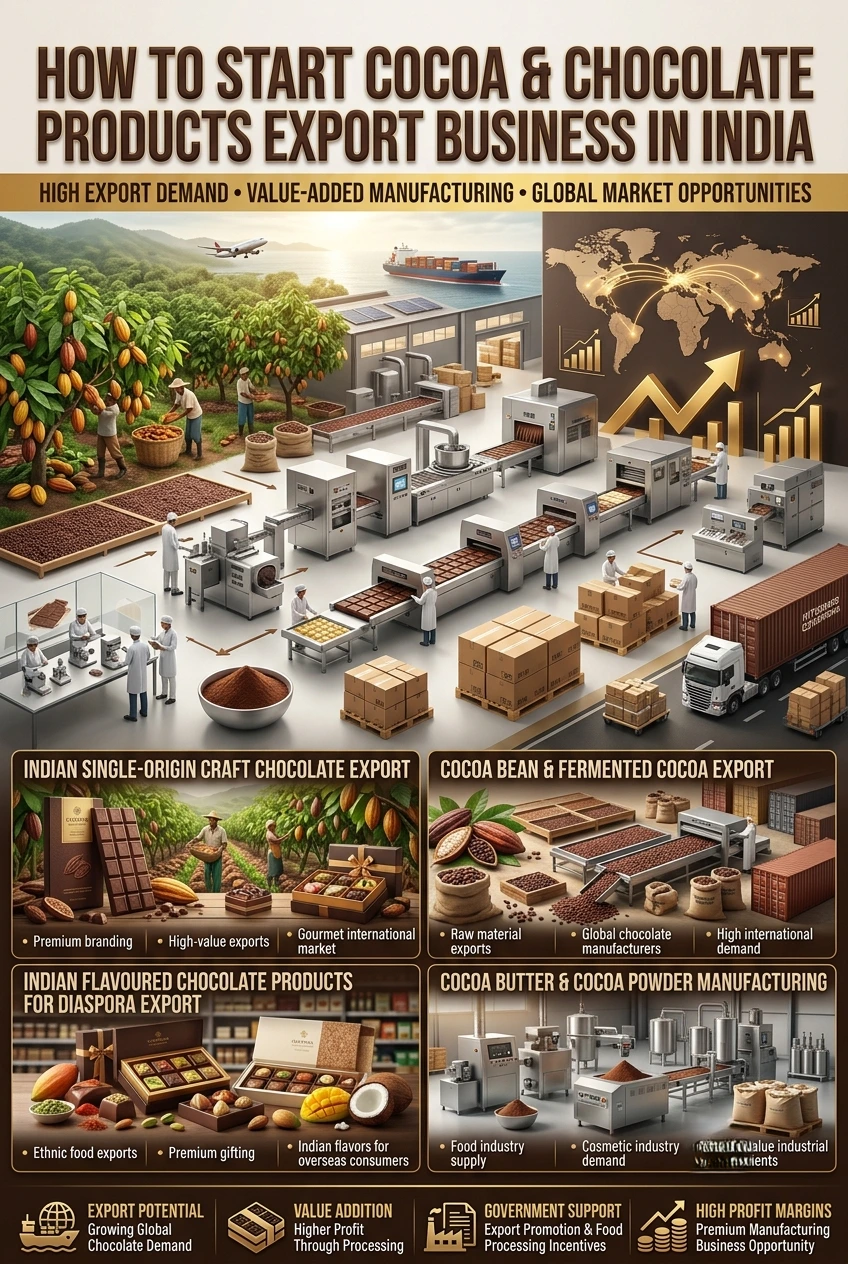
3. Indian Flavoured Chocolate Products for Diaspora Export
Indian flavoured chocolate is a category of chocolate-based products that can be found in various forms, such as Chai spice, Masala, Rose and Cardamom, Gulkand and Paan, catering to both the “diaspora” consumers, interested in Indian flavours in a familiar confectionery format, and the “mainstream” global consumers who are looking for “exotic” flavours. The investment required for the manufacture of the products will range from ₹15 lakh to ₹40 lakh in the chocolate processing unit by incorporating good quality couverture chocolate with Indian spices and botanicals.
The main export markets include Gulf diasporas, Indian grocery and specialty food stores in the UK and markets in the Indian-American community in the US. High margins are earned on gifting formats such as luxury assortment collections and festive chocolate boxes in diaspora festival gift markets.
Get Detailed Project Report (DPR): Chocolate Manufacturing Plant Report
4. Cocoa Butter and Cocoa Powder Manufacturing
Cocoa butter extraction and cocoa powder production from Indian cocoa beans is an industrial cocoa processing opportunity for the entrepreneurs with more capital. Demand for Indian cocoa butter comes from the cosmeceuticals and chocolate manufacturing industries, with export demand coming from the food and cosmetic ingredients industries in the EU. The investment in hydraulic press system, defatting system, alkalisation (Dutch processed cocoa powder), drying and packaging in a cocoa processing unit to produce cocoa butter and cocoa powder range between ₹80 lakh and ₹2.5 crore. Compliance involves APEDA registration, FSSAI licence and food grade quality certifications.
Import-Export Opportunity Analysis
India’s cocoa and chocolate export is growing from a small but significant base. The APEDA AgriExchange export data shows cocoa-derived products export growing year on year. The US, UK, and EU are the primary premium export destinations; the Gulf serves diaspora-oriented Indian-flavoured chocolate products.
The global craft chocolate market’s active search for new cocoa origins creates a unique timing advantage for Indian exporters. Craft chocolate makers in the US, UK, and Europe are specifically researching Indian cocoa and travelling to Kerala and Karnataka to source beans — demonstrating real and growing buyer demand that Indian cocoa entrepreneurs can convert into commercial export relationships.
Indian MSME Success Stories in Cocoa and Chocolate
Manam Chocolate from Hyderabad, India, proved to be a significant step when this bean-to-bar chocolate business gained international recognition by buying from Indian farmers and making their Indian origin chocolates to world-class quality. Getting an award at an international chocolate event showed that Indian craft chocolate can compete with global quality, taste and not just prices – making the export case for craft chocolate entrepreneurs in India very strong.
Mason & Co, based in Auroville, built one of India’s first craft chocolate export brands — shipping single-origin Indian chocolate to US and European specialty food buyers through both direct sales and Amazon. Their model — authentic farm sourcing, minimal processing, and brand-led premium positioning — is the blueprint for Indian craft chocolate export businesses.
Paul & Mike, founded by Abhijit Avatade, built a significant premium Indian chocolate brand distributed across UAE, US, Singapore, and other markets — demonstrating that Indian craft chocolate with distinctive Indian flavour profiles can achieve both mainstream and specialty retail distribution in international markets.
Build a profitable business with the right idea
How NPCS Supports Cocoa and Chocolate Business Planning
We at Niir Project Consultancy Services (NPCS) provide professional consulting for the preparation of Market Survey cum Detailed Techno-Economic Feasibility Reports (DPRs) for setting up new cocoa processing and chocolate manufacturing export businesses. Our reports include chocolate processing technology guidance, APEDA registration and financial assistance mapping, sourcing and supply chain analysis, market research and demand analysis, brand development guidance, and complete project financials with profitability projections.
Cocoa and Chocolate Export Business: Key Data Overview
| Product Category | Investment Range | Key Certification | Target Markets | Typical Margin |
| Single-Origin Craft Chocolate | ₹20L – ₹60L | FSSAI + Fair Trade/Organic | US, UK, EU, Japan | 60–150% |
| Fermented Cocoa Beans Export | ₹15L – ₹40L | APEDA + Rainforest Alliance | US, UK, France, Japan | 40–80% |
| Indian Flavoured Chocolates | ₹15L – ₹40L | FSSAI + APEDA + Halal | Gulf, UK, US, SE Asia | 50–100% |
| Cocoa Butter and Powder | ₹80L – ₹2.5 Cr | APEDA + FSSAI + ISO 22000 | EU, US, India (cosmetic) | 25–45% |
| Premium Chocolate Gifting | ₹15L – ₹35L | FSSAI + APEDA | Gulf, UK, US, Canada | 70–150% |
Frequently Asked Questions (FAQ)
1. What is bean-to-bar chocolate and why does it command premium pricing?
Bean-to-bar chocolate is chocolate crafted by companies that manage every single step of production – all the way from purchasing the raw cocoa bean itself, through fermentation, drying, roasting, grinding, conching, and tempering all the way to the final product. This gives bean-to-bar chocolate makers complete control over their flavour profile, and makes their bars genuine single origin products. High-end bean-to-bar chocolate costs between 5 to 20 times more than commodity chocolate because people recognize that.
2. Where in India is quality cocoa grown for chocolate making?
Kerala produces the majority of India’s cocoa — particularly from the Thrissur, Kozhikode, and Wayanad districts — where cocoa is grown under natural shade in multi-crop agroforestry systems that produce distinctive complex flavours. Karnataka (Hassan, Chikmagalur districts) and Andhra Pradesh also produce cocoa. Kerala single-origin cocoa has achieved international recognition for its fruity, complex flavour profile.
3. Is Fair Trade certification important for cocoa export?
With chocolate consumers in the EU and the US paying a price premium for ethical sourcing, Fair Trade certification – ensuring cocoa producers are paid fairly and operate in safe conditions – is becoming an expected ethical credential for many premium international chocolate brands. The other dominant sustainability certification in the premium chocolate space is Rainforest Alliance certification.
4. Can Indian chocolate brands achieve international award recognition?
Yes. A number of Indian craft chocolate brands including Manam Chocolate, Mason & Co, and more, have won awards from the International Chocolate Awards, the Salon du Chocolat, and the Academy of Chocolate. Winning international awards are great for your export marketing credentials when attempting to enter premium markets, and make it much faster for buyers to find and connect with your brand.
5. What EU regulations apply to chocolate exports?
EU CHOCOLATE STANDARDS EU chocolate standards (Directive 2000/36/EC) determine composition, labeling and additives allowed for products sold as chocolate. The Directive sets out standards for chocolate, as for example, that any product sold as ‘chocolate’ must contain a minimum proportion of cocoa and includes regulations for labelling to include information on origin, allergens (e.g. Milk and soy lecithin) and an accurate list of ingredients. Organic labeling in the EU requires compliance with organic certification schemes.
6. Can small-batch Indian craft chocolate be exported through e-commerce?
Yes. E-commerce export is the primary initial channel for Indian craft chocolate brands. Direct-to-consumer export through the brand’s own website with international shipping, Amazon Global Selling for US and UK, and specialty food online platforms (iGourmet, Goldbelly, Abe’s Market) provide market access for small-batch producers. Compliance with destination country food import regulations and correct labelling are required.
Conclusion
Cocoa and chocolate products export represents one of India’s most exciting and narratively rich business ideas — combining an extraordinary origin story, globally distinctive flavour profiles, and a surging global premium chocolate market that actively seeks new and authentic origins. Indian craft chocolate is at an inflection point: enough pioneers have demonstrated international market success to validate the model, but the vast majority of the opportunity remains open for new entrants. Entrepreneurs who invest in quality bean sourcing, artisan processing, authentic brand storytelling, and international food safety compliance will find this sector to be one of the most personally rewarding and commercially compelling food export businesses available in India today.


