






A Complete Industry, Policy and Business Ideas Guide for Indian Entrepreneurs
India’s agriculture sector is slowly moving away from the traditional reliance on chemical fertilisers and this change is enabling genuine business ideas to surface for entrepreneurs willing to see agriculture from a manufacturing perspective. Microbial inoculants are right in the middle of this change. These are living formulations of microorganisms, bacteria, fungi and other beneficial microorganisms, which are packaged and sold to the farmers, to enable them to carry out nitrogen fixation, phosphorus solubilisation and soil health improvement without relying completely on synthetic inputs.
Establishment of microbial inoculants manufacturing enterprise is one of the more feasible, policy friendly and scalable business options in the biological agri-inputs sector in India at present for a first-generation entrepreneur or an established agro-input dealer aiming to grow up the value chain.
Why This Sector Deserves a Serious Look
There’s no “hope” in the business logic. It is based on the numbers which consultants encounter on a regular basis when preparing feasibility reports for agri-input projects. The continuous use of heavy chemical fertilisers since decades has been adversely impacting India’s soil health, and the Soil Health Card data from government agencies has been highlighting its decreasing status from state to state.
This has led to a steady demand for biological alternatives, rather than the ups and downs of a more aggressive growth spurt, and that’s a good sign for a new manufacturer. A market that surges is difficult to plan for in terms of capacity. A steady growth market allows the new unit to develop the confidence of farmers, improve their formulations and increase the distribution without having to burn through working capital.
Presently, the Indian biofertilizer and microbial inoculants market is in the few hundred crore rupees range, and is projected to grow at double-digit rate annually for the next few years due to the growth of organic farming, quality standards imposed for export and state-level subsidies. There are already high adoption levels in the southern states like Karnataka and Maharashtra, partly because of the cropping pattern with high horticulture content, which is responsive to the biological input, and partly because of the strength of extension service in the region.
For a new entrepreneur, that geographic trend is important as it will give you an idea of where it will be easier to find early customers and where distribution partnerships will make sense.
The cost angle is one that founders often cannot see. Unlike a chemical fertiliser plant, microbial inoculant production does not require a lot of capital. The fermentation-based unit can be developed with moderate investment at MSME scale and the cost of raw material is based on the use of relatively inexpensive carrier materials, culture media, and packaging instead of expensive imported chemical feedstock. Lower investment capital and a sizeable market that is clearly expanding are the kind of parameters a feasibility consultant would seek in advising a first-time manufacturer.
Get Detailed Insights from This Book: Complete Guide to Biofertilizer and Organic Farming
Government Policies and Incentives Supporting New Entrants
Business owners who are starting this kind of business are not going into it alone. The Government of India, in the Ministry of Agriculture and Farmers Welfare, has established various schemes that either directly or indirectly help the manufacturers of microbial inoculants.
Paramparagat Krishi Vikas Yojana (PKVY)
The farmer clusters implementing organic farming under PKVY are provided financial assistance for organic inputs such as biofertilizers, microbial formulations etc. for three years. This effectively reduces the “cost of adoption” for the farmer, making his costs cheaper than those of chemical inputs and reducing the resistance a new brand would otherwise confront when attempting to persuade farmers to move away from their traditional chemical inputs.
Mission Organic Value Chain Development for North Eastern Region (MOVCDNER)
This scheme is specifically for the North Eastern states where use of chemical fertiliser is comparatively limited and hence organic farming has good natural potential. A manufacturer in this area can try to match product positioning to a customer base that is already receptive, and supported by the government.
Soil Health Card Scheme and National Mission on Sustainable Agriculture
These programmes have institutionalized soil testing in India, and the data generated in these soil testing programs invariably guides farmers towards biological solution to nutrient deficiencies. Therefore, the government’s extension officers themselves are a sales channel for the biofertilizer producers who can establish compliance and the efficacy of biofertilizer products.
Related Article: The Complete Business Guide to Biofertilizer Manufacture and Organic Farming
MSME Benefits and PLI-Adjacent Support
A microbial inoculants unit, being a micro, small or medium enterprise, is eligible for the existing MSME support structure – such as collateral-free loans available under the Credit Guarantee Fund Trust, capital subsidy for technology upgradation under the Credit Linked Capital Subsidy Scheme, or priority-sector lending from the nationalised banks. The procedure for GST registration and compliance is also fairly simple for agri-input manufacturers and some states provide extra capital subsidies to agro-processing / biotechnology units as part of their industrial policy.
Further, the Department for Promotion of Industry and Internal Trade (DPIIT) is seeking to promote Startup India recognition benefits, including those for income tax benefits for eligible start-ups and streamlined compliance for labour and environmental laws for a specified period. For a startup entrepreneur, these advantages have a significant impact on the early cash burn when setting up a new microbial inoculants business as a legal startup.
Multiple Business Ideas Within the Microbial Inoculants Space
Microbial inoculants is not a single product; it’s a product family. For a new entrepreneur this is a very valuable option since he/she can select the entry point depending upon the amount of money available, geographic area of the target crop, and comfort level in technical. Here are a few specific business concepts in this area that could be executed as standalone MSME-sized businesses.
Nitrogen-Fixing Bacterial Inoculants (Rhizobium and Azotobacter Units)
Rhizobium inoculants for pulses and legumes still hold the most prominent position in the industry as the science is well established and the production is relatively simple for a first-time manufacturer. A small unit for producing Rhizobium/Azotobacter cultures (carrier or liquid) could be utilized in belt cultivation of pulses in Madhya Pradesh, Maharashtra and Rajasthan where pulse cultivation is a part of the cropping calendar. The technical entry barrier is moderate but culture maintenance and quality control is more important than heavy machinery, therefore it is a good starting point for an entrepreneur who does not have a strong biotechnology background but is able to bring in a qualified microbiologist.
Phosphate-Solubilising Bacteria (PSB) Manufacturing
PSB formulations are one of the biggest soil bottle necks in Indian agriculture and its problem is the locked unavailable phosphorus in the soil despite good soil reserves. Wheat and maize yield benefits with the use of PSB in conjunction with lower levels of chemical phosphate have consistently been observed in field studies referenced by agricultural research institutes. The new entrant’s dedicated PSB manufacturing line allows it to have a strong foothold in wheat-growing states like Punjab, Haryana and Uttar Pradesh where the farmers are keen on reducing their fertiliser costs without compromising with yield.
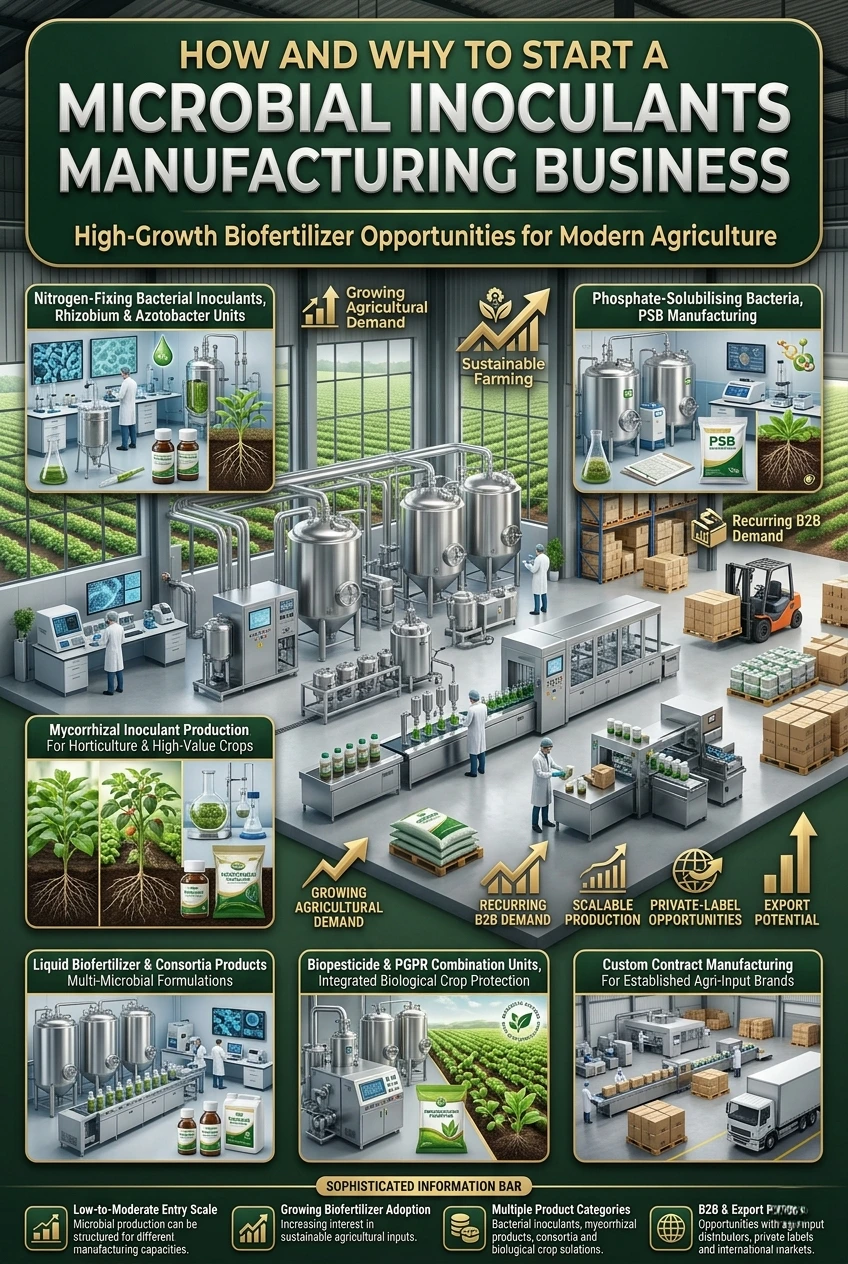
Mycorrhizal Inoculant Production for Horticulture
Mycorrhizal fungi are particularly useful in horticultural crops and plantation crops like grapes, pomegranate, citrus, and banana and are symbiotic with plant roots. Currently, this segment shows a significant market share for biofertilizer products on the basis of product form, and has a better margin than basic bacterial inoculants due to the high value of export-oriented crops in which the science is more specialised and farmers’ willingness to pay is higher. If you are an entrepreneur in Maharashtra, Karnataka or Andhra Pradesh where horticultural belts are strong, you can create a niche brand of mycorrhizal and tie it up with direct contact with innovative farmers of fruits and vegetables.
Liquid Biofertilizer and Consortia Products
Many progressive farmers prefer to use liquid formulations because they have a longer shelf life and are compatible with irrigation systems, and they do not have the problem of contaminants in carrier-based powders. The use of consortia products, containing several strains of microorganisms simultaneously (including nitrogen fixers, phosphate solubilises and potassium mobilisers) in a single product, is actually an innovative opportunity. A company that invests in early development of a liquid formulation technology and the creation of multi-strain consortia can gain a significant competitive advantage over the large number of SSP (single-strain/powder) competitors already in the market.
View Full Project Details: Liquid Biofertilizer Manufacturing Industry
Biopesticide and PGPR Combination Units
In addition to nutrient fixation, Plant Growth Promoting Rhizobacteria (PGPR) also help to reduce soil-borne pathogens and enhance root architecture. A single manufacturing plant for both the basic bio-fertilizer formulations and PGPR based products enables an entrepreneur to cater to the wider crop protection and nutrition market, instead of competing solely on the bio-fertiliser price. This model is suitable for units that are aimed at exporting horticulture growers, who require yield support, as well as residue free pest management, to satisfy standards of the international buyer.
Explore This Book: Biopesticides Handbook
Custom Contract Manufacturing for Established Agri-Input Brands
All entrepreneurs don’t have to create a brand from scratch. Many major agrochemical and fertiliser firms have the fermentation and formulation of microorganisms outsourced to smaller specialised manufacturing firms by contract, private-label. A compliant, quality accredited fermentation facility just for contract manufacturing significantly lightens the marketing load and allows a new facility to start earning money while it establishes technical credibility and eventually introduce a line of its own if it decides to.
Import-Export Opportunity Analysis
This sector’s export potential is underestimated by a great deal of new entrants. The Indian microbial inoculant companies that have the proper organic certification, including NPOP certification, which is recognised as equivalent by the European Commission, Switzerland and the United States are already exporting products to the countries like the United States, Spain, Australia, and Turkey. This is important as it reflects that with proper certification Indian manufacturing quality is acceptable in international market place and it provides a route for new entrants to plan for export readiness from the get-go and not as an add-on.
India continues to rely on imported specialty microbial strains, some components of fermentation equipment and some advanced culture media components mostly from Europe and U.S. on import side. This can be done either by importing high value strains (under license or technical cooperation agreements) to get a product of quality, like the established Indian companies have done, or by investing in strain isolation and R&D at home, in collaboration with agricultural universities, thereby reducing the dependence on imported strains over the years. Both paths work and both depend a great deal on the amount of early-stage start-up capital that is available for R&D versus the speed at which the entrepreneur can be on the market.
Export incentives under the APEDA organic and processed agricultural products and duty benefits under the Foreign Trade Policy of the Government of India further enhance the economics for a manufacturer that aims to be export ready from the outset, as opposed to exporting ready later.
Indian MSME Success Stories in This Sector
Kan Biosys: From a Single Founder’s Vision to a Patent-Holding Exporter
Sandeepa Kanitkar is the founder of Kan Biosys, which was established in Pune in 2005, and the business is one of the best examples of disciplined focus in this industry. The company had begun with biofertilizers and biopesticides and made a deliberate choice to go into two of the most challenging export crops – grapes and pomegranate – because their production farmers were already using sophisticated methods of agronomy and would embrace scientific solutions to biological inputs more readily than other segments. This thinking—choosing a tough but well-informed customer—and not going after volume first—bear fruited.
Kan Biosys went on to become the first company to get a patent for microbial products in liquid form in India and is exported to various countries such as the United States, Spain, Australia and Turkey. The lesson to new entrepreneurs is simple: a small and well-targeted first customer base can help establish the credibility for much wider expansion later.
Biostadt India: Scaling Biologicals Within a Larger Agrochemical Group
A model that is very different, but nonetheless instructive, is that of Biostadt India, a part of the UPL group, which has dedicated resources to developing a dedicated biological inputs portfolio (mycorrhizal and soil-productivity products) within an existing agrochemical distribution network. This model demonstrates that entrepreneurs who have agri-input trading or distribution related business may not have to start the microbial inoculant business as a separate entity. It can be added to the existing customer relationship and dealer network, thereby drastically reducing the time needed to get to meaningful sales volume.
Stanes and Company: Legacy Trust as a Competitive Asset
Stanes and Company, one of India’s older agro-biological manufacturers, continues to compete successfully by leaning on farmer-reported outcomes built up over decades rather than aggressive pricing alone. Its continuity shows new entrants an important truth about this business: because microbial products are living formulations whose performance depends on correct handling and storage, farmer trust built through consistent field performance becomes the strongest long-term competitive moat, stronger, in most cases, than short-term price competition.
Identify high-growth industries before others do
About Niir Project Consultancy Services (NPCS)
We at Niir Project Consultancy Services (NPCS) provide professional consulting for the preparation of Market Survey cum Detailed Techno-Economic Feasibility Reports (DPRs) for setting up new industries or businesses, including microbial inoculant and biofertilizer manufacturing units. Our reports include detailed manufacturing processes, market research and demand analysis, process flow diagrams, product mix and capacity planning, machinery and raw material details, and complete project financials with profitability analysis. Our objective is to help entrepreneurs evaluate feasibility, profitability, and long-term scalability before investing, so that the capital they commit goes into a business plan that has already been stress-tested on paper.
Indicative Market and Cost Data
| Parameter | Indicative Figure | Remarks |
| Indian biofertilizer market size | Approx. USD 140-165 million (current) | Industry estimates; excludes broader biopesticide segment |
| Projected CAGR | Approx. 9-12% annually | Range across independent market studies |
| Small unit indicative capital investment | ₹40 lakh – ₹1.5 crore | Fermentation-based carrier/liquid unit; varies by capacity and automation |
| PKVY assistance per hectare | ₹15,000 over 3 years | Direct benefit transfer to farmer clusters |
| MOVCDNER assistance per hectare | ₹32,500 over 3 years | North Eastern Region specific |
| Chemical fertiliser reduction potential | 20-30% | With sustained microbial input use, per manufacturer field data |
Conclusion
Microbial inoculants manufacturing sits in a rare position within Indian agri-business: the capital requirement is moderate, the policy environment is genuinely supportive rather than merely promotional, and the underlying demand driver, deteriorating soil health combined with rising organic and export-quality expectations, is structural rather than temporary. For an entrepreneur evaluating serious business ideas in the agricultural manufacturing space, this sector rewards patience, technical discipline, and a clear choice of initial customer segment far more than aggressive early spending. The founders who have succeeded here, from Kan Biosys to established legacy players, all point to the same underlying lesson: build product credibility with a defined farmer segment first, and scale follows naturally once that trust is established.
References
Indian Council of Agricultural Research (ICAR)
Ministry of Micro, Small and Medium Enterprises
Department for Promotion of Industry and Internal Trade (DPIIT)
Agricultural and Processed Food Products Export Development Authority (APEDA)


