





PMEGP subsidy 2026
Thousands of new business owners with little funds walk into banks in India with a business idea every year. Most of them have never heard of the term business ideas with government funding, but the Employment Generation Programme by the Prime Minister (PMEGP) provides just that. It is one of the rare schemes that the government invests subsidy funds in the project; that is, it reduces the burden of the loan by 15-35% depending on who you are and where you locate the manufacturing business.
This article will explain PMEGP like a consultant talking to a client across the table — eligibility requirements, the true margin money calculation, the paperwork, the common reasons for applications to be rejected, and a list of business ideas that will easily fit in the project limits of the scheme. PMEGP is an option to consider before approaching a bank for your manufacturing or service business models for 2026.
Related Article: Best Rural Manufacturing Business Ideas with PMEGP, PMFME & SFURTI Subsidies
Why PMEGP Deserves Your Attention Right Now
It has always been the most difficult aspect to start a small manufacturing unit, and that is bank lending to entrepreneurs who are starting up without providing any collateral. PMEGP addresses this issue in a fairly straightforward manner. The bank provides for the financing of 90-95% of the project cost, the government provides a non-refundable margin money subsidy and the promoter provides a small amount of capital from their own pocket. The credit-linked nature of the subsidy also encourages banks to be more generous to first-generation borrowers – which is a characteristic that they are not typically seen doing with a traditional term loan.
The larger context is important, too. India’s journey towards making a country ‘Atmanirbhar Bharat’ and ‘Make in India’ has expanded the scope of manufacturing work to which MSMEs can jump with reasonable capital investments ranging from food processing and packaging to light engineering and eco-friendly products. The demand for locally produced products, GST registered supply chains, retail through e commerce is giving good offtake to the small units, which were not having any buyers a decade ago. Hence, a well-planned PMEGP unit today has lesser distance to breakeven as compared to five years ago.
New applicants are also given the advantage of the timing. The funding in PMEGP has increased over the years and now the scheme has increased the project cost in manufacturing up to ₹50 lakh and in service/business unit up to ₹20 lakh. The larger ceiling allows not only for more micro trading operations, but also for more serious, more well-equipped small factories.
Government Policies and Incentives Supporting New Businesses
The Khadi and Village Industries Commission (KVIC), Ministry of Micro, Small and Medium Enterprises and State KVIBs/District Industries Centres administer PMEGP. Before you start making your own calculations to find your margin money, it’s important to understand the incentive scheme.
Margin Money Subsidy Structure
The subsidy percentage is based on two criteria: the type of applicant and the place of the unit. 15% subsidy is given to the general category applicants in urban areas and 25% subsidy is given to the general category applicants in rural areas. Special category applicants (SC, ST, OBC, minority, transgender persons, ex-servicemen, North Eastern Region, hill and border) get 25% in urban areas and 35% in rural areas. The financing of the project cost is 90% from banks to general category applicants and 95% to special category applicants, with the balance financed by the promoter.
Complementary Schemes Worth Combining
Very rarely do we see PMEGP operating in isolation. It is recommended to be used in conjunction with other central schemes when the unit is in operation. Later expansion loans can be continued with the help of Credit Guarantee Fund Trust for Micro and Small Enterprises (CGTMSE) without the requirement of any collateral. The Stand-Up India scheme is a helpful complimentary or alternative to the bank loan scheme for the SC/ST and women entrepreneurs who are interested in bank loans ranging from 10 lakh to 1 crore. Meanwhile, the Udyam Registration portal bestows your unit with MSME status, thereby securing preferential lending, delay payment protection and preference in government procurement.
Incentives for export-oriented manufacturing line set-up for entrepreneurs: Product specific incentives under Production Linked Incentive (PLI) scheme available on the DPIIT website, State level capital or interest subsidy available under the local industries department, e.g., Delhi Khadi and Village Industries Board available for the applicants of the State of Delhi and the respective State Industries Department portal for other States. The addition of a central PMEGP subsidy with the state capital investment subsidy can materially reduce the effective cost of the project.
Eligibility at a Glance
- Applicant should be minimum 18 years of age and there is no maximum age limit.
- Minimum Class 8 Pass for Projects above ₹10 Lakhs (Manufacturing) or projects above ₹5 Lakhs (Service/Business).
- Only new units are eligible — existing unit availing subsidy under PMRY/REGP/CMEGP/PMEGP is not eligible except for an upgradation loan as may be permitted.
- PMEGP assistance is to benefit only one family member (self and spouse).
- Additionally, Self Help Groups, registered institutions and production cooperative societies are eligible to apply for this.
- The training of Entrepreneurship Development Programme (EDP) is compulsory prior to disbursement, which is 10 working days for projects above ₹5 lakh, 5 working days for projects up to ₹5 lakh and exempt for projects up to ₹2 lakh.
Multiple Business Ideas for Startups Under PMEGP
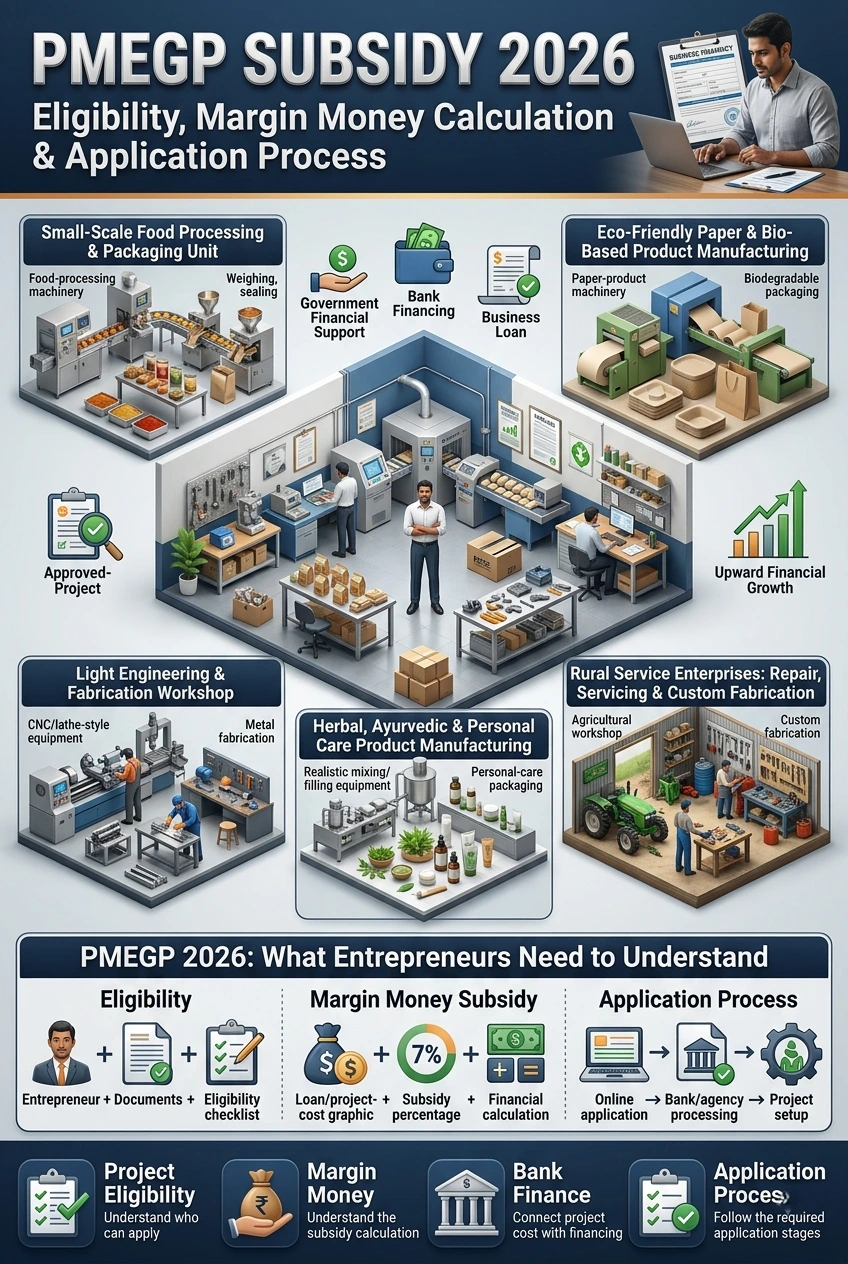
The range of manufacturing and service activities that are funded are truly broad, and the key is finding something that fits local raw material availability, market demand and your comfort and convenience of operation. The following are the consistent ideas which have proven to work in the business successfully even in the project cost limits of PMEGP.
Small-Scale Food Processing and Packaging Unit
One of the best business ideas that the PMEGP applicant can have is food processing as raw materials are easily available locally, demand of food is recurring and the technology is not very complicated at small scale. The cost of setup of a unit for pulses, spices, snacks or ready-to-cook mixes is around ₹15-25 lakh, which is within the manufacturing range.
Packaged food is one of the categories that can develop a strong order book quicker than other food items today, due to the fact that it can be sold both through the traditional Kirana stores and the quick-commerce platforms, which are also dealt with by a small processor, provided they have a quality control approval and a FSSAI license. A large portion of an investment in the project is its cost of machinery (grinders, pouch-sealing units, dryers); this is where the subsidy cushion is most useful.
Explore This Book: Food Packaging Technology Handbook
Eco-Friendly Paper and Bio-Based Product Manufacturing
There are an increasing number of states that are enforcing plastic ban; therefore, paper bags, disposable paper plates, areca leaf plates, and biodegradable packaging have become regular businesses. The cost of the machinery of a small paper-plate or bag making unit is comparatively cheap, project costs are generally in the range of ₹10-20 lakh and the demand is from the caterers, retailers and institutional buyers who are legally mandated to move away from single-use plastic. This is a segment that is right in the middle of the government’s own environmental thrust so the loan approval as well as the sales dialogue is often easier for those applying in this category than for more generic manufacturing lines.
View Full Project Details: Paper Industry & Manufacturing Guide
Light Engineering and Fabrication Workshop
For applicants with ITI/diploma background, a small metal fabrication shop for manufacturing metal furniture, farm implements or industrial components for big manufacturers is a good fit for PMEGP. The basic equipment for welding, cutting, and fabrication would cost ₹20-40 lakh, which is perfect for manufacturing within the ₹50 lakh limit. They are also attractive because of the demand of ancillary demand; for example, factory users in industrial estates often contract small components for fabrication and a new fabricator would have a ready market from day one as opposed to having to create one.
Herbal, Ayurvedic, and Personal Care Product Manufacturing
There has been a marked consumer preference for herbal soaps, hair oils, ayurvedic skin care and natural cosmetics and it is a low entry barrier. Herbal soap/oil manufacturing can be set-up in small scale with contract packaging arrangement within ₹10-18 lakh. This business idea is found to be attractive under PMEGP because the retail profit is high and the demand for e-commerce is increasing, even for small business units, they can sell their product to the buyers outside their district through online business platforms.
Get Detailed Insights from This Book: Herbal Cosmetics Handbook
Rural Service Enterprises: Repair, Servicing, and Custom Fabrication
All good PMEGP ideas are not necessarily manufacturing units. The service category includes mobile and appliance repair centres, two-wheeler servicing garages, computer hardware repair and small custom tailoring/fabrication services, and the project cost ceiling is reduced to ₹20 lakh. The industries have less requirement in terms of machinery investment, have quick cash flow and are especially suitable for the rural and semi-urban entrepreneurs who wish to forgo the long period of break-even as usually required for manufacturing.
Import-Export Opportunity Analysis
There are several categories among PMEGP which directly relate to India’s export basket. The processed food and spices, herbal and ayurvedic products and light engineering components are all on the export promotion radar of various bodies like APEDA as well as Federation of Indian Export Organisations (FIEO). Once a small processor has established quality systems and is FSSAI or BIS certified, he/she has the option of getting export orders through state export promotion cells that hold buyer-seller meet exclusively for MSME manufacturers.
Eco-friendly and biodegradable products have a special export potential. As more and more European and Gulf buyers prefer suppliers who can produce plastic-alternative packaging, Indian units that establish this credibility early pick up export enquiries at a smaller scale than traditional exporters. A similar case applies to ancillary businesses in the light engineering sector that supply parts to the bigger original equipment manufacturers (OEMs) that are likely to get integrated into the OEM’s export value chain in the long run than go head-to-head with foreign buyers.
Indian MSME Success Stories Worth Learning From
In Bihar, Sharda Devi began a small food processing unit of makhana (fox nut) with a small institutional support and expanded it to a multi-district supply operation, supplying retail and bulk customers. Her logic was straightforward and grounded: she adhered to a single product line, invested in early successes to improve sorting and packaging machinery to avoid spreading resources too thin, and dealt directly with wholesale buyers rather than relying on intermediaries. The message for those new to PMEGP is that concentrating efforts on one or two strong product lines, with quality control, typically outweighs trying to do too many products at once.
Kalpana Saroj, who turned Kamani Tubes into a turnaround success story from a state of having very little resource to the tune of Rs 1,000,000, is often quoted in the MSME circles for one single principle: Every rupee of borrowed money has to be backed by a clear operational plan rather than just a feeling of optimism. When new entrepreneurs are looking at project reports for PMEGP, they tend to ignore this discipline and overestimate the sales figures without any solid market grounds — which is the very thing the government emphasises against in its guidance.
A small enterprise packaging manufacturer, such as Vijay Sharma of the small-scale packaging enterprise of the Uttar Pradesh (U.P.) case study frequently mentioned in the DIC records, established an enterprise for making corrugated boxes, which expanded primarily driven by the packaging requirements of FMCG and e-commerce products and brands. He deliberately limited his product range, standard box sizes of known industries close by which reduced the complexity of the machinery, enabling him to achieve capacity utilisation sooner than others bidding for custom orders. It’s a helpful tip for the first-time entrepreneur to remember that a focused product line that is well done can reach profitability quicker than an ambitious, unfocused product line.
Getting Your Project Report Right
A large share of PMEGP rejections trace back to one document: the project report. Banks and Task Force committees scrutinise the technical and financial assumptions closely, and a report with unrealistic sales projections or vague machinery costing rarely survives appraisal. We at Niir Project Consultancy Services (NPCS) provide professional consulting for the preparation of Market Survey cum Detailed Techno-Economic Feasibility Reports (DPRs) for setting up new industries or businesses.
Our reports include detailed manufacturing processes, market research and demand analysis, process flow diagrams, product mix and capacity planning, machinery and raw material details, and complete project financials with profitability analysis. Our objective is to help entrepreneurs evaluate feasibility, profitability, and long-term scalability before investing, so that the numbers presented to the bank hold up under real scrutiny rather than collapsing at the first appraisal question.
Build a profitable business with the right idea
PMEGP Margin Money Subsidy: Data Table
The table below summarises the subsidy structure so you can estimate your own margin money quickly.
| Applicant Category | Urban Area Subsidy | Rural Area Subsidy | Bank Finance Share |
| General Category | 15% | 25% | Up to 90% |
| Special Category (SC/ST/OBC/Minority/Women/Transgender/Ex-servicemen/NER/Hill & Border/Aspirational Districts) | 25% | 35% | Up to 95% |
| Max Project Cost – Manufacturing | ₹50 lakh | – | – |
| Max Project Cost – Service/Business | ₹20 lakh | – | – |
Worked Example: Margin Money Calculation
Consider a special category applicant in a rural area setting up a food processing unit with a project cost of ₹20 lakh. At a 35% subsidy rate, the margin money works out to ₹7 lakh. The applicant’s own contribution, typically 5% for special category, comes to ₹1 lakh. The remaining ₹12 lakh is financed by the bank as a term loan, repayable over 3 to 7 years after an initial moratorium period. This is the calculation logic every applicant should run before approaching a bank, since it shapes how much working capital actually needs to be arranged.
The Bottom Line
PMEGP remains one of the more practical entry points into manufacturing and service business ideas in India, precisely because it reduces the equity burden on first-generation entrepreneurs while keeping the process linked to formal banking. The applicants who succeed are rarely the ones with the biggest project cost; they are the ones with a realistic, well-documented project report, a product chosen for genuine local demand, and a clear understanding of what the subsidy calculation actually means for their repayment schedule. Get that groundwork right, and PMEGP can turn a modest idea into a functioning, profitable small enterprise well within a year of applying.


