





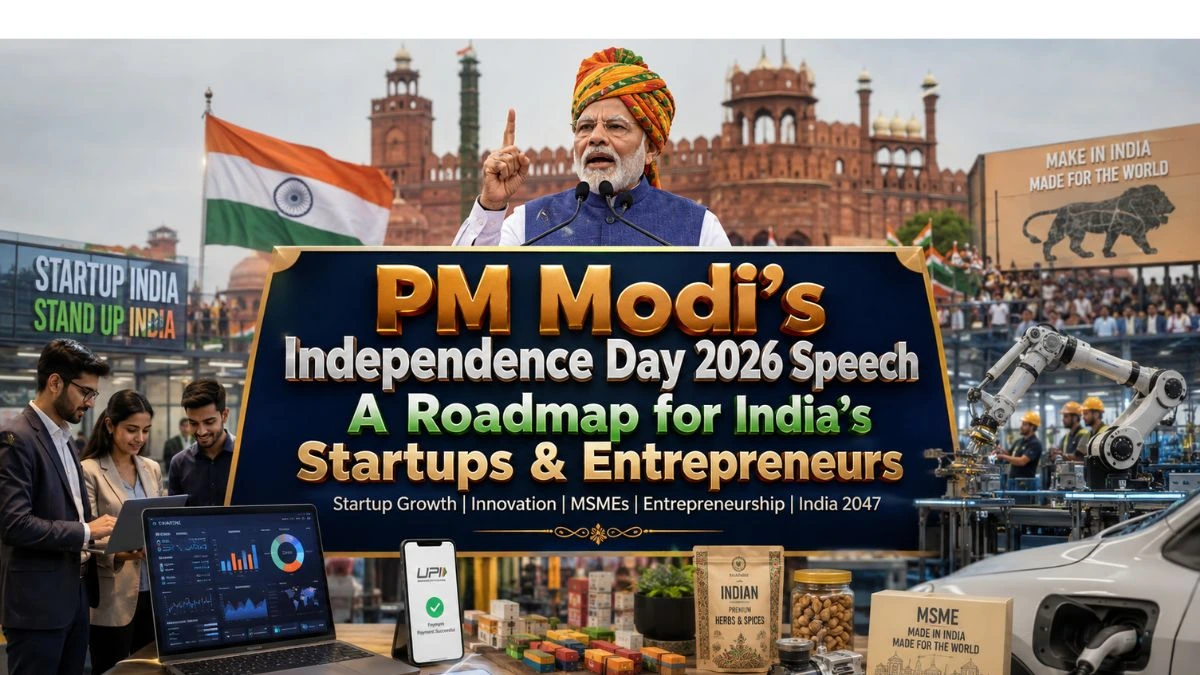
PM Modi Independence Day 2026 Speech
The Red Fort speech is not just an annual oratory; it is a way of indicating the direction of the country’s policy energy for the coming year. India is celebrating its 80th Independence Day on August 15, 2026, with Prime Minister Narendra Modi delivering his 13th consecutive Independence Day Address from the Red Fort. Celebrations for the first time since Independence, included the complete rendition of Vande Mataram as it was written 150 years ago. However, in the context of the symbolism, the hour and 18-minute speech delivered a lot of very plain and straightforward messages for the young founders, the innovators and the small business owners of India.
This speech is for any startup, that is considering starting one or anyone who just wants to see the direction of India’s entrepreneurial economy. What this means to you and how you can act on this through existing support (such as project consultancy platforms like NPCS).
Related Article: How Indian Industries Are Growing Under PM Modi: A Founder’s Field View
The “Sapta Dhara” Vision: Seven Streams of Growth
The main part of this year’s speech was a new blueprint, which the Prime Minister termed as “Sapta Dhara” — seven streams of national strength, taken from the Sapta Sindhu, the seven sacred rivers of the Vedic era that laid the foundations for early Indian civilisation. The highlights compiled by News Gram says these seven streams include:
- Manufacturing and quality
- Fishing and seafood processing
- Technology and innovation
- Connectivity and infrastructure
- Defence
- The green and blue economy sectors.
- India’s soft power
PM Modi said that these seven streams can take India to the next five to seven years an achievement it could not do over the past five to seven decades. This for the entrepreneurs is a diagram of where the government wants private money, ideas and manufacturing capacity to go. Almost all these seven streams — ranging from agri-tech to food processing, from green energy to defence manufacturing — have their presence already in the Indian start-up ecosystem, and are expected to see further attention and policy support in the near future.
As reported on ThePrint and fully transcribed by The Singju Post, the entire speech illustrates a government that wants entrepreneurship to feature in the national agenda instead of being a sideline.
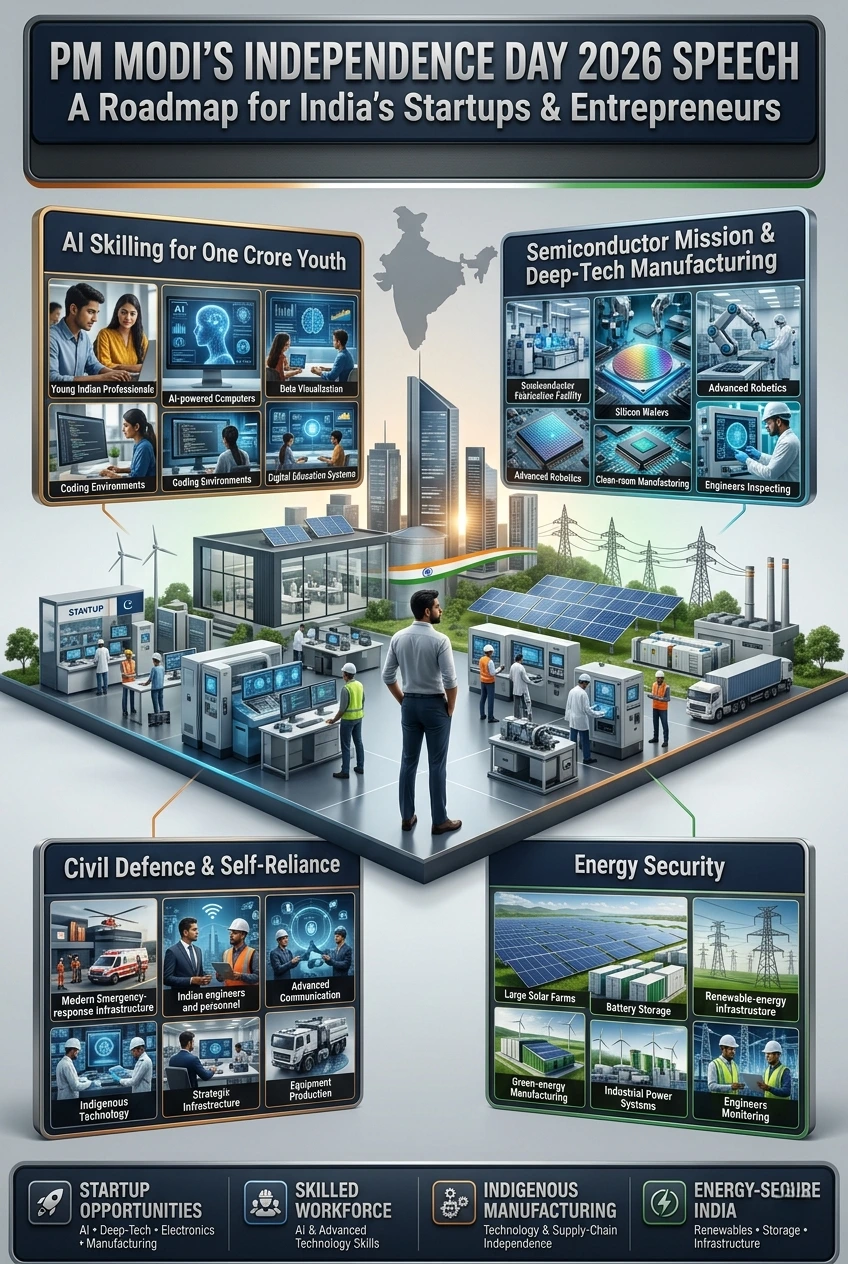
AI Skilling for One Crore Youth
The most clear-cut signal to the startup and tech community was the promise to train more than one crore (10 million) young Indians in AI skills in the next one year. The Prime Minister described this as a key element of India’s vision to become a leading force in the field of AI, emphasizing that the youth are the “driving force” for the nation to realize its goal to achieve Viksit Bharat, or a developed India, by 2047.
This is important for AI and deep-tech startups because I) they are most likely still in the process of scaling and II) building a competent team of experts is crucial to their success. First, it indicates a massive effort to boost the number of homegrown AI talent, thus directly solving one of the major issues for startup companies – the availability of skilled AI engineers. Second, the downstream effect of this kind of mass AI literacy is that more businesses are going digital, more government departments are implementing AI tools, and more citizens are becoming accustomed to using AI-powered products. This is a marketplace opportunity, not just a skilling effort.
Semiconductor Mission and Deep-Tech Manufacturing
The Prime Minister also detailed India’s Semiconductor Mission, saying that seven to eight semiconductor manufacturing plants would come up within a year or two, apart from three existing plants. He reiterated that India made the chips will also be exported, making the country a viable option in the global supply chains for semiconductors.
It has a huge impact on India’s start-up ecosystem, including hardware, electronics, and deep-tech businesses, which have been relying on imported parts for long. This gives electronics, IoT, automotive technology and defence hardware companies greater opportunities to create products from within India, reduce supply chain delays and save on costs, areas where India has historically lacked manufacturing expertise.
Access Complete Business Plan: Transistor and Semiconductor
Civil Defence, Self-Reliance, and Energy Security
The Prime Minister also spoke about building a large, modern civil defence volunteer force and about India becoming a global hub for advanced defence manufacturing — a sector where, as the government noted at an earlier event this year, more than a thousand defence startups are now operating in the country, working on drones, anti-drone systems, AI-based surveillance, and robotics.
On energy, the government reiterated its goal of 100 GW nuclear power capacity by 2047 and five new reactors are to be constructed in this decade, based on the framework of the SHANTI Act, 2025. As India accelerates the development of its energy infrastructure to meet new manufacturing demand, clean-energy and climate-tech startups in the area of grid technology, storage and industrial decarbonisation will reap the rewards.
Get Detailed Insights from This Book: Solar PV Power and Solar Products Handbook
A Decade of Startup India: The Foundation Already Laid
This year’s speech builds on momentum that the government has been building steadily. In January 2026, the Prime Minister marked ten years of the Startup India initiative — launched on January 16, 2016 — at an event where he interacted directly with founders at Bharat Mandapam in New Delhi. According to the official government readout on Startup India’s decade milestone, the programme has helped recognise more than two lakh (200,000) startups across the country, strengthening institutional support, access to capital, and mentorship networks.
The Prime Minister had also mentioned that at the Startup Mahakumbh event earlier, India’s number of recognised startups had crossed 1.25 lakh and over 45 per cent of the startups in India are led by women and the country has now become the third largest startup hub in the world with 110-plus unicorn startups. If the speech made this Independence Day is taken together with the preceding year’s address, it’s not just an announcement this year, it’s the next step in a consistent policy trajectory of over the past decade, which has been focused on a path from a ‘job-seeker’ to a ‘job-creator’ India.
You can find information on official startup registration, tax benefits and funding schemes directly on the Government’s own Startup India portal and get detailed information on the other aspects of the digital economy through Digital India and MyGov.
Where NPCS Fits into This Vision
Government policy sets the direction, but entrepreneurs still need practical, on-the-ground help to convert a vision like “Sapta Dhara” into an actual, bankable business. This is where organisations like Niir Project Consultancy Services (NPCS) play a useful role alongside government schemes.
NPCS is an ISO 9001:2015-certified, DUNS-registered project consultancy that has worked with entrepreneurs, startups, and MSMEs since 1992, across more than 50 industries. According to its own about page and service overview, NPCS provides:
- Detailed Project Reports (DPRs): covering manufacturing process, plant layout, machinery selection, raw material sourcing, and financial projections — the kind of document banks and investors typically require before releasing funding.
- Techno-economic feasibility studies: assessing whether a business idea is commercially viable before an entrepreneur commits capital.
- Business plans and market research reports: including demand-supply analysis, competitor mapping, and growth forecasts, published through its allied platform Entrepreneur India.
- The Startup Selector tool: a free, instant business-idea matching tool built on a database of over 12,000 project profiles, which lets aspiring entrepreneurs — including Non-Resident Indians exploring manufacturing investment in India — filter ideas by budget, ROI, and break-even timeline, as explained in this Startup Selector overview.
- Guidance on government subsidy schemes: such as the Prime Minister’s Employment Generation Programme (PMEGP), which offers 15–35 percent margin-money subsidy on projects, and the CGTMSE scheme, which provides collateral-free credit guarantees of up to ₹5 crore for small manufacturing units, as detailed on the NPCS FAQ page.
In practical terms, this kind of consultancy support complements the government’s Sapta Dhara priorities well. An entrepreneur inspired by the manufacturing, agri-processing, or green-economy themes of the Independence Day speech can use tools like the Startup Selector to shortlist a viable business idea, then commission a detailed feasibility report before approaching a bank or the PMEGP scheme for funding. This bridges the gap between a national policy announcement and an actual, fundable business plan on the ground — which is often where good ideas stall.
Identify high-growth industries before others do
Why This Matters for India’s Entrepreneurs
Put together, the Independence Day 2026 speech reflects three consistent themes that matter for anyone building a business in India today:
- Deep-tech and manufacturing are being actively de-risked. Through the Semiconductor Mission, nuclear energy expansion, and defence manufacturing push, the government is trying to build the underlying industrial base that hardware and manufacturing startups have historically struggled without.
- Talent supply is being scaled deliberately. The AI training commitment for one crore youth, alongside free online coaching for competitive exams, is meant to widen the pool of skilled people startups can hire from — while also easing the financial burden on families investing in their children’s futures.
- Sectoral priorities give founders a clearer signal. The Sapta Dhara framework — manufacturing, agriculture and food processing, technology, infrastructure, defence, green/blue economy, and soft power — effectively tells entrepreneurs where policy support, incentives, and public procurement are likely to be concentrated over the next several years.
None of this guarantee’s success for any individual startup, of course. But it does suggest a policy environment that continues to reward founders building in manufacturing, deep-tech, agri-tech, clean energy, and defence-adjacent sectors — supported by a startup ecosystem that has grown from a handful of recognised startups in 2016 to well over two lakhs today.
Final Thoughts
For India’s entrepreneurs, the message from this year’s Red Fort address is fairly consistent with the last decade: the opportunity is real, the sectors are getting clearer, and the support infrastructure — from Startup India registration to consultancy services like NPCS that help convert ideas into bankable project reports — is more mature than it was even five years ago. The task now is execution: picking the right sector, validating the idea with solid feasibility work, and using the schemes and mentorship already on offer.
As India works toward the 2047 vision of a Viksit Bharat, the founders who align their businesses with these seven streams — manufacturing, agriculture, technology, infrastructure, defence, green and blue economy, and soft power — may find themselves building not just a company, but a part of the country’s next growth chapter.


