




BHAVYA Rasayan Scheme 2026
It appears that outsiders are barred out of chemical manufacturing. It is not. Many of the world’s reputable chemical companies started as small partnership firms with people having no industrial background. Before they built anything, they knew who they had in mind as their buyer. The same approach used in this article is used when it comes to business ideas, but instead of what you make, it’s who pays. It then takes you down a helpful (and straightforward) seven-step entry strategy that you can proceed with step-by-step.
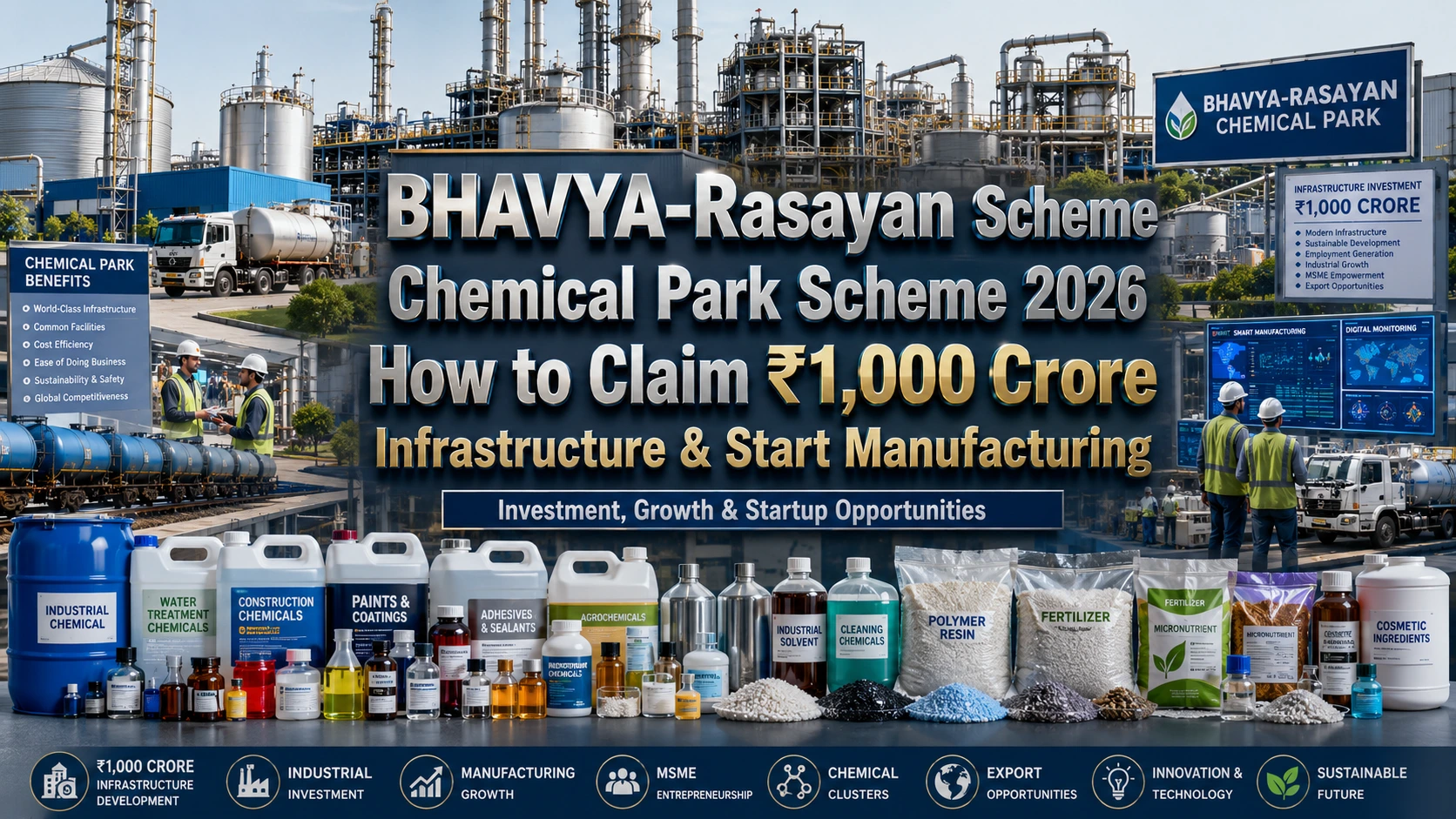
The policy backdrop is very helpful too to a first-timer. Union Cabinet has approved the project under BHAVYA-Rasayan scheme to construct three dedicated chemical parks with shared infrastructure at a cost of ₹3,030 crore. That’s more important to a beginner than any subsidy cheque. It actually implies that you do not have to construct the costly components, but instead rent them.
Start With the Buyer, Not the Molecule
Why Product-First Thinking Fails Beginners
New promoters frequently become enamored of a product advertised in print. Then, they find that the buyers already have three trusted suppliers. The experienced consultants work the other way round. They select an industry with growth potential and learn what they buy or don’t buy, and are concerned about and then select the chemistry. This means that the market question is resolved prior to the capital commitment.
The Downstream Industries That Buy the Most
The same buying sectors are mentioned over and over in government policy documents. Chemical inputs are required for agriculture, textiles, pharmaceuticals, nutraceuticals, construction, automobiles and electronics. All of these are growing. In this regard, they have their own set of needs and gaps. The following ideas are based on that map.
Business Ideas Mapped to India’s Biggest Buying Industries
Selling to Agriculture
Most people don’t realise how much chemistry is involved in farming. A formulation unit is required to transform technical grade pesticide into emulsifiable concentrate or suspension concentrate or granules; and does not require a significant amount of capital compared to the molecule. Patience is required to register under the Insecticides Act, and that’s why it protects those who’ve taken the time for registration. In addition to the traditional agro-chemicals, there is a growing demand for biopesticides, bio-stimulants, micronutrient mixes, as export buyers increasingly require free-from products.
This really does give a first-time person with rural contacts a real advantage since it is difficult to get to dealers than it is to make the product. If you are a bigger brand, contract formulation is a logical method to begin to earn income while your own brand is growing in recognition.
Selling to Textiles
Huge quantities of dyes, dye intermediates, sizing agent, softeners, finishing chemicals, and effluent treatment chemicals are used in the textile belts of India. This is an industry where suppliers who are close by are rewarded as freight and delivery speed are determining factors of many orders. There is also constant pressure on textile processing houses for effluent compliance that also demands regular use of chemicals for effluent treatment and cleaner auxiliaries.
A novice may enter in the blending of finishing chemicals or auxiliaries, where the application of more complex synthesis skills is not as critical. In addition, mills prefer to be supplied by a company that consistently addresses shade and consistency issues. These very sticky customers are incredibly valuable after you’ve won them.
Get Detailed Insights from This Book: Modern Technology of Textile Dyes & Pigments
Selling to Pharmaceuticals and Nutraceuticals
This is the most challenging of all the buyer groups, and also the most satisfying. India has a significant import dependency for the major raw materials and intermediates provide good import substitution potential. Expectations of buyers are premium prices but documentation, impurity profiles and audit readiness from first consignment. As such, a first-time promoter should allow for a quality control lab and experienced chemists to come before any dreams of capacity. The less aggressive approach of nutraceutical ingredients creates a gentler entry, with that ingredient’s specifications being simpler and margins attractive. Either way, team up with an experienced process chemist from the start. Technical credibility is the key in this segment that price can never open.
Selling to Construction
All construction sites today are utilizing chemistry that was once voluntary. Sales of waterproofing compounds, tile adhesives, concrete admixtures, grouts and sealants are increasing in all states. Unlike other sectors, a founder can create a real brand here and not just provide at the name level. Discounting is no significant sales driver; in fact, dealer networks and applicator training and site demonstrations are. Capital remains moderate due to the fact that most products require dispersion and blending, rather than reactors. But the credit is a must for dealers and that’s where discipline of working capital makes the difference. Be local, get contractors on board, then expand district by district rather than go national too early.
Selling to Automobiles
Metal treatment chemicals, coolants, brake fluids, adhesives, sealants, paint additives and industrial cleaners are attracted to vehicle manufacturing. This demand is very clustered around Pune, Chennai and Gurugram, with auto component clusters being concentrated in these areas. A small supplier’s first customer base isn’t in terms of vehicle assemblers, but rather in terms of component makers. Order volumes are consistent and predictable only after you have been approved, and quality audits are rigorous, with documentation a key concern. Further, the move towards EVs is generating new requirements for thermal management fluids and other niche adhesives. For a novice with 2-3 component manufacturers the business can be a steady one without having to sell directly to a major auto manufacturer.
Get Detailed Project Report (DPR): Automobile Industry & Auto Components
Selling to Electronics and Batteries
As this is the latest entry into the list, it is the least crowded. Today, most of the high-purity solvents, electrolyte salts, binders, cleaning agents and specialty gases are imported. Purity spec is a demanding one and it’s appropriate for a promoter who wants to invest in purity technology and really good instruments. The qualification processes take a long time and rejection hurts. Yet the supplier list is limited with government incentive schemes actively pushing for more customers. Play this as a long shot wager with a high payoff. Newcomers to the industry should start with a less complex raw material that is of a high level of purity instead of jumping into battery-grade material right away.
Selling to Personal Care and Home Care
Surfactants and specialty ingredients are essential to every shampoo, detergent, cleaner and soap. The revenue typically is not cyclical, like that in the industrial sectors, but instead is sensitive to household income, which gives it unusual stability in recessions. Both multinational companies and fast-growing regional brands buy from independent suppliers. Contract manufacturing provides a low-risk approach to a new product launch, the formulation is often dictated by the client, and the specification is also likely to be supplied by the client.
Many units began this way, took the quality discipline imposed by large buyers, and developed their own institutional cleaning lines with far more favourable terms. That’s a much safer way to go than going out with a consumer brand on day one for a first time.
Check Out This Recommended Book: Surfactants, Disinfectants, Cleaners, Toiletries, Personal Care Products Manufacturing and Formulations
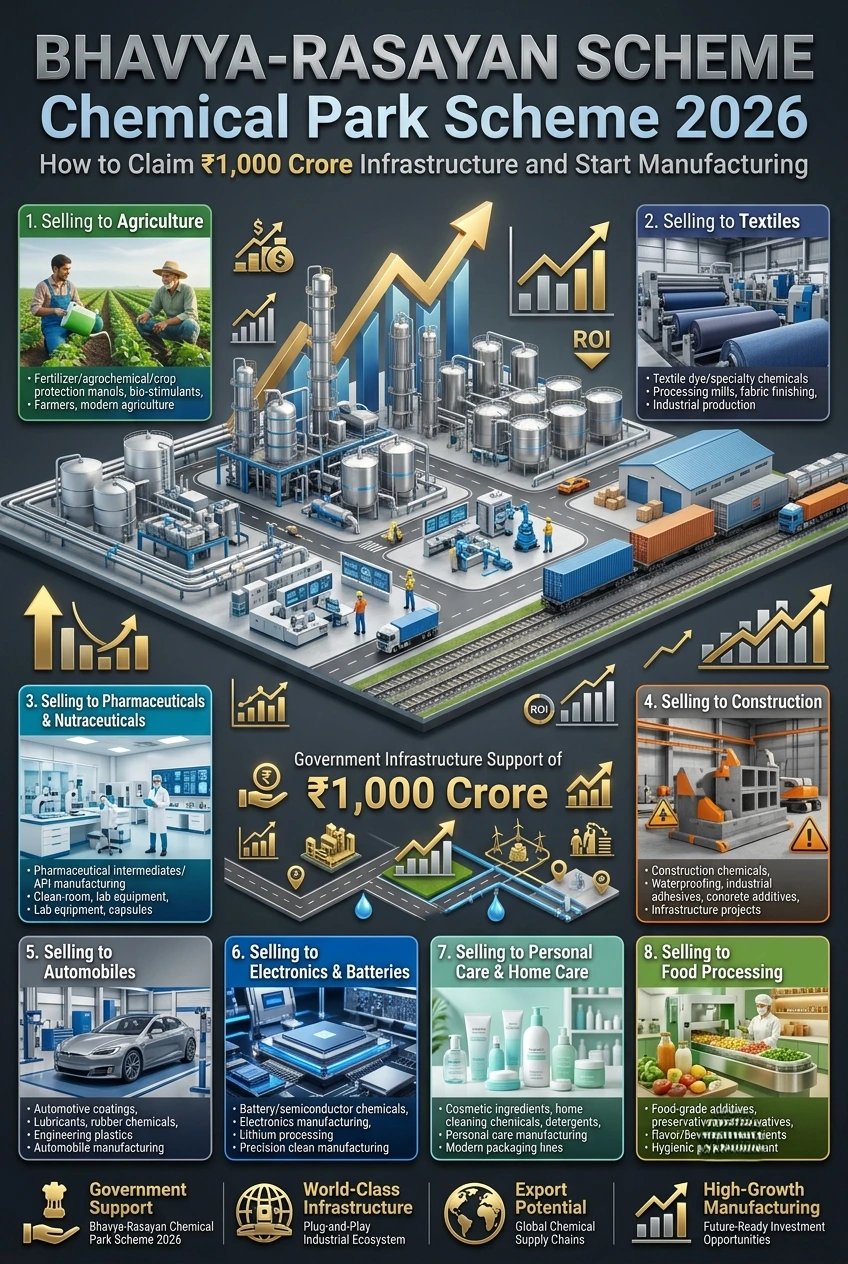
Selling to Food Processing
Processing aids, emulsifiers, preservatives, anti-caking agents and food grade cleaning chemicals are purchased by food plants. The primary constraint is regulatory approval which demands compliance and traceability for food contact products. Once you clear that barrier, it’s your advantage as you will not have to worry about casual competitors anymore. There is an interesting segment about oleochemical derived additives, using vegetable-based inputs produced in India. Consumption of packaged foods has also been increasing and so is the demand. This segment is not as crowded as it might seem at first glance if the person is a first-time founder and has some patience for certification, and willing to invest in clean manufacturing practice.
Related Article: Top Food Processing Industry Consultants in India: A Complete Guide
The Seven-Step Entry Plan
Please do the following steps in order. The top reason for first projects going astray is skipping ahead.
Step 1 — Choose One Product, not a Category
Don’t think about getting into specialty chemicals. Design to produce a known specification product. A tight selection helps you dimension machines properly, calculate raw material costs accurately and approach targeted buyers. The range can be expanded when the plant is running. The wide plans are lofty and unfeasible on the ground.
Step 2 — Prove the Demand on Paper
See if the product is already imported into India. If it does, then the demand is proved and you need only to change the source. Then list the actual companies that purchase it, and estimate how much it is used by those companies. Communicate with 2-3 of them prior to finalizing capacity. This is the one step that makes the difference between realistic projects and hopeful projects.
Step 3 — Pick the Location Before the Machinery
Utility cost, freight, manpower available and clearance speed are determined by location. Often times, a chemical park or a functional cluster will outperform cheap land in isolation. A fifth of your capital can be saved by using shared effluent treatment. Compare two or three states – incentives vary widely from one to the next. Finalising plant layout should only be done after the location is fixed.
Step 4 — Start the Licences Early
It takes longer to get approvals than it does to build, start them at the same time. Requirements: Udyam, GST, factory licence and consent of the state pollution control board for starting and running a factory. Hazardous or flammable materials must be approved by PESO. Registration of agrochemical products is required under the Insecticides Act. Founders who start paperwork after placing machinery orders are wasting the interest on equipment that remains idle.
Step 5 — Lock the Technology Before the Equipment
First find your process path, then purchase machines to fulfill the process path. It’s quite frequent and costly to reverse this. This can mean licensing an existing process, enlisting the services of an experienced process chemist or collaborating with a technology provider. Regardless of which way you go, make sure you have it in writing that you will get a guaranteed yield and quality before paying for it.
Step 6 — Arrange Funding in the Right Order
Concurrently approve the term loan and working capital limit. If a plant has no working capital, it is idle as interest money is added onto it. Operating cost: Three to four months of operating cost should be kept as working capital. Furthermore, keep in mind that most state subsidies are received after commissioning, and should not be considered “up-front money.
Step 7 — Win the First Customer Before You Commission
Do not send trial samples after, send them during construction. Qualification for buyers may take 3-6 months and the export approval will take longer. That process can be done in parallel with commissioning, which uses one-quarter of the idle capacity. This means that your plant begins to profit from almost the moment you get it running.
Government Support a First-Timer Should Claim
Start With MSME Registration
The Udyam registration is free and simple; the majority of the benefits follow. The Ministry of MSME runs credit, cluster and technology upgrade programmes. In the meantime, CGTMSE is offering loan facilities with guarantee cover of up to ₹10 crore without any collateral. PMEGP offers margin money subsidy for small enterprises and ZED or RAMP programme offers support for quality improvement.
Understand the Parks Scheme Properly
It is not the scheme where the promoters are paid directly from the BHAVYA-Rasayan scheme. It provides financing for common facilities within three specific chemical parks, such as hazardous waste facilities, pipelines, warehouses, water supply, steam networks and common effluent treatment. These parks are being auctioned among states and they’ll have to pay a minimum of ₹500 crore apiece. The benefit for the beginner is indirect, but great. You do not finance the costly infrastructure, you rent.
Check State and Product-Linked Schemes
The State policies often include capital subsidy, interest subvention, reimbursement of SGST and power tariff relief, which can be as high as 15-25 per cent of the project cost. Other schemes, such as PLI for bulk drugs and key starting materials are added for product specificity. Invest India and Department of Chemicals and Petrochemicals.
Choose the right startup backed by real market demand
Import and Export: Where a Beginner Should Look First
View the list of imports before the export market. India’s export of chemicals is in the vicinity of US$ 250 billion, and ranks approximately at 14th position globally in chemical exports; however, the domestic market is near the eighth position with respect to imports of chemicals in the world, according to industry data compiled by IBEF. Where already a port in India has been reached, this has demonstrated demand and a known price. It’s much easier to replace an import than build a new market.
It is possible to export later and with consistency if it’s good quality. Once ready, RoDTEP refunds embedded taxes, Advance Authorisation enables duty-free input imports for export production and EPCG enables zero-duty machinery for export production. They are based with the Directorate General of Foreign Trade. Further, CHEMEXCIL provides funds for buyer meets and coordinates product registration and the Indian Chemical Council conducts safety and Responsible Care programmes to assist small units at the buyer audits.
Three Companies That Started Very Small
Sudarshan Chemical Industries — The Rathi Family
Sudarshan was started with an initial investment of around ₹3.4 lakh by Dr. R.J. Rathi and L.J. Rathi in Pune. Engineered a lot of their own equipment and created locally-sourced pigments, which were unavailable elsewhere. That was a limitation, but it was a strength because they had to do it because of the constraint. The company subsequently emerged as the largest pigment manufacturer in India and thence expanded through overseas acquisitions to gain worldwide recognition. The lesson is encouraging for a first-time. With limited capital, resourcefulness is essential and resourcefulness accumulates over the decades.
Fine Organics — Ramesh Shah and Prakash Kamat
The founder of Fine Organics, Ramesh Shah, is a Mumbai businessman who has an experience in chemical trading, while the other is Prakash Kamat, who has a technocrat background and has been trained from the Institute of Chemical Technology. They would not have been able to create the company without each other. The technocrat knew how to do the process; the trader knew markets and customers. They have concentrated on oleochemical based food and plastic additives, for which vegetable-based inputs are available in India. The one thing that is most useful from that partnership is the partnership model itself. Don’t pretend to know more than you actually do. Look for a person who has it.
Meghmani Organics — Jayanti Patel and Partners
Meghmani started life as a small partnership firm in Gujarat making pigments, founded by Jayanti Patel along with Ashish Soparkar, Natwarlal Patel and other partners. As volume increased it was later transformed into a limited company. The group expanded from pigments to agrochemicals and basic chemicals and always developed new chemistry on top of the existing understanding. The structure is as important to the story as it is to first-time founders. It began as a partnership and scale was only adopted once it proved cost-effective.
The Pattern Behind All Three
None of these founding fathers waited for perfect conditions. Both started at a small scale, got to know the process well and only grew into adjacent chemistry. In addition, the three combined commercial and technical skills, in one or across partners. This is the industry’s best predictor of whether someone will live or die.
Put the Plan on Paper Before You Spend
Most first projects don’t fail due to chemistry, they fail due to planning. Promoters overestimate the utility load or the effluent volume or design a plant based on an unconfirmed demand. These issues are identified by a proper techno-economic study which is still inexpensive to fix.
At Niir Project Consultancy Services (NPCS) we offer professional market survey cum detailed techno-economic feasibility report preparation services for new industries and businesses. Our reports include the manufacturing process, market research and demand analysis, process flow diagrams, product mix and capacity planning, machinery and raw material details, and complete financials of the project with a profitability analysis. The objective is simple. We provide feasibility, profitability and long-term scalability analysis before investing.
These reports are carefully read by banks and state agencies. Hence, a properly prepared report will save you from a costly mistake and ensure that money discussions go much more easily.
Buyer Industry Demand Map
Use this table to match your background and contacts against a buying industry.
| Buyer Industry | What It Buys From Small Suppliers | Entry Investment | Beginner Difficulty |
| Agriculture | Formulations, biopesticides, micronutrient blends | ₹3 – 12 crore | Medium |
| Textiles | Auxiliaries, finishing chemicals, effluent chemicals | ₹1 – 6 crore | Low |
| Pharmaceuticals | Intermediates, key starting materials | ₹15 – 60 crore | High |
| Construction | Adhesives, admixtures, waterproofing compounds | ₹1.5 – 6 crore | Low |
| Automobiles | Metal treatment, coolants, adhesives, cleaners | ₹3 – 15 crore | Medium |
| Electronics and batteries | High-purity solvents, electrolyte materials | ₹20 – 80 crore | High |
| Personal and home care | Surfactants, specialty ingredients | ₹5 – 20 crore | Medium |
| Food processing | Emulsifiers, processing aids, food-grade cleaners | ₹2 – 10 crore | Medium |
Approval Checklist for a New Chemical Unit
| Approval | Issuing Authority | When to Apply |
| Udyam registration | Ministry of MSME portal | Before anything else, it is free |
| GST registration | GST department | Alongside company formation |
| Consent to establish | State pollution control board | Before construction begins |
| Factory licence | State factories directorate | During construction |
| PESO licence | Petroleum and Explosives Safety Organisation | If handling flammable or hazardous material |
| Consent to operate | State pollution control board | Before commissioning |
| Insecticides Act registration | Central Insecticides Board | Only for agrochemical products |
| Import Export Code | Directorate General of Foreign Trade | Before first import or export |
Indicative First-Project Timeline
| Phase | Main Activity | Indicative Duration |
| Planning | Product selection, feasibility study, site comparison | 2 – 4 months |
| Approvals | Registrations, consent to establish, factory licence | 4 – 8 months, run in parallel |
| Funding | Term loan and working capital sanction | 2 – 4 months |
| Construction | Civil work, plant erection, utilities | 6 – 10 months |
| Trials | Commissioning, sample supply, buyer approval | 3 – 6 months |
| Ramp-up | Reaching break-even utilisation | 6 – 12 months after commissioning |
Timelines overlap heavily in well-run projects. Sequential planning is what stretches a two-year project into four.
Frequently Asked Questions
I don’t have a chemistry background. Is it still possible to begin a chemical business?
Yes, and numerous successful founders have done just that. A trader is working with a technocrat to build Fine Organics. Skipping the technical skill altogether is not what you can do. Get a senior plant chemist, or find a technical partner as early in the project as possible, and it’s an essential budget item, not an add-on.
What industry does it make the easiest thing to provide for a first-time entrepreneur?
These are typically the gentlest taking points: textiles and construction. Both purchase blended products, instead of complex synthesis, both have buyers throughout the country and both can overlook a new supplier who can rectify issues quickly. Other industries like pharmaceuticals and electronics offer higher pay, but come with a more difficult-to-acquire culture of documentation discipline.
But should I begin by going into contract manufacturing or by developing a brand?
The typical first step is typically contracting manufacturing. There is learning of quality discipline, revenue is generated and the formulation and specification are provided by customer. Make your own label when the process is stable and market is known. When starting a brand on day 1, you’re taking your chances on marketing in addition to manufacturing.
How to get customers before the plant is open?
Begin in the construction and not after. Go to industry exhibitions, join the export promotion council of the respective industry and pitch to buyers with samples made at the job-work shop. Three to six months is already sufficient for qualification, so running it in parallel means that your plant will make a small profit from the very beginning.
Are you required to work in a chemical park?
Not required but highly recommended for the first project. Capital and approval risk are significantly reduced with shared effluent treatment, utilities and pre-cleared land. When it comes to compliance, a stand-alone unit is bearing the weight of compliance alone, and that’s a lot for a new player in the sector. If land is already available that is appropriate, consider that risk carefully when deciding whether to save.
So, what do you think is the most frequent error made by first time entrepreneurs?
Securing machines prior to the confirmation of process route and buyer. Equipment remains unused until approvals and customer trials are completed, and interest builds up from day one. Before paying out a big sum to a supplier, get your product, process and at least one interested buyer “fixed”.
Final Word: Small Starts Still Work
The profit of chemical manufacture is in preparation rather than capital. Sudarshan started with some lakhs of rupees. Meghmani started out as a partnership company. Fine Organics started out as a trader and a technocrat coming together with their respective assets. None of them waited for ideal conditions.
Your route may be the same shape. Pick a buying sector in which you are familiar. Choose a product inside of it. Verify the need, lock up the site, get early approvals and have your first customer lined up before starting commissioning.
Then it’s just a plant to tend and care for. If you skip it, you will never be able to save the project with any machinery.


