





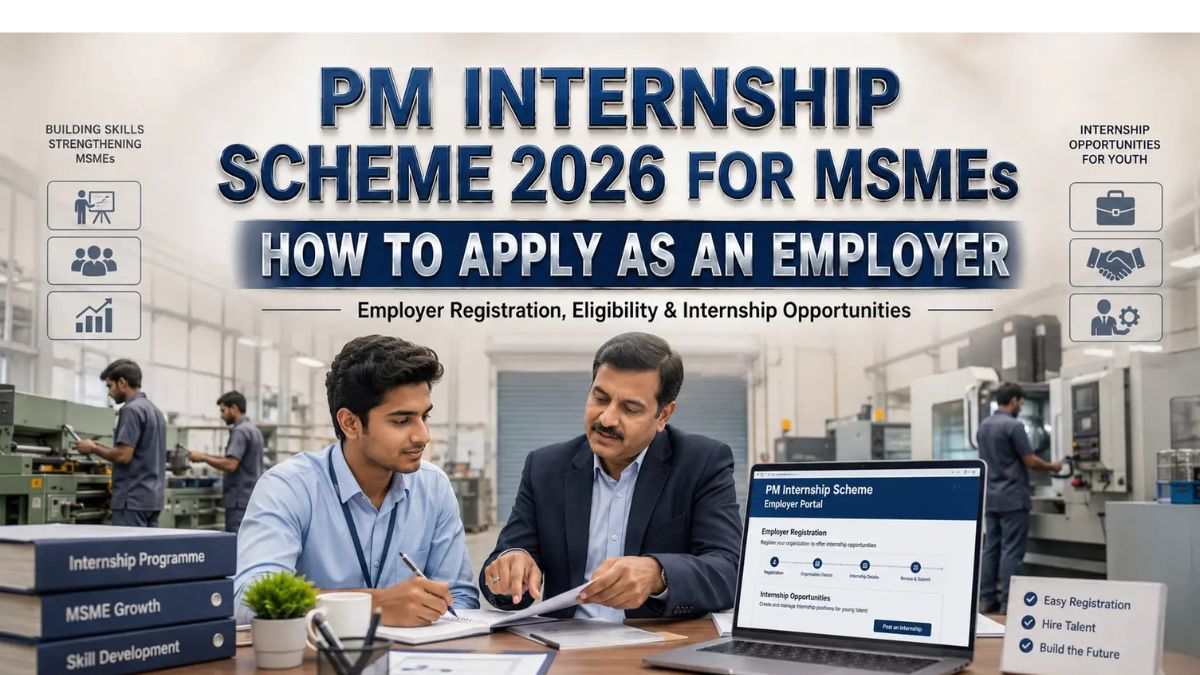
Indian SMEs have been at the same brick wall for years. They required young and talented employees to train, but the government’s internship platform was only available to the top 500 companies with the largest CSR budgets. This was until Pilot Round 3 of the PM Internship Scheme. MSMEs, global capability centres and professional bodies will now be able to register as host organisations and the move has transformed the scheme into a real talent pool and a source of new business ideas for the owners of factories that have been struggling with manpower for too long.
This article takes MSME owners, HR heads, and first-generation entrepreneurs through the entire process: eligibility, stipend-sharing rules, and how to make an internship a full-fledged recruitment program and a cost-saving initiative.
Why MSME Employers Should Look at PMIS Right Now
India’s manufacturing MSMEs have an employment base of about 11 crore people and yet have some of the most adverse skills shortages in the economy. Students leave college with degrees and haven’t had any work experience on the shop floor. As a result, small manufacturers train a new employee for months until the employee is productive. With PMIS this equation is reversed – the government pays part of the wage cost during the training.
The scheme also addresses a location issue which plagued the previous rounds. Employment opportunities for internships were limited in metro cities and candidates from smaller towns were usually making no offers that involved relocation. The wide spread of MSME clusters in all industrial belts, from Ludhiana to Coimbatore to Rajkot, means that an employer of MSME can now be able to provide internships near the candidate’s place of residence. This one single change boosts all joining rates and reduces all attrition.
There’s also a profit motive. The cost of an intern under PMIS is significantly less than that of a fresh full-time employee in the training period as most of the monthly stipend is transferred directly from the government. For a small manufacturer considering the expansion of a quality-control department or an export-documentation department, that subsidy could be the key to hiring sooner instead of later.
Choose the right startup backed by real market demand
Government Policies and Incentives Backing the Scheme
The Prime Minister Internship Scheme, established by the Ministry of Corporate Affairs (MCA), aims to provide 1 crore internships in 10 years in the top companies in India and from this pilot round onwards, the MSME ecosystem too. It’s important to know what the policy shape is, as the rules have changed rapidly since launch.
Pilot Round: What Changed for MSMEs
Previous rounds had limited the number of companies to about 500, most of whom had spent money on CSR, their annual turnover was more than Rs 1,000 crore and net worth was over Rs 500 crore. The number of organisations was increased to around 2,000 in Pilot Round 3, and more significantly, an additional stream for Micro, Small & Medium enterprises, global capability centres and professional institutes like ICAI, ICSI and ICMAI was set up. The statutory bodies such as the Airports Authority of India and Shipping Corporation of India were also in attendance. The government is now directly in talks with the MSME clusters of industrial towns to develop a model to bring interns nearer to home.
Stipend, Duration and Cost-Sharing
Under the new set-up, the monthly allowance for each child has been increased from Rs 5,000 to Rs 9,000, half of which will come from the government and the other half from the host organisation. The internship period has also been reduced from a fixed 12-month period to 6–9 months, more appropriate for a typical project or seasonal hiring cycle of an MSME. The age criterion for interns has been relaxed and now the age range has been reduced to 18-25 years, and the pilot will continue up to December 2026, focusing on providing 1.10 lakh internship opportunities across the country.
Where MSMEs Fit In Central and State Schemes
PMIS is not a standalone for MSMEs. It goes with Udyam Registration, Credit Guarantee Fund Trust for Micro and Small Enterprises assistance and PLI related expansion incentives which are all being availed by many manufacturers. To be eligible to be a PMIS host organisation, an MSME should be Udyam-registered, have a GST registration and be availed of any scheme by the Ministry of MSME. There are also single window portals established by a few state industry departments, which MSME employers can utilise to check with local incentives as part of their internship-based hiring plans, such as MAITRI by Maharashtra’s government, and Gujarat’s iNDEXTb.
Related Article: Industrial Opportunity, Inclusion, and Business Growth under PM Modi
Business Ideas: Functional Roles MSMEs Can Build Around PMIS Interns
It’s just the first step in becoming an employer. The true benefits are in creating internship positions that can also be a new business capability. While this raises the importance of getting a job while being an MSME intern, here are some MSME-tested business ideas on how to make the internship worth its while beyond the term of the stipend.
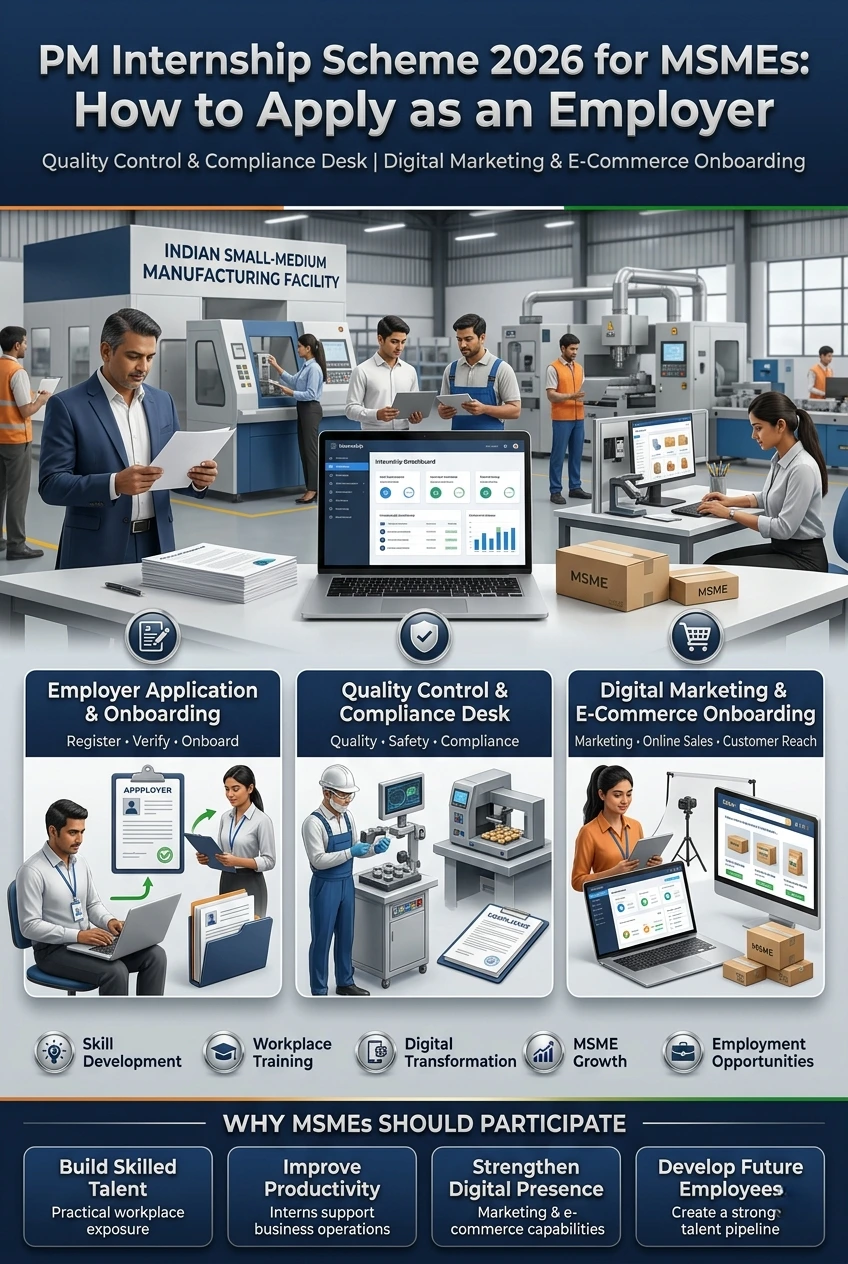
Quality Control and Compliance Desk
Small manufacturers continue to do informal BIS certification, ISO documentation and batch quality checks, typically carried out by an overworked supervisor. Having a science or engineering intern to create a structured quality-control desk provides the unit with a documented process to present to buyers, banks, and export inspectors. With a 6-9 month posting, an intern can establish sampling protocols, keep digital quality logs and prepare the unit for a formal audit by BIS or ISO. That’s not a one-time shot; it’s a capability they’ll have for a long time and it can have a direct impact on their ability to win more institutional orders.
Digital Marketing and E-Commerce Onboarding
A significant number of the manufacturing MSMEs in India are selling just through the dealer network without any presence on GeM (Government e-Marketplace), Amazon Business and IndiaMART. An intern in commerce or marketing can create product listings, do simple SEO for the company website and track bid for GeM. This position requires digital skills over industry experience, so it’s one of the easiest positions for a first-time PMIS employer, and can provide a new sales outlet that continues to bring in orders after the internship.
Export Documentation and Trade Compliance Cell
Most of the MSME exporters are intimidated by the export paperwork, ranging from IEC codes, shipping bills to the Rules-of-Origin certificate under free trade agreements signed by India. The standard operating template for export documentation can be created by a commerce or law intern with the help of the owner’s existing CA or CS. Please check with DGFT guideline for IEC/export compliance. This one simple element can save weeks on a unit’s initial export job and prevent the common compliance issues that often cause payments to be delayed from overseas buyers.
Financial Modelling and DPR Support
Typically, a Detailed Project Report is required prior to bank sanction of a term loan by MSMEs who are considering an expansion of their capacity or a new product line. The owner can train a finance / commerce intern to help with cost sheets, break-even analysis and working-capital forecasting with support from an external expert such as NPCS. It establishes an in-house financial planning routine that most small manufacturers never learn to do on their own and, in the best of cases, it saves the small manufacturer the next time an incoming banker asks if it has considered its financial planning.
Explore This Book: Select & Start Your Own Industry
HR and Shop-Floor Training Systems
Interestingly, the most important task that MSMEs overlook is the one that PMIS relies on – structured onboarding. An HR-focused intern will be able to map out SOP, establish a basic attendance log and a training program that details the safety protocols in place, as well as create a checklist for new hires. Once this system is in place, the next group of PMIS interns or any new worker, enters into a unit with experience in training people quickly.
How to Register and Apply as an Employer: Step by Step
The official PM Internship Scheme portal is used for the core registration with no application fee incurred throughout the process. Before beginning, it is important for MSMEs to have their Udyam Registration number, GST details, PAN, and CIN or LLPIN (if applicable).
- Step 1: Go to pminternship.mca.gov.in and click on the company/employer registration option instead of the youth registration option.
- Step 2: Fill the Organisation’s CIN/LLPIN/Udyam Registration Number, PAN and GST details to validate the Organisation.
- Step 3: Fill organisational KYC – Sector classification (Manufacturing / MSME), Organisational registered address, Bank account for stipend co-contribution and authorised signatory information
- Step 4: Go through the internship opportunities. Define the title of the role, functional area, location, co-contribution of stipend, skills needed, and time in 6–9 months.
- Step 5: Take a look at the candidates available on the portal, based on the AI matching capabilities of the portal, and shortlist or approve the matching profiles for the available role.
- Step 6: Once the candidate is selected, send the provisional offer letter through the portal, and monitor the acceptance on the employer dashboard.
- Step 7: Induct intern, arrange mentor within the workplace and commence monthly stipend co-contribution as per costs sharing formula for the scheme.
- Step 8: Keep attendance and progress log on the portal – this will be part of the intern’s completion certificate and the government’s disbursement schedule.
Currently, the MSME onboarding process is a cluster-by-cluster exercise for Pilot Round 3, so it might be quicker for some units to register their interest via the local FICCI or CII affiliated MSME association before completing the on-line formalities once the portal’s window opens for their sector. It is good to periodically review the portal as MCA is being phased in with sectors and geographies.
Import-Export Opportunity Analysis for New MSME Employers
PMIS internships provide an actual but indirect trade advantage. MSMEs that have developed export-documentation and quality-control skills via interns will have an advantage in complying with buyer audits in the US, EU and Gulf markets. Further, India’s Production Linked Incentive (PLI) marked sectors like electronics components, specialty chemicals, food processing are actively facing a shortage of young employees who are ready for exports. An MSME using its PMIS cohort to establish an in-house muscle early on will gain an edge over others who are still outsourcing all compliance work.
Interns can be deployed at MSMEs in procurement or supply-chain position and assist them in identifying alternative sourcing options for raw materials they are currently sourcing from a single country; most MSMEs are reluctant to do this as no one has the bandwidth to be able to do in-depth research on vendors. Use Invest India to gain access to trade data with sector-specific sourcing intelligence. Creating a viable vendor comparison sheet and getting a Unit’s supply chain de-risked in 6 months will start its productive life.
Indian MSME Success Stories Worth Learning From
There is a common thread in all the MSMEs that have become national manufacturing brands – investing in people and process discipline long before it was ‘material’ to the financials.
Karsanbhai Patel — Nirma
Karsanbhai Patel began manufacturing and selling detergent powder in his backyard in Ahmedabad and selling the product door to door at a small price as compared to the established players. His logic was to maintain the manufacturing process as lean as possible, charge at the bottom end of the range for the mass market and develop the distribution network before creating the image. What’s key for Nirma to have become a national FMCG manufacturer is that Patel saw process efficiency as a competitive weapon — a lesson that any MSME can apply to compete with more well-funded and established manufacturers.
View Full Project Details: Nirma-Type Washing Soap & Powder Manufacturing
C.K. Ranganathan — CavinKare
The founding principle behind CavinKare was simple: rural and semi-urban consumers wanted the quality personal care products they desired but could not afford the large pack sizes. He brought in sachet packaging for shampoo, a manufacturing and packaging choice that changed the way FMCG products brought to small-town India. His story illustrates the power of a small manufacturing business to out-innovate larger rivals, all the while proving that it doesn’t always take much to be smarter — just a better product format that meets an actual void in the marketplace.
Ramesh Chauhan — Bisleri
Ramesh Chauhan, the founder of Bisleri, turned bottled water, which was a niche and almost unknown product in India, into a household necessity before urban India even came to think of bottled water as a necessity. The way he operates reflects a key lesson that all MSME manufacturers need to learn: If you want your business to grow, you need to create manufacturing capacity before demand is visible, but also ensure that your manufacturing quality is consistent.
Where NPCS Fits into Your Expansion Plan
We at Niir Project Consultancy Services (NPCS) provide professional consulting for the preparation of Market Survey cum Detailed Techno-Economic Feasibility Reports (DPRs) for setting up new industries or businesses. Our reports include detailed manufacturing processes, market research and demand analysis, process flow diagrams, product mix and capacity planning, machinery and raw material details, and complete project financials with profitability analysis. If your MSME is using PMIS interns to build a financial-modelling or export-readiness function, our reports give that internal team a professional benchmark to work from, and they help you evaluate feasibility, profitability, and long-term scalability before you commit fresh capital to expansion.
PM Internship Scheme: Employer Snapshot
| Parameter | Current Pilot Round 3 Detail |
| Administering Ministry | Ministry of Corporate Affairs (MCA) |
| Eligible Employer Categories | Large companies (CSR/turnover/net-worth criteria), MSMEs, GCCs, statutory bodies, professional institutes (ICAI, ICSI, ICMAI) |
| Approx. Eligible Companies | Around 2,000, up from about 500 in earlier rounds |
| Intern Age Band | 18 to 25 years |
| Internship Duration | 6 to 9 months (reduced from 12 months) |
| Monthly Stipend | Rs 9,000 per month, shared between government and host organisation |
| Intern’s One-Time Grant on Joining | Rs 6,000 (paid by government) |
| Application Fee | Nil, for both interns and employers |
| Pilot Extended Till | December 2026 |
| Internship Target (This Round) | 1.10 lakh opportunities |
| Portal | pminternship.mca.gov.in |
Conclusion
PMIS has moved from a large-corporate pilot to a genuine MSME opportunity, and that shift matters more than the headline stipend numbers suggest. An MSME that registers early on, designs its internship rolls around real business gaps, and uses the training window to build lasting systems, will come out of this pilot round with more than a batch of trained interns. It will come out with a stronger, more export-ready, better-documented business.
Key Government and Institutional References
- PM Internship Scheme Official Portal
- Ministry of Corporate Affairs
- Ministry of MSME
- Udyam Registration Portal
- Startup India — DPIIT
- Make in India
- GeM (Government e-Marketplace)
- DGFT — Directorate General of Foreign Trade
- Invest India
- FICCI
- Maharashtra MAITRI Portal
- Gujarat iNDEXTb


