





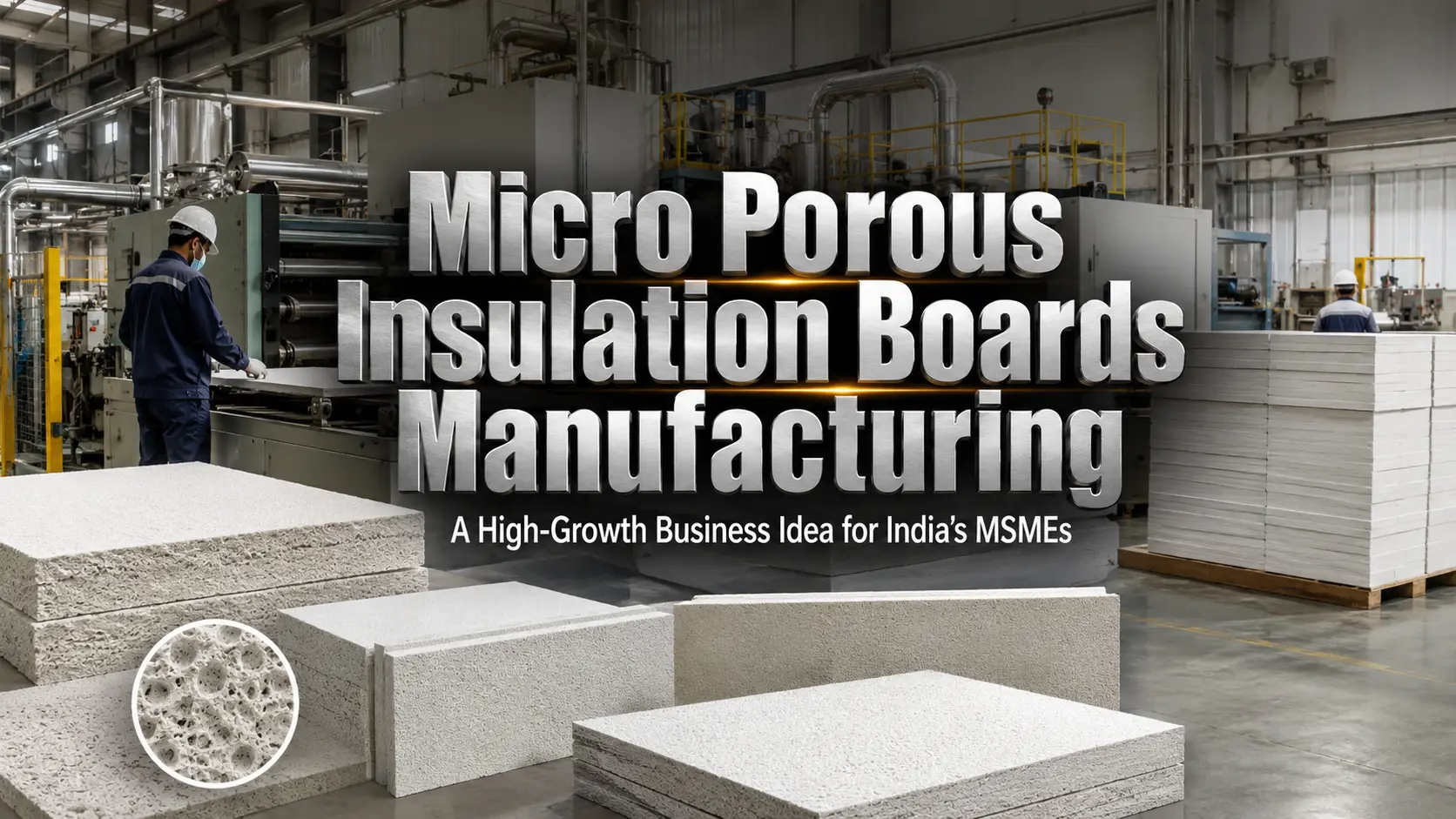
Micro porous insulation boards are emerging as one of the most promising manufacturing business ideas in India and are making their way into the list of other business ideas in India. These boards are used effectively at steel plants, glass furnaces, cement kilns and the rapidly expanding EV battery industry. But nowadays there are very few manufacturers in India which are producing them in India. Despite the efforts of most industrial importers to seek alternatives to high performing micro porous boards from Europe, China or Japan, a real supply gap exists.
This is for entrepreneurs who prefer a technical, high-margin manufacturing business and not a crowded, low-margin business. This article offers explanation on why the sector is worthy of attention, what government schemes are available for funding a new unit and how the first time’s entrepreneur can make a realistic plan for the set-up of the new unit.
Get Detailed Project Report (DPR): Micro Porous Insulation Boards: A High-Margin Manufacturing Opportunity Worth Serious Attention
What Are Micro Porous Insulation Boards, exactly?
Micro porous insulation board is a solid board of predominantly fumed or precipitated silica. It is mixed with opacifiers (titanium dioxide, silicon carbide, etc.) and reinforced with glass fiber or ceramic fiber mesh. The internal pores remain smaller than the mean free path of air molecules, which causes a significant reduction of the heat transferring ability of the material compared to conventional insulation.
The 10mm micro porous board can be superior to a 50mm layer of mineral wool, in practice. The efficiency makes this product useful in any application where space and weight savings are important, such as furnace linings, industrial kilns, battery packs, and components used in aerospace applications.
Why This Sector Deserves Serious Attention Right Now
A Widening Demand-Supply Gap
The industry will see a compound annual growth rate of approximately 8.5% for the flexible microporous insulation board market rise to nearly USD 4 billion in the coming years, according to industry researchers, while the global demand for microporous insulation materials will continue to rise steadily. Despite this, even the advanced micro porous board is mainly imported into the country, with the domestic production capacity being limited.
By itself this makes local manufacturing appealing since the entrepreneur can charge a competitive price and still enjoy adequate margins on freight and import duty savings.
Fast-Growing End-Use Industries
Asia-Pacific is already the largest consumer of microporous insulation globally and India is an important contributor to this region’s growth. The Indian construction industry grows by approximately 7% annually, steadily driving up the demand for energy-efficient building and industrial material.
High temperature insulation is also essential in the automotive and EV battery industry, oil and gas and steel and cement industries. This means that a manufacturer that enters this market is not reliant on any one buyer industry. Demand comes in from several directions at the same time which greatly lowers the risk associated with business.
The Profitability Logic Behind the Business
The cost of raw materials for silica-based boards remains comparatively low in relation to the selling price particularly in the case of the high temperature grades used in furnaces and kilns. Moreover, after a plant is proved to have the quality, buyers are more inclined to remain loyal to a plant, as changing insulation suppliers requires technical validation and risk of downtime for the buyers.
The result is a more reactive customer relationship than in the case of commodity manufacturing and margins are long-term protected. Therefore, this line of work is more rewarding to the patient and more technical than the competition in price.
Government Policies and Incentives Supporting New Manufacturers
Once entrepreneurs avail the layering support currently given by the government, one can set up a manufacturing unit easily. Central schemes, state incentives and credit guarantee programmes combine to reduce the funding barrier and risk for the first time industrialists.
Udyam Registration Comes First
All new manufacturers need to register under Udyam first before they apply for any other central MSME scheme as it opens doors to almost all other central MSME schemes. For most of the programmes, the application is not processed without the Udyam Registration Number. The entire registration process takes just a few minutes and will be free of cost through the official portal of the Ministry of MSME.
PMEGP: Funding for First-Generation Entrepreneurs
PMEGP is a scheme for providing project funding of up to ₹50 lakh for manufacturing units. A 15% (25% for women, SC/ST and special category) subsidy on the margin money is provided for the general category and 25% to 35% for the women, SC/ST and special category. The entrepreneurs apply directly on the e-Portal of KVIC which is called as PMEGP portal.
CGTMSE: Loans Without Collateral
Many of the first-time manufacturers are at a loss to secure collateral for a loan from a bank and this is where the Credit Guarantee Fund Trust for Micro and Small Enterprises, or CGTMSE, comes in handy. The scheme offers loans of up to Rs 2 crore, with no need of property or third-party security. The guarantee cover varies between 85% for applicants with category and 50% for applicants without category. It is a Programme run by the Ministry of MSME in association with the SIDBI through CGTMSE portal.
Related Article: Top Manufacturing Business Ideas in India: Profitable Industrial Opportunities
Make in India and Manufacturing Competitiveness Support
Domestic value addition is still being promoted under the Make in India initiative and insulation products are now becoming advanced materials. Though there is no dedicated PLI scheme for the category of ‘microporous insulation boards’, the technology upgradation subsidy scheme, i.e. CLCSS, can be availed by the manufacturers of such boards and ZED certification scheme can also be availed by the manufacturers of such boards, which remunerates a big proportion of the cost incurred on the unit certification process if the unit follows the ‘zero defect, zero effect’ production process. Make in India MSME schemes details are provided on the full scheme page.
State Industrial Policies Add Another Layer
In addition to central policy, some states have their own industrial policy, which has been very active in providing capital and interest subsidy. For instance, Gujarat’s industrial policy provides up to 30% capital subsidy on the new unit not exceeding ₹15 crore and further 10% on the unit in backward regions. The state also offers an interest subsidy of 7% on loans of a maximum of ₹50 lakh that are being availed by new MSMEs. Eligibility can be checked on Gujarat Industries Commissionerate portal by the entrepreneurs.
Uttar Pradesh runs its own Industrial Investment and Employment Promotion Policy, with full details and application access available through the Invest UP portal. Maharashtra offers comparable support through its MAITRI single-window clearance system, accessible at the MAITRI Maharashtra portal. Because incentive packages vary meaningfully by state, entrepreneurs should compare at least two or three locations before finalizing the plant site.
Multiple Business Ideas for Startups in This Sector
Small-Scale Micro Porous Board Unit for Furnace and Kiln Linings
One of the easier routes to start an entrepreneur career is setting up a small-scale unit making rigid microporous boards for kiln and furnace lining. Steel re-rolling mills, foundries and ceramic kilns across industrial areas in Gujarat, Maharashtra and Tamil Nadu frequently require replacement of aged refractory linings. That ensures steady recurring demand, not single order-based business.
A young entrepreneur can start with a single press-and-cure line, minimal silica processing units and a small quality laboratory for an investment between ₹50 lakh and ₹1.5 crore (depending on the plant capacity).
Since the product is safety-critical in high-temperature applications, potential customers test thoroughly before switching to an alternative, however once a plant has met requirements in a few instances, such a relation often continues for long periods because plant engineers are reluctant to validate a new vendor every time. The business model appeals to an entrepreneur looking for constant industrial B2B supply rather than a consumer-facing brand, and goes well with PMEGP loans and CGTMSE-secured collateral-free loans.
Export-Focused Manufacturing for Global Industrial Buyers
Export of microporous insulation to countries like countries in Southeast Asia, middle east, and part of Africa There is even less local production of microporous insulation than there is in India, in all these regions. In fact, most countries these days that are making rapid progress in industries like cement, glass and steel, import almost all of their requirements for high performance insulations and Indian companies can be competitive in terms of cost once they meet international quality levels that required for export orders.
Initial set up cost would also need to be somewhat higher for export oriented business model as export customers would need quality assured batch to batch, better documentation and in many cases have certification standards like ISO and CE equivalents.
A few international trade fairs and some working capital should also be provided for, as export orders generally have larger payment cycles and cash conversion cycle would increase. Despite the higher entry bar, the reward is a diversified customer base that does not depend on any single country’s economic cycle, and export earnings often carry better margins because of lower price competition in underserved markets.
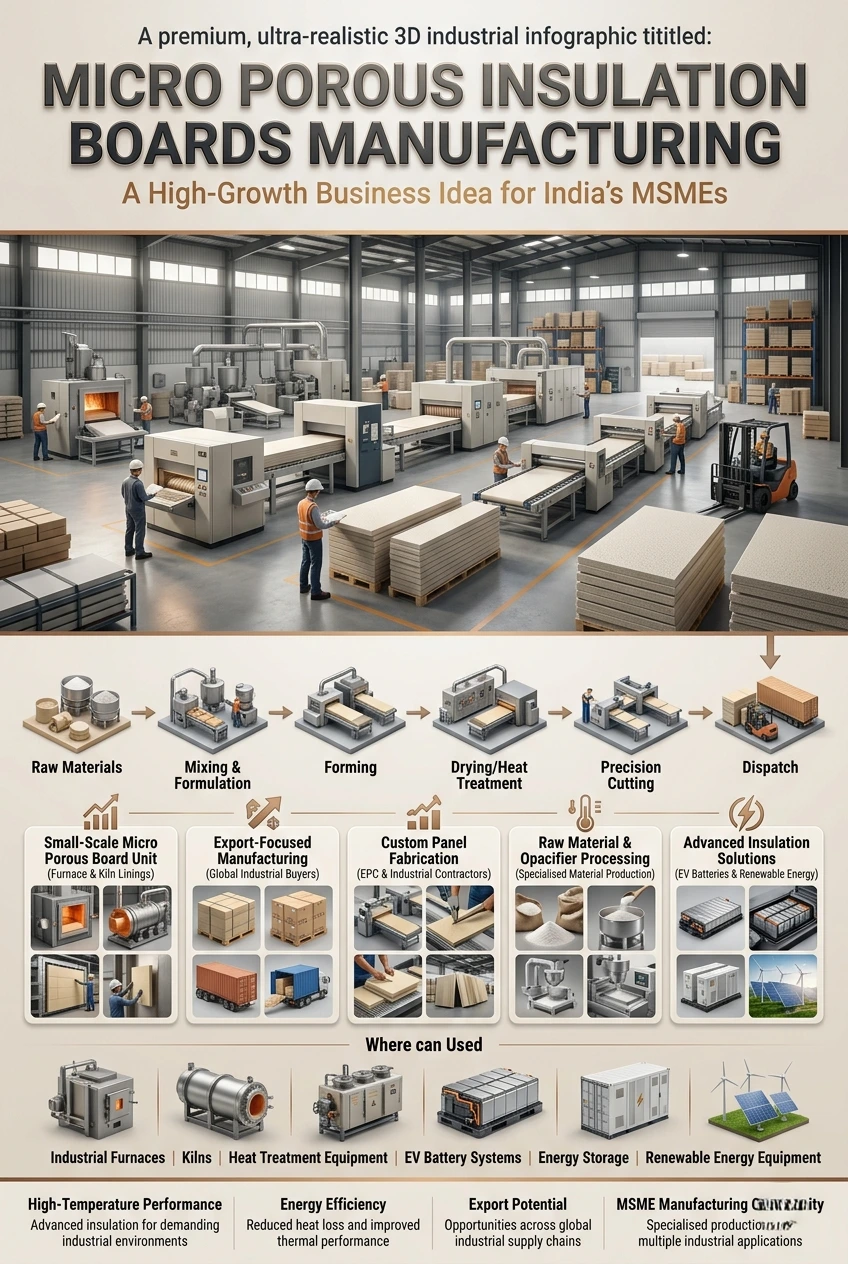
Custom Panel Fabrication for EPC and Industrial Contractors
Custom panel fabrication for EPC contractors and industrial insulation applicators represents a lower-capital, faster-revenue business idea. Instead of manufacturing raw micro porous board from scratch, this model involves sourcing base material and converting it into project-specific shapes, cut sizes, and pre-assembled panel units for pipelines, boilers, and process equipment. EPC contractors always are in demand for insulation partners that could deliver customized orders on urgent basis, and current suppliers are unable to meet the delivery schedules during busy construction season.
A fabrication shop with cutting facilities, forming facilities and a slight assembly capacity could be started from 25 to 60 lakh as an investment. This is how a potential entrepreneur with no manufacturing background can enter into the business. Building strong relationships with two or three EPC firms early on can create a dependable order pipeline well before the unit even reaches full capacity.
Raw Material and Opacifier Processing Unit
A raw material and opacifier processing unit addresses a different, less obvious layer of this industry. Micro porous board manufacturers depend on precisely processed fumed silica, titanium dioxide opacifiers, and reinforcement fiber, and much of this input material currently comes from a handful of large suppliers or imports. An entrepreneur with a background in chemical processing or materials science could set up a dedicated unit that processes and supplies these inputs to multiple downstream board manufacturers, rather than competing directly with them.
This business idea demands more technical expertise and stricter quality control, but it also faces less direct competition, because few Indian units currently specialise in this narrow supply layer. Selling to multiple board manufacturers, rather than one buyer, also spreads business risk more evenly across the customer base.
Specialised Insulation Solutions for EV Batteries and Renewable Energy
Specialised insulation solutions for EV batteries and renewable energy equipment represent the fastest-growing business idea in this category. As India’s EV manufacturing base expands rapidly, battery pack designers need lightweight, fire-resistant, thermally efficient insulation between cells, and micro porous material fits this requirement better than most alternatives. Similar high-performance insulation is also utilized in Solar Thermal equipment and in components of Wind energy equipment in small scale and specialized format.
Entrepreneurs for this niche may expect higher degree of interaction with OEM designing teams, lower volumes and stringent certifications as compared to conventional industrial insulation materials. But the growth curve for this niche also promises the steep climb for long term, since EV & renewable energy manufacturing is growing in India with greater pace.
Get Detailed Insights from This Book: Handbook on Electric Vehicle Manufacturing
Import–Export Opportunity Analysis
India currently imports a meaningful share of its high-performance micro porous insulation from China, Germany, and Japan, particularly for aerospace-grade and battery-grade applications where domestic manufacturing capability remains thin. This import dependence creates a natural opportunity for import substitution, especially because raw silica and opacifier materials are available domestically, and only the processing technology needs upgrading.
On the export side, Indian manufacturers hold a genuine cost advantage over European and Japanese producers, mainly due to lower labour and energy costs. Middle Eastern and African markets, where cement, steel, and glass industries are expanding but local insulation manufacturing barely exists, represent the most accessible export opportunity for a new Indian unit.
Moreover, India has entered into a number of FTAs with some of the ASEAN nations and the UAE, which lower the tariff barriers for manufactured industrial goods and makes export economics more favourable. Entrepreneurs who plan for exports from day one, as against “add-on” policy to business strategies, tend to have a much stronger design to quality systems and eventually tend to win more both domestic and overseas orders.
Indian MSME Success Stories in Insulation and Refractories
Lloyd Insulations (India) Limited
Set up some decades back, Lloyd Insulations rapidly emerged as one of the biggest insulation companies in India, and at its peak, managed a market share above 70% in its segment. They earned this stature by a combination of manufacturing and doing turnkey projects – instead of just selling raw materials to end-customers, they designed, supplied and installed them for major industrial projects. This complete service package instead of a mere product delivery, is one the lessons from their journey: it’s important to be a solutions provider in B2B industry, and not merely a supplier.
Manishri Refractories & Ceramics Private Limited
Manishri offers a different but equally instructive story. Started by Founder Late Sri B.C. Mohanty, our founder had years of technical apprenticeship experience at site, in an industrial giant, learning refractory and insulation properties firsthand in a running plant environment; even prior to setting up his first unit. Combined with this strong base and ongoing investment in R&D via our research tie-up with various National research institutes, we have emerged as a dependable supplier for major steel plants of India. The Moral – Technical prowess (learned or acquired) is still king in this industry even against capital.
U.P. Twiga Fiberglass
U.P. Twiga Fiberglass came into existence as a result of a venture created with the support of Indian promoters, along with the assistance of the Industrial Promotion Agencies of the Uttar Pradesh state government and over decades emerged as one of India’s major glass wool insulator manufacturing businesses; that was subsequently sought after by a global materials giant, for acquisition. Here lies a good example of the use of state-government partnership for founding, alongside a technological alliance with a known global leader to help build a fledgling manufacturing company.
Identify high-growth industries before others do
How NPCS Supports New Entrepreneurs in This Journey
Turning a promising business idea like this into an actual, fundable factory requires more than enthusiasm. It requires a properly researched feasibility report that examines machinery costs, raw material sourcing, capacity planning, and realistic profitability numbers before a single rupee gets invested.
We at Niir Project Consultancy Services, NPCS, prepare exactly this kind of Market Survey cum Detailed Techno-Economic Feasibility Report, or DPR, for entrepreneurs planning to set up new industries or businesses. Our reports cover detailed manufacturing processes, market research and demand analysis, process flow diagrams, product mix and capacity planning, machinery and raw material details, and complete project financials with profitability analysis. Our objective stays simple: help entrepreneurs evaluate feasibility, profitability, and long-term scalability before they commit capital to a new venture.
Market Snapshot: Key Data at a Glance
| Market Parameter | Approximate Figure / Insight |
| Global microporous insulation board market | Around USD 2.3–2.5 billion currently, trending toward the USD 4 billion range |
| Expected growth rate | Roughly 6.5% to 8.5% CAGR, depending on segment and region |
| Leading global region | Asia-Pacific, capturing over one-third of global demand |
| India’s construction sector growth | Approximately 7% annually |
| Typical small-unit investment (India) | ₹25 lakh to ₹3 crore, depending on scale and product range |
| Key demand-driving industries | Steel, cement, glass, oil & gas, automotive, EV, aerospace, power generation |
| PMEGP subsidy range | 15% to 35% of project cost, depending on category and location |
| CGTMSE guarantee cover | Up to 85% for eligible categories, on loans up to ₹2 crore |
Conclusion
Micro porous insulation board manufacturing sits at an unusual intersection of steady industrial demand, thin domestic competition, and strong government support. Few manufacturing business ideas in India currently offer this particular combination.
However, entrepreneurs, with a grounded tech and viable feasibility report, who strategically use this product with their desired mixture of the PMEGP, CGTMSE, and their states’ respective benefits can make a business that not only stands the test of time, but truly is not a passing phase. Since India’s infrastructure is at the boom and to cope with the growth of not only our steel industry, cement industry, EV industry but, also the renewable energy sector; the demand for this type of performance-based insulations would just increase. Those who establish themselves early would undoubtedly reap a large benefit in the long run.
Additional Reference Sources
Entrepreneurs can also track policy updates and industry data through the Department for Promotion of Industry and Internal Trade (DPIIT), the Federation of Indian Chambers of Commerce and Industry (FICCI), and the Confederation of Indian Industry (CII), all of which regularly publish manufacturing and MSME sector data relevant to new entrants in this industry.


