





Rural Manufacturing Business Ideas in India
Most lists of “business ideas” are compiled by the entrepreneur sitting in Mumbai or Bengaluru, with a number of industrial sheds, skilled labour and dozens of lenders being within walking distance. That is of little use for a person who is establishing a unit in a tehsil town or a group of villages.
In rural areas it’s all about the raw materials, power and water costs, even the availability of semi-skilled labor, and — crucially — a subsidy system in place that rewards this type of unit. Fortunately, a few government programs were created with rural and semi-urban manufacturing in mind, and the following categories of businesses regularly qualify for these programs.
This guide covers the list of manufacturing businesses which can be easily established in a rural/semi-urban area in India, the approximate cost and which subsidy scheme to go for.
The unorganised food processing sector accounts for about 74 per cent of India’s food processing units, something that is exactly what the gap offers a solution for; less to do with initiating something new, and more to do with putting what is already in existence, into a formal structure.
Why Rural Manufacturing Gets Preferential Subsidy Treatment
There are a number of major schemes that intentionally provide a greater subsidy rate for projects in rural areas than those in urban areas. For example, the margin money subsidy for the general category for an urban applicant is 15 percent, but 25 percent for women, SC and ST and other special categories in some structures under PMEGP. The reason for this is simple: expenses for land and labour are generally lower in rural areas, but the market is more challenging and so the subsidy is more of a compensation.
This is because the same business opportunity can be economically different in two places if the subsidy is taken into account. A unit which may be a marginal one in an urban industrial estate may become comfortably viable when the higher rate of PMEGP and the rural incentive if any, is added to it.
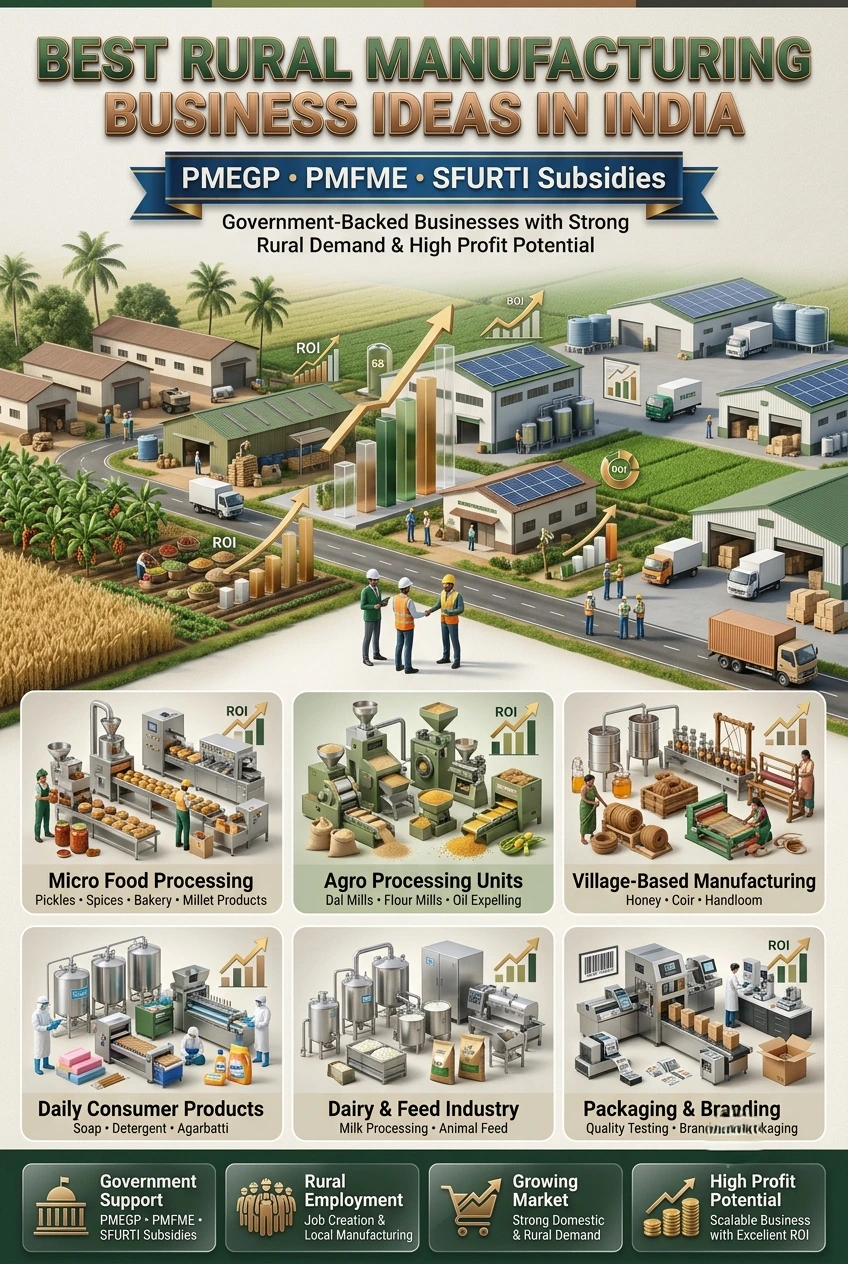
1. Micro Food Processing Units — Pickles, Spices, Bakery, Millet Products
This is the biggest chunk of rural manufacturing opportunity in India today and the industry most targeted by a specific scheme. Under the PM Formalisation of Micro Food Processing Enterprises scheme, the beneficiary pays for around 10 per cent of the project cost, and the remaining 35 per cent is financed through a bank loan, to a limit of ₹10 lakh per micro enterprise.
The scheme is specifically directed towards enterprises that produce small quantities of pickles, spices, bakery products, pulses, dairy products, coarse grains and locally-made traditional foods, all of which are often produced informally in most villages. Karnataka’s findings under the scheme are a very good indicator of the performances: In the years 2020-21 to 2024-25, more than 6,500 beneficiaries (individual micro enterprises and producer cooperatives) were provided with subsidy and marketing assistance; and, millet-based and cold-pressed oil products worked well.
In the real world, the entrepreneur normally starts with a product that has a local market, such as mustard oil, jaggery, flour milling, or even a local snack which has been established and registered by FSSAI (Food Safety and Standards Authority of India) with appropriate packaging and basic testing for quality — all of which is what the PMFME subsidy is supposed to facilitate.
Get Detailed Insights from This Book: Modern Technology of Food Processing & Agro Based Industries
2. Dal Mills, Flour Mills and Oil Expelling Units
In fact, Primary agro-processing, which involves converting raw grain, pulses or oilseed into a packaged retail product, has been one of the most consistently approved categories under PMEGP as the raw grain and oilseed is locally available and the product has guaranteed local demand. The cost of a small dal mill or mustard/groundnut oil expelling unit is usually in the project cost band of ₹10-25 lakh, which is recognised by PMEGP for manufacturing, and thus qualifies for subsidy at the maximum amount.
There is a structural cost advantage in the economics here with regard to procurement: a unit placed close to a Mandi or a group of producing villages will have a cost advantage over a unit located at a district headquarter town. This is one of the most obvious examples where site location should be determined based on availability of raw materials first and eligibility for subsidy second, but in practice, these two factors are often combined together and PMEGP’s rural rate is geared towards such scenarios.
3. Honey Processing, Coir Products and Handloom-Linked Manufacturing
The scheme of the fund for regeneration of traditional industries is different from PMEGP for the entrepreneurs in the areas with traditional artisans like handloom weavers, coir, beekeepers, bamboo craftsmen etc. Instead of funding infrastructure of a single unit, SFURTI provides funds for cluster-level infrastructures like common facility centres, raw material bank etc. and common processing equipment, the nodal agency for khadi clusters is Khadi and Village Industries Commission and for coir clusters, the Coir Board.
Till the last parliamentary update, SFURTI has approved 513 clusters with the committed government assistance amounting to over ₹1330 crore; while 364 cluster projects have been completed. However, the answer for a single entrepreneur is whether a SFURTI cluster exists, or is being planned in the area, if so, setting up a small processing unit or finishing unit that connects to the common facility centre of the cluster, can bring a tremendous reduction in the individual capital requirement, as the shared equipment is funded at cluster level and not by each unit.
A small processing and bottling facility (filtering, drying the moisture and packaging) is a particularly good match because collection of raw honey is already relatively common in the forest fringe areas, and there is minimal equipment to be invested, yet it enhances the value of raw honey significantly.
Related Article: How to Start a Honey and Jaggery Products Export Business in India
4. Soap, Detergent and Agarbatti Manufacturing
These remain among the most frequently approved PMEGP projects for a simple reason: the machinery cost is modest, the raw materials are widely available, and the products have year-round local demand that does not depend on a distant export market. A basic soap or detergent powder unit can be set up within a project cost of ₹5-15 lakh, comfortably within PMEGP’s manufacturing ceiling, and agarbatti rolling and packaging units can start even lower.
The author of this guide has written extensively on this category in the Soaps, Detergents and Disinfectants Technology Handbook, published under NPCS, which covers formulation, machinery selection and quality parameters for entrepreneurs entering this space — a sector where the barrier to entry is genuinely low but where formulation knowledge makes the difference between a product that sells and one that does not.
Check Out This Recommended Book: Modern Technology of Soaps, Detergents & Toiletries (with Formulae & Project Profiles)
5. Dairy Processing and Animal Feed Units
Rural areas with an existing livestock base are natural candidates for small-scale dairy processing — paneer, ghee, flavoured milk, curd — or for animal feed manufacturing using locally available agricultural residue. These fall under the agri-allied category for several schemes and can draw on NABARD-linked infrastructure funds in addition to PMEGP or PMFME, depending on whether the unit is positioned as a food processing enterprise or a primary agriculture input business.
Get Detailed Project Report (DPR): Milk & Dairy Products: Complete Guide
| NPCS Insight Choosing the right scheme often depends on how the project is classified on paper — the same dairy unit can be structured as a PMFME food processing project, a PMEGP manufacturing unit, or an agri-infrastructure project, each with different subsidy rates and documentation requirements. NPCS prepares detailed project reports that position the project correctly for the scheme offering the strongest terms for that specific location and product mix. |
6. Common Packaging, Branding and Quality Testing Units
One gap that consistently limits rural producers is the absence of standardised packaging and branding, which keeps otherwise good products confined to local markets. Under PMFME, Special Purpose Vehicles formed by groups of micro enterprises can receive a 50 percent subsidy on the cost of common branding, packaging and standardisation, as several state implementations of the scheme have highlighted.
This opens a distinct business opportunity: a shared-service packaging and labelling unit that serves multiple small producers in a cluster — food processors, honey producers, oil millers — rather than a single product line. Because this serves multiple beneficiaries, it is often easier to justify under the common infrastructure components of PMFME or SFURTI than a single-product unit would be.
Business Idea vs. Subsidy Fit
| Business Idea | Typical Project Cost | Best-Fit Scheme | Subsidy Rate |
| Micro food processing (pickles, spices, bakery) | Up to ₹10 lakh | PMFME | 35% capital subsidy |
| Dal mill / oil expelling unit | ₹10-25 lakh | PMEGP (rural) | 25-35% margin money |
| Honey processing & bottling | ₹5-15 lakh | SFURTI / PMEGP | Cluster infra + margin money |
| Soap / detergent / agarbatti unit | ₹3-15 lakh | PMEGP | 25-35% margin money |
| Dairy processing (paneer, ghee, curd) | ₹5-20 lakh | PMFME / PMEGP | 35% or 25-35% |
| Shared packaging & branding unit (SPV) | Varies by cluster | PMFME common infrastructure | Up to 50% on branding/packaging |
Eligibility Snapshot for the Two Core Rural Schemes
| Criteria | PMEGP | PMFME |
| Who can apply | Individuals, 18+ years, basic education for higher project costs | Individuals, SHGs, FPOs, cooperatives, existing micro units |
| Project cost ceiling | ₹25 lakh (manufacturing) / ₹10 lakh (services) | ₹10 lakh per individual micro unit |
| Beneficiary contribution | 5-10% depending on category | Around 10% of project cost |
| Subsidy | 15-35% depending on area and category | 35% of eligible project cost |
| Implementing agency | KVIC / state KVIB / DIC | Ministry of Food Processing Industries via state nodal agencies |
Key Inputs to Plan Before Choosing a Location
| Factor | Why It Matters | Where to Check |
| Raw material proximity | Reduces transport cost and ensures consistent supply | Local mandi / agricultural department |
| Existing SFURTI or PMFME cluster | Access to shared infrastructure and higher approval likelihood | State MSME / KVIC office |
| Power and water availability | Determines feasible machinery and shift capacity | State electricity board / gram panchayat |
| State-specific rural subsidy top-ups | Can add to central subsidy on the same project | State industries department portal |
| Local market vs. export potential | Affects packaging, branding and FSSAI/export registration needs | District industries centre |
How NPCS Supports Rural Manufacturing Projects
Every business idea in this guide depends on one document that determines whether the subsidy application succeeds: the detailed project report. Niir Project Consultancy Services has prepared DPRs and techno-economic feasibility studies for manufacturing units across exactly these categories — food processing, agro-processing, soaps and detergents, packaging, and agro-industrial parks — structured to meet the appraisal standards of PMEGP, PMFME, NABARD-linked agri-infrastructure funds and state industries departments.
For entrepreneurs evaluating a rural manufacturing project, the most useful first step is often a feasibility assessment that maps the chosen product against the available subsidy schemes for that specific location, before committing to land or machinery purchase.
Discover business ideas that actually make money
Starting Point: Match the Product to What Already Exists Locally
The strongest rural manufacturing businesses are rarely entirely new ideas. They are formalised, scaled-up versions of activities that already happen informally in the area — oil pressing, pickle making, honey collection, dal processing — brought up to a standard where they qualify for FSSAI registration, bank finance and subsidy support.
Starting from what the local economy already produces, then working backwards to the scheme that funds formalisation of exactly that activity, tends to produce a far more bankable project than starting from a generic business idea and searching for a subsidy to fit it afterwards.
Frequently Asked Questions
Can an existing informal unit apply for these subsidies, or only new units?
PMFME specifically supports existing operational micro food processing units for upgradation, in addition to new units, provided the applicant meets ownership, experience and turnover criteria. PMEGP is primarily for setting up new enterprises, though it also covers expansion in some cases.
How is project cost calculated for subsidy purposes?
Project cost commonly consists of expenditure incurred on plant and equipment, building/ shed construction cost and pre-operative charges, excluding the cost of the land which has to be provided by the entrepreneur at own disposal.
What is the role of FSSAI registration in food-related rural businesses?
FSSAI registration or licensing is generally required for any food processing unit and is often a prerequisite for subsidy disbursement under PMFME, since it formalises the unit’s compliance status.
Is one person eligible for both PMEGP and PMFME for the same project?
No. Schemes generally require a declaration that a subsidy has not been availed under another central scheme for the same project, so the entrepreneur needs to choose the scheme that offers the better fit for that specific project rather than applying to both.
Do SHGs and FPOs get any additional benefit under these schemes?
Yes. Under PMFME, SHGs, FPOs and cooperatives are eligible for the same 35 percent capital subsidy as individual micro enterprises, and additionally for support on common infrastructure projects with a higher subsidy ceiling, which makes group-based applications attractive for cluster-level investments.
Where can an entrepreneur get a project report prepared for these schemes?
Consultancies such as NIIR Project Consultancy Services prepare detailed project reports and feasibility studies for rural and agro-based manufacturing units, covering machinery selection, financial projections and the documentation format expected by bank appraisal committees and scheme nodal agencies.
Sources and Further Reading
Niir – PMFME Scheme: Transforming India’s Food Processing Sector: niir.org
The Hans India – PMFME Scheme Strengthens Rural Entrepreneurship in Chamoli: thehansindia.com
Organiser – SFURTI Scheme Revives Traditional Industries Across Bharat: organiser.org
Bajaj Finserv Markets – SFURTI Scheme Overview: bajajfinservmarkets.in
Bank of Maharashtra – PMEGP Scheme Details: bankofmaharashtra.bank.in
Punjab Agro – PMFME Scheme: punjabagro.gov.in


