





Indian Chemicals Market
Market Insight at a Glance
The chemical industry is no longer a supporting character in the long history of Indian industries; it is now a chapter of its own. India’s chemical industry is valued at around USD 250 billion and is the sixth largest chemical industry in the world with the third largest share in Asia and accounts for around 7% to the GDP of the country. According to India Brand Equity Foundation (IBEF), the sector is expected to grow to USD 300 billion in the near future and USD 1 trillion in 2040. At this moment, there is no sector so rich in opportunity for an entrepreneur willing to put his money into manufacturing as the Indian chemical industry is.
It comprises over 80,000 commercial products and is divided into six main pillars: bulk chemicals, agrochemicals, specialty chemicals, polymers, petrochemicals and fertilizers. All of these have their own demand curve, consumption profile and investment rationale — and together, they represent a large, and under-served market in significant value segments.
The Big Picture: Demand Story, Forecasts, and Growth Vectors
The average consumption of chemicals per capita in India is very low as compared to the global average, and this is also a clear signal of investment value. Increasingly, all these factors are driving demand across all application segments in the expansion of urbanization, rising consumption of the middle-classes, a booming medical sector, the fast-paced penetration of mechanization in agriculture, and the government’s thrust for domestic manufacturing through Make in India and Atmanirbhar Bharat.
The story of specialty chemicals is a great one alone. It is estimated to be USD 62–65 billion today and is expected to reach USD 92–95 billion by 2030–2033 at a compound annual growth rate between 4.8% and 8.7% depending on the segment. Among this larger group of chemicals are certain sub-segments that are developing at a more rapid rate, such as pharma grade intermediates, agrochemical formulations, electronic grade chemicals and green/bio-based chemicals.
The construction chemicals market is also interesting, albeit smaller, valued at more than USD 4.5 billion currently, and steadily expanding due to the ongoing rapid growth of the residential, commercial and infrastructure construction projects in India. Demand for concrete admixtures, waterproofing and protective coatings is growing rapidly for government-funded infrastructure and private residential projects in particular.
On the fertilizer front, India produced its maximum urea of over 314 lakh metric tonnes (LMT) in a recent production year, but imported to meet the demand of about 601 LMT which is once again a clear indicator of the persistent shortage in the most basic agricultural chemical.
Related Article: How to Start a Specialty Chemicals Plant: ₹80 Lakh Investment, ₹3 Crore Revenue Potential
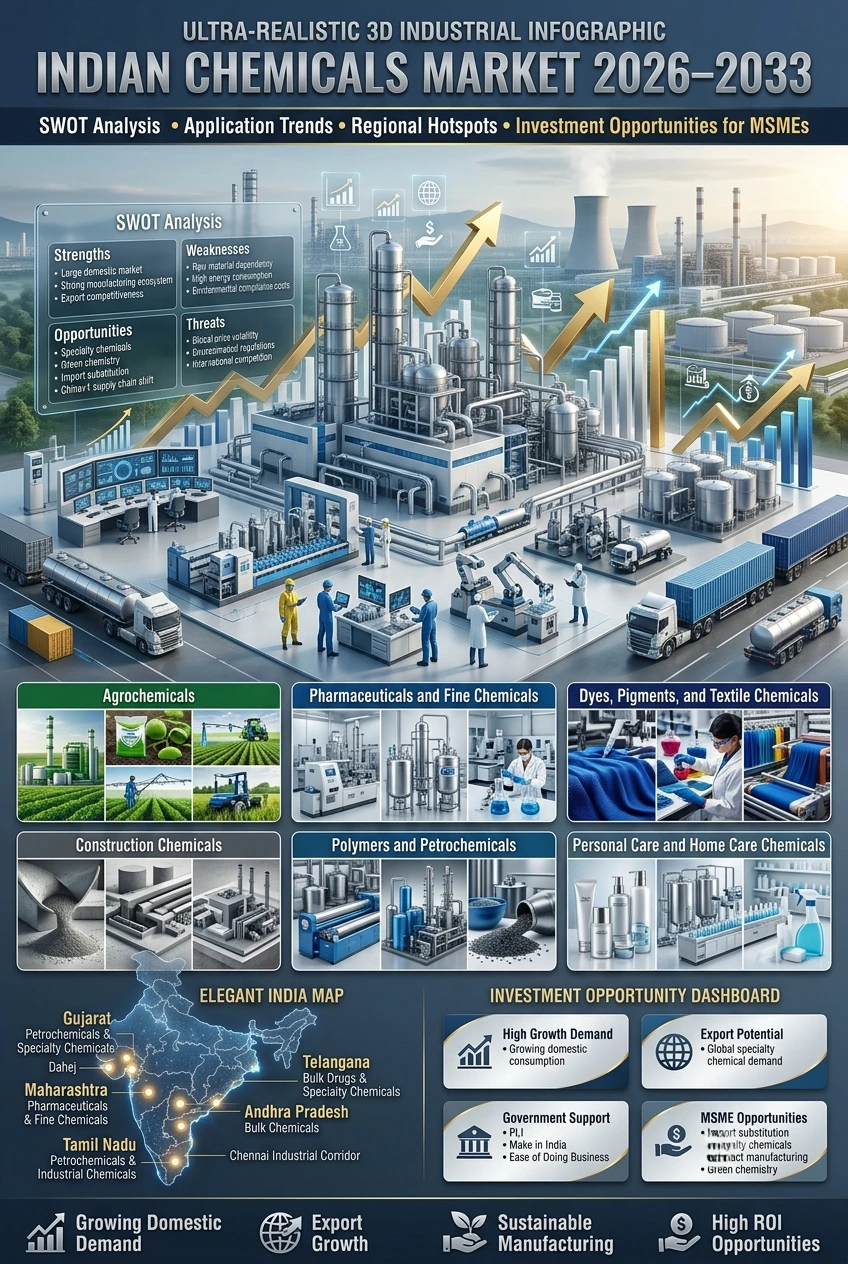
SWOT Analysis of the Indian Chemicals Industry
Strengths
- Scale and Diversity of Product Portfolio India’s chemical industry is very diversified in terms of the capacity of production ranging from petrochemicals to agrochemicals, specialty chemicals, dyes and pigments, polymers and pharmaceutical intermediates. The diversity helps shield the industry from category-specific demand shocks, and allows manufacturers to shift product lines based on market signals.
- Cost-Competitive Manufacturing Base India is one of the world’s lowest cost manufacturing chemical bases. Indian producers enjoy a structural cost advantage over Western producers because of lower labor costs, availability of a large number of technically trained chemical engineers and process chemists, and the close proximity to important feedstock sources, in particular those of petrochemical intermediates from the Middle East.
- Dyestuff and Agrochemical Leadership India, exporting to over 90 countries. India is the fourth largest producer of agrochemicals in the world and produces 50% of technical grade pesticides in the world. These are not part-time jobs; they are real industrial depth that has been developed over many years. IbeF’s chemical industry analysis indicates that India is at 14th position in terms of exporting chemicals in the world, accounting for 2.5% of the global chemical sales.
- Strategic Geography India is located on the natural trade crossroads linking Middle East (feedstock), South East Asia (end markets), Africa (agrochemical exports) and Europe/North America (specialty and pharmaceutical chemical buyers). This geographical location helps to cut down on logistics expenses and delivery time for various export categories.
- As of now, India allows 100% Foreign Direct Investment (FDI) through the automatic route in the chemical industry, excluding specific hazardous chemicals. The Department for Promotion of Industry and Internal Trade (DPIIT) reports that the total FDI in the chemicals sector (apart from fertilizers) have accumulated to around USD 23.9 billion from April 2000 to December 2025. This continued investor confidence in India is proof of its long-term competitiveness in manufacturing.
- Government Infrastructure Push The establishment of Petroleum, Chemicals and Petrochemicals Investment Regions (PCPIRs) at Dahej (Gujarat), Visakhapatnam–Kakinada (Andhra Pradesh), and Paradeep (Odisha) has created world-class clustered manufacturing infrastructure. As per the PIB Government Press Release, these three PCPIRs collectively host 2,246 operational chemical units with cumulative investments exceeding Rs. 3,49,192 crore and direct employment for 3.7 lakh persons.
Weaknesses
- Apart from the PCPIRs, the majority of chemical industries in India are located in the old industrial estates with poor infrastructure, such as inadequate effluent treatment facilities, road connectivity, power supply, and logistics for temperature-sensitive products. These infrastructure shortcomings translate to increased risk of regulations and costs of operations for an MSME establishing outside of a PCPIR.
- Raw material import dependency for some key feedstocks that include some organic intermediates, specialty monomers, fluorspar and important petrochemical building blocks. China is the primary source for many of these materials, thus causing vulnerability to the supply chain and exposure to exchange rates. The chemical trade deficit at present is estimated USD 31-32 billion per year – it is India’s weakness as well as its biggest investment opportunity.
- Fragmented MSME Manufacturing Base: A significant portion of chemical production in India is from small and medium manufacturers, who are lacking in scale, R&D and EHS (Environment, Health and Safety) infrastructure. This reduces product quality uniformity and makes it difficult to compete against the global MNCs that have strict quality assurance protocols for long-term supply contracts.
- Environmental Compliance Burden The regulatory environment for chemical manufacturing is increasingly stringent. The Ministry of Environment, Forest and Climate Change (MoEFCC) mandates comprehensive Environmental Impact Assessments (EIAs) for large chemical plants, and the Bureau of Indian Standards (BIS) has implemented Quality Control Orders (QCOs) for over 150 chemical products. For smaller manufacturers, meeting these compliance requirements involves significant capital expenditure that can challenge project viability.
- Underinvestment in R&D India’s chemical R&D spend as a percentage of sectoral revenue lags significantly behind global peers. While large players like Aarti Industries and Tata Chemicals have in-house R&D labs, the majority of Indian chemical manufacturers are process-followers rather than process-innovators, limiting their ability to capture high-value niches that require proprietary chemistry.
Opportunities
- China+1 Supply Chain Diversification The most significant opportunity influencing the Indian chemical industry at this moment is the global trend towards supply chain diversification that is taking place in China. The western pharmaceutical companies, agrochemical formulators, electronics manufacturers are actively looking for diversifying their supply chain and India is the most credible option in scale. There are firms like Atomgrid, which have set up special R&D labs in Bengaluru with a view to harnessing the change and it seems it’s a trend that is set to continue.
- India’s demand of specialty chemicals from its downstream industries such as agrochemicals, electronics, automotive and pharmaceuticals is significantly larger than the current production capacity. Domestic supply is still quite inadequate for sub-segments such as fluorochemicals, electronic-grade solvents, advanced polymer additives, and high-performance coatings.
- Green Chemistry and Bio Based Chemicals: India’s green chemicals market will be over USD 15 billion by 2016 at more than 10% CAGR. Premium market positioning is moving towards the Tata Chemicals-TERI Centre of Excellence on Biochemicals, which is now in development utilizing renewable feedstocks. There is robust demand for the export of MSMEs that can implement green chemistry processes early and buyers in Europe and North America have requirements for sustainability procurement.
- The PLI scheme for Bulk Drugs, under the Ministry of Chemicals and Fertilizers, has helped in investments exceeding Rs. over 4. As of December 2025, 4,814 crore greenfield pharmaceutical chemical projects have been approved, and 38 projects with 28 notified products have been commissioned. Indian pharmaceutical intermediates (PIs) demand is growing at a rapid pace as global pharma firms keep de-risking their API procurements from China.
- The electric mobility aspirations of the Lithium-Ion Battery and EV Value Chain India are establishing new product segments for the chemicals market, namely the electrolyte solvents, cathode active materials, binders, and separator coatings. The government’s Rs. The knowledge that 7,280-crore scheme for Rare Earth Permanent Magnets (launched November 2025) is an indication of the intent to develop the capacity of the country on this nascent chemical value chain.
Threats
- Chinese Import Competition Notwithstanding the China+1 theme being positive for India’s export stance, Chinese manufacturers have been able to outprice Indian manufacturers in the domestic market, especially in bulk chemicals, polymers and commodity dye intermediates. The low price of imports reduces domestic producer margins and, if import protection or product differentiation is not in place to some extent, can make new manufacturing enterprises unprofitable.
- Global Commodity Price Volatility The profitability of India’s chemical manufacturers is very sensitive to crude oil and natural gas pricing, which dictate the price of raw material feedstocks for the petrochemical industry. Crude prices rising lead to a massive rise in raw material cost and this makes the margin for Indian producers — particularly the smaller ones lacking in the ability to hedge crude prices — to take a hit.
- Environmental and Safety Incidents Safety and environmental risks are also part and parcel of the chemical industry and a high-profile incident (some have happened in the industrial clusters of Gujarat and Maharashtra in the past) attracts close attention from the regulatory authorities, shuts down operations or leads to damage to the reputation of the company. For MSMEs, single environmental violation can result in closure notice and their business comes to an end.
- Export Market Compliance Requirements with the increasing amount of export markets, the level of compliance required to compete in those markets becomes increasingly complex: REACH regulations in Europe, EPA regulations in the USA, and quality specifications from Japanese and Korean buyers. Smaller chemical exporters in India may not have the facilities for documentation, testing, and submission for regulatory approval to compete in regulated markets.
Application-Wise Market Analysis
Agrochemicals
The agrochemical industry in India worth USD 15.5 billion, is one of the most competitive sectors in the Indian chemical industry. It is the third largest producer of agrochemicals in the world after the USA and China. Domestic agriculture that produces food for more than 1.4 billion people in various agro-climatic regions creates huge and repetitive demand for the use of pesticides, bio-fertilizers, fungicides and herbicides.
The export momentum is also encouraging with agrochemical exports reaching USD 3,567 million during the first two quarters of FY26 (April–February), compared to imports of USD 1,420 million, resulting in a healthy trade surplus in this one of the few chemical sub-segments. The biological crop protection and precision agriculture, as well as low-residue pesticide formulations, are creating new opportunities for product development within the segment.
Get Detailed Insights from This Book: The Complete Technology Book on Agrochemicals
Pharmaceuticals and Fine Chemicals
India’s pharmaceutical industry is the largest consumer of chemical intermediates in the world, being the world’s largest supplier of generic drugs. One of the largest and fastest growing demand pools is specialty chemicals in drug formulation, excipients, APIs and chemical building blocks. Since the inception of PLI, pharmaceutical chemicals have been kept as an important sub-sector for nurturing domestic capacity in the country, and investments in these sub-sectors have already surpassed the targeted amounts.
The Federation of Indian Chambers of Commerce and Industry (FICCI) has always identified pharmaceutical chemicals as a key sub-sector for nurturing domestic capacity and investments in this sub-sector are already surpassing the targetted amounts. Companies that can produce fine chemicals to the quality standards required by GMP, and document all requirements under cGMP can realize substantial price premiums.
Dyes, Pigments, and Textile Chemicals
The dye industry in India is a world class industry. This segment is a regular foreign exchange earner as it accounts for about 16 per cent of the world production of dyestuff & dye intermediates and exports worth USD 2,157 million for FY26 (April – February). Major markets for exports are China, Bangladesh, Italy, the USA, Russia, Netherlands, Turkey, Brazil, Indonesia and Japan. It should be noted however, that India exports dye molecules but India imports huge amount of dye intermediates and specialty textile chemicals, thus there is a clear opportunity for the entrepreneurs for the backward integration in the production of dyes.
Get Detailed Project Report (DPR): Textile Bleaching, Dyeing, Spinning, Weaving, Printing, Finishing and Textile Auxiliaries Projects
Construction Chemicals
The market for construction chemicals – concrete admixtures, waterproofing compounds, epoxy coatings, adhesives, and grout systems is growing rapidly as a result of initiatives such as PM Gati Shakti and National Infrastructure Pipeline (NIP) in India. The construction chemicals market is expected to expand at a compound annual growth rate of 4.0% from USD 4.48 billion in 2019 to USD 6.19 billion by 2034. The domestic manufacturing component within the segment is dispersed with high level of dependency on imports in high performance product categories.
Polymers and Petrochemicals
India is the third biggest consumer of polymers in the world. The structural growth from the packaging, automotive, FMCG, healthcare and electronics sectors is providing a boost to demand. However, domestic production capacity has grown with the additions at the Jamnagar polymer plant of Reliance and the ONGC’s oil field polymer plants, but failed to match the demand growth, particularly in the high-performance specialty polymer and engineering plastics segments.
Personal Care and Home Care Chemicals
The formulation chemicals segment serving FMCG — surfactants, emulsifiers, preservatives, UV filters, fragrance chemicals, and specialty polymers — is growing alongside India’s expanding personal care and home hygiene market. Export of castor oil, essential oils, cosmetics, and toiletries reached USD 3,832 million in FY26 (April–February), reflecting strong global demand for India-sourced formulation ingredients.
Regional Analysis: Where Indian Chemical Manufacturing Lives
Gujarat is the leading chemical manufacturing state of India with the production of about 40% of the total chemical production in India. The state has Dahej PCPIR, Vapi industrial cluster (one of Asia’s largest integrated chemical clusters) and Jamnagar petrochemicals complex. Gujarat’s port facilities, state level chemical promotion policies, established supplier base makes it the starting point of any new chemical manufacturing investment of significant size.
The state of Maharashtra is the second biggest chemical producing state with a significant presence in Tarapur, Thane-Belapur, Taloja and Raigad. The state is home to many specialty and fine chemical producers, including a few companies involved in pharmaceutical and dye production. The financial capital of Mumbai offers better access to equity markets and institutional finance to companies in the chemical industry based in the state of Maharashtra.
Andhra Pradesh and Telangana are growing into major chemical manufacturing hubs with the Visakhapatnam-Kakinada PCPIR and the pharma cluster at Hyderabad (one of the world’s largest pharma manufacturing clusters) being set to become major hubs. BPCL’s proposed Rs. The 1,00,000-crore greenfield refinery and petrochemical complex announced in 2025 in Andhra Pradesh will make a significant chemical footprint in the region for the next 10 years.
The Paradeep PCPIR of Odisha has drawn investments of Rs. 73,518 crore and provided jobs for some 40,000, it proved to be a viable large-scale chemical manufacturing location with the coastal infrastructure advantage.
Tamil Nadu and West Bengal are the other important chemical-producing states in India, with Tamil Nadu being a stronghold in specialty chemicals, leather chemicals and pharma intermediates.
Demand–Supply Gap: The Core Investment Case
The demand-supply gap in the chemical industry is most clearly reflected in India’s chemical trade deficit, which is estimated at some USD 31–32 billion each year. This is not a shortfall in a marginal sense, but a structural inability to meet the needs of the consuming industries, because the production capacity is not growing at the pace needed.
The following areas are most notable in particular:
- Advanced organic intermediates for the synthesis of agrochemicals and pharmaceuticals which are mainly imported from China.
- Domestic production of fluorochemicals and fluor intermediates that are in short supply compared to pharmaceutical and refrigerant uses
- Engineering plastics and high-performance polymers are the other category of plastics where India is still highly reliant on imports even though it is the third largest consumer in the world.
- The fast-expanding semiconductor and display manufacturing industry ecosystem requires electronic grade chemicals.
- Bio-based specialty chemicals with a higher demand in the global market than in India
- India has to import dyes/dye intermediates worth Rs. Annuity cost of 1,378 crore of intermediates (FY26 data)
If this gap is a problem for an entrepreneur or MSME investor, then it is a business opportunity. The categories each reflect a product category in which domestic manufacturing can be formed with a degree of confidence in demand absorption, due to currently less competition in the market by established domestic firms.
Major Indian Players: Organized Sector Landscape
Reliance Industries Limited (RIL), which runs what is believed to be the world’s biggest integrated facility for refining and manufacturing ethylene, polypropylene, polyester and specialty chemicals at Jamnagar in the State, has 30-plus processing units. RIL’s chemical segment revenues make it the largest chemical business in India by revenue, while its recent 15-year agreement to supply green ammonia to Samsung C&T Corporation (March 2026) marks its progression into the next generation chemical segments.
Tata Chemicals Limited is the third largest soda ash manufacturer in the world, and also operates in the advanced materials (lithium-ion battery materials) and specialty chemicals businesses, as well as consumer products. The company’s collaboration with TERI on the Centre of Excellence on Biochemicals is another testament of its ability to be at the forefront of sustainable chemistry.
Aarti Industries Limited is perhaps India’s best known specialty chemical company. Aarti serves customers in more than 60 countries and exports more than 50% of its revenues and has more than 200 products in the benzene-based intermediates, specialty chemicals, agrochemical intermediates, pharmaceutical building blocks and polymers. The company has over 15 manufacturing centres in Gujarat and Maharashtra.
UPL Limited, also known as United Phosphorus Limited, is an agrochemical company and the largest agrochemical business in India and one of the world’s leading players in crop protection chemicals, bio-fertilizers and digital agronomy tools. UPL is a prime example of the scale that Indian chemical companies can reach when they go for aggressive global integration, with more than 80% of its revenue coming from outside India, and products in a wide range of categories, including herbicides, insecticides, fungicides and seed treatments.
Both Deepak Nitrite Limited and SRF Limited are noted for their process innovations in fine chemicals and specialty polymers, respectively, their strong presence in the international markets of fluorochemicals, packaging films and technical textiles. These are mid-level performers with which one could learn something from the development of their own careers as chemical entrepreneurs.
Startup Opportunity: Why MSMEs and First-Generation Entrepreneurs Should Enter Now
The Indian chemical market is characterized by residual import dependency, a China+1 tailwind, government incentives for domestic manufacturing and rising downstream demand from the pharma, agri and infrastructure industry puts new players in the market in a rare sweet spot.
The door to the entry is truly open. In the Indian chemical market, there is no sector where two or three conglomerates were dominant, as there is a long tail of product categories which are not captured in any significant way by the domestic players. A well-equipped MSME can set up a viable and profitable business in the following categories: Pharma intermediates (pre-API), Specialty agricultural adjuvants, Construction chemical formulation for Tier-2 city contractors, Industrial water treatment chemicals, Bio-based surfactants and high purity industrial solvents.
The government’s policy settings have never been more conducive. The PCPIR structure provides for common infrastructure, lower CAPEX obligations, and regulatory support for chemical companies that are willing to invest in these areas. In the case of bulk drugs, the PLI scheme has shown that government support for drugs in adjacent categories is indeed providing real financial returns. The dedicated vertical for the chemicals sector in the Make in India initiative will give new manufacturers more visibility and buyer connection.
Import substitution is both profitable and patriotic. For an entrepreneur setting up a specialty chemical unit that replaces a currently imported product, the business case is unusually strong: procurement departments at large Indian companies are actively motivated to reduce import dependency, government procurement increasingly favors domestic suppliers, and the buyer base is both known and accessible. A startup entering this space with a quality domestic product, credible EHS compliance, and competitive pricing can win contracts faster than in most other sectors.
Export potential provides an additional revenue floor. Even if domestic market penetration is slow in the early years, many specialty chemical categories have robust export demand from markets in Africa, Southeast Asia, the Middle East, and South America. India’s reputation as a cost-competitive, technically capable supplier in pharma and agrochemical chemicals is well-established globally, which means a new domestic producer can credibly access export channels from the beginning.
The ideal startup profile for this sector is an entrepreneur with a chemistry or chemical engineering background, or access to strong technical advisors, who is willing to invest in quality systems and regulatory compliance from day one. Chasing the lowest possible setup cost is the wrong approach in chemicals — but an investor willing to build correctly will find that defensible margins and long-term supply contracts are very achievable.
Find the most profitable startup for your investment range
Data Table: Indian Chemicals Sector — Key Metrics Summary
| Parameter | Current Status | Forecast / Target |
| Total Market Size | USD 250 billion | USD 300 billion (near-term); USD 1 trillion (2040) |
| Specialty Chemicals Market | USD 62–65 billion | USD 92–95 billion (2033) |
| Agrochemicals Market | USD 15.5 billion | USD 23.3 billion (2033) |
| Construction Chemicals | USD 4.48 billion | USD 6.19 billion (2034) |
| Global Rank (Chemical Production) | 6th globally, 3rd in Asia | Target: Top 5 globally by 2030 |
| Chemical Trade Deficit | USD 31–32 billion annually | Reduction target via import substitution |
| Dye & Dye Intermediates Exports | USD 2,157 million (FY26 Apr-Feb) | Growing |
| Agrochemical Exports | USD 3,567 million (FY26 Apr-Feb) | Growing |
| FDI in Chemicals (Cumulative) | USD 23.9 billion (Apr 2000–Dec 2025) | Increasing with PLI rollout |
| PCPIR Investment | Rs. 3,49,192 crore | Expanding to new locations |
| Employment | 2 million+ direct | Growing with capacity expansion |
| Global Chemical Exports Rank | 14th | Target: 10th by 2030 |
Government Policy Landscape: Enabling the Next Phase of Growth
The policy framework supporting Indian chemical manufacturing has strengthened considerably over the past several years, and several instruments deserve specific attention from investors and entrepreneurs.
The Production Linked Incentive (PLI) scheme for pharmaceutical chemicals has already catalyzed Rs. 4,814 crores in actual investment by December 2025, with 38 projects commissioned. A dedicated PLI scheme for chemicals and petrochemicals is currently under formulation by the Department of Chemicals and Petrochemicals, Ministry of Chemicals and Fertilizers, which — once notified — will represent a significant additional investment catalyst across non-pharma chemical categories.
The Union Budget 2026–27 allocated Rs. 185.72 crore to the Ministry of Chemicals and Fertilizers, and the broader Rs. 1.97 lakh crore PLI outlay across end-use sectors (pharma, telecom, auto, electronics) indirectly drives chemical demand across each of these verticals.
PCPIRs continue to offer one of the most compelling infrastructure arrangements available for any chemical manufacturing project in Asia — integrated plots, shared effluent treatment, steam networks, logistics connectivity, and single-window clearance processes. Entrepreneurs seriously considering setting up chemical manufacturing capacity should evaluate PCPIR location as a strategic priority.
Quality Control Orders (QCOs), now covering over 150 chemical products and overseen by BIS, are progressively limiting the import of substandard chemical products — a direct benefit to compliant domestic manufacturers.
About NPCS: Supporting Your Project from Concept to Commissioning
Niir Project Consultancy Services (NPCS) – www.niir.org is one of the established Professional Consultants for Entrepreneurs, MSME Entrepreneurs, Industrialists, and Investors analyzing prospective new manufacturing projects from various industry groups including chemicals.
NPCS’ Market Survey cum Detailed Techno-Economic Feasibility Reports (DPRs) usually contain:
- Detailed manufacturing process description and flow diagrams (PFD/BFD)
- Market research, demand analysis, and consumption trend assessment
- Product mix recommendations and optimal capacity planning
- Machinery specifications and vendor identification
- Raw material sourcing, cost benchmarking, and import-export dependency analysis
- Environmental compliance pathway and regulatory clearance roadmap
- Complete project financials including capital cost estimation, working capital requirements, revenue projections, and profitability assessment
Regardless of whether the proposal is for greenfield specialty chemical plant, agrochemical formulation unit, pharmaceutical intermediates manufacturing plant, or an import-substitution project in polymers or construction chemicals, NPCS offers the systematic analytic platform required for a responsible investment decision.
The mission of NPCS is to help entrepreneurs analyze new industrial and manufacturing projects in terms of their technical feasibility, financial viability, market potential and scalability; and thereby, providing to first-generation entrepreneurs with the level of project intelligence that big corporations have always enjoyed as a given fact.
Frequently Asked Questions (FAQ)
Q1: What is the current size of the Indian chemicals market, and how fast is it expected to grow?
Market worth in 2020, the chemical market in India stood at round USD 250 billion and was ranked as one of many largest on the earth. By the top of the 2020-2030 decade, it’s anticipated to reach USD 300 billion and USD 1 trillion by 2040 as a result of increase in residential consumption, growing exports and per capita consumption of chemical substances throughout all sectors.
Q2: Which chemical sub-segments offer the best opportunity for new MSME manufacturing units?
The segments where the demand-supply gaps are most significant, and there is realistic entry point for MSMEs, are as following: Pharmaceuticals and APIs (intermediates), specialty agrochemical formulation, Construction Chemicals, Electronic grade solvents, Fluorochemicals, bio-based specialty chemicals and industrial water treatment chemicals. The logic of import substitution is the most convincing across all these.
Q3: What government support is available for setting up a chemical manufacturing unit in India?
Key Support Mechanisms PCPIRs locations with common infrastructure facilities (Dahej, Visakhapatnam, Paradeep), PLI scheme on Pharmaceutical Chemicals, single window clearance in a number of states, 100% FDI on Automatic route for a number of categories, Make in India sectoral support framework, A dedicated PLI scheme on Chemicals & Petrochemicals under the formulation stage.
Q4: What is the demand-supply gap in the Indian chemicals sector, and which products are most import-dependent?
India has an annual chemical trade deficit of around USD 31-32 billion. The most import-dependent segments are advanced organic intermediates, fluorochemicals, engineering plastics, selected dye intermediates, electronic grade chemicals, and bio-specialty chemicals, where capacity can be built.
Q5: Where is chemical manufacturing concentrated in India, and does location matter for a new project?
Yes, location matters significantly. Gujarat (particularly Dahej, Vapi, Ankleshwar) and Maharashtra (Tarapur, Taloja) are the dominant clusters and offer the best supplier ecosystems, workforce availability, and infrastructure. Andhra Pradesh and Odisha are emerging destinations with PCPIR advantages. For large projects, PCPIR locations are strongly recommended for their infrastructure and regulatory benefits.
Q6: Are there opportunities for chemical startups to export from India?
Absolutely. India is already a major exporter of dye intermediates, agrochemicals, pharmaceutical chemicals, castor oil, and industrial chemicals. Many specialty chemical categories have active global demand, particularly from Africa, Southeast Asia, and the Middle East. India’s cost competitiveness and technical reputation make export a viable revenue stream from the early stages of a new manufacturing project.
Q7: What kind of feasibility report should a first-generation entrepreneur commission before setting up a chemical plant?
The Detailed Project Report should include aspects like Market Analysis, Selection of Process technology, Plant Capacity estimation, Capital cost Estimation, Raw material cost & availability, regulatory approvals and financial analysis including IRR, NPV & Break-Even analysis. There are some organizations who prepare DPRs for entrepreneurs. One such is the National Product Council Services (NPCS) who provides this kind of reports and other reports in the chemical industry (www.niir.org).
Sources and References:
- India Brand Equity Foundation – Chemical Industry India
- Department of Chemicals and Petrochemicals, Ministry of Chemicals and Fertilizers, Government of India
- Press Information Bureau – PLI Scheme for Bulk Drugs Update
- DPIIT – Department for Promotion of Industry and Internal Trade
- FICCI – Federation of Indian Chambers of Commerce and Industry
- Make in India – Chemicals Sector


