





spandex manufacturing India
India is rapidly moving towards higher value synthetic Fibers and one of the segments experiencing rapid growth today is that of manufacturing spandex Fibers. Spandex, which is also called elastomeric yarn is today an essential element of apparels and performance fabrics.
It is truly remarkable the way domestic production of elastomeric filament yarn had a CAGR of amazing 32% and grew from 6.6KT to 20.03KT over 4 years within the period in the Annual Report 2025-26 of the Ministry of Chemicals & Fertilizers, Govt of India. In spite of this expansion, India relies very heavily on imports from China, South Korea and Taiwan as local production is far less than the local demand.
The gap between demand and supply is providing a huge opportunity for Indian manufacturers, MSMEs and startup owners who would like to venture into specialty textile manufacturing.
Table of Contents
ToggleGet Detailed Insights from This Book: Modern Technology of Textile Dyes & Pigments (3rd Edition)
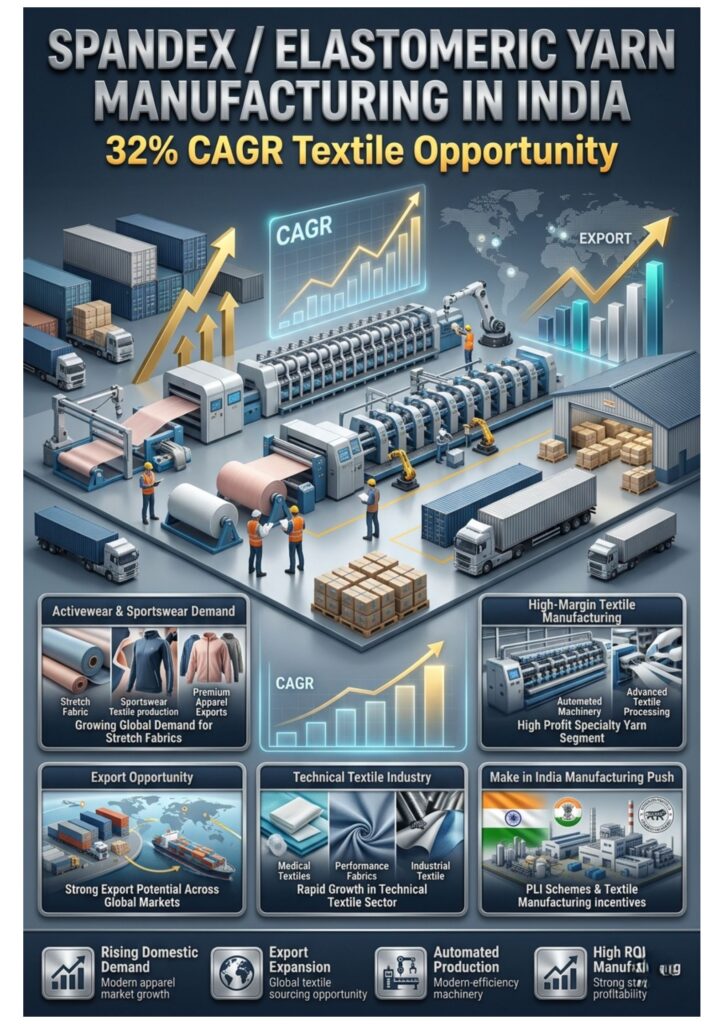
Why Spandex Manufacturing in India Is Growing So Fast
The growth is led by fashion trend and an increasing demand for stretchable fabric. Up to date customers are looking for clothing that is flexible, comfortable and performance focused. As a result, elastomeric yarn is now widely used in the fashion and healthcare industries.
The primary demand factors are:
- Activewear, gym clothes.
- Stretch denim and casual fashion
- Sportswear and athleisure
- Swimwear and lingerie
- Medical compression garments
- Apparel for yoga/performance
The textile sector is also getting ready for exports to India. Global brands are demanding quicker delivery and better sourcing from non-China. This has enhanced the role of the Indian raw material suppliers.
A domestic spandex manufacturer has several advantages over importers:
- Faster delivery cycles
- Reduce the amount of inventory required for buyer.
- Rupee-based pricing stability
- This translates to less foreign exchange volatility.
- Improved customer service to textile mills
Hence, many textile manufacturers in Tirupur, Surat and Noida are seeking reliable Indian suppliers.
Current Market Opportunity
Currently, India has installed capacity to produce 28.5 KT of spandex and estimated demand is 35-45 KT annually. This means a large portion of the market is still dependent on imports.
Industry Snapshot
Parameter | Figure |
Installed Capacity | 28.5 KT |
Current Production | 20.03 KT |
CAGR | 32% |
Estimated Demand | 35–45 KT |
Import Dependency | 40–50% |
This gap is a huge opportunity for import substitution. A medium scale manufacturing organization can also see good revenues, provided they ensure quality and consistency of delivery.
How Spandex Is Manufactured
The manufacturing process of spandex is a special one which needs to have a chemical engineering process together with fibre technology. It is made by dry spinning technology, which consists of transforming a polymer solution made from polyurethane to elastic fibres.
Generally, manufacturing process consists of:
- Polymer preparation
- Chemical reaction processing
- Dry spinning extrusion
- Solvent evaporation
- Winding and finishing yarns.
- Inspection and packaging of quality
The main raw materials used are PTMEG and MDI. The PTMEG is imported, whereas MDI is partly available in India.
The process is technologically advanced, which means that the manufacturers need to have skilled engineers, controlled production systems and suitable environmental management infrastructure.
Get Detailed Project Report (DPR): Textile Bleaching, Dyeing & Finishing Projects
Investment Required to Start a Spandex Plant
The demand for investment is more in spandex manufacturing than the traditional textile industries due to the use of specialized machinery and technology licensing.
Estimated Project Cost
Plant Type | Investment Range |
Pilot Scale Unit | ₹25–50 Crore |
Mid-Size Plant | ₹80–150 Crore |
Medical Grade Unit | ₹20–30 Crore |
Recycling Unit | ₹12–18 Crore |
These are the total investments:
- Plant and machinery
- Civil construction
- Utility systems
- Solvent recovery setup
- Raw material storage
- Working capital
- Technology licensing fees
The entry is tough, but so is the potential for long-term profits.
Profit Margin and Business Potential
Spandex manufacturing is regarded as a high value textile industry due to its high demand and lack of competition with other domestic textile industries.
Typical industry estimates are:
- Gross margins can be as high as 30–40%
- Net operating margins could be anywhere from 15–22%.
- On average, a break-even is typically at 55-60% utilization.
- The typical payback period is 5–7 years.
Profitability relies greatly on the price of raw materials, however. The cost of production of PTMEG is almost 60-70% of the total. The correct procurement planning and price hedging play a crucial role in achieving profitability stability.
Best Locations for Spandex Manufacturing in India
Site location is a key factor of logistic efficiency and customer accessibility.
Recommended Industrial Clusters
Tirupur, Tamil Nadu
India’s biggest knitwear and activewear production centre.
Surat, Gujarat
Ideal for synthetic fabric and textile mill applications.
Ludhiana, Punjab
Great demand from hosiery and sportswear producers.
Silvassa and Daman
Good industrial infrastructure with manufacturing ecosystem advantages.
Dahej, Gujarat
Favourable connectivity and PCPIR support for excellent.
Placing near textile clusters is beneficial for manufacturers to lower transportation expenses and increase the speed of serving clientele.
Emerging Business Opportunities
There are also niche markets that are rapidly expanding, apart from the regular apparel grade spandex yarn.
Medical-Grade Compression Yarn
The growth of healthcare facilities and the aging population are driving up demand for medical textiles. Compression stockings and orthopaedic products demand special qualities of an elastomeric yarn.
This segment offers:
- Higher pricing power
- Better profit margins
- Lower competition
- Export opportunities
Spandex Recycling & Sustainable Textiles
Recycled synthetic fibres are being increasingly targeted by international fashion brands. A MSME opportunity to recycle and re-spin elastomeric waste could be a big opportunity in the years ahead.
Government Support for the Sector
Multiple schemes are being promoted by the government of India to promote man-made fibre in addition to specialty textile manufacturing.
Ways to get help include:
- PLI Scheme for synthetic textiles
- MSME registration benefits
- Collateral-free loan support from CGTMSE is available.
- State textile subsidies
- PCPIR industrial infrastructure support
These incentives can be a great way to lower project setup costs.
Why Feasibility Planning Is Important
The reason of many businessmen failing is that they are investing in the equipment without proper market validation. When it comes to capital-intensive business-like spandex making, it’s crucial to carefully plan ahead of investing.
NPCS (Niir Project Consultancy Services) assists the entrepreneurs in developing detailed project reports and techno-economic feasibility studies for manufacturing industries.
They include the following in their reports:
- Market demand analysis
- Machinery selection guidance
- Raw material sourcing plans
- Preliminary cost and profitability estimates are provided.
- Financial feasibility reports
- Calculate the IRR and the payback of a project.
- Plant layout and process details
These DPRs can be used to:
- Bank loan approvals
- Investor funding
- MSME financing
- Government subsidy applications
In industries such as the one that produce spandex where there are huge technology and capital investments, thorough feasibility study would greatly reduce risk and improve project viability.
Future of Spandex Manufacturing in India
Technical textiles and Specialty synthetic fibres are the future of Indian Textile Industry. Spandex is at the heart of this metamorphosis.
A number of factors are likely to boost the future growth:
- Rising sportswear demand
- Expansion of athleisure fashion
- China+1 sourcing trend
- Increasing textile exports
- Import substitution opportunity
- Governments provide assistance to synthetic fibres
The industry is still in the early stage as seen from the current 32% CAGR. If they are taking the plunge now, with some technical strategy and sound buyer connections, they should reap long-term benefits from market expansion.
FAQs
Q1. How much is the least investment that needs to be made in a manufacturing unit that produces spandex in India?
The range of investment required for a small pilot scale unit is around ₹25 lakh to ₹50 lakh in the machinery, utilities, civil works and working capital.
Q2. What is the reason for India’s import of such a huge quantity of spandex yarn?
Demand from the domestic market substantially exceeds production capacity resulting in textile manufacturers being reliant on imports from China, South Korea and Taiwan.
Q3. Profitability of spandex manufacturing in India?
Yes. With stable and well managed production, the net operating margin is between 15–22%.
Q4. What are the biggest consumers of spandex yarn?
The main markets using elastomeric yarn are sportswear, activewear, stretch denim, lingerie and medical textiles, as well as swimwear.
Q5. What are the ways NPCS can support entrepreneurs in this industry?
NPCS provides detailed project reports, market study, financial forecast, guideline on machinery and feasibility study for setting up of a manufacturing unit and to obtain bank loans.


