





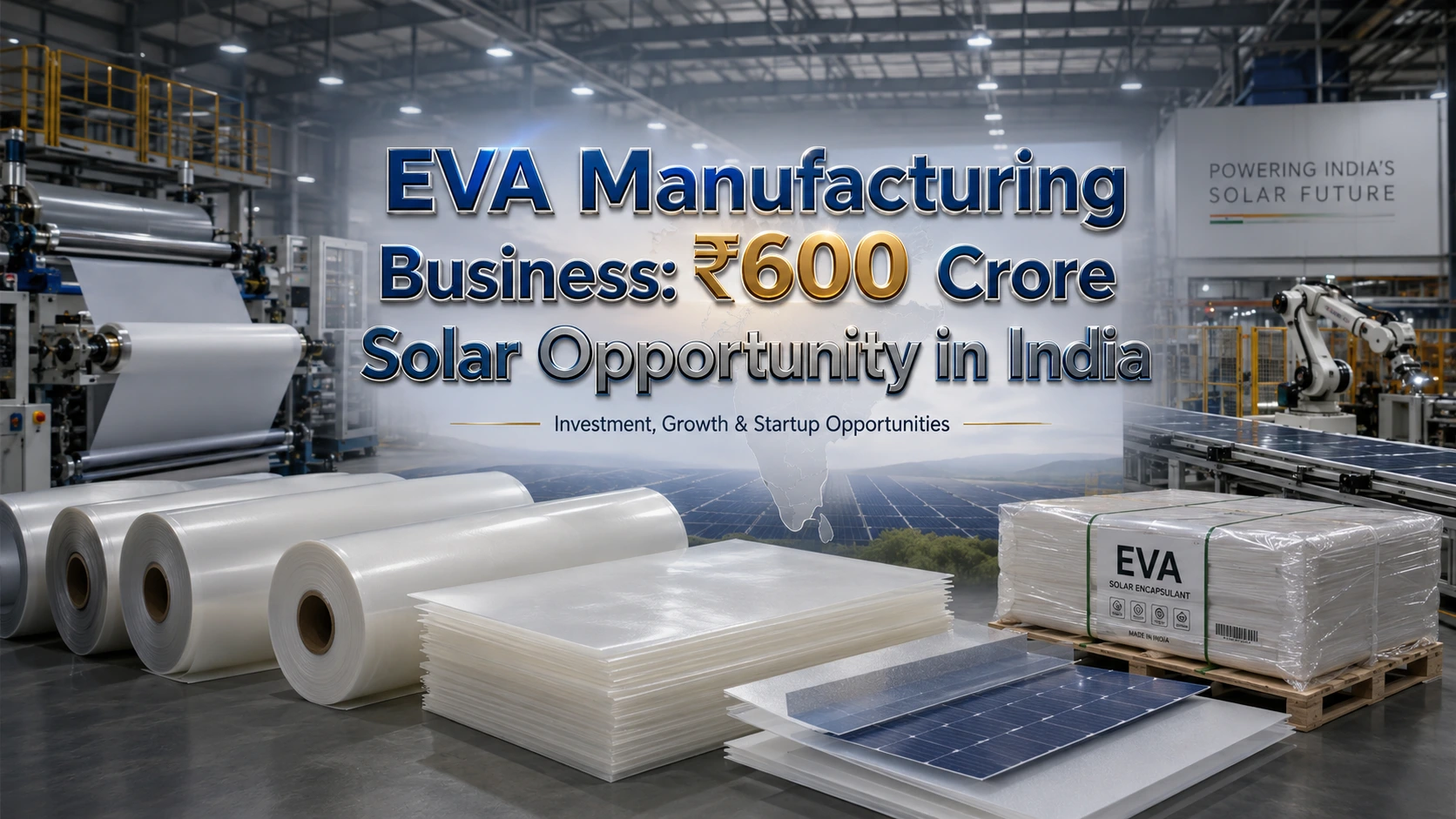
EVA manufacturing business in India
India adds 10 to 20 GW of solar power each year. Each of the modules has a thin transparent film (Ethyl Vinyl Acetate — EVA) between the glass and the PV cells. No encapsulant – no module. No module – no electricity. India’s hopes for solar are huge. This should chill all manufacturing entrepreneurs: India has 15,000 tonnes of installed EVA copolymer capacity, but has produced none of it in the last five years tracked.
This number is directly from the Annual Report 2025-26 of the Ministry of Chemicals and Fertilizers, Government of India, which details that Ethyl Vinyl Acetate is a member of the group of ‘Synthetic Rubber’ with an installed capacity of 15,000 MT and production of 0.00 for all years 2020-21 to 2024-25. The difference between capacity and production is complete.
Solar manufacturers in India today use all of the EVA encapsulant film that is shipped in from South Korea, China and a few European suppliers. The import bill is in the hundreds of crores every year. That’s the time — big, public, government-supported, and unclaimed by local makers.
Why This Sector Is a Strong Startup Opportunity
Market Demand Signals and Growth Drivers.
The Indian renewable energy industry has pledged to make huge investments in capacity over the coming decade, with the bulk of this being from PV. The equivalent amount of EVA encapsulant film is approximately 400–500 tonnes for each gigawatt of solar PV capacity. At relatively low solar module installation rates, the need for solar-grade EVA encapsulant film is in the tens of thousands of tonnes per year.
EVA’s applications are not limited to solar. The material forms the backbone of hot-melt adhesives in the packaging industry, footwear soles in the Rs 25,000 crore Indian footwear segment, cross-linked foam sheets in sports goods and automotive interior components, wire and cable jacketing compounds and specialty medical films. This product diversity is the structural strength of any solar manufacturer – solar buys provide the business, but other products provide income when solar buying cycles slow.
Get Detailed Insights from This Book: Solar PV Power and Solar Products Handbook
Export Potential and Import Substitution Logic
EVA compounds/copolymers are currently imported to India from China, South Korea and Saudi Arabia. The sun encapsulant market is nearly all import-dependent. The Department of Chemicals and Petrochemicals has clearly identified import substitution as its priority policy and any domestic producer will automatically be part of this story. According to the department’s Annual Report 2025-26, ‘lessen India’s reliance on imports’ is an important objective of the department’s sectoral mandate which is aimed at meeting the vision of Viksit Bharat.
Export opportunities are also available. The Vietnam, Indonesia and Malaysia solar manufacturers are importing a considerable amount of EVA film from China. These markets can be reached by an Indian producer with competitive pricing and quality certification by using existing trade routes, especially with the development of export infrastructure at ports such as Mundra, Hazira and JNPT in India.
Government Schemes, PLI, and MSME Incentives
EVA copolymers are under the aegis of the Ministry of Chemicals and Fertilizers, which is responsible for the enactment of the Petroleum, Chemical and Petrochemical Investment Regions policy, which has resulted in the establishment of three operational PCPIRs at Dahej (Gujarat), Vishakhapatnam-Kakinada (Andhra Pradesh), and Paradeep (Odisha). A new EVA manufacturing plant built within or near such clusters benefits from the infrastructure benefits: common effluent treatment system, common utilities, port proximity and ready industrial community.
MSME scale EVA processing units can avail credit guarantees under CGTMSE for a loan exposure of up to 85% of term loan and also avail working capital loan under MUDRA and also avail capital subsidy schemes in various states. There are additional incentives for chemical manufacturing units in Gujarat and Andhra Pradesh where the PCPIRs are large. For units with a capex in the range of Rs 5-30 crore, PMEGP is not that relevant and it would be prudent to explore SIDBI’s specialty chemical financing windows.
Entry Barriers: Capex, Licensing, and Raw Materials
To founders, this is where clarity of vision is required. The EVA encapsulant film production line equipment includes twin-screw extruder or cast film line, UV stabilizer blending, lamination machine and optical transmittance, peel strength and moisture vapour transmission rate testing equipment. The minimum capex required for a pilot plant of 300-500 TPA solar encapsulant film is Rs 12-18 crore. The cost for a mid-size one of 1,500-2,000 TPA is between Rs 35-60 crore with working and building capital.
The raw material, which is EVA resin with vinyl acetate of 28%-33% content for solar applications is also imported, mainly from Hanwha of South Korea and LG of South Korea, China’s Sinopec. This puts a structural lock in the way of any domestic manufacturer that would like to compete. Some of the current debates about domestic ethylene-vinyl acetate copolymer (EVA) production as a source of raw materials in the medium term should be followed by forward-thinking investors.
Business Selection Logic: Margins, Scalability, and Risks
There are various entry points in the EVA manufacturing space in India with varying risk and return. A first-generation entrepreneur who has Rs 15-25 crores in cash can handle the project of starting EVA foam sheet conversion or hot-melt adhesive compounding using imported EVA resin as raw material, as compared to the project of attempting backward integration into base resin synthesis, which calls for investment in the petrochemical scale.
The gross margin of EVA film conversion is 18%~25% according to the specification of products and concentration of buyers. The premium end is occupied by solar encapsulant film. However, the solar procurement cycle is bumpy as module manufacturers conduct negotiations every quarter, and payment terms can be negotiated. If a business plan is based on solar demand, it must have an operating fund of 45-60 days in the end.
Predictable scalability path. Begin with a 300-500 TPA film line for 2 or 3 anchor buyers. In the first 3 years, build quality certifications, which are a necessary prerequisite for exports of modules, e.g. test reports according to IEC 61215 from accredited laboratories, TÜV or UL product approvals. With these secured, the production unit is secured on the quality front against lower cost Chinese products and open to export markets. Once a unit achieves 1,500 TPA with exports, it is a credible candidate for PE interest.
Risks that need to be considered: currently no anti-dumping duties exist on EVA resin imports into India, maintaining raw material prices at a relatively inexpensive level, but simultaneously the government can levy duties that can immediately destabilize your costs. Regulatory risk exists in BIS standards – the QCO regulations in this context, are managed by the Department of Chemicals and Petrochemicals and apply to Ethylene Vinyl Acetate Copolymers (IS 13601:1993, HS 39013000), and records need to be kept. The other risk is that Chinese producers have developed scale and benefit from 10-15% landed cost advantage in standardized products. Your offering needs to be differentiated based on faster delivery time, favorable payment terms, strong relations, customization.
Product and Project Opportunities
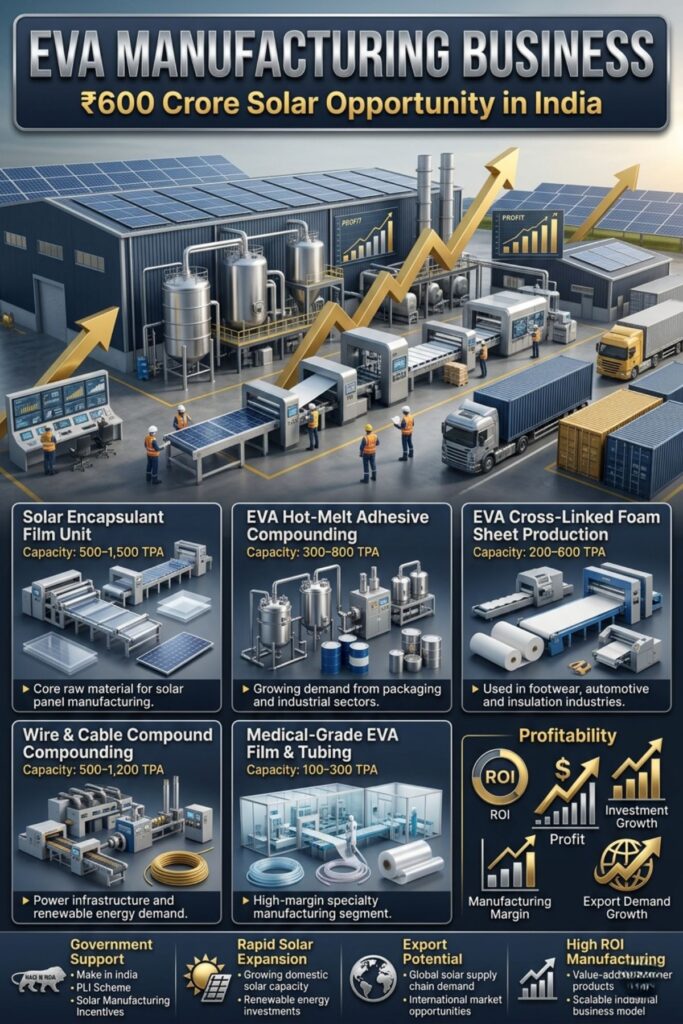
1. Solar Encapsulant Film Unit (500–1,500 TPA)
This is the most public space. A cast film line for EVA encapsulant for mono- and poly-PERC solar cells in the thickness range of 0.45-0.5mm. Target buyers include module manufacturers in Rajasthan, Gujarat, and Tamil Nadu like Ware Energies, Adani Solar, Vikram Solar and dozens of others. Capex: Rs 18–35 crore for 500–1,500 TPA. Gross margin: 18–24%. The unit requires UV additive knowledge and optical clarity testing facilities.
Get Detailed Project Report (DPR): Renewable Energy Sector: Green Power & Renewable Energy Projects
2. EVA Hot-Melt Adhesive Compounding (300–800 TPA)
EVA base resin hot-melt adhesives are used in packaging, bookbinding, woodworking and automotive trim assembly. This is a less expensive and easier to set up compounding extruder than encapsulant film. The target buyers are packaging converters, NCR, Pune, Surat. Capex: Rs 8–15 crore. Gross margin: 14–20%. The need for working capital is less than in film-making.
3. EVA Cross-Linked Foam Sheet Production (200–600 TPA)
EVA foam sheets are used for footwear midsoles, yoga mats, sports padding and automotive headliners. China and Taiwan are some the biggest sources of imports for the Indian footwear industry in the cities of Agra, Chennai and Kolkata. The fast turnaround times and the capability of a domestic producer to produce custom densities and colours has a real market. Capex: Rs 5–12 crore. Gross margin: 20–28%. This is the easiest segment to start out in for first-time manufacturers.
4. Wire and Cable Compound Compounding (500–1,200 TPA)
Flexible cables use EVA-based compounds as insulation and jacketing material, especially in the solar industry where special flame retardancy profiles are required for DC cables. The targets for the buyers are the cable manufacturers in the Silvassa and Haridwar clusters as well as in Hyderabad. Capex: Rs 12–20 crore. Gross margin: 15–22%. Adding value: BIS Compliance for Cable Compounds.
5. Medical-Grade EVA Film and Tubing (100–300 TPA)
Specialty EVA grades with very low vinyl acetate content and very high purity specification are used in medical applications, such as IV bags, blood bags, IV tubing, and surgical drape material. It is a high margin but it requires Pharma Grade GMP facilities and regulatory applications. Capex: Rs 10–20 crore. Gross margin: 25–35%. Not for novices, but useful for companies with established relationships in the pharma industry.
Your investment deserves the right opportunity
EVA Project Opportunity Matrix
| Project Opportunity | Scale (TPA) | Capex Range (₹ Cr) | Target Buyer | Gross Margin (%) |
| Solar-grade EVA encapsulant film | 500–2,000 | 15–35 | Solar PV module makers | 18–24% |
| EVA hot-melt adhesive granules | 300–1,000 | 8–18 | Footwear, packaging industry | 14–20% |
| EVA foam sheets & rolls | 200–800 | 5–12 | Sports goods, automotive | 20–28% |
| Wire & cable-grade EVA compounds | 500–1,500 | 12–22 | Cable manufacturers | 15–22% |
| Medical-grade EVA film/tubing | 100–400 | 10–20 | Pharma & device makers | 25–35% |
Source: NPCS industry analysis; market estimates based on sector benchmarks.
Indian Entrepreneur Case References
Waaree Group — Hitesh Doshi, Mumbai
Hitesh Doshi, the founder of Waaree Energies, established India’s highest solar panel manufacturing capacity by leveraging the supply chain from the domestic market as much as possible. This group’s decision to go into manufacturing in India at scale, instead of importing Assembled Panels, created a pull demand for the local encapsulant suppliers. The procurement model followed by the Waaree, which focuses more on development of the vendors instead of importing goods on a spot basis, has actually given material suppliers from India tangible opportunities to invest in the quality certification process. The take home message: There is a willingness of the large domestic module manufacturers to collaborate with Indian EVA film manufacturers, but the key is to ensure consistency and seriousness in the technical support provided.
Supreme Industries — M. P. Taparia, Malegaon
Supreme Industries, led by M. P. Taparia, developed a diversified plastics operation, which involved more than PVC and polyethylene applications, but also EVA-based products. They chose to invest in multiple end markets from common compounding infrastructure, rather than in a single vertical, providing them with business resilience during times of downturns in certain sectors. The Supreme model is a structural lesson for an EVA manufacturing entrepreneur that you should plan your plant for at least three end markets from the start. It is much cheaper to increase product flexibility at set-up than later in the life of the product.
Cosmo First (formerly Cosmo Films) — Ashok Jaipuria, New Delhi
A path smaller EVA film makers can follow has been taken by Cosmo First as it evolved from BOPP film to specialty coated films for solar applications. The company’s commitment to investment in application engineering (developing grades in conjunction with end-users, not commodity grades) enabled it to stay profitable in a commoditized market. EVA encapsulant is not a commodity product in the solar market and there are some differentiating factors such as grade specification, packages of additives, and adhesion characteristics. If an Indian investor invests in application development and not only in the conversion capacity, then he/she creates a more defensible position.
Related Article: Solar Panel Manufacturing Business in India: Cost, Profit, Investment & Complete Startup Guide
Import-Export Opportunity Analysis
Indian import of EVA is very transparent from the government data. The EVA copolymers installed capacity for the tracked years in Annexure II of the Annual Report 2025-26 of the Ministry of Chemicals and Fertilizers, GoI is 15,000 MT. On this capacity, production has been zero, which implies that India’s EVA demand is 100% imported. India has been estimated to be importing solar encapsulants at a rate of 8,000-12,000 tons annually, and the import substitution value is estimated to be around Rs 400-600 crore per year and is growing.
The big buyers of the EVA encapsulant and other related materials are the ASEAN solar manufacturing cluster – Vietnam, Indonesia, Thailand – and they are importing almost exclusively from China and South Korea currently. Indian manufacturers can have a shot at this market once they are able to obtain quality certifications and the geographic proximity and potential free trade benefits under ASEAN agreements. The Middle East is also seeing a surge in solar capacity, especially with Saudi Arabia’s NEOM and Red Sea projects, which also are capable of being addressed as an export market within 2–3 years after commissioning.
Feasibility-First: Testing Your Numbers Before You Commit Capital
All business ideas that come to mind in the EVA space seem like a great idea at the revenue level. The discipline is in the financial model — which must be created from a project costings base, adjusted for reasonable capacity utilisation assumptions over the first three years and based on realistic working capital calculations.
NPCS (Niir Project Consultancy Services) conducts a detailed techno-economic feasibility analysis and prepares elaborate MS DPRs for manufacturing units planned by entrepreneurs in the chemicals and specialty materials sector. This includes EVA products as well. Market Survey cum Detailed Project reports are also offered for projects and include detailed analysis of manufacturing process, equipment & raw materials specifications, product mix and capacity, demand study, and full financial statements of project and profit forecast, cash flow statements and break-even analysis etc. Any entrepreneur taking the step forward for investing Rs 15 Crore or Rs 50 crore for the first generation on an EVA project cannot and must not step out to meet financiers or lenders without having this DPR as the banker will certainly reject the proposals without this DPR.
Conclusion: The Window Is Open — But Not Indefinitely
India has a capacity of 15,000 MT of EVA co-polymers producing zero. It is still importing the encapsulant film from Korea and China for use in its solar panel manufacturing. For the footwear industry, it imports foam compounds from Taiwan. It imports jacketing compounds from the exporters of petrochemicals. Each of these is an opportunity for a technologically skilled and well capitalized Indian entrepreneur to make a mark.
The policy setting is conducive. The Government of India’s Ministry of Chemicals and Fertilizers has clearly made reduction of imports a priority area. The PCPIR complex in Dahej and Paradeep has location advantage for chemical industry. BIS quality systems are increasingly stringent and so make the entry bar for low quality imports higher, and also improve the quality of domestic producers who invest in BIS certification.
The sobering truth: it’s a capital-intensive business that’s very raw material dependent. If the existing equity of an individual entering into EVA manufacturing is less than Rs 12-15 crore, or if he does not have a credible off-take arrangement with at least one anchor buyer, then he is running more risks than the margin structure can cover. Begin by conducting market validation. Before pouring the concrete, get your anchor buyers interested.
The domestic manufacturers will not come to the market at ease, as the solar encapsulant market will not wait. Chinese manufacturers are efficient, certified producers and price competitive. Market opportunity for Indian manufacturers is already open, and will remain open for some time — but that time is not forever. Those who are moving in the next 24 months will be in a much better place than those who wait a few years.
FAQ: EVA Manufacturing in India — Founder Questions Answered
Q1. How much startup capital would be needed for an EVA encapsulant film unit?
The first operating cycle total project cost of a realistic entry point for a 300–500 TPA solar encapsulant film unit is Rs 12–18 crore comprising the cost of plant, equipment, building and working capital. Any unit less than Rs 10 crore isn’t technically viable and doesn’t meet solar module manufacturers’ quality standards. Include a cost overrun percentage of 15-20% in all financial planning.
Q2. How long does it take to break even on an EVA film unit?
With a 500 TPA encapsulant film line, margins of 18-22% and controlled overheads, cash break-even is expected in 18-24 months after commissioning, during year two of operation. The total capital will be recovered in about 4.5 to 6 years. This is greatly accelerated if there is higher capacity utilisation in year one as a result of contracts with anchor buyers.
Q3. Does it need any government license to make EVA copolymers or films?
EVA film is not an industry that needs industrial license under the industries (Development and Regulation) Act. But for a domestic sale or for claims of import substitution BIS compliance as per the Ethylene Vinyl Acetate Copolymers Quality Control Order (IS 13601:1993) is compulsory. Typical requirements include factory registration, GST, pollution control consent (usually green or orange category), and fire NOC. The solar-grade encapsulant film should also be certified by accredited labs before the module manufacturer has qualified the product.
Q4. Is it possible for small MSME with EVA encapsulant to compete with Chinese imports of EVA encapsulant?
Competition from Chinese imports is not easily done at small scale. The viable approach is differentiation – customize the formulations for specific cell types, shorter delivery times (2-3 weeks vs. 8-12 weeks for imports), have no currency risk, provide local technical support, and offer smaller minimum order quantities. The Tier-2 and Tier-3 manufacturers of modules are more receptive to domestic suppliers as compared to large exporters; thus, they represent a better starting point for market.
Q5. What is the primary risk in the EVA manufacturing business in India?
Three risks dominate. Firstly, raw material dependency: EVA resin is imported and any interruption to the supply of raw materials or unforeseen import duties affects cost. Second, customer concentration: If two or three companies are generating the bulk of the revenue from solar modules, a pause by any one of them puts them in a bad situation with regard to cash flow. Thirdly, technology obsolescence: the solar industry is changing rapidly with the introduction of POE and other means of encapsulant replacement; the manufacturer has to keep abreast of developments and be ready to change within a 5–7-year time frame.


