





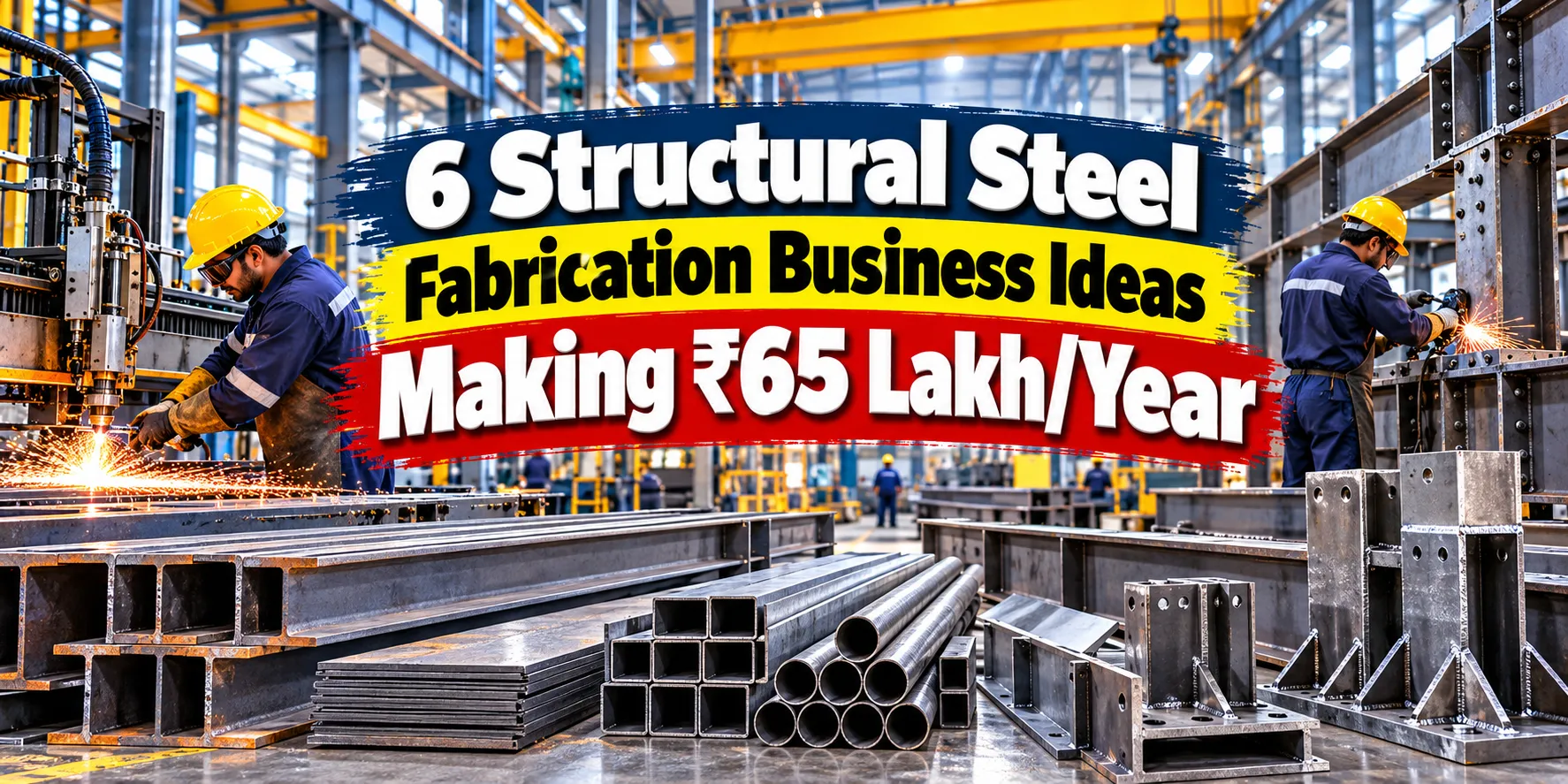
Steel Fabrication Business Ideas are gaining strong traction in India as sustained infrastructure development and industrial construction continue to drive demand for fabricated structural steel. Warehouses, manufacturing plants, bridges, industrial sheds, and pre-engineered buildings require accurately cut, welded, drilled, and assembled steel components before they are transported to construction sites.
For engineering-minded entrepreneurs, this creates a dependable business opportunity with demand spread across multiple sectors. Large construction companies and EPC contractors often outsource fabrication work to specialised units instead of maintaining expensive in-house facilities. A well-equipped steel fabrication workshop with skilled manpower, reliable machinery, strict quality control, and the ability to meet project specifications can therefore build long-term relationships with contractors, developers, manufacturers, and infrastructure companies.
Entrepreneurs exploring Steel Fabrication Business Ideas can also diversify into structural frames, industrial sheds, staircases, platforms, handrails, equipment supports, storage systems, and customised fabrication. This flexibility helps reduce dependence on a single customer segment while creating opportunities to secure both recurring industrial orders and project-based construction contracts.
Why Structural Steel Fabrication Is a Smart Business Idea Right Now
Warehousing, logistics parks, renewable energy infrastructure, and factory construction have all expanded rapidly, and every one of these depends on fabricated structural steel for framing, roofing support, and equipment platforms. Pre-engineered building demand in particular has grown quickly because it offers faster construction timelines than conventional concrete structures, and PEB manufacturers depend heavily on fabrication partners for components. Because fabrication quality directly affects structural safety, contractors increasingly prefer certified, quality-consistent vendors over the lowest bidder, rewarding fabricators who invest properly in welding certification and quality control.
Government Policies & Incentives
Steel-sector policy support, including quality control orders on structural steel grades, is administered through the Ministry of Steel, which also promotes domestic steel consumption in government infrastructure projects. Fabrication units qualify for standard MSME manufacturing credit and technology upgradation support through the Ministry of MSME, while quality benchmarking against structural steel standards is guided by the Bureau of Indian Standards. Skill development schemes coordinated with state labour departments also offer subsidised welder certification training, which fabricators can access to build workforce capability without bearing the full training cost themselves.
6 Steel Fabrication Business Ideas for Startups
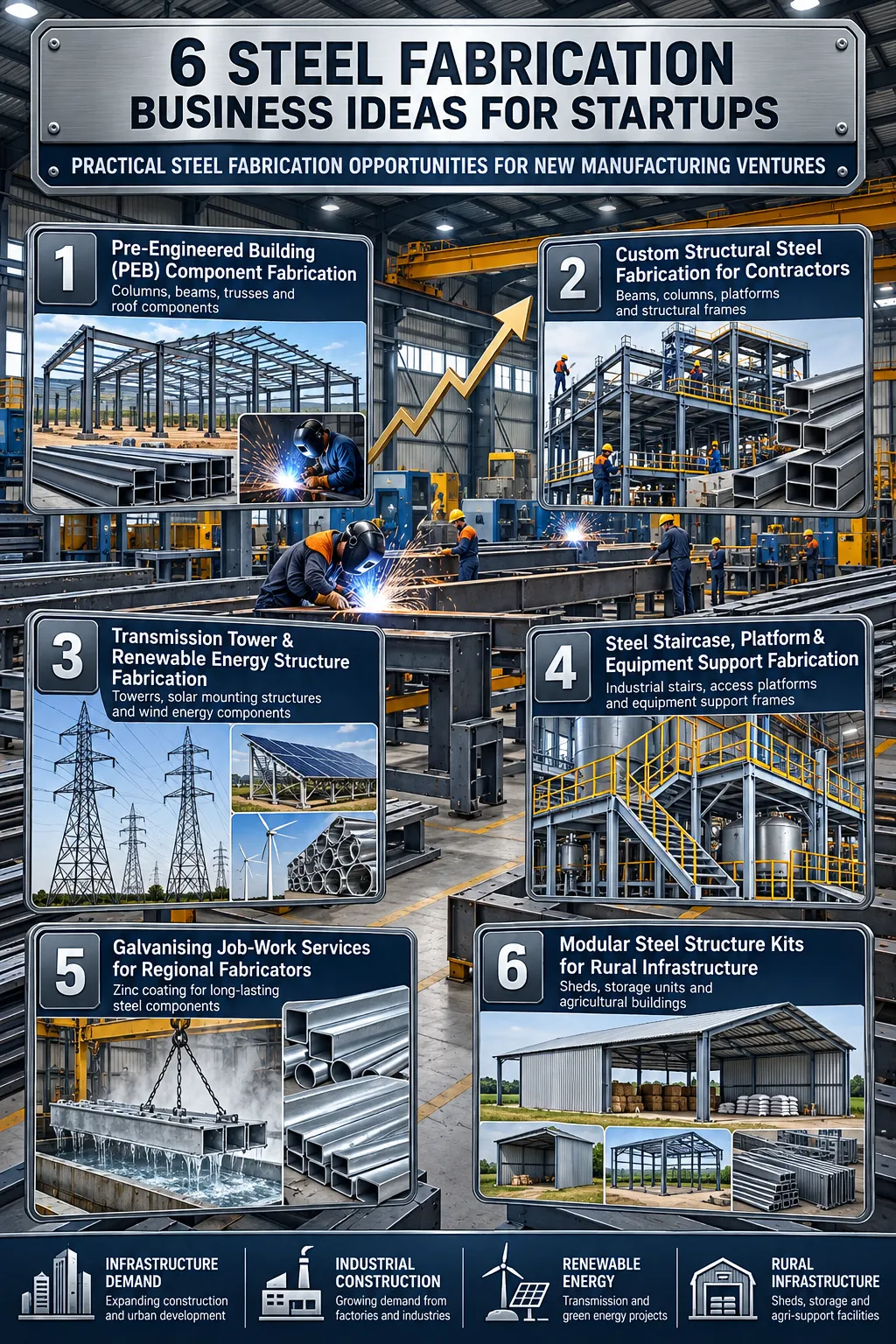
Pre-Engineered Building (PEB) Component Fabrication
Supplying primary and secondary structural components for pre-engineered buildings is one of the highest-volume opportunities in this sector, as warehousing and factory construction increasingly favour PEB systems over conventional structures. A fabricator that builds a reliable relationship with PEB design-and-build companies can secure recurring, multi-project supply contracts rather than one-off orders.
Custom Structural Steel Fabrication for Contractors
General contractors executing bridges, industrial platforms, and commercial buildings regularly need custom-fabricated steel components that match specific project drawings. This model requires strong drawing-interpretation and welding capability, but it commands better margins than standardised PEB components because each order is engineered to a unique specification.
Transmission Tower & Renewable Energy Structure Fabrication
Solar mounting structures and transmission towers represent a fast-growing fabrication category tied directly to renewable energy expansion, and manufacturers who understand galvanisation and wind-load specifications specific to this segment can win steady orders from EPC contractors executing solar and grid infrastructure projects.
Steel Staircase, Platform & Equipment Support Fabrication
Industrial facilities constantly need fabricated staircases, mezzanine platforms, and equipment support structures as part of ongoing expansion and maintenance, providing smaller, faster-turnaround orders that keep a fabrication shop’s cash flow steady between larger structural contracts.
Galvanising Job-Work Services for Regional Fabricators
Hot-dip galvanising capacity is often concentrated in a handful of large facilities per region, forcing smaller fabricators to transport finished steel long distances for corrosion protection. A dedicated galvanising job-work unit located near a fabrication cluster can serve multiple smaller fabricators on a per-batch basis, generating steady processing revenue without needing to compete directly in fabrication itself.
Modular Steel Structure Kits for Rural Infrastructure
Government programmes building rural infrastructure, such as cold storage units, warehouses, and community centres, increasingly specify modular, fast-to-erect steel structures. A fabricator that develops standardised structural kits for these applications can win recurring government tender business beyond typical urban commercial fabrication work.
Import–Export Opportunity Analysis
Structural steel raw material is predominantly sourced domestically from major Indian steel producers, keeping this business largely insulated from import dependence. Export opportunity exists mainly through supplying fabricated components for overseas infrastructure and industrial projects, an area where Indian fabricators have grown competitive on cost, supported by trade facilitation from the Federation of Indian Chambers of Commerce and Industry.
Market Outlook & Scaling Roadmap
India’s infrastructure pipeline, spanning logistics parks, renewable energy structures, and urban metro expansion, points to sustained multi-year demand for structural steel fabrication capacity across the country, not concentrated in any single project type. Fabricators who diversify across PEB components, custom structural work, and renewable energy structures tend to maintain steadier order books than those dependent on a single contractor relationship or project category.
Skills, Manpower & Quality Control
Fabrication quality depends heavily on certified welders and drawing-interpretation skill, making skilled welder recruitment and retention one of the biggest ongoing operational challenges in this business. A small unit typically employs 25 to 35 workers, with welding supervisors holding recognised certification being essential for winning contracts that require ISO 3834 compliance. Many fabricators also invest in in-house welder training programmes to build a reliable talent pipeline rather than depending entirely on the open labour market.
Indian MSME Success Stories
Everest Industries — H.C. Jain and family
Everest Industries built a strong position in structural steel buildings and roofing solutions by focusing on standardised, quality-consistent product lines, a strategy that let the company scale fabrication capacity predictably across multiple states.
Kirby Building Systems (India) — Regional leadership under Alghanim Industries
Kirby’s rise as a pre-engineered building specialist in India shows how deep technical focus on one structural system, rather than general fabrication, can build a defensible market position against broader, less specialised competitors.
How NPCS Can Help Entrepreneurs Evaluate the Opportunity
We at Niir Project Consultancy Services (NPCS) provide professional consulting for the preparation of Market Survey cum Detailed Techno-Economic Feasibility Reports (DPRs) for setting up new industries or businesses. Our reports include detailed manufacturing processes, market research and demand analysis, process flow diagrams, product mix and capacity planning, machinery and raw material details, and complete project financials with profitability analysis. Entrepreneurs use these reports to evaluate feasibility, profitability, and long-term scalability before investing, which reduces guesswork at the most capital-intensive stage of a new venture.
For anyone evaluating Structural Steel Fabrication, that groundwork matters most before any capital is committed: NPCS studies work through machinery selection, raw material sourcing, plant layout, manpower planning, and a full financial model covering capital cost, working capital, revenue projections, and return on investment. Entrepreneurs approaching banks, NBFCs, or state MSME schemes for financing typically need exactly this kind of documented feasibility study, since lenders rarely fund a project on an idea alone. Working with an established consultancy also shortens the learning curve considerably, letting a first-time promoter benefit from patterns NPCS has already observed across hundreds of similar manufacturing projects.
NPCS has published a comprehensive printed reference book on Structural Steel Fabrication, covering technology, market analysis, investment parameters, and manufacturing processes in depth — the printed book: Steel and Iron Handbook
For a detailed techno-economic Project Report on setting up a manufacturing business in this sector — including plant economics, machinery lists, financial projections, and applicable government incentives — the NPCS Project Report: Detailed Project Report For Steel Fabrication Business
Data Table
Indicative Cost & Capacity for a Structural Steel Fabrication Unit
| Parameter | Small Unit | Mid-Size Unit |
|---|---|---|
| Approximate project cost | ₹2–3 crore | ₹8–12 crore |
| Fabrication capacity | 150–200 tonnes/month | 600–800 tonnes/month |
| Core manpower | 25–35 | 80–100 |
| Key certification | IS structural welding standards | IS standards, ISO 3834 welding quality |
| Typical payback period | 3–4 years | 4–5 years |
Note: Figures above are indicative planning estimates for feasibility discussion and vary by location, scale, and machinery configuration.
Common Pitfalls to Avoid
A common mistake is underinvesting in welding quality certification early on, which then blocks access to higher-value contracts that specifically require it. Another frequent pitfall is poor project scheduling across multiple simultaneous orders, leading to delivery delays that damage contractor relationships built up over time.
Conclusion
Structural steel fabrication remains one of the steadiest business ideas linked to India’s infrastructure growth, particularly for founders who invest early in welding quality and certification. Coordinating with industrial states such as Andhra Pradesh Industrial Infrastructure Corporation (APIIC) can help new fabricators secure land and power connections suited to heavy manufacturing operations.
Your Investment Deserves the Right Opportunity
Every serious investment begins with choosing the right sector and the right business model. With hundreds of industrial opportunities available across India’s manufacturing and clean-energy landscape, making the most informed choice is critical. NIIR’s Startup Selector tool helps entrepreneurs, MSMEs, and investors identify the most suitable business opportunities based on their investment capacity, location, and interests — so your capital is directed toward a venture with the strongest fit and potential.


