





The Central Government’s Production Linked Incentive (PLI) programme has moved from promise to production. Across 14 sectors, PLI units had invested ₹2,58,835 crore by 30 June 2026, generated production and sales of over ₹23.79 lakh crore, and supported 14.57 lakh direct and indirect jobs.
The numbers are important now as the first phase (the phase of attracting the large anchor plants) is pretty much complete. Mobile phone imports have come down by nearly 77%, 99.2% of the mobiles used in India are now made in India and 191 bulk drugs are being manufactured in India for the first time. (PLI Scheme Business Opportunities)
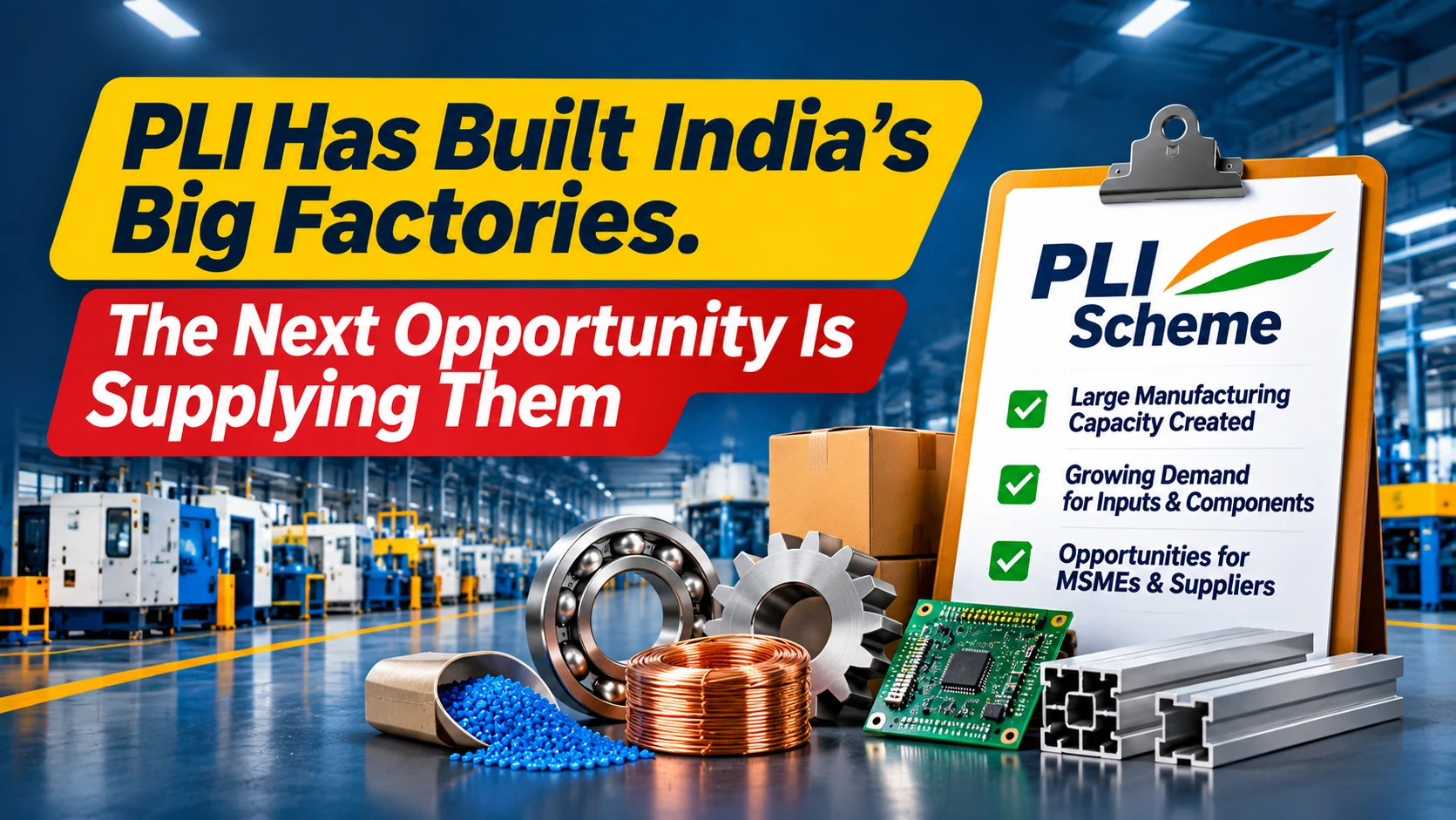
Every one of those anchor plants requires a deep bench of local suppliers (PCB assemblies, cable harnesses, AC and LED parts, drug intermediates, machined auto components, solar module hardware etc). That’s where the opportunity is for MSMEs, manufacturers, investors and startups. PLI pays the big players to manufacture in India; the sensible thing for the smaller players to do is to become the suppliers that enable them to do that.
The Announcement in Detail: What the Central Government Has Reported
In a background paper entitled “The Manufacturing Transformation Powered by PLI” issued by the Press Information Bureau (PIB) on 13th November 2026, the Government of India lays out the outcomes of the PLI schemes. The key points are:
- Scale: PLI covers 14 sectors with an approved outlay of Rs 1,91,049 crore. Launched in 2020 as part of Atmanirbhar Bharat.
- Results as at 30 June 2026: 791 approved applications; cumulative investment of Rs 258835 crore; production and sales of over Rs 23.79 lakh crore; exports of Rs 15.53 lakh crore; and 14.57 lakh jobs (8.81 lakh direct and 5.75 lakh indirect).
- Incentives paid: ₹36,754 crore have been disbursed so far, only on release of the incentives when the companies meet the investment, production and eligibility criteria.
- Export growth (average annual 2021-25): IT hardware 77.2%, ACC batteries 45.0%, electronics 38.8%, solar PV modules 23.9% and specialty steel 22.5%.
- Import substitution: mobile imports down by nearly 77%; 191 bulk drugs are now being manufactured in India for the first time; telecom exports came in at ₹21,033 crore while telecom imports were down 18.5% on the year.
- Electronics: PLI in large scale electronics attracted investment of ₹20,580 crore (vs ₹7,000 crore target) and generated 1.69 lakh direct jobs. Production in the sector was up 15.8% to ₹13.11 lakh crore in 2025-26, exports were at ₹4.24 lakh crore and mobile production at ₹6.27 lakh crore.
- Pharma and medical devices: the ₹15,000 cr pharma PLI attracted ₹46,744 cr of investment; there are separate schemes for bulk drugs (outlay of ₹6,940 cr) and medical devices (outlay of ₹3,420 cr).
- White goods: the ₹6,238cr scheme for ACs and LED components had 13 applications and ₹1,914cr committed in round 4. (PLI Scheme Business Opportunities)
- Automobiles, food, steel, batteries and solar: Auto PLI (₹25,938 cr outlay) attracted ₹45,477 cr of investment; food processing PLI has approved 165 applications (including 69 MSMEs); specialty steel has attracted ₹27,368 cr; 40 GWh of ACC battery capacity has been awarded with a 10 GWh grid storage tender expected in 2026; and solar PV module PLI has awarded capacity for 48,337 MW.
Reference: Press Information Bureau (PIB), Government of India — The Manufacturing Transformation Powered by PLI
What This Development Means for Indian Businesses
PLI rewards incremental production by large, eligible manufacturers. Most MSMEs won’t be able to meet those thresholds themselves, but they don’t have to. Each anchor plant that increases its output generates a stream of orders for parts, sub-assemblies, tooling, packaging inputs and services. That’s what localisation of those inputs is all about and that’s what drives domestic value addition which is what both the Government and the anchor plants want. (PLI Scheme Business Opportunities)
For entrepreneurs and startup founders the opportunity is in specific, qualified supply. MSMEs can go from job work to approved vendor. Manufacturers can add component lines on to existing capacity. Investors can fund tier 2 suppliers with locked in demand. Exporters can follow the anchors into global supply chains and the service providers in the areas of testing, calibration, tooling and certification will all have a steady flow of business.
Why This Industry Could See Stronger Growth
Anchor capacity is already in place and is still being expanded on so supplier demand is not speculative. Fresh rounds are still opening with white goods having new applications in round 4 and a new grid storage battery tender due to be launched.
The next policy layer is one that targets the components themselves. The Electronics Component Manufacturing Scheme covers sub-assemblies, bare components and capital equipment with a number of states now adding top-ups on top of the central incentives. This is all being underpinned by strong growth in exports of electronics, IT hardware and batteries which suggests that demand for local inputs will remain very strong over the rest of the decade. (PLI Scheme Business Opportunities)
Government Policies and Incentives
The PLI schemes across the 14 sectors remain the anchor. In pharma the DOP schemes cover bulk drugs, KSMs and intermediates and the white goods scheme has consolidated guidelines which list the AC and LED components that qualify (a very useful map of what the anchors want to source locally).
States are all vying for the component makers. UP’s Electronics Component Manufacturing Policy 2025 provides top-up incentives to match the central ECMS support. TN’s Industries Department has also brought out the Tamil Nadu Electronics Hardware Manufacturing Policy to expand its ESDM supplier base.
For smaller firms the MSME Sustainable (ZED) Certification Scheme will subsidise the quality certification that the larger buyers require from their suppliers. Hardware startups can go to the incubators under the Startup India Seed Fund Scheme. Pharma exporters can use Pharmexcil’s guidance on the bulk drug PLI scheme as they build up their export linked capacity.
Manufacturing Business Opportunities Emerging From This Development
1. PCB Assembly and Electronics Sub-Assemblies
Product: Populated PCBs, cable harnesses, chargers and adapters, enclosures. The reason for the demand is that the electronics manufacturing industry is growing so rapidly and they need local sub-assemblers. The customer base is electronics, IT hardware and telecom manufacturers. The concept is SMT lines, wave soldering, testing and harness crimping. MSME fit is good from ₹50 lakh to ₹2 crore for harness and assembly units. There is a good export opportunity via contract manufacturing. The risks are of course the rigorous quality audits, the volatility of component prices and the fact that you’re reliant on a small number of customers.
2. AC and LED Lighting Components
Product: Copper tubing, heat exchanger parts, sheet metal parts, LED drivers and metal core PCBs. The reason for the demand is the White Goods scheme which is specifically focused on localising the AC and LED components. The customer base is AC and LED makers and their tier 1 suppliers. Raw materials: copper, aluminium, steel and electronic parts. MSME fit: high (in the areas of fabrication and driver assembly). Export: moderate. Risks: seasonal AC demand and metal price volatility.
3. Pharma Intermediates and Key Starting Materials
Product: Drug intermediates and KSMs for API manufacture. The demand is up because 191 bulk drugs are now being made in house and each of those requires a reliable supply of intermediate. The customers are API and formulation companies. The concept is batch chemical synthesis using reactors, centrifuges and dryers. The investment is moderate to high with very strict effluent and GMP requirements. There is a very strong export potential. The risks are regulatory, pollution control and competition from the established importers.
4. Precision Machined and Sheet-Metal Auto Components
Product: Machined shafts, brackets, pressed parts and fasteners for vehicles and EVs. Demand is rising as auto PLI investment ramps up in the area of advanced technology vehicle and component manufacturing. Customers are the auto OEMs and tier 1s. The concept is CNC machining, press shop and finishing. A good MSME fit in the existing auto clusters. Good for export to global auto supply chains. Risks: very long qualification cycles, IATF certification and price pressure. (PLI Scheme Business Opportunities)
5. Solar Module Hardware
Product: Aluminium frames, junction boxes and mounting hardware. The demand is up due to the awards for over 48GW of module capacity which creates a significant amount of ongoing demand for module inputs. The customers are the module manufacturers and the EPCs. The raw materials are aluminium extrusions, polymers and copper. MSME fit is good for the frames and boxes. Export is moderate. Risks are BIS and reliability certification and price competition from imports.
Import-Export and International Market Opportunity
Export opportunity. The fastest-growing PLI exports, IT hardware, electronics, batteries and solar modules, all depend on a supply base. Indian suppliers can follow anchors into the US, Europe and the Middle East, and pharma intermediates already have established global buyers. Certification, consistent quality and cost competitiveness are the main entry tickets. (PLI Scheme Business Opportunities)
Import substitution. Final assembly is now largely local, but many components, from PCBs and passives to compressors, intermediates and module hardware, are still imported. These are the clearest substitution targets, and component-focused schemes at central and state level are designed to close exactly these gaps.
Indian MSMEs and Startups in Related Industries
Dixon Technologies began as a small electronics contract manufacturer in Noida and became one of India’s largest electronics manufacturing services companies. It shows how a supplier that builds manufacturing capability for brands can scale with the industry. The lesson is to specialise in reliable, cost-efficient production for others.
Amber Enterprises focuses on air-conditioner components and sub-assemblies for AC brands. It illustrates the component-supplier model that white goods localisation rewards. Entrepreneurs can learn that deep expertise in a narrow set of components can create lasting customer relationships.
What Entrepreneurs Should Evaluate Before Investing
- Market demand and pricing: identify the specific anchor plants you can supply and their localisation plans.
- Raw materials: check import dependence for electronic parts, cTechnology and machinery: match the equipment to the customer’s specification, particularly in the case of SMT, CNC and reactors.cially for SMT, CNC and reactors. (PLI Scheme Business Opportunities)
- Location and utilities: locate near clusters such as Noida, Chennai, Pune or pharma belts, with reliableManpower and working capital: budget for skilled operators and the long customer payment cycle.and long customer payment cycles.
- Quality and regulation: plan early for ISO, IATF, Competition, break-even and scalability: model break-even on real vendor volumes and design for capacity additions.ndRisk management: don’t put all your eggs in one basket and hedge your key raw materials.omer and hedge key raw materials.
How NPCS Can Help Entrepreneurs Evaluate the Opportunity
NPCS (Niir Project Consultancy Services) helps entrepreneurs evaluate component and supplier projects before they invest. Its team prepares Detailed Project Reports, carries out market research and feasibility studies, advises on technology and plant and machinery, and plans manufacturing projects with complete investment evaluation, including how central and state incentives apply. (PLI Scheme Business Opportunities)
NPCS have published a very thorough printed reference book on the subject, covering the technology, the market, the investment parameters and the manufacturing processes in great depth. You can get a copy of the printed book here: Handbook on Electric Vehicles Manufacturing (E-Car, Electric Bicycle, E-Scooter, E-Motorcycle, Electric Rickshaw, E-Bus, Electric Truck with Assembly Process, Machinery Equipments & Layout)
For a detailed techno-economic Project Report on the set up of a manufacturing venture in this sector (including plant economics, machinery list, financials, government incentives etc.) please see the NPCS Project Report here: Start Printed Circuit Board (PCB) Manufacturing Business – Detailed Project Report
Business Opportunity Snapshot
| Parameter | Snapshot |
| Industry | Tier-2 component and sub-assembly supply to PLI manufacturers |
| Market Driver | Anchor plants in electronics, pharma, autos, white goods and solar scaling production |
| Key Development | PLI results to June 2026: ₹2,58,835 crore investment, ₹23.79 lakh crore production, 14.57 lakh jobs |
| MSME Opportunity | PCB assembly, harnesses, AC/LED parts, intermediates, machined parts, module hardware |
| Manufacturing Potential | High across electronics, pharma, auto and solar supply chains |
| Export Potential | Strong through anchor customers’ global supply chains |
| Import Substitution | Strong for components, intermediates and module inputs |
| Government Support | PLI, ECMS, state component policies, ZED, Seed Fund |
| Investment Consideration | Quality certification and customer qualification are critical |
| Risk Level | Medium |
| Growth Outlook | Strong through the decade |
Conclusion
The Central Government’s latest PLI results show a manufacturing base that has grown in scale: ₹2.59 lakh crore of investment, ₹23.79 lakh crore of production, ₹15.53 lakh crore of exports and 14.57 lakh jobs. Big anchor plants in electronics, pharma, autos, white goods, batteries and solar are now operating.
The next opportunity lies one level down. These plants need local suppliers of PCB assemblies, AC and LED components, drug intermediates, machined parts and solar module hardware. MSMEs that win approved-vendor status can grow with their customers, export through them and replace imports, backed by ECMS, state component policies and ZED support.
The window is open while localisation targets are rising. Move methodically through Market Research → Feasibility Study → DPR Preparation → Investment Planning.
Your Investment Deserves the Right Opportunity
Every serious investment begins with choosing the right sector and the right business model. With hundreds of industrial opportunities available across India’s manufacturing and clean-energy landscape, making the most informed choice is critical. NPCS Business finder tool helps entrepreneurs, MSMEs, and investors identify the most suitable business opportunities based on their investment capacity, location, and interests — so your capital is directed toward a venture with the strongest fit and potential.


