





10-Opportunities for Profitable MSME Manufacturing in India’s Power and Infrastructure Sectors
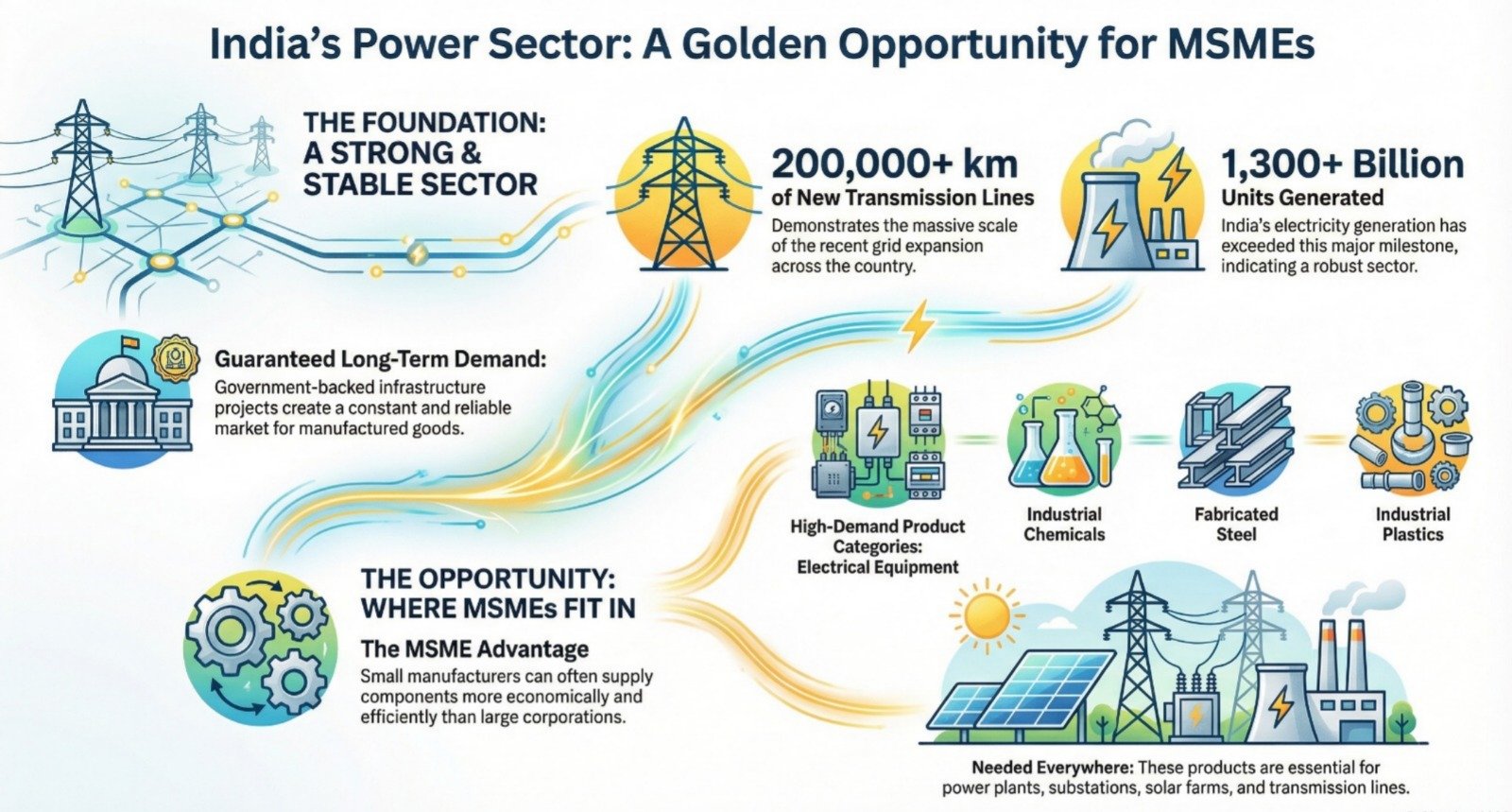
The power, energy and infrastructure sectors of India have been a significant and stable source of growth for MSME manufacturing companies. While many other consumer-orientated manufacturing sectors rely very heavily on the spending habits of consumers and market trends to drive sales, the long-term nature of all infrastructure projects creates a guaranteed and constant level of demand that is supported by governments.
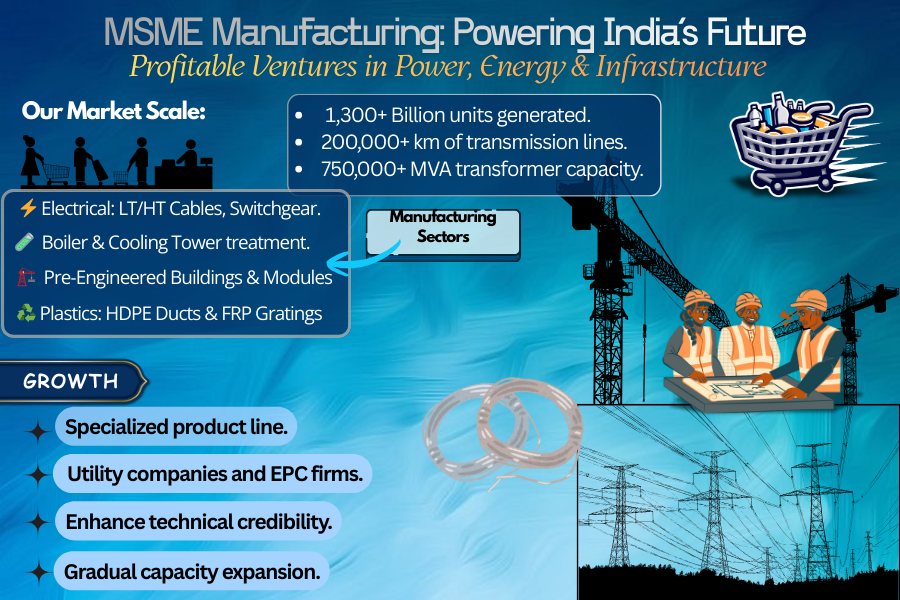
Over the past few years, the Indian government has made tremendous progress in building out the strength of the country’s power infrastructure. Data provided by the Indian government indicates that the country has significantly reduced the amount of time it experiences widespread power shortages; that the country has exceeded 1,300 billion units of electricity generated; that over 2,00,000 kilometers of transmission lines have been added to the network; and that the total transformation capacity of the country’s grid exceeds seven hundred thousand megavolt-amperes (MVA).
While these successes have created an environment where there is much policy-based success, they also provide the MSME manufacturer with a wealth of business opportunities as MSMEs can manufacture electrical equipment, industrial chemicals, fabricated steel structures and industrial plastic products that will be used in every power plant, substation, transmission line, solar or wind farm and in every electrification project being developed in India.
New entrepreneurs and first-time manufacturers who are looking at entering into the power and infrastructure manufacturing sectors will find the one major advantage to be the ability to see and know the demand for their product or service. These MSME manufacturing opportunities in power and infrastructure provide long-term demand stability and scalable growth for small manufacturers. Each of the aforementioned facilities will require a vast array of components and materials to be manufactured and delivered in order for them to operate. In addition, many of the components and materials required will be more economically and efficiently supplied by MSME manufacturers rather than the large corporation.
Below are some of the most efficient and cost-effective MSME manufacturing opportunities available related to the power, energy, and infrastructure sectors of India.
MSME Manufacturing Opportunities in India’s Power, Energy and Infrastructure
Demand for manufacturing related to infrastructure is on a longer term demand curve then product for consumers. Demand for this type of manufacturing is created by:
- Government programs to build national infrastructure
- EPC and utility contracts that are signed over a number of years
- Requirements for safety and quality compliance (mandated)
- Continuing maintenance and replacement of existing equipment
After an MSME is qualified as an approved vendor they will likely be able to receive repeat orders and establish a long-term relationship with their customer(s).
The size of India’s electric power industry is large enough to provide a stable source of demand over time:
- Over 1,300 billion units of electricity generated annually
- More than 200,000 km of transmission line circuits
- More than 750,000 MVA of transformer capacity
- On going development of both thermal and renewable energy projects
This shows that demand for this type of manufacturing has a long term structural base rather than a short term temporal one.
1. Opportunities for MSMEs within the Electrical Manufacturing Segment
Low Tension (LT) and High Tension (HT) Power Cable Production
These power cables are utilized throughout Generation Plants, Substations, Distribution Networks, Renewable Energy Projects, Railways, and Industrial Facilities.
Why this is an ideal opportunity for MSMEs:
There is a consistent demand for large volumes of power cable products
Utilizing extruded cable manufacturing can easily scale-up to meet increasing production demands
Orders for power cable products from EPC Contractors and Utilities occur regularly
As a result, a significant number of Specialized Cables, including Fire-Retardant, Heat-Resistant, and Customized Variants are still being imported; this represents a very significant Import Substitution Opportunity.
2. Panel and Busbar Systems and Switchgear Equipment
The electrical panel and busbar are important components of all power control and distribution systems.
Advantages of MSMEs in the panel and busbar segments:
Entry to the market is facilitated by customization
Technical expertise is more valuable than large volume production
MSMEs have strong linkages with panel fabricators and engineering procurement contractors (EPC) in India. In India many MSMEs have begun as panel assemblers and then graduated into busbar systems and switchgear equipment.
3. Insulators, Cable Accessories & Transmission Hardware
The demand for these items is fairly consistent with respect to both the local and international markets. These are items that are utilized extensively throughout the transmission and distribution networks for electrical energy.
Why it is suitable for MSMEs:
Government utilities (for example) purchase large quantities on a continuous basis
MSMEs can benefit from growing markets in developing countries
Indian manufacturers have earned a good reputation for producing quality products
Opportunities in Industrial Chemical Manufacturing.
4. Boiler Chemical Manufacturing
Boiler chemicals are consumed continually by thermal power plant operators and users of industrial boilers.
Why this presents a good opportunity for an MSME project:
Continuous demand regardless of new equipment being installed
Price based upon value rather than cost
Cooling Towers – Chemical Treatment for Corrosion Control & Scaling Prevention
As continuous operating systems cooling towers need chemicals for corrosion prevention, scale control, & microbial control.
Why MSMEs can succeed in the formulation of these chemicals:
Low-cost formulating allows low capital requirements
Customer retention is enhanced by providing technical services
The repeated use of products provides a consistent source of income
Manufacturing Opportunities – Fabrication of Steel Structures
Structural Steel Fabrication of PEB (Pre-Engineered Building) & other structural steel works
Why MSMEs succeed in this area of steel fabrication:
Demand for pre-engineered buildings is generated on an individual project basis for construction companies.
Fabricating in modules makes the engineering process easier
A predictable supply chain exists
Plastic Equipment Platforms, Ladders, & Skids
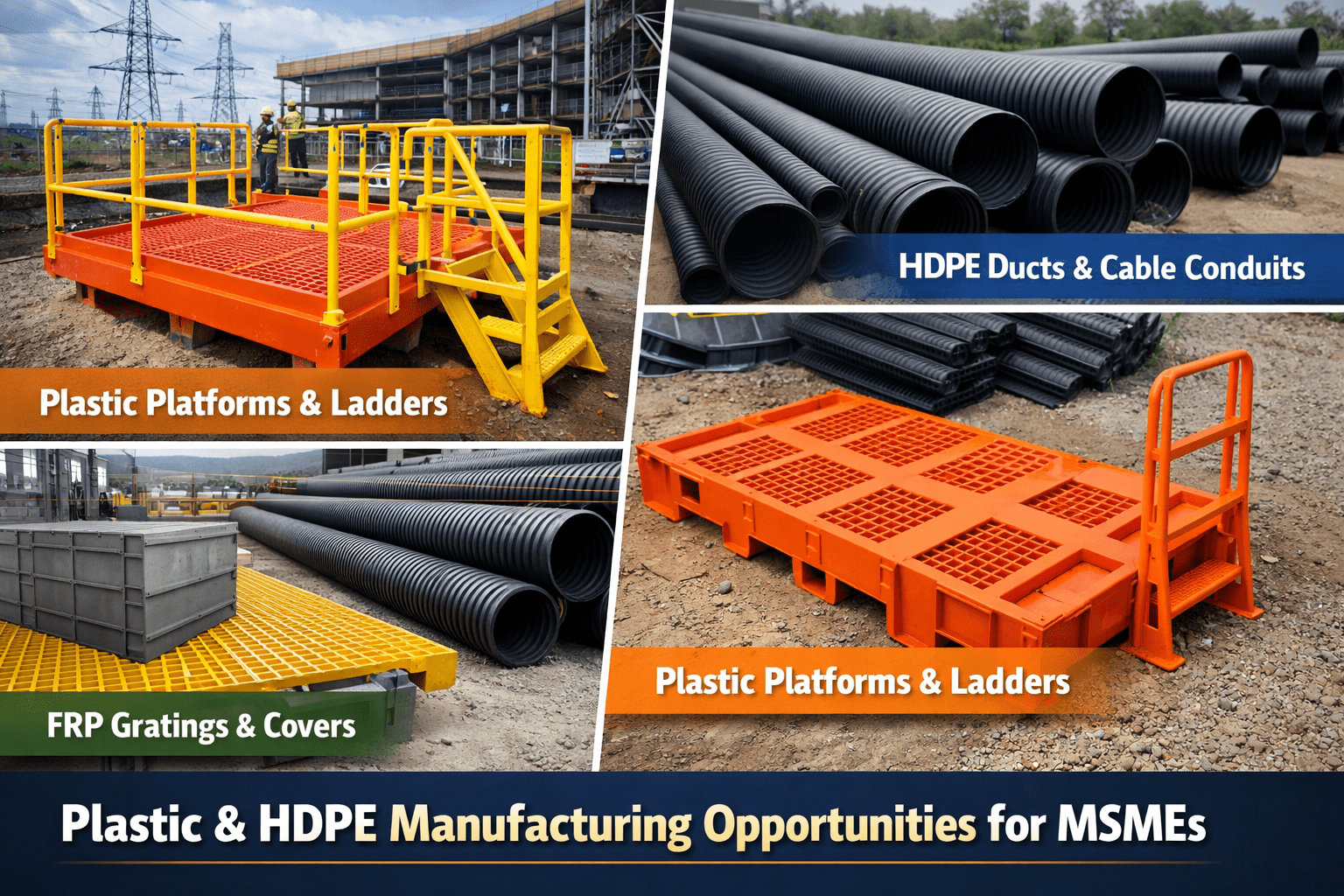
The use of plastic safety platforms, ladders and equipment skids is required on all major construction sites.
MSMEs are consistently able to obtain a steady stream of work from this segment due to:
- Low Technology Complexity
- MSMEs can also expect a high degree of stability through the maintenance of strict safety standards which will result in an ongoing demand for their products; and
- There are strong opportunities for replacement and retrofitting of products that have been installed or utilized over time.
- Industrial Plastic Manufacturing Opportunities
- HDPE Ducts & Cable Conduits
- HDPE ducts are being widely adopted as a cost-effective solution for underground cabling; smart grid projects; and renewable energy (wind, solar etc.) transmission.
MSMEs can be successful in this area because:
MSMEs have the ability to produce large volumes of product with relatively low costs due to the standardized nature of the HDPE extrusion process; and
Procurement is based on infrastructure projects.
There is a growing trend of using Fiberglass Reinforced Polymer (FRP) gratings and covers instead of steel in harsh corrosive or outdoor conditions
The reason why this is a good opportunity for MSME’s:
- High strength to weight ratio
- Excellent corrosion resistance
- Growing market potential for the substitution of imports.
 Import Replacement Opportunity for MSME’s
India still has significant import requirements of many specialized products despite its well established domestic manufacturing base; examples include:
- Advanced high performance electrical cables and accessories
- Industrial chemical formulations and advanced specialty chemicals
- Precision fabricated steel systems
- High quality FRP and Multi-Duct HDPE Products
MSME’s that have good quality control processes, testing facilities and certification will be best suited to capitalize on these opportunities.
The most successful MSMEs in India’s Power & Infrastructure Ecosystem have focused on the following strategic path
Only provide a narrow defined product line to avoid confusion.
MSMEs register with utility companies and EPC firms for projects.
Gradually increase their production capabilities.
Take profits earned and put them back into their business to improve their quality and grow.
They do not quickly expand their offerings by “diversifying” but rather strengthen themselves technically as credible businesses before rapidly expanding.
Why a Business Needs A Professional Project Plan Before They Invest Their Capital
A feasibility study is required before capital investment to clearly define and assess the potential success of an idea or project.
Entrepreneurs who want to start their own business can receive assistance from NIIR Project Consultancy Services (NPCS) in creating Market Surveys and Detailed Techno-Economic Feasibility Reports (DPR’s) to aid them in planning their new industrial ventures.
Typically these DPR’s will have included:
- Detailed manufacturing process descriptions
- Competitive market demand and competitive analysis
- Process flow diagrams
- Determining capacity and establishing a product mix
- Equipment needs and raw materials needed for production
- Projected financial performance and profit assessments
By having a systematic plan, entrepreneurs can establish and implement a well-informed and low-risk business strategy.
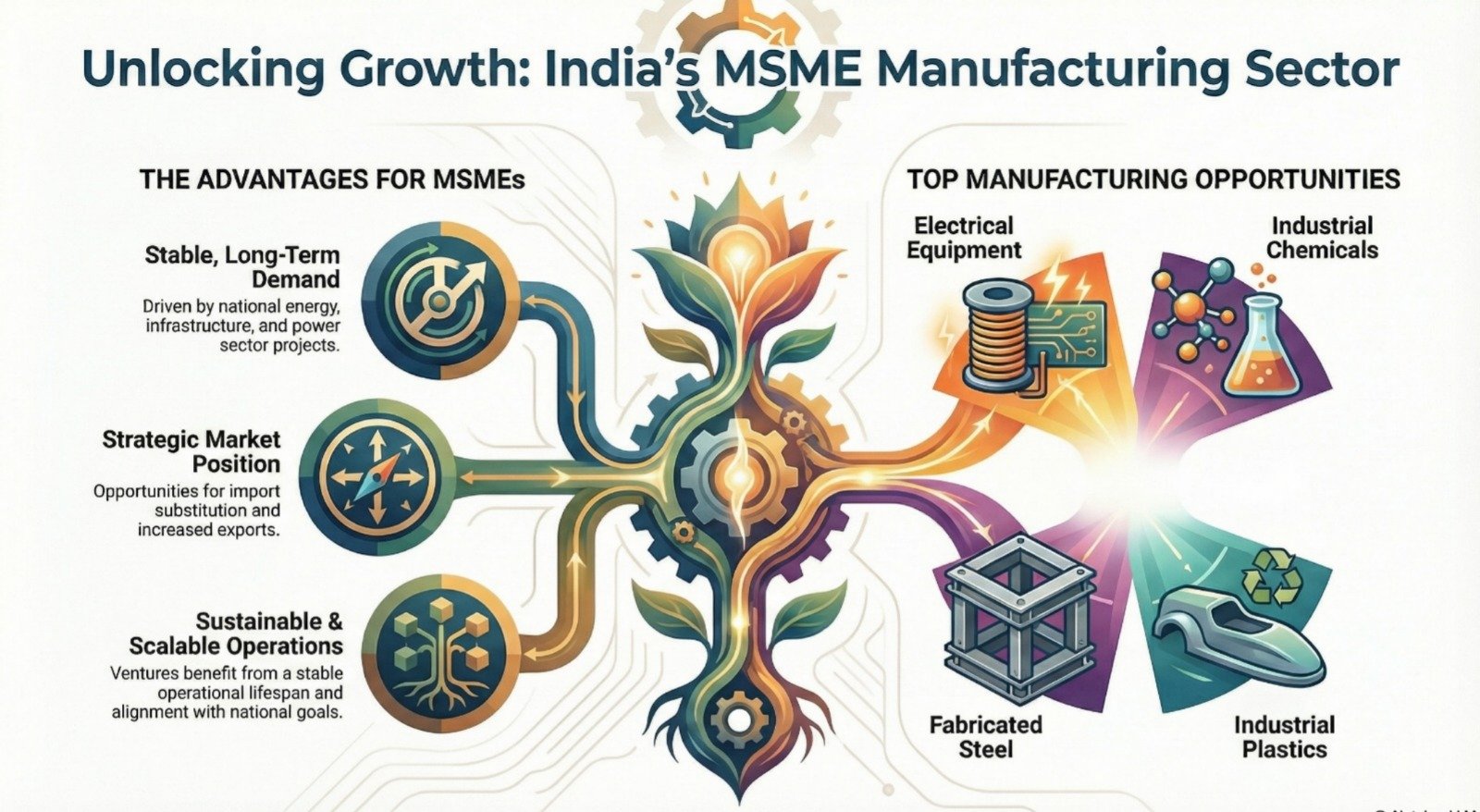
MSME manufacturing offers a path toward sustainable growth
MSME manufacturing projects related to India’s energy, infrastructure and power sectors will provide MSMEs:
- A long-term, stable demand
- Alignment with national goals
- Import substitution and export opportunity
- Scalability and a stable operational lifespan
Electrical equipment, industrial chemicals, fabricated steel, and industrial plastics are among the top MSME manufacturing business opportunities in India today for entrepreneurs who want to establish successful, sustainable, and forward-thinking manufacturing ventures.
 Additional Key Opportunity: MSMEs in Operation, Maintenance & Retrofit Manufacturing
One of the most overlooked yet highly lucrative areas for MSME manufacturing in India’s power and infrastructure ecosystem is operation, maintenance, refurbishment, and retrofit-driven manufacturing. While much focus is placed on new installations and greenfield projects, India’s vast installed base of power plants, substations, transmission networks, and industrial infrastructure is aging and requires continuous upgrading, replacement, and efficiency improvements.
India’s power infrastructure is no longer in an early expansion-only phase; it is entering a long-term lifecycle management phase. This creates sustained demand for MSMEs that manufacture components specifically designed for maintenance, life extension, efficiency enhancement, and retrofitting of existing assets.
Why Maintenance-Oriented Manufacturing is a High-Stability Opportunity
Every power station, transmission line, substation, cooling system, and industrial facility has a defined operating life for its components. Electrical panels, cables, insulators, chemical systems, steel structures, ladders, platforms, ducts, and protective covers must be periodically replaced due to wear, corrosion, thermal stress, or evolving safety regulations.
Unlike greenfield projects that depend on approvals and funding cycles, maintenance-driven demand is non-discretionary. Utilities and EPC operators are legally and operationally obligated to maintain uptime, safety, and efficiency. This ensures:
-
Predictable repeat orders
-
Shorter procurement cycles
-
Lower payment risk compared to new project execution
-
Long-term vendor relationships
MSMEs that specialize in replacement parts, customized retrofit solutions, and upgraded materials often enjoy higher margins than suppliers focused solely on standard new-installation products.
Examples of High-Demand Retrofit Manufacturing Segments
Some key retrofit-focused manufacturing opportunities include:
-
Replacement LT/HT cables with improved insulation and fire-retardant properties
-
Retrofit busbar systems with higher current-carrying capacity
-
Corrosion-resistant FRP gratings replacing legacy steel structures
-
Upgraded HDPE cable ducts for capacity expansion in existing corridors
-
Plastic and FRP safety platforms replacing metal units that no longer meet safety norms
-
Improved chemical formulations to meet tighter emission and water treatment standards
Many utilities prefer MSMEs for such work because retrofit manufacturing requires customization, quick turnaround, and site-specific engineering, areas where MSMEs often outperform large manufacturers.
Regulatory Push Driving Retrofit Demand
India’s power and infrastructure sectors are seeing increasing regulatory emphasis on:
-
Worker safety standards
-
Fire safety and electrical insulation norms
-
Environmental compliance
-
Energy efficiency improvements
As regulations tighten, older infrastructure must be upgraded to remain compliant. This creates policy-driven demand for MSME-manufactured components, particularly in plastics, chemicals, electrical accessories, and fabricated structures.
MSMEs that proactively align their products with updated BIS, IEC, and utility-specific standards can position themselves as preferred vendors for retrofit and modernization projects.
Strategic Advantage: MSMEs as Localized & Responsive Supply Chain Partners
Another critical strength of MSMEs in the power and infrastructure manufacturing ecosystem is their ability to function as localized, responsive supply chain partners—an increasingly important factor in large-scale infrastructure execution.
India’s infrastructure projects are geographically dispersed, time-sensitive, and often executed under tight completion schedules. Delays in component supply can result in significant penalties for EPC contractors. This reality has led to a shift away from over-reliance on distant or imported suppliers toward regionally anchored MSMEs.
Why Localization Matters in Infrastructure Manufacturing
Large power and infrastructure projects require:
-
Just-in-time deliveries
-
Rapid design modifications
-
Emergency replacements
-
On-site coordination
MSMEs located near project clusters—such as power corridors, industrial zones, renewable energy parks, and transmission hubs—offer unmatched advantages:
-
Faster delivery timelines
-
Lower logistics costs
-
Better coordination with EPC teams
-
Flexibility to accommodate design changes
This makes MSMEs indispensable partners rather than interchangeable vendors.
MSMEs as Problem-Solvers, Not Just Suppliers
In many infrastructure projects, engineering challenges emerge during execution rather than at the planning stage. MSMEs that provide engineering-backed manufacturing—rather than commodity products—can play a critical role in solving site-specific issues.
Examples include:
-
Custom-designed cable trays or ducts to fit constrained spaces
-
Modified steel or FRP structures to address load changes
-
Chemical reformulations to suit local water quality
-
Specialized insulation or protective covers for extreme climates
This problem-solving capability allows MSMEs to command long-term contracts and higher value per order, reducing dependency on price competition.
Supply Chain Resilience & Import Substitution
Global supply disruptions in recent years have reinforced the importance of domestic manufacturing. EPC contractors and utilities increasingly prefer Indian MSMEs that can ensure continuity of supply without foreign exchange risk, shipping delays, or geopolitical exposure.
By investing in:
-
Testing and certification
-
Consistent quality systems
-
Documentation and traceability
MSMEs can integrate deeply into national and regional supply chains, positioning themselves as reliable long-term partners rather than short-term vendors.
Long-Term Impact of These Additional Opportunities
Together, maintenance-driven manufacturing and localized supply chain integration significantly strengthen the MSME value proposition in India’s power and infrastructure sectors. These opportunities:
-
Reduce dependence on new project cycles
-
Improve cash flow predictability
-
Enable gradual, low-risk scaling
-
Enhance vendor stickiness with utilities and EPCs
MSMEs that recognize these dynamics early and align their manufacturing strategy accordingly will be better positioned to achieve sustained profitability, resilience, and long-term growth within India’s infrastructure-driven economy.
How NIIR Project Consultancy Services (NIIR.org) Supports MSMEs
NIIR Project Consultancy Services (NIIR.org) plays a critical role in helping entrepreneurs convert manufacturing ideas into bankable, executable, and profitable projects. For expert guidance on MSME project planning, visit our MSME consultancy services page.
NIIR’s Key Support Areas:
- Identification of high-demand MSME manufacturing opportunities
- Detailed Market Research & Demand Analysis
- Preparation of Techno-Economic Feasibility Reports (DPRs)
- Manufacturing process design and technology selection
- Machinery, raw material, and utility planning
- Financial modelling, profitability analysis, and break-even studies
- Guidance for bank loans, subsidies, and government schemes
- Support for quality standards, compliance, and certifications
By working with NIIR, entrepreneurs significantly reduce project risk and improve the success rate of their manufacturing ventures.
Key Government Websites for MSME & Infrastructure Projects
Entrepreneurs should regularly refer to the following official portals:
- Ministry of Power – https://powermin.gov.in
- Ministry of New and Renewable Energy (MNRE) – https://mnre.gov.in
- Ministry of MSME – https://msme.gov.in
- Invest India – https://www.investindia.gov.in
These platforms provide policy updates, schemes, tenders, and sector-specific data.
Frequently Asked Questions (FAQs)
Q1. Why are power and infrastructure sectors ideal for MSMEs?
Because they offer long-term demand, government-backed projects, repeat orders, and lower market volatility compared to consumer industries.
Q2. Do MSMEs need large capital to enter these sectors?
Not necessarily. Many segments such as cables, panels, chemicals, and plastics can be started with moderate investment and scaled gradually.
Q3. How important is a DPR for MSME manufacturing?
A DPR is essential for project planning, risk assessment, bank financing, and long-term sustainability.
Q4. Can MSMEs benefit from import substitution?
Yes. India still imports several specialized products, creating strong opportunities for quality-focused MSMEs.
Q5. How does NIIR help first-time entrepreneurs?
NIIR provides end-to-end project consultancy—from idea validation to DPR preparation and financial planning—reducing risk for new entrepreneurs.
Conclusion
MSME manufacturing in India’s power, energy, and infrastructure sectors offers long-term stability, scalability, and alignment with national development goals. With rising investments in power generation, renewable energy, transmission, and infrastructure, the demand for electrical equipment, industrial chemicals, fabricated steel, and industrial plastics will continue to grow.
With expert guidance from NIIR Project Consultancy Services (niir.org), entrepreneurs can confidently plan, launch, and scale profitable MSME manufacturing ventures that are future-ready and globally competitive.


A comprehensive and well-articulated overview highlighting strong, long-term MSME manufacturing opportunities in India’s power and infrastructure sectors, with clear focus on scalability, stability, and import substitution potential.