






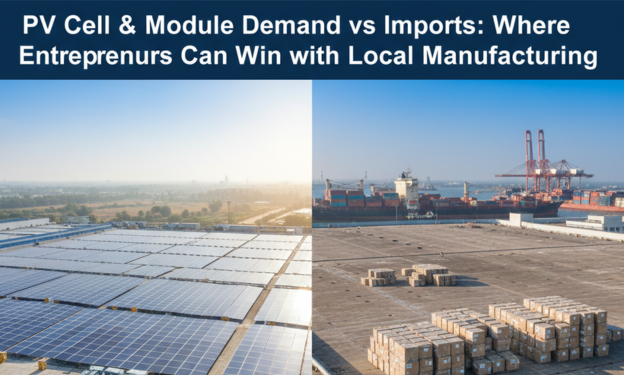
PV Cell manufacturing: India’s solar manufacturing story is no longer about ambition alone; it is about arithmetic. Installed capacity additions, procurement pipelines, and domestic manufacturing capability are now colliding in ways that create very specific windows for entrepreneurs. When you read the national renewable energy dashboards, procurement tenders, and manufacturing capacity disclosures together—as we routinely do while evaluating projects—the opportunity becomes sharply defined: demand for PV cells and modules is structurally higher than dependable domestic supply, and the gap is being bridged through imports at a cost that India’s industrial policy clearly wants to reduce.
Insights drawn from the Annual Report 2024–25 of the Ministry of New and Renewable Energy, Government of India reveal a market that is expanding faster at the module and cell consumption end than at the integrated manufacturing end. For entrepreneurs, this mismatch is not a macroeconomic footnote—it is a commercial signal.
Demand Growth Is No Longer the Question—Supply Reliability Is
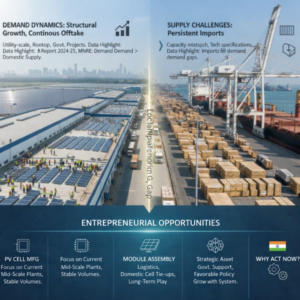
In recent planning cycles, the switch in solar capacity additions has moved from the sporadic bidding model to the pipeline implementation. Models Utility-scale models, distributed rooftop models, and government procuring models now overlap and provide year-round offtake at modules and cells. The thing that the data makes clear is that demand is not lumpy anymore but it is continuous.
Yet manufacturing capacity has grown unevenly. Module assembly expanded first because it required lower capital and faster execution. The manufacture of cells is an expensive business to capitalise on, though the risk profile is significantly better when the plant is planned to meet the current tender specifications and not efficiency benchmarks. Those entrepreneurs who are able to match the capacity, choice of technology, and optimisation of yields with the actual procurement norms can have a long term contract with module-maker.
This structural imbalance is where local manufacturing economics begin to favour new entrants—provided they choose the right segment and scale.
Imports: A Structural Gap, Not a Temporary Phase
One of the most revealing aspects of the import–export analysis is that imports are not confined to peak-demand months. They persist even when domestic factories are operating, indicating a deeper issue: capacity mismatch by technology type and efficiency band.
Cells and modules that are imported, do so due to tendencies to satisfy certain wattage, efficiency or delivery schedules that local plants cannot assure to satisfy on a regular basis. This is not a reflection of the Indian quality of manufacture, it is a sequencing problem. Capacity was added faster than upstream integration and technology migration.
For entrepreneurs, this implies two clear lessons:
- Import substitution is not about volume alone; it is about specification-fit manufacturing.
- Plants designed around current procurement specifications—not yesterday’s—can displace imports quickly.
Domestic Manufacturing Snapshot (Derived from National Data)
| Segment | Demand Trend | Domestic Capacity Coverage | Import Dependence Pattern |
| PV Modules | Strong, multi-channel | Moderate to high | Used to bridge delivery gaps |
| PV Cells | Strong, utility-driven | Moderate | Persistent and structural |
| Wafers & Ingots | Emerging | Limited | High and strategic |
| Ancillary Materials | Stable | Mixed | Selective imports |
This pattern explains why integrated projects are being announced but also why mid-scale, focused plants remain commercially attractive.
Read our book: Business Ideas of Solar Photovoltaic (PV) Cell.
Where Entrepreneurs Can Realistically Win
PV Cell Manufacturing Focused on Current Tender Specifications
Typically cell production is a capital-intensive business, although the risk story is much better in the case that the plant is geared to meet current tender needs rather than the headline efficiency history. With the capacity, technology choice, and yield optimisation, which is consistent with what the actual procurements can provide, the entrepreneurs will be able to acquire long term identifying of the module-maker contracts. Margins here are thinner than modules, but volume stability compensates.
Module Assembly with Assured Cell Tie-Ups
Module assembly is not obsolete—it is maturing. New entrants who lock in domestic cell supply or backwards-integrate partially can still build profitable, scalable businesses. The key is automation depth and logistics discipline, not sheer nameplate capacity.
Ingot–Wafer Manufacturing as a Strategic Bet
This is where the import substitution logic becomes most compelling. Wafer availability constrains cell expansion. While capital and learning curves are steep, entrepreneurs with patient capital and technical partners can create strategic assets that large players will rely on. This is less about quick returns and more about industrial positioning.
BOS-Integrated Manufacturing Clusters
Projects that integrate modules with mounting structures, junction boxes, or power electronics enjoy better negotiation power with EPC contractors. This cluster approach reduces dependency on spot pricing and improves cash-flow predictability.
Read More: Solar Panel
Lessons from Indian Industrial Leaders
The scale of solar manufacturing policies by Gautam Adani (Adani Group) and Mukesh Ambani (Reliance Industries) has been frequently mentioned with reference but the underlying message is sequencing. The two groups started investing upstream once they had downstream demand recognition and alignment of policies. Their decision logic was not driven by incentives alone but by control over supply chains.
For MSMEs and first generation entrepreneurs the takeaway is practical: do not over integrate too early. Start where demand certainty is highest and integration adds immediate commercial value.
Profitability Logic- What Makes a Plant Bankable
From a feasibility consultant’s lens, profitability in PV manufacturing is determined by four controllable variables:
- Capacity Utilisation Discipline – Realistically designed plants perform better than the over sized units that run at low loads.
- Technology Stability– Incremental improvements are less risky for new entrants than disruptive changes.
- Input Cost Predictability– It includes long-term sourcing contracts, which are more important than spot bargains.
- Working Capital Design – Inventory cycles in solar manufacturing can erode margins faster than price competition.
We at Niir Project Consultancy Services (NPCS) routinely see projects fail not because demand was overestimated, but because cash-flow timing and yield assumptions were unrealistic. Our Market Survey cum Detailed Techno-Economic Feasibility Reports are structured precisely to stress-test these variables—before capital is committed.
Read Also: Solar PV Manufacturing in India 2026
Why This Window Matters for New Entrepreneurs
Import dependence is not a permanent condition. As large integrated plants come online, the window will narrow. However, large players move deliberately; MSMEs move faster. Those entrepreneurs who come in with new projects of well scoped projects, with specification compatible projects can freeze customer relationships that continue even when capacity comes to a normal level.
The Ministry released the national renewable energy roadmap (also known as mnre.gov.in) which also reinforces the same message that has been echoed multiple times: the depth of domestic manufacturing is just as important as the generation capacity. Entrepreneurs who swim along this priority are not going against the tide, but are going with it.
Read Also: Railway Infrastructure Boom
Practical FAQs for Founders
Can PV manufacturing remain viable for MSMEs?
Yes, provided the scope of the projects is narrowly defined. Mid-scale cell / module plants with guaranteed offtake, and the conservative technology options can still be effective.
Should a new entrant start with cells or modules?
Modules offer faster execution and lower risk. Cells offer stronger strategic positioning but demand higher technical discipline.
How critical are government schemes to project viability?
Support mechanisms improve returns but should not be the sole profitability driver. Projects must stand on operating economics.
What is the biggest risk new manufacturers underestimate?
Yield variability and working capital cycles. Both can silently erode margins if not modelled conservatively.
Can EPC relationships replace marketing effort?
Partially. Long-term supply contracts matter more than spot EPC orders for financial stability.
Closing Perspective
The PV manufacturing opportunity in India is no longer about chasing incentives or headlines. It has to do with the realisation of the structural mismatch of demand with reliable supply and constructing exactly around that mismatch. Thinkers not speculators Entrepreneurs who are able to think like feasibility consultants will realise that there remains space to win in local manufacturing.


