
• Latest
  • Trending
  • All
Paper Water Bottle Manufacturing: Cost, Machinery & Business

Paper Water Bottle Manufacturing: A Sustainable Business Opportunity Explore Manufacturing Technology, Machinery, Investment and Market Potential

September 20, 2026
Maize Starch Manufacturing: Business, Plant Cost

Why Maize Starch Is Becoming a High-Potential Manufacturing Business

September 20, 2026
GRC Manufacturing Business in India: Investment, Market.

GRC Manufacturing Business in India: Facade Panels, Decorative Products, Investment and Market Opportunities

September 20, 2026
Project & Profile
गांव में Business Ideas और ग्रामीण उद्यमिता के अवसर

गांव में शुरू करें ये 7 Business Ideas और हर महीने कमाएं ₹50,000 — कम निवेश, ज़्यादा मुनाफा

September 19, 2026
Solar Business Ideas in India: 5 Profitable Manufacturing

5 Solar Business Ideas: Profitable Manufacturing and Service Units in India

September 19, 2026
Food Processing Business Ideas: 5 Profitable Units

Food Processing Business Ideas: 5 Profitable Manufacturing Units to Start in India

September 19, 2026
Chemical Business Ideas in India: 5 High Manufacturing Units

5 Chemical Business Ideas: High-Margin Manufacturing Units to Start in India

September 19, 2026
Ferro Alloy Manufacturing Business in India: Opportunities

India’s Steel Surge Is Creating a New Wave of Opportunities for the Ferro Alloy Sector

September 18, 2026
बिना किसी गारंटी के सरकार दे रही ₹50 लाख

बिना किसी गारंटी के सरकार दे रही ₹50 लाख तक का बिज़नेस लोन, जानिए कैसे करें क्लेम?

September 18, 2026
2027 में कभी न बंद होने वाले 5 बिज़नेस आइडियाज

2027 में कभी न बंद होने वाले 5 बिज़नेस आइडियाज: कम लागत में शुरू करके बनाएं बड़ी कंपनी

September 18, 2026
Compressed Biogas CBG Plant in India: Government Schemes

India’s Compressed Biogas Revolution: Why Animal and Agricultural Waste Could Fuel the Next Wave of Rural Manufacturing Opportunities

September 17, 2026
Goat Farming Business Loan Detail

बकरी पालन बिज़नेस लोन कैसे ले | Goat Farming Business Loan Detail

September 15, 2026
Biomass Gasification Business in India: Syngas, Methanol

Business Ideas in Biomass-Derived Syngas, Methanol, Hydrogen & DME: From Farm Waste to Clean Fuel

September 13, 2026
  • About
  • Advertise
  • Privacy & Policy
  • Contact
Sunday, September 20, 2026
  • Login
Entrepreneur India Blog
  • Home
  • About
  • Books
  • Business Ideas
  • Contact
No Result
View All Result
Entrepreneur India Blog
No Result
View All Result
Home Plastic & Packaging Business

Paper Water Bottle Manufacturing: A Sustainable Business Opportunity Explore Manufacturing Technology, Machinery, Investment and Market Potential

by Diksha Garg
September 20, 2026
in Plastic & Packaging Business, Eco Friendly Sustainable Business
0
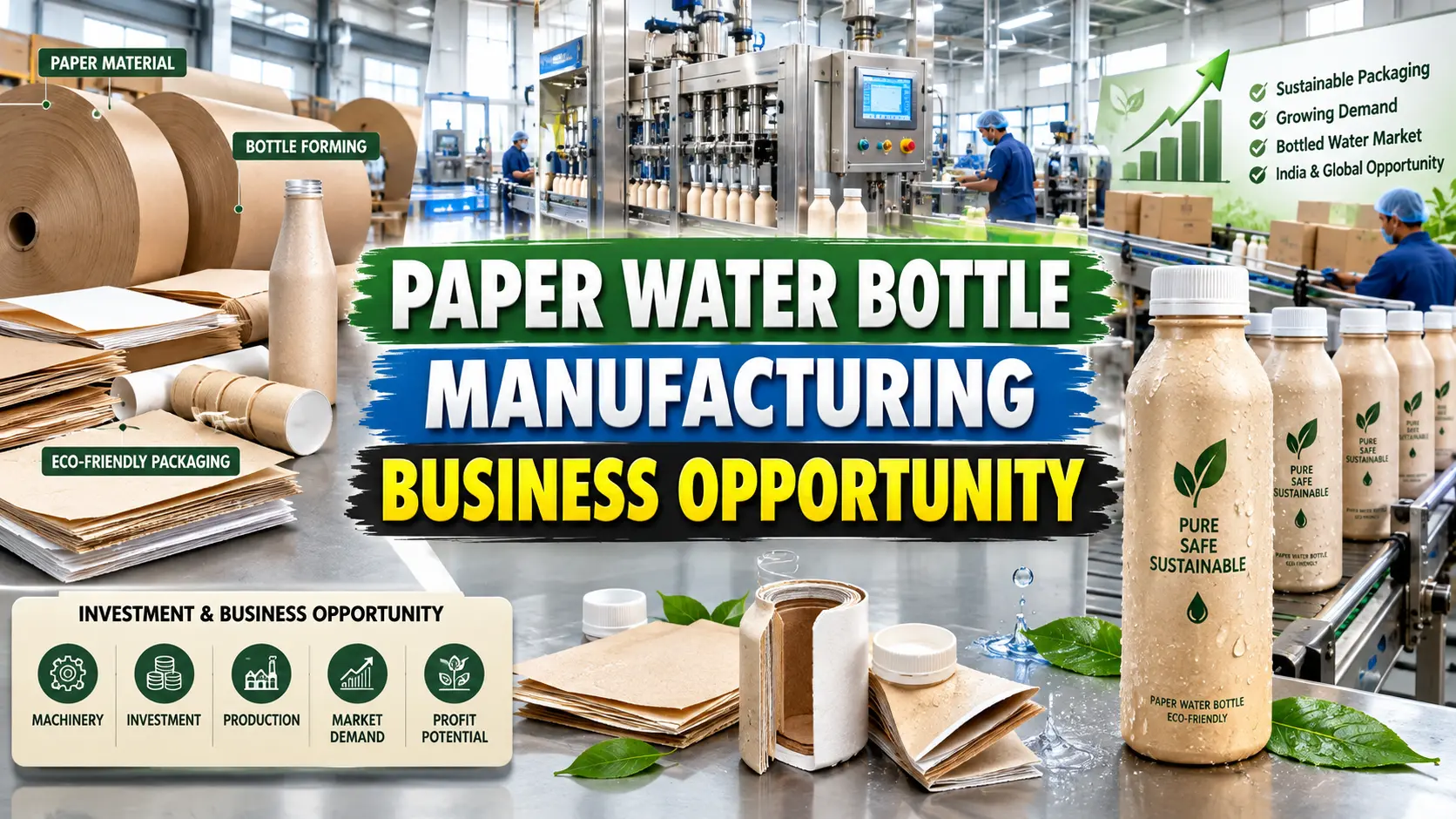
Paper Water Bottle Manufacturing: Cost, Machinery & Business

Paper water bottle manufacturing offers a sustainable alternative to traditional plastic water bottles.

491
SHARES
1.4k
VIEWS
Share on FacebookShare on Twitter

India’s single-use plastic restrictions have created an opportunity in the packaged-water market, and paper water bottle manufacturing is proving one of the more promising sustainable business ideas to meet it. Hotels, airlines, and premium retail chains are seeking plastic alternatives that retain liquid reliably, and paper-based bottles with a thin inner barrier layer meet the need without the baggage of PET. Early entrants can build direct relationships with hospitality and FMCG brands before the category becomes crowded.

Table of Contents

Toggle
  • Why Paper Water Bottle Manufacturing Is a Smart Business Idea Right Now
  • Government Policies & Incentives
  • Multiple Manufacturing Business Ideas for Startups
  • Import–Export Opportunity Analysis
  • Indian MSME Success Stories
  • How NPCS Can Help Entrepreneurs Evaluate the Opportunity
  • Common Pitfalls to Avoid
  • Conclusion
  • Your Investment Deserves the Right Opportunity
    • Frequently Asked Questions

Why Paper Water Bottle Manufacturing Is a Smart Business Idea Right Now

Plastic-alternative packaging has transitioned from a niche sustainability pitch to a procurement requirement as hotel chains, airlines, and corporate offices commit publicly to reducing single-use plastic. Paper water bottles solve this without asking consumers to change behaviour, since the format still looks and functions like a familiar bottle. Domestic manufacturing capacity for this specific format is thin, so early entrants may secure long-term supply contracts with hospitality groups before larger converters enter the category at scale.

Government Policies & Incentives

The plastic waste management rules enforced through the Central Pollution Control Board and phased single-use plastic bans notified by the Ministry of Environment, Forest and Climate Change directly favour paper-based alternatives in institutional procurement. Sustainable packaging startups also have early-stage support through Startup India, while paper-sector technical guidance is available through industry bodies such as the Indian Paper Manufacturers Association. Food processing and packaging clusters in several states also offer shared testing laboratory access to smaller manufacturers, to reduce the cost of barrier and leak testing that would otherwise require in-house investment.

Multiple Manufacturing Business Ideas for Startups

Barrier-Coated Paper Bottle Manufacturing for Hospitality

Hotels and airlines are the most receptive early customers, as they face pressure to remove plastic bottles from guest rooms and in-flight service. A manufacturer that can supply branded, barrier-coated paper bottles in bulk with reliable lead times may secure annual supply agreements, resulting in far more predictable cash flow than chasing scattered retail orders.

Private-Label Paper Bottled Water for Corporate Events

Corporate offices, weddings, and large events want branded water bottles that reflect their sustainability positioning, and a smaller-scale unit focused on private-label, low-minimum-order paper bottles may serve this segment profitably, since customers pay a premium for both the sustainability story and the customisation.

Paper Bottle Component & Barrier-Film Supply

Instead of bottling water directly, a manufacturer may specialise in producing the paper bottle shells and barrier-lined inserts that other beverage companies then fill themselves, reducing exposure to beverage licensing requirements while still capturing value from the fastest-growing part of the packaging chain.
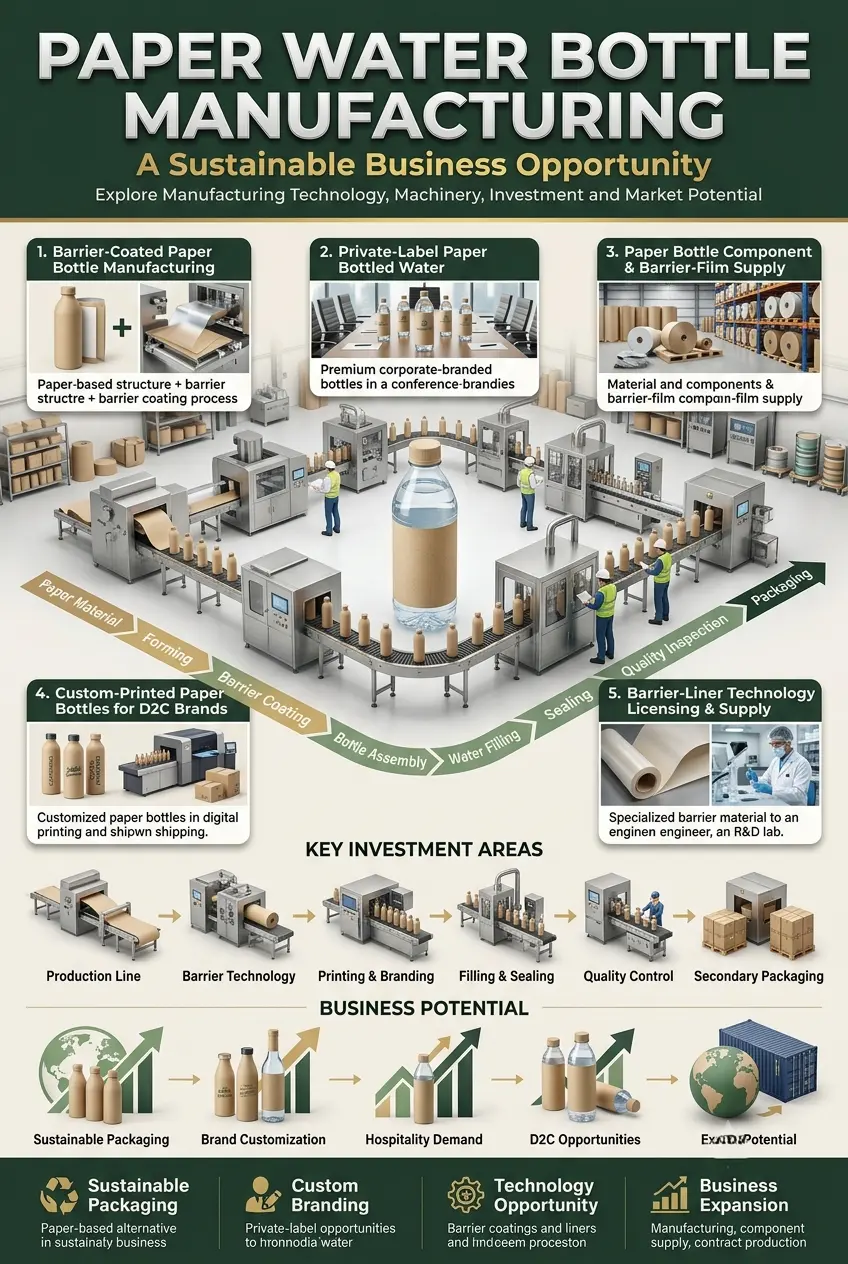
Paper Water Bottle Manufacturing Business and Sustainable Packaging
Paper water bottle manufacturing offers a sustainable alternative to traditional plastic water bottles.

Custom-Printed Paper Bottles for D2C Beverage Brands

Smaller direct-to-consumer beverage and cold-pressed juice brands wish for distinctive, sustainable packaging to support their pricing story but cannot commit to the minimum order quantities large converters demand. A manufacturer that offers shorter production runs with flexible printing may win a base of emerging beverage brands willing to pay a premium for both sustainability and shelf differentiation.

Barrier-Liner Technology Licensing & Supply

Rather than manufacturing finished bottles, a technically focused business might specialise in developing and supplying the barrier-coating technology and liner materials that other converters need, serving as an upstream technology partner to the broader paper packaging industry as it scales.

Import–Export Opportunity Analysis

Barrier-film technology for paper bottles is still partly import-dependent, as specialised coating lines and certain bio-based liners are sourced from international suppliers. As domestic converters build capability, this creates an import-substitution opening similar to what happened earlier in flexible packaging. On the export front, hospitality chains across the Middle East and Southeast Asia have shown early interest in sustainable packaging sourced from India, an area actively promoted through Invest India’s sustainability-linked investor outreach.

Market Outlook & Scaling Roadmap

As plastic-reduction commitments from hospitality, airline, and FMCG brands move from pilot programmes to standard procurement policy, paper water bottle demand is expected to grow considerably faster than the broader packaging market over the next several years. Manufacturers who secure early hospitality supply agreements are likely to hold a durable position once larger converters enter the category at scale, as switching packaging suppliers involves real operational disruption that buyers prefer to avoid once a reliable partner is found.

Skills, Manpower & Quality Control

This business needs a mix of pulp-moulding process knowledge and food-safety discipline, as the barrier coating stage directly determines whether a bottle leaks. A small unit typically runs with 10 to 15 workers across pulp preparation, moulding, coating, and quality inspection, with the coating supervisor role the most technically demanding, since barrier consistency cannot be judged by eye alone but needs basic testing equipment and training. Founders without a packaging or food-science background often bring in a technical consultant during the first six to twelve months to stabilise the coating process.

Indian MSME Success Stories

Paper Water Bottle (Pvt) Ltd, Bengaluru — Sirish Veeravalli

Sirish Veeravalli’s early bet on barrier-coated paper bottles targeted hospitality clients directly rather than mass retail, a sequencing decision that allowed the venture to prove reliability with a smaller, higher-value customer base before scaling production.

ITC Limited (packaging division) — Corporate innovation team

ITC’s long-standing investment in paperboard and sustainable packaging R&D demonstrates how established paper manufacturers are repositioning existing pulp expertise towards bottle-grade barrier products, a pathway smaller entrants can also follow by partnering with paper mills instead of building pulp capacity from scratch.

How NPCS Can Help Entrepreneurs Evaluate the Opportunity

We at Niir Project Consultancy Services (NPCS) provide professional consulting for the preparation of Market Survey cum Detailed Techno-Economic Feasibility Reports (DPRs) for setting up new industries or businesses. Our reports include detailed manufacturing processes, market research and demand analysis, process flow diagrams, product mix and capacity planning, machinery and raw material details, and complete project financials with profitability analysis. Entrepreneurs utilise these reports to evaluate feasibility, profitability, and long-term scalability before investing, reducing guesswork at the capital-intensive stage of a new venture.

For anyone evaluating Paper Water Bottle Manufacturing, this groundwork is critical before any capital is committed: NPCS studies work through machinery selection, raw material sourcing, plant layout, manpower planning, and a complete financial model covering capital cost, working capital, revenue projections, and return on investment. Entrepreneurs approaching banks, NBFCs, or state MSME schemes for financing typically need exactly this type of documented feasibility study, as lenders rarely fund a project on an idea alone. Working with an established consultancy also shortens the learning curve considerably, enabling a first-time promoter to benefit from patterns NPCS has already observed across hundreds of similar manufacturing projects.

NPCS has published a comprehensive printed reference book on Paper Water Bottle Manufacturing covering technology, market analysis, investment parameters, and manufacturing processes in detail — the printed book: Paper Water Bottles, Bioplastics & Biodegradable Products Manufacturing Handbook.

For a detailed techno-economic Project Report on setting up a manufacturing business in this sector — including plant economics, machinery lists, financial projections, and applicable government incentives — the NPCS Project Report: Biodegradable Products, Recyclable, Disposable & Eco-Friendly Packaging Projects.

Common Pitfalls to Avoid

A frequent early mistake is finalising a barrier-coating formulation without adequate accelerated shelf-life testing, only to discover leakage issues after a large order has been shipped. Another common pitfall is underpricing early contracts to win hospitality clients, which makes it difficult to raise prices later as raw material costs rise.

Conclusion

Paper water bottle manufacturing suits founders comfortable working closely with hospitality and corporate procurement teams, rather than mass retail from day one. With plastic-reduction rules tightening and interest from bodies like Invest Karnataka portal growing around sustainable manufacturing, early movers stand to capture disproportionate market share.

Your Investment Deserves the Right Opportunity

Every serious investment begins with choosing the right sector and the right business model. With hundreds of industrial opportunities available across India’s manufacturing and clean-energy landscape, making the most informed choice is critical. NPCS Startup Selector tool helps entrepreneurs, MSMEs, and investors identify the most suitable business opportunities based on their investment capacity, location, and interests — so your capital is directed toward a venture with the strongest fit and potential.

Frequently Asked Questions

Is a paper water bottle fully biodegradable? +
A: Most current designs use a thin barrier layer to hold liquid, so full biodegradability depends on the specific liner used; fully bio-based liners are an emerging area.
How much investment does a small unit need? +
A: A basic setup with forming, coating, and filling equipment typically starts around ₹80 lakh to ₹1.2 crore.
Who are the primary customers for paper bottles? +
A: Hotels, airlines, corporate offices, and event organisers are currently the strongest demand segments.
Does this business need a food-manufacturing licence? +
A: Yes, FSSAI licensing is required if the unit will also bottle water rather than only supply bottle shells.
What is the shelf life of water in a paper bottle? +
A: Shelf life depends on barrier quality, but well-coated bottles are designed to match standard packaged drinking water timelines.
Can this unit also supply other beverage companies? +
A: Yes, supplying bottle shells and barrier inserts to other beverage brands is a viable B2B business model.
Are paper bottles more expensive than plastic ones? +
A: Currently yes, though the premium is narrowing as production scales and hospitality clients increasingly absorb the cost for sustainability positioning.
What government support exists for this business? +
A: Plastic-reduction regulations indirectly support demand, while Startup India and MSME schemes support financing and early-stage guidance.
Is export demand realistic for paper bottles? +
A: Yes, particularly among hospitality chains in the Middle East and Southeast Asia seeking sustainable packaging sourced from India.
What is the biggest technical challenge in this business? +
A: Achieving a reliable, food-safe barrier coating that prevents leakage while remaining cost-competitive is the central technical challenge.
Can paper bottles be recycled through standard paper recycling streams? +
A: Depending on the barrier liner used, some formats can be processed through standard paper recycling, while others require specialised composting or de-lamination facilities.
How do hotels typically procure paper bottles? +
A: Most hospitality buyers prefer annual or multi-year supply agreements negotiated directly with manufacturers or their appointed regional distributors.
What print and branding options are available on paper bottles? +
A: Water-based flexographic and digital printing are both commonly used, allowing full-colour branding directly on the paperboard surface.
Is FSC certification necessary for the paperboard used? +
A: It is not mandatory but strongly preferred by export buyers and sustainability-conscious brands as proof of responsibly sourced fibre.
How does the cost of paper bottles compare to plastic over time? +
A: The cost premium is narrowing as production scales, and many hospitality buyers already accept the current premium given sustainability commitments.
What is the biggest scaling challenge for this business? +
A: Securing consistent barrier-coating quality at higher production speeds is typically the biggest technical challenge when scaling beyond a pilot line.
How many workers does a small paper bottle unit need? +
A: A small unit typically operates with 10 to 15 workers spanning pulp preparation, moulding, coating, and quality inspection.
Is a food-science background necessary for the founder? +
A: It is helpful but not mandatory; many founders bring in a technical consultant during early operations to stabilise the barrier-coating process.
What testing confirms a paper bottle will not leak? +
A: Standardised fill-and-hold leak tests over a defined shelf-life period confirm barrier integrity before a design is approved for commercial use.
Can smaller manufacturers access shared testing facilities? +
A: Yes, several food-processing and packaging industrial clusters offer shared laboratory access, reducing the cost burden for smaller manufacturers.
Why is accelerated shelf-life testing important before large orders? +
A: It reveals barrier and leakage issues under realistic storage conditions before a large order ships, avoiding costly post-delivery failures.
Is underpricing early hospitality contracts a common mistake? +
A: Yes, and it often makes future price increases difficult once a client base is accustomed to an unsustainably low introductory rate.
Should pricing be tested with a smaller pilot order first? +
A: Yes, a smaller pilot order at sustainable pricing helps validate both product performance and commercial terms before scaling commitments.
Tags: Biodegradable PackagingEco Friendly PackagingPaper Bottle BusinessPaper Bottle ManufacturingPaper Water Bottle BusinessPaper Water Bottle ManufacturingSustainable Packaging
Share196Tweet123
Previous Post

Why Maize Starch Is Becoming a High-Potential Manufacturing Business

Diksha Garg

Diksha Garg

Diksha Garg is a marketing strategist and business growth enthusiast with over 7 years of experience driving impact through data-driven insights and strategic storytelling. She writes for entrepreneurs and startups, breaking down complex business challenges into actionable ideas that help founders scale smarter, market better, and build sustainable growth.

Leave a Reply Cancel reply

Your email address will not be published. Required fields are marked *

Contact Us

    Categories

    • Agri Business Opportunities
    • Business Ideas
    • Chemical Industry Business Opportunities
    • Cosmetics and Personal Care Business
    • Eco Friendly Sustainable Business
    • Entrepreneurship Leadership and Startup Growth
    • FMCG Consumer Products Business
    • Food Processing Business Industry
    • Future & Emerging Industries
    • Government Schemes Policies for Business
    • Import Export Business Opportunities
    • Industrial Project Reports Business Guide
    • Investment Funding for Startups
    • Manufacturing Business Ideas for Startups
    • Market Research Trends for Business
    • MSME & Small-Scale Industries
    • Paper Pulp Industry Business
    • Pharmaceutical Industry Business
    • Plastic & Packaging Business
    • Renewable Energy Startups
    • Startup Business Opportunities
    • Startup Business Planning and Strategy
    • Technology & Automation Business
    • Textile Industry Business
    • Uncategorized
    • Waste Management & Recycling Business
    • Water & Environmental Business
    Entrepreneur India Blog

    Copyright © 2026 Entrepreneur India

    Navigate Site

    • About
    • Advertise
    • Privacy & Policy
    • Contact

    Follow Us

    Welcome Back!

    Login to your account below

    Forgotten Password?

    Retrieve your password

    Please enter your username or email address to reset your password.

    Log In
    No Result
    View All Result
    • Home

    Copyright © 2026 Entrepreneur India

    Not enough quota to unlock this post
    Unlock left : 0
    Are you sure want to cancel subscription?