





Potassium Permanganate manufacturing in India: Market Opportunity and Start-up Guide
Potassium permanganate Plant (KMnO4) is one of the most extensively used industrial chemicals in the water and pharmaceutical fields, agriculture, and chemical production. Although rarely in the public eye, this deep purple crystalline compound plays an important role in everything from maintaining the quality of water, to being used in the synthesis of pharmaceuticals to enabling a number of industrial processes.
In recent years, the potassium permanganate industry in India has gained a lot of attention from entrepreneurs and investors. The reason is simple: India is already one of the world’s biggest exporters of potassium permanganate, but the domestic demand is still growing faster than local supply in a number of places.
With growing infrastructure, increasing environmental regulations, and swift growth in the pharmaceutical sector, the demand for potassium permanganate is projected to increase tremendously between 2026 and 2031. For MSME’s and first generation entrepreneurs, this is a great opportunity for establishing a potassium permanganate manufacturing plant in India.
This article discusses market potential; demand-supply gap; production process; and startup opportunities in the Potassium permanganate manufacturing industry.
Potassium Permanganate Market Overview: Global
The global potassium permanganate market has experienced steady growth in the previous decade. In 2024 the global market is worth around 1.2 billion and experts predict a steady growth at a compound annual growth rate between 5 and 10% over the next few years.
Industry projections have estimated the market at a range of USD 1.8 billion to USD 3.6 billion by the early 2030s with the growth being driven by rising demand from water treatment plants, pharmaceutical companies and agricultural sectors.
The Asia-Pacific region currently dominates global markets because it controls more than 39 percent of worldwide market demand. The main users of this resource include China India and Vietnam along with Indonesia because these countries are experiencing fast industrial growth together with their development of infrastructure projects.
China currently produces more than 50 percent of the world’s potassium permanganate output which makes it the largest manufacturer. India has established itself as an important potassium permanganate exporter which gives it a significant role in global supply chains.(Potassium Permanganate Plant)
Demand for Potassium Permanganate in India
India’s yearly demand for potassium permanganate amounts to approximately 8300 metric tonnes. Demand is dispersed across several industries including water treatment, pharmaceuticals, textiles, agriculture and chemical manufacturing.
The water treatment industry is the largest segment of consumption making up almost 60% of total consumption. Potassium permanganate serves a common purpose which involves removing iron manganese hydrogen sulphide and various other pollutants from drinking water sources.
Various factors are driving the growth in demand in India:
- Expansion of Water Infrastructure
The Jal Jeevan Mission together with other government programs works to deliver clean drinking water to numerous households across the country. The program has brought about a significant transformation in the market needs for water treatment chemical products.
- Rapid Growth of the Pharmaceutical Industry
The Indian pharmaceutical market will reach a value of USD 130 billion by 2030 because of its strong market need for potassium permanganate which serves as a chemical reagent in medicine production.
- Agricultural Applications
Farmers use potassium permanganate as a germicide, fungicide and soil disinfectant; the most important use is for disease control and crop protection.
- Textile Industry Expansion
The textile industry uses potassium permanganate as a bleaching and decolouring agent, especially in the denim and fabric industry.
These trends point towards the steady increase in demand for potassium permanganate for the domestic market over the next decade.(Potassium Permanganate Plant)
Read More: Startup Selector
Demand and Supply Gap in Indian Market
Despite being major exporter, India is still facing the deficiency of supply-demand imbalance for potassium permanganate in the domestic market.
The industry is dominated by a few large manufacturers and much of the production is aimed at the export market. As a result, a number of regional industries are faced with supply shortages or price swings.
Trade data also indicates that India is importing potassium permanganate from China, and the value of the imports is about USD 1.82 million in 2023. This is a clear sign that there is sometimes a greater demand, domestically, than locally available.
For new entrepreneurs, this gap is a definite manufacturing opportunity. Establishing production facilities close to industrial clusters or water treatment infrastructure can help tap the underserved regional markets.
Potassium Permanganate Production Procedure
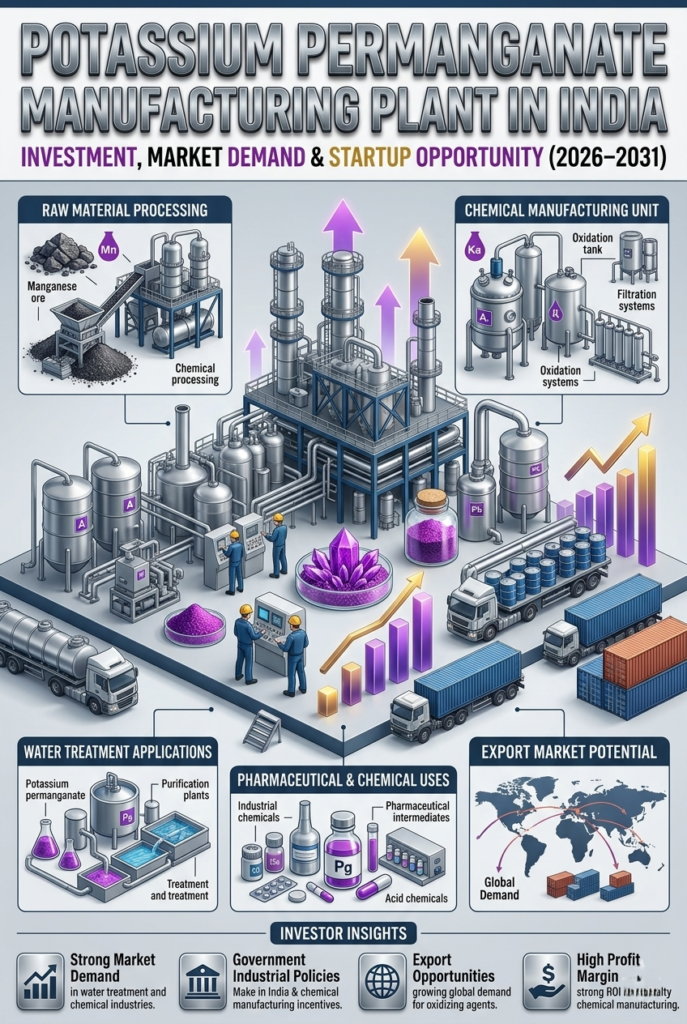
The potassium permanganate production process follows established chemical procedures which maintain system simplicity. The main steps include:
- Fusion Reaction
Manganese dioxide (MnO2) reacts with potassium hydroxide (KOH) under high-temperature conditions while an oxidizing agent or air serves as the reaction medium. Potassium manganate (K2MnO4) results from this chemical reaction process.
- Electrolytic Oxidation
The process starts with potassium manganate destruction through electrolysis which produces potassium permanganate.
- Crystallization
The solution undergoes cooling, which leads to the formation of KMnO4 crystals.
- Filtration and Drying
The team performs crystal filtration, which they follow by washing and drying the crystals before they package the product.
The manufacturing technology is known and available for large-scale chemical manufacturing, so it is suitable for manufacturing plants with MSME scales.(Potassium Permanganate Plant)
Read More: Project Reports & Profiles
Availability of Raw Material in India
One of the greatest benefits of production of potassium permanganate in India is the availability of raw materials.
Key inputs include:
- Manganese Dioxide (from Manganese Ore)
- Potassium hydroxide
- Oxidizing agents and processing chemicals
The significant deposits of manganese ores found in India are located in:
- Odisha
- Maharashtra
- Madhya Pradesh
- Karnataka
- Rajasthan
Potassium hydroxide is also produced in country by several chemical companies, which makes the country less dependent on imports.
Investment and MSME Start-up Potential
Starting a potassium permanganate manufacturing unit can be relatively capital efficient when compared to other chemical manufacturing projects.
A small to mid-scale plant of 500-1,000 tonnes per annum can normally be developed within MSME investment limits.
Entrepreneurs may also benefit from government support programs such as:
- MSME financing schemes
- MUDRA loans
- CGTMSE credit guarantees
- State industrial subsidies
Because of the various application industries for potassium permanganate, businesses are able to diversify their product grades in order to tap into different markets.
Common grades of products include:
- Technical grade
- Water treatment grade
- Free-flowing grade
- Pharmaceutical grade
Multiple grades are produced to enable manufacturers to sell to a broader range of customers.
Best Place to Start Potassium Permanganate Plant in India
Location is very important to project success. Ideal locations should have easy access to raw materials, customers and logistics.
Some of the best states for potassium permanganate manufacturing are:
- Odisha – near manganese ore mines
- Maharashtra – good chemical and pharma industry
- Gujarat – major center of chemical manufacture
- Madhya Pradesh – availability of raw materials
- Andhra Pradesh – increasing industrial infrastructure
Proximity to ports can also support export oriented operations.
Why Potassium Permanganate Manufacturing Is a Good Opportunity (2026-2031)
The variety of reasons why this industry is attractive for the new entrepreneurs:
- Introducing taxonomy: “Increasing demand from key industries”: “Growing demand from essential industries”
- Relatively small number of big manufacturers
- Tick the box if domestic raw material availability is available.
- Check off – Export potential to global markets
- Suitable for Investment on MSME scale
Because potassium permanganate has applications in water purification and healthcare, the demand for potassium permanganate is relatively stable, even in times of economic downturn.
For investors who are looking at the Indian chemical manufacturing sector, this product is a balanced blend of the market stability and the potential of growth.(Potassium Permanganate Plant)
Frequently Asked Questions (FAQ)
- What are potassium permanganate used for?
Potassium permanganate is applied in water treatment, pharmaceutical synthesis, textile bleaching, agriculture, aquaculture and chemical production.
- What is the size of the global market for potassium permanganate?
The global potassium permanganate market was estimated to be worth USD 1.2 billion in 2024 and is projected to continue to grow steadily throughout the next decade.
- How much potassium permanganate is consumed in India every year?
India’s own internal demand is estimated at about 8,300 metric tonnes per annum, largely from the water treatment and pharmaceutical industries.
- Is potassium permanganate manufacturing profitable?
Yes. With growing demand, low production base domestically and export prospects, potassium permanganate manufacture can be a good chemical manufacturing business if properly planned.
- What are the Raw Materials needed for Potassium Permanganate Production?
The main raw materials are manganese dioxide, potassium hydroxide and oxidizing agents.
- How much investment is required for the establishment of a plant?
A small scale plant of potassium permanganate (500-1000 TPA capacity) may be initiated at the MSME-level investment, depending on location and design of the plant.
- Which industries contribute to Potassium permanganate demand?
Major demand is from water treatment plants, pharmaceutical companies, textile manufacturers, agriculture and chemical industries.


