





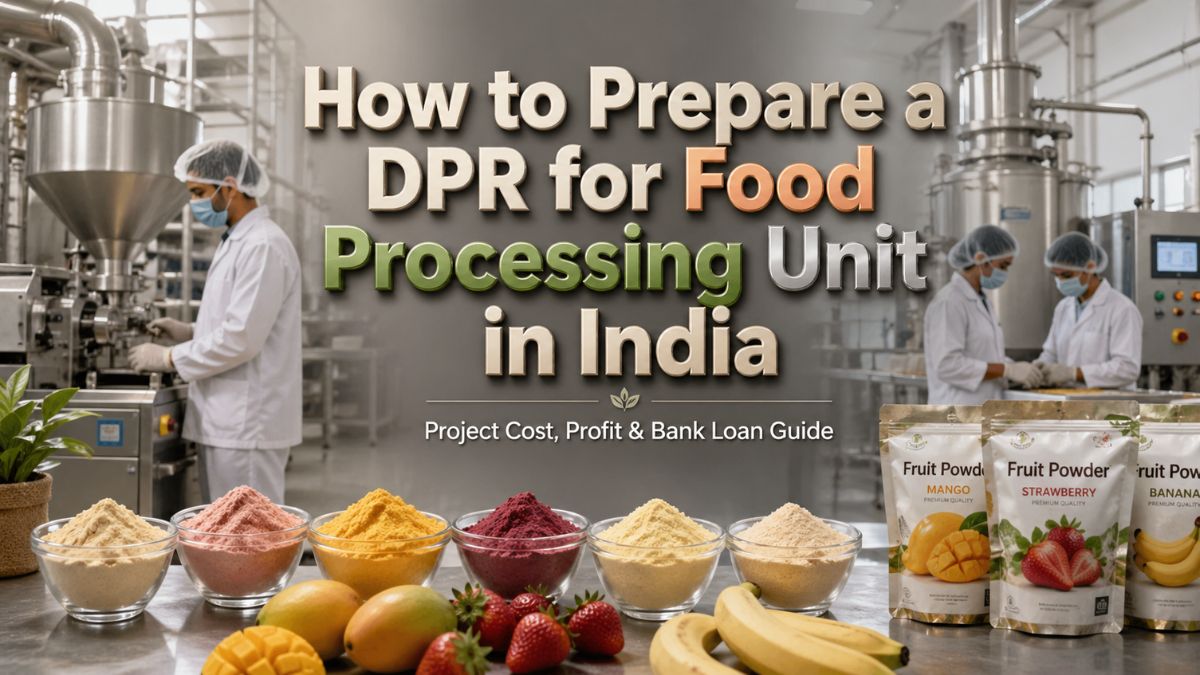
Introduction: DPR for food processing unit
Food processing business is one of the most rapidly growing opportunities in the country. And the consumption of packaged foods like flour, spices, snacks, cooking oils and ready-to-eat foods is growing annually. But before buying equipment or taking a loan from a bank, the first step is to create a Detailed Project Report (DPR).
A DPR is not a bank-only document. It is the detailed plan for your business. It details how the business will run, how much capital will be required, how revenue will be earned and how risks will be mitigated. This report is used to determine the viability of your business by banks, investors and government agencies.
The reason many entrepreneurs are not able to secure loans is that their project report is either not comprehensive or not feasible. A well-prepared DPR will not only improve your chances of getting funding, but also make the process of starting your business easier.
Table of Contents
ToggleGet Detailed Insights from This Book: Handbook on Fruits, Vegetables & Food Processing with Canning & Preservation (3rd Edition)
What Is a Detailed Project Report (DPR)?
A Detailed Project Report is an in-depth report on all aspects of a business before it starts operating. It covers technical specifications, financial projections, market studies and legal aspects.
Put simply, a DPR provides the answers to the critical questions of your business:
- What will you make?
- How much money do you need?
- Where will the plant be?
- Who will buy your product?
- What will you make in profit?
Banks cannot give businesses loans, or governments subsidies, unless they know the answers to these questions.
Why Banks Require a DPR Before Approving a Loan
Banks want to be sure the company applying for a loan will be able to repay the funds. The DPR gives them an idea of the project’s financial viability.
Banks check the following when assessing a loan application:
- Total project cost
- Expected monthly revenue
- Operating expenses
- Profit margins
- Loan repayment capacity
- Risk factors
Lenders are more likely to approve of a loan if the financial projections of the new business are accurate and the business plan is realistic.
A DPR is particularly crucial for those trying to apply for any government schemes like PMFME, PMEGP or Mudra Loan, where documentation is required.
Get Detailed Project Report (DPR): Fruits and Vegetables Value Addition and Food Processing
Main Sections Included in a Food Processing Unit DPR
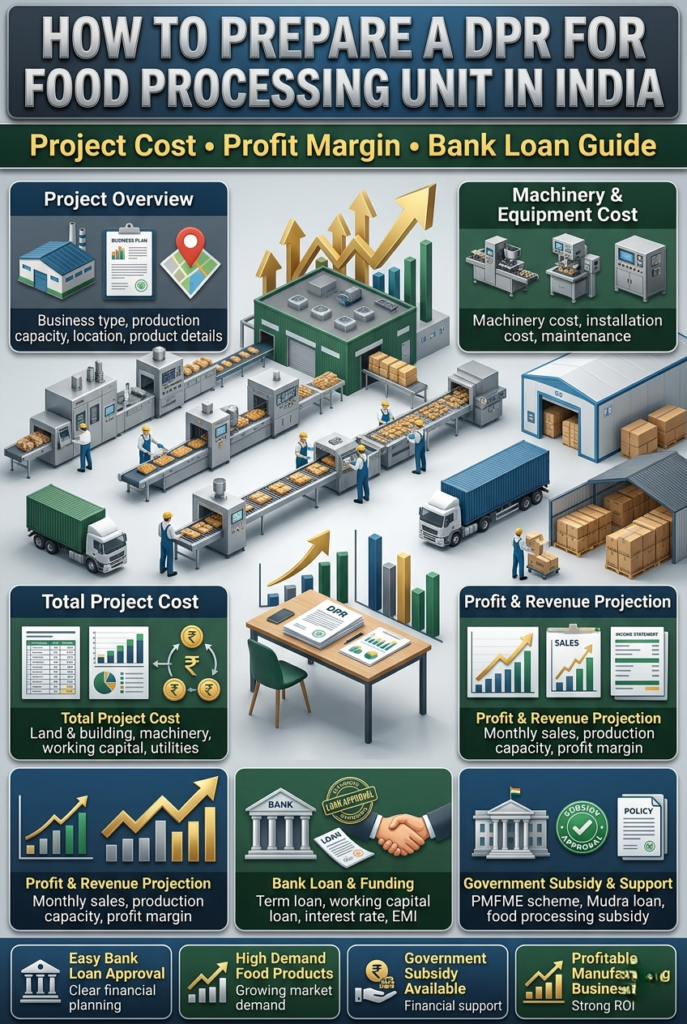
An expert-prepared DPR for a food processing unit typically includes information on business, process and finances. The reports are usually 40-80 pages long, depending on the size of the project.
1. Executive Summary
This is the first part of the DPR and gives a general description of the business. This section provides a brief description of the product, capacity, investment and profitability.
It is significant because this is usually the first section read by bank officers.
2. Business and Promoter Profile
This is the profile of the entrepreneur and business. It provides information about the entrepreneur’s profile.
Typical information included:
- Name and address of the promoter
- Educational qualification
- Work experience
- Investment in the project
- Business ownership details
Banks want to see how much interest and understanding you have of the business.
3. Product and Market Analysis
Market analysis explains why there is a market for your product, and who your customers are. It also provides details about your competitors and pricing.
For instance, suppose you want to set up a spice processing unit. The report should show that there is a constant demand for packaged spices in local markets, supermarkets or online.
This section usually covers:
- Target customers
- Market demand trends
- Competitor analysis
- Selling price strategy
Market analysis instils confidence in lenders and investors.
4. Technical Details and Machinery Requirements
The technical section of the document describes the methods used to manufacture the product. The document explains the methods of production together with the required equipment and production capabilities.
This section holds significant value for banks because it demonstrates the business’s ability to function as a technically sound operation.
Technical information usually includes:
- Manufacturing process description
- Capacity in units per day/month
- List of machines and equipment
- Water and electricity needs
- Factory layout plan
The correct technical information enables proper equipment setup for optimal performance.
5. Investment and Project Cost
This gives a breakdown of the total investment needed to establish the business. This includes capital and working capital.
A small food processing unit requires funding for various needs which include the following equipment requirement:
- Land or building setup
- Machinery and equipment
- Packaging materials
- Raw materials
- Labor and utilities
- Marketing and transportation
In India, establishing a small-scale food processing business requires an investment between ₹35 lakh and ₹65 lakh which depends on both the product type and operational size of the business.
Expected Profit and Financial Performance
The DPR document includes its main element which represents the financial performance of the business. The entrepreneur must project the revenue, costs and profit before starting the business.
A small food processing enterprise can provide a regular income stream. The production capacity together with market demand and sales network establishes the revenue stream of the business.
In many cases:
- Monthly turnover ranges from ₹4 lakh to ₹8 lakh
- Total expenses are between ₹2.8 lakh and ₹3.5 lakh
- Net profit margin is 14% – 22%
- Payback period is 4 to 6 years
This may differ based on the product and market.
Government Subsidies Available for Food Processing Units
The government of India offers a range of funding schemes to promote food processing industries. These allow entrepreneurs to reduce the cost of investment and ease the process of starting their own business.
The most popular schemes are:
- PMFME Scheme, which provides a subsidy of up to 35% of project costs
- PMEGP Scheme, which offers capital subsidy for new enterprises
- Mudra Loan, which provides uncollateralised loans for small businesses
- CGTMSE Scheme, which provides loan guarantee for small businesses
DPR holders can obtain these financial support schemes through simple access methods.
How Consultants like NPCS helps entrepreneurs
To prepare a Detailed Project Report, technical and financial expertise, and knowledge of government rules and regulations are needed. Entrepreneurs find it difficult to get the right data and to prepare the report as per bank’s specifications.
Consultancy firms make this task easier. In India, NIIR Project Consultancy Services (NPCS) is one of the prominent organisations.
NPCS helps entrepreneurs with:
- Project Reports for manufacturing industries
- Market research and feasibility studies
- Machinery selection guidance
- Plant layout design
- Cost and financial projections
- Help with loan applications to banks
Entrepreneurs receive valuable support from their industrial consulting experience which helps them to avoid business mistakes while improving their chances of getting a loan.
Steps to Start a Food Processing Business Using a DPR
Organising a food processing business is easier with a plan. The DPR provides a foundation for each step.
The process generally involves:
- Deciding on the product to be manufactured
- Conducting market research
- Preparing the Detailed Project Report
- Availing bank loan or subsidy
- Obtaining required licenses
- Purchasing machinery
- Beginning to produce and sell
These steps ease the process of starting a business and minimise the risk.
Conclusion
A Detailed Project Report is vital to the success of a food processing business. It sets the stage on the investment, production and financial aspects of the business.
Business owners who create a professional DPR are more likely to receive bank funding, attract government assistance and build successful enterprises. Business planning is crucial for success in today’s marketplace.
If you want to set up a food processing unit, ensure that you have a well-prepared DPR.
Frequently Asked Questions (FAQ)
How much does it cost to prepare a DPR for a food processing unit?
The total cost will be around ₹25,000 to ₹80,000 based on size of the project.
Do you need a DPR for bank loan?
Yes. A Detailed Project Report is required for most bank loans to businesses and for government subsidies.
How long does it take to prepare a DPR?
A DPR can be prepared in 7-30 days by a professional.
How much money is needed to start a food unit?
It can be as low as ₹35 lakh for a small unit.
Can I prepare a DPR myself?
Yes, but it is best to get it prepared by a professional to increase the chances of loan approval.


