





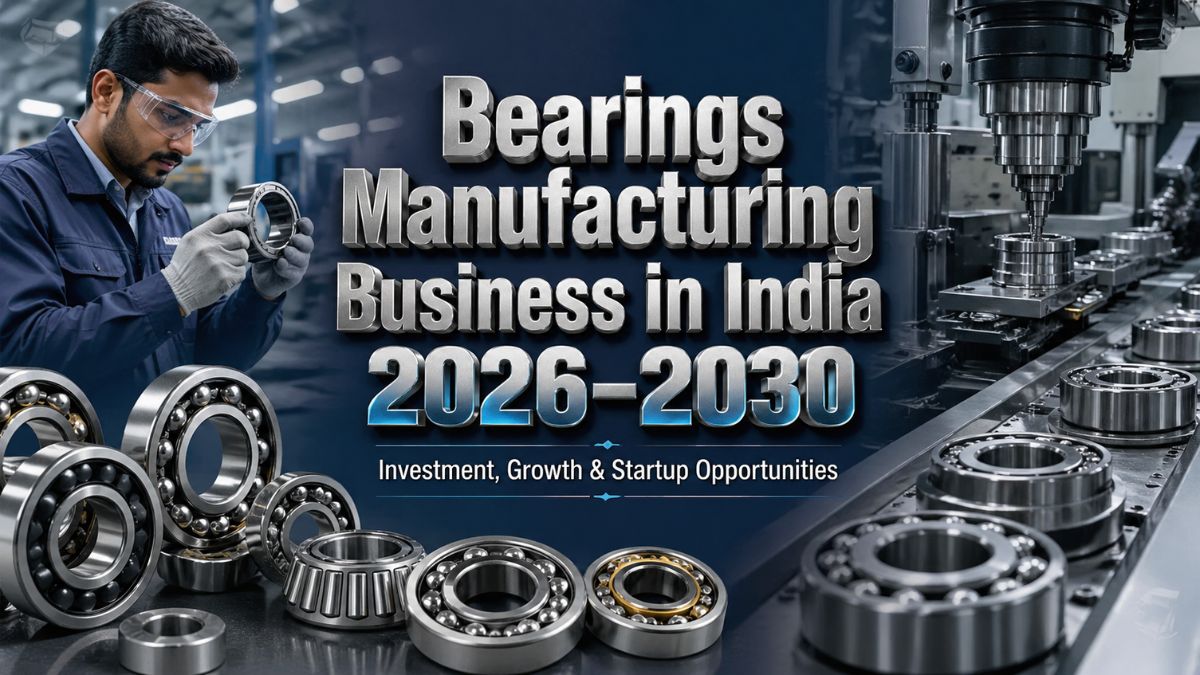
Introduction: Bearings Manufacturing Business in India
The manufacturing industry in India is booming and this increases the need for critical industrial components. One of these components is the bearing. While these components may be tiny, bearings are essential in ensuring machines operate efficiently by minimizing friction and enabling movement.
Bearings are present in numerous fields that include tractors and motorcycles and manufacturing equipment and wind turbines. The growth of India’s infrastructure and automobile manufacturing and renewable energy sectors creates an increasing demand for bearings.
The bearings market in India is currently worth ₹14,500-16,000 crore and forecast to grow to almost ₹28,000-30,000 crore by 2030. India needs to import most of its bearing requirements because the country lacks domestic production capacity for advanced and precision bearings. The market need for bearing manufacturing creates an entrepreneurial opportunity that MSMEs can use to establish their production facilities.
Table of Contents
ToggleGet Detailed Project Report (DPR): Bearing Ring Forging Manufacturing Project Report
Market Size and Growth Potential of the Bearings Industry
The Indian bearings industry is about to experience rapid expansion because of industrial growth and government efforts to boost domestic production. The growth is driven by the automobile, railway, agricultural and machinery industries.
India imports over ₹5,500-6,500 crore worth of bearings annually. This is a significant opportunity for local manufacturers in terms of producing high-quality products at competitive prices.
Key Market Highlights
- Current market size: ₹14,500–16,000 crore
- Expected market size by 2030: ₹28,000–30,000 crore
- Annual growth: 11-12%
- Import dependency: Approximately 35–40%
- Direct employment: More than 80,000 jobs
The consistent growth in demand makes bearings manufacturing a lucrative business in India.
Why Bearings Manufacturing Is a Future-Proof Business
The bearings market is highly resilient, as the demand is across various industries. Bearings are vital components of machinery.
The rise of the electric car is also driving the need for higher speed and temperature resistant bearings. And government spending on railways, metro rail and renewable energy systems is boosting demand for bespoke bearings.
These developments mean the bearings manufacturing industry will continue to be viable for decades.
Major Demand Drivers
- Explosive growth in automotive and EV market
- Growing railway and metro networks
- Adoption of automation in manufacturing
- Increasing use in agricultural and food processing industries
- Increasing renewable energy projects
These industries are growing and hence, the need for bearings will continue to be strong in the future.
Get Detailed Insights from This Book: Our Books
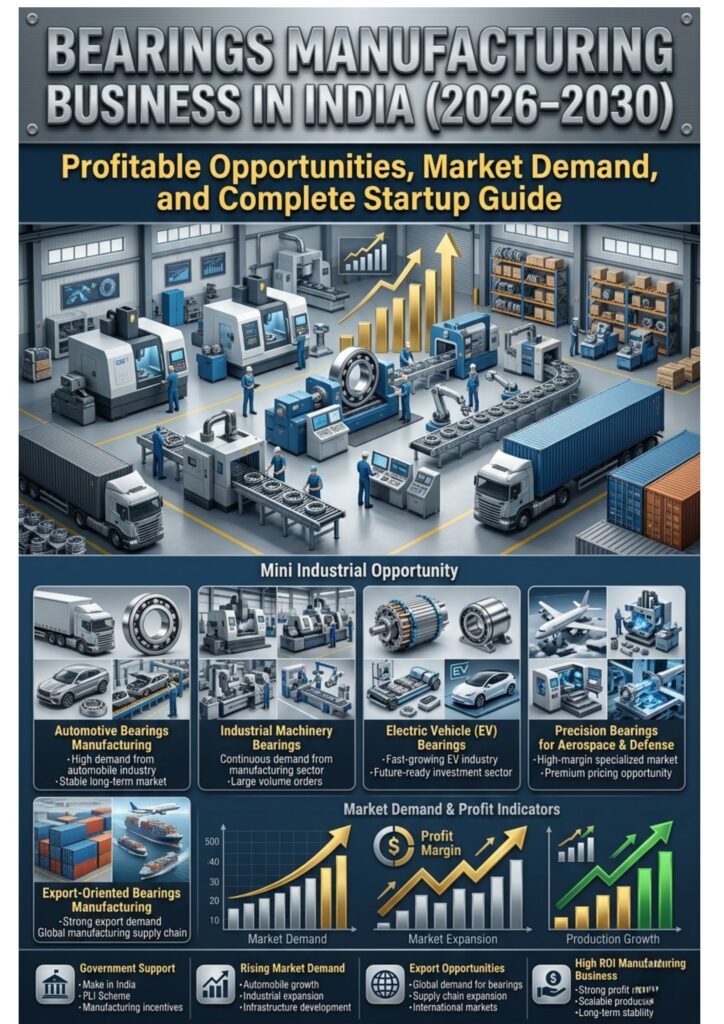
Types of Bearings You Can Manufacture
It’s crucial to know the categorization of products to set up a bearing manufacturing unit. Bearings are used in various industries depending upon speed, load and applications.
Common Types of Bearings
- Deep groove ball bearings
- Tapered roller bearings
- Cylindrical roller bearings
- Needle roller bearings
- Thrust bearings
- Spherical roller bearings
- Miniature bearings
- Housed bearings (pillow block units)
Deep groove ball bearings are the most common because they are versatile and can be used in many applications such as cars and machinery.
Best Business Opportunities in Bearings Manufacturing
There are several ways to enter the bearings business, depending on the investment and business objectives. Businesses can begin with a low investment and build up capacity.
Small-Scale MSME Opportunity (Investment: ₹3–8 Crore)
This is the ideal option for new entrepreneurs. Typical products are those that are readily available for agricultural and small-scale industries.
Typical products include:
- Pillow block bearings
- Flange bearings
- Housed bearing units
- Agricultural machinery bearings
These have high demand and straightforward manufacturing processes, making them ideal for start-ups.
Medium-Scale Manufacturing Opportunity (Investment: ₹15–40 Crore)
Companies have two main options to direct their efforts which include serving aftermarket customers and industrial clients. The market is huge and channels are established throughout the country.
Advantages of this segment include:
- Large customer base
- Faster sales turnover
- Strong aftermarket demand
- Good profit margins
This is a middle ground in terms of investment and revenue.
High-Growth Precision Bearings Opportunity (Investment: ₹75–150 Crore)
Precision bearings show the highest potential for growth because companies require more capital for their development. These technologies serve advanced fields which include electric vehicles and aircraft and robotic systems.
Key benefits include:
- High profit margins
- Limited competition
- Export opportunities
- Long-term supply contracts
The investment requires a significant initial expenditure but it generates high financial returns.
Raw Materials and Machinery Required
The establishment of a manufacturing operation depends on obtaining both essential raw materials and necessary machinery. The Indian market provides access to most raw materials which manufacturers require to produce bearings.
Main Raw Materials
- Chromium bearing steel (high carbon)
- Bearing cages (steel or brass)
- Lubricants and grease
- Seals and shields
- Grinding fluids
Essential Machinery
- CNC grinding machines
- Turning machines
- Heat treatment furnace
- Super finishing machines
- Assembly equipment
- Quality testing instruments
The establishment of a bearings manufacturing company needs both proper machinery and effective quality control processes.
Government Schemes and Support for Bearings Manufacturers
The Indian government supports domestic manufacturing through its multiple incentive programs and operational schemes. These programs reduce business establishment costs because they make it easier for entrepreneurs to create their new ventures.
Important Government Schemes
- MSME Registration
- PMEGP Loan Scheme
- CGTMSE Collateral-Free Loan
- Production Linked Incentive (PLI) Scheme
- State Industrial Subsidies
The schemes provide companies with better access to financial resources which they can use to establish their production operations.
Profit Potential and Business Outlook
Bearings manufacture has good profit margins due to high demand and widespread use. Companies with a focus on quality control and customer service can be profitable for years.
Companies maintain average profit margins between 10 percent and 15 percent across various product categories and different production levels while their majority of businesses reach break-even point after two to four years.
Export-focused companies and niche market businesses tend to achieve higher growth rates and better profitability than other firms.
About NPCS (Niir Project Consultancy Services)
NPCS (Niir Project Consultancy Services) is one of the fastest-growing industrial consultancy firms in India with over 45 years of experience in providing project reports and consultancy services to entrepreneurs and investors.
NPCS is engaged in the preparation of project reports and feasibility studies for manufacturing projects. These reports provide entrepreneurs with information on technical, financial and marketing details before they invest their capital.
Services Offered by NPCS
- Detailed Project Reports (DPR)
- Market Surveys and Demand Forecasts
- Machinery Selection Guidance
- Costing and Financial Planning
- Raw Material and Production Planning
- Business Setup and Expansion Support
NPCS reports are extensively consulted by entrepreneurs, banks and financial institutions for considering new business proposals and sanctioning loans.
The use of consultancy services enables organizations to reduce operational risks while boosting their chances of achieving successful outcomes.
Conclusion
The bearings manufacturing sector in India shows rapid growth which creates excellent opportunities for businesses to expand their operations. The industry maintains sustainable development through its increasing customer requirements, government support and ability to import products.
The establishment of a bearings manufacturing facility requires three essential elements: strategic planning and financial resources and market research. Through their commitment to delivering high-quality products and efficient operations and excellent customer support, entrepreneurs can establish successful ventures in this business field.
India offers bearings manufacturing as an excellent business opportunity because it allows people to establish sustainable enterprises which have promising prospects for growth.
Frequently Asked Questions (FAQ)
- How much capital is needed to set up a bearings manufacturing unit?
The budget to establish a small manufacturing unit starts at three crore rupees and it will cost between three to five crore rupees for the setup. The cost to establish larger manufacturing units begins at 15 crore and increases with their operational requirements.
- Can the manufacture of bearings be profitable in India?
The business operates successfully because various industries show continuous growth in demand while local manufacturing requirements need to be fulfilled.
- How long will it take to set up a bearings manufacturing unit?
Small-scale manufacturing units require a setup period between six to twelve months after their operators secure land and equipment and necessary licenses.
- Where should one set up the bearings manufacturing plant in India?
Gujarat, Maharashtra, Rajasthan and Tamil Nadu are preferred states because of the infrastructure and supply chain facilities.
- Is the business suitable for small businesses?
Yes. Small manufacturers can initially deal with regular products for farming and local industries, and then move into the advanced segments as the business develops.
- What is the need for a project report before starting a manufacturing business?
A project report is vital to estimate costs, risks, understand market needs and to get bank financing while starting a business.


