






Introduction; India New Zealand FTA 2026
The India-New Zealand Free Trade Agreement (FTA) 2026 is set to provide a new organized and structured export opportunity for Indian companies, particularly MSMEs to penetrate developed markets. New Zealand is a small, high-value import economy, rather than a high-volume economy like the US or EU, which means that quality, compliance and consistency are more important than volume.
The significance of this agreement is the complementary nature of the two economies. New Zealand economy is import driven and there is high volume production of pharmaceuticals, food items, textile items, engineering products and wellness items by India. With the elimination of tariffs & improving market access, the goods produced by the Indian export industry will be competitive.
Table of Contents
ToggleIdentify high-growth industries before others do
Why India–New Zealand Trade Has Strong Potential
New Zealand imports USD 50-60 billion annually but India has a small market share. This is not for want of capability but due to previous trade barriers like tariffs, stringent compliance requirements, and lack of channels.
The FTA however addresses these issues and opens a way for Indian exporters.
The key change is that New Zealand is a high-end consumer market and customer’s demand:
- Certified and quality goods
- Health and natural products
- Long-term suppliers instead of cost-effective
This presents a good opportunity for “quality conscious” and compliant Indian MSMEs.
Pharmaceuticals and Nutraceuticals: Highest Growth Sector
The India-New Zealand FTA is likely to have the greatest impact on the pharmaceutical and nutraceutical sector. India is a world leader in generic drugs, but New Zealand imports large quantities of healthcare and nutraceutical products.
Particularly in demand are:
- Generic medicines
- Herbal supplements
- Fitness and protein nutraceuticals
- Immuno-stimulants and ayurveda products
The population is health conscious, thereby leading to a constant demand for these products.
But this is a highly regulated market. The exporters have to comply with regulatory norms, which include WHO-GMP certification and Medsafe (New Zealand’s drug authority) approval.
Regulation notwithstanding, this is one of the most lucrative export markets with margins of 28% – 38%. The typical investment for a medium-sized unit is ₹1.5-3 crore.
Get Detailed Insights from This Book: Drugs & Pharmaceutical Technology Handbook
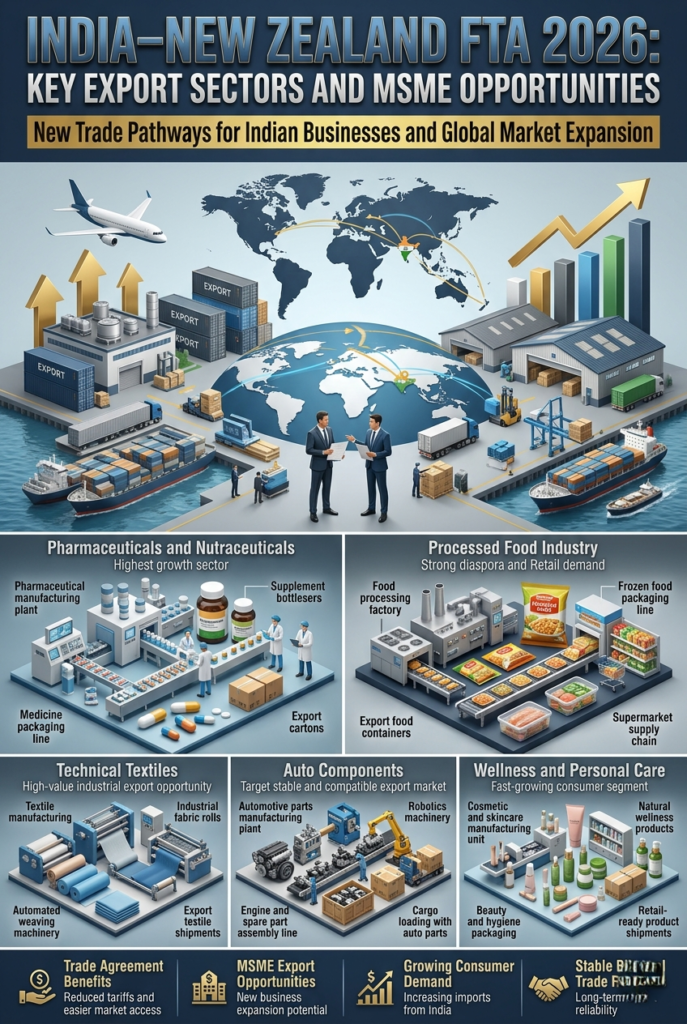
Processed Food Industry: Strong Diaspora and Retail Demand
Another rapidly growing export under the FTA is processed food. India is home to a growing number of New Zealanders, who provide a base market for ethnic food. Meanwhile, the local supermarkets are also carrying more Asian and Indian food products, as a result of evolving customer preferences.
Key export opportunities include:
- Masala mixes and spices
- Ready-to-eat meals
- Rice, pulses and lentils in packs
- Fruit pulp, beverage concentrates
For the Indian exporter, the product is known and this simplifies the marketing process.
The regulatory compliance needed is FSSAI in India and FSANZ in New Zealand. With these, exporters can reach ethnic and mainstream retailers.
The margins in this sector are between 30% and 38%, particularly for branded and packed goods. The capital required ranges from ₹60 lakh to ₹1.2 crore.
Technical Textiles: High-Value Industrial Export Opportunity
Technical textiles are an exciting export opportunity. This category is based on functional performance textiles used in agriculture, construction, outdoor sports and other industries.
Products with high demand include fire-resistant textiles, sun protection and protective work wear.
The nature of industries like outdoor sports and agriculture, which are vital to New Zealand, demands technical textile as an import.
Key requirements for exporters:
- BIS certification of standards
- Adherence to New Zealand’s consumer safety laws
- Minimum scale (50,000 metres/month) for viability
The requirement in this category is higher (2 cr-5 cr) but the profit margins are also higher and orders are often placed on a long-term basis.
The margins are also better than commodity textiles (20% – 30% higher).
Access Complete Business Plan: Technical Textiles Sector-wise Project Guide
Auto Components: Stable and Compatible Export Market
The auto components market is stable, long-term. Kiwi car manufacturers rely on imports, particularly aftermarket parts.
India has an inherent advantage as the country drives on the left.
There is a high demand for exports of:
- Brake systems
- Filters and lubricants
- Clutch assemblies
- Electrical and engine components
Most Indian MSMEs in this category are already exporting to OEMs around the world, so New Zealand would be an easy market to break into.
The only certificate required is IATF 16949. Most exporters will already have this certification.
This category usually requires no further CAPEX as exporters will be able to accommodate these orders with the already existing manufacturing facilities. Gross margins are in the 18% to 28% range, depending on the supply chain.
Wellness and Personal Care: Fast-Growing Consumer Segment
The world’s desire for chemical-free products has driven this segment of wellness and personal care. Kiwi consumers demand sustainable, herbal and organic products.
Herbal & wellness items, Ayurvedic skin care and cosmetics, essential oils, herbal cosmetics fits perfectly with Indian manufacturers.
Key demand areas include:
- Organic skincare products
- Herbal shampoos and oils
- Aromatherapy oils and products
- Natural personal care items
PCB CPCB approval, FSANZ compliance.
Low investment: Investment is less as compared to manufacturing any other type of products, i.e., from 50 lacs to 1.5 crore. Small entry for MSMEs. Profitability: high with a profit of 25-35%.
Role of NPCS in Export Business Success
Planning is crucial for successful export trading. This is the area where NPCS can be useful for the MSME sector and entrepreneurs.
NPCS offers services to formulate business plans including:
- Project reports (DPRs)
- Market and demand studies
- Feasibility and financial analysis
- Plant and machinery identification and costing
- Export business model development
By providing factual data on the level of investment, manufacturing plan and anticipated profit. NPCS helps to minimize risks for MSME that look forward to capitalize on the FTA between India and New Zealand.
NPCS reports are also used by banks and financial institutions for loan sanctioning, thus helping access capital.
Conclusion
The India-New Zealand FTA 2026 offers a great export possibility for Indian MSMEs however, success relies on appropriate choice of sectors and compliance readiness. Pharmaceuticals, processed food, technical textiles, auto components and wellness products will gain most. Each sector represents a different investment & profit potential, making them feasible for entities of various sizes. Requires careful planning and research beyond volume. There should be quality consistency, certification and structured planning, a product for a developed economy. India’s MSMEs must make informed feasibility studies & secure NPCS-driven support to make successful entry & gain sustained export revenue.
FAQs
Q1. Which sectors would gain more from India-New Zealand FTA?
Pharmaceuticals, processed food, technical textile items, auto components and wellness products.
Q2. Is New Zealand a potential export destination for MSMEs?
Yes, small but niche & important market with a large demand for imported high quality products.
Q3. How much is the minimum investment to export to New Zealand?
Roughly 50 lakhs for wellness and food products, while up to 5 crores for technical textiles.
Q4. What certificates would be necessary to be able to export to New Zealand?
FSSAI, WHO-GMP, FSANZ, BIS and IATF 16949 are few among the numerous possibilities, dependent on sector.
Q5. How does NPCS contribute in assisting Indian MSMEs in exports?
NPCS helps the exporters through detailed feasibility study reports, project profiles and business plans to initiate an export business.


