





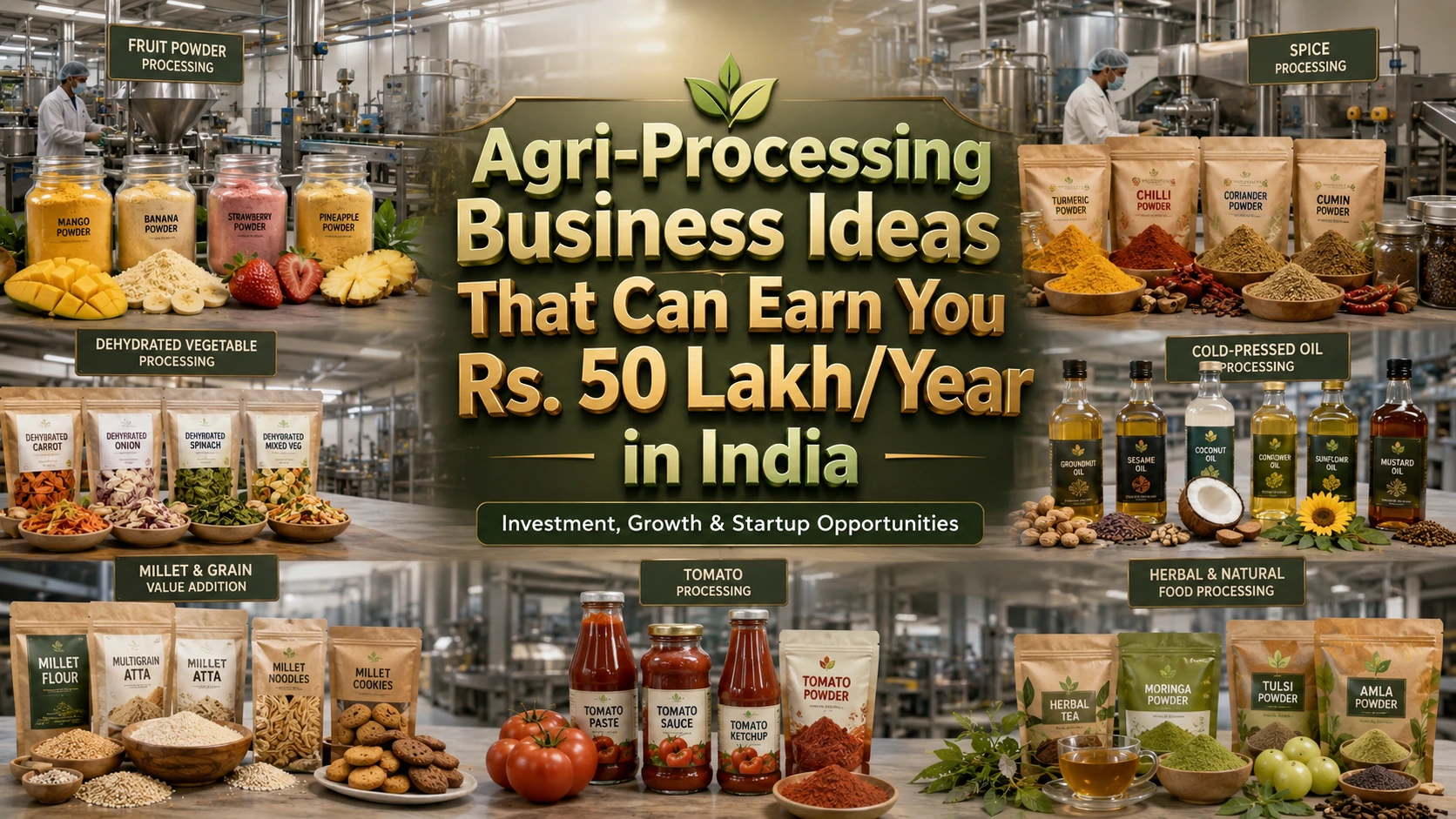
Agri Processing Business Ideas in India
India has a food production system that produces more food than it can digest. It grows pulses which it does not mill here. Crushes oilseeds with low recoveries. It eliminates fruit overages because of lack of cold storage or processing lines. In the interim it imports value added products from the crops it exports as raw commodities.
India’s production deficit, between what it produces and processes, is where manufacturing opportunity resides. The time is probably now riper than ever for entrepreneurs who have the right ideas for their businesses and have the right information.
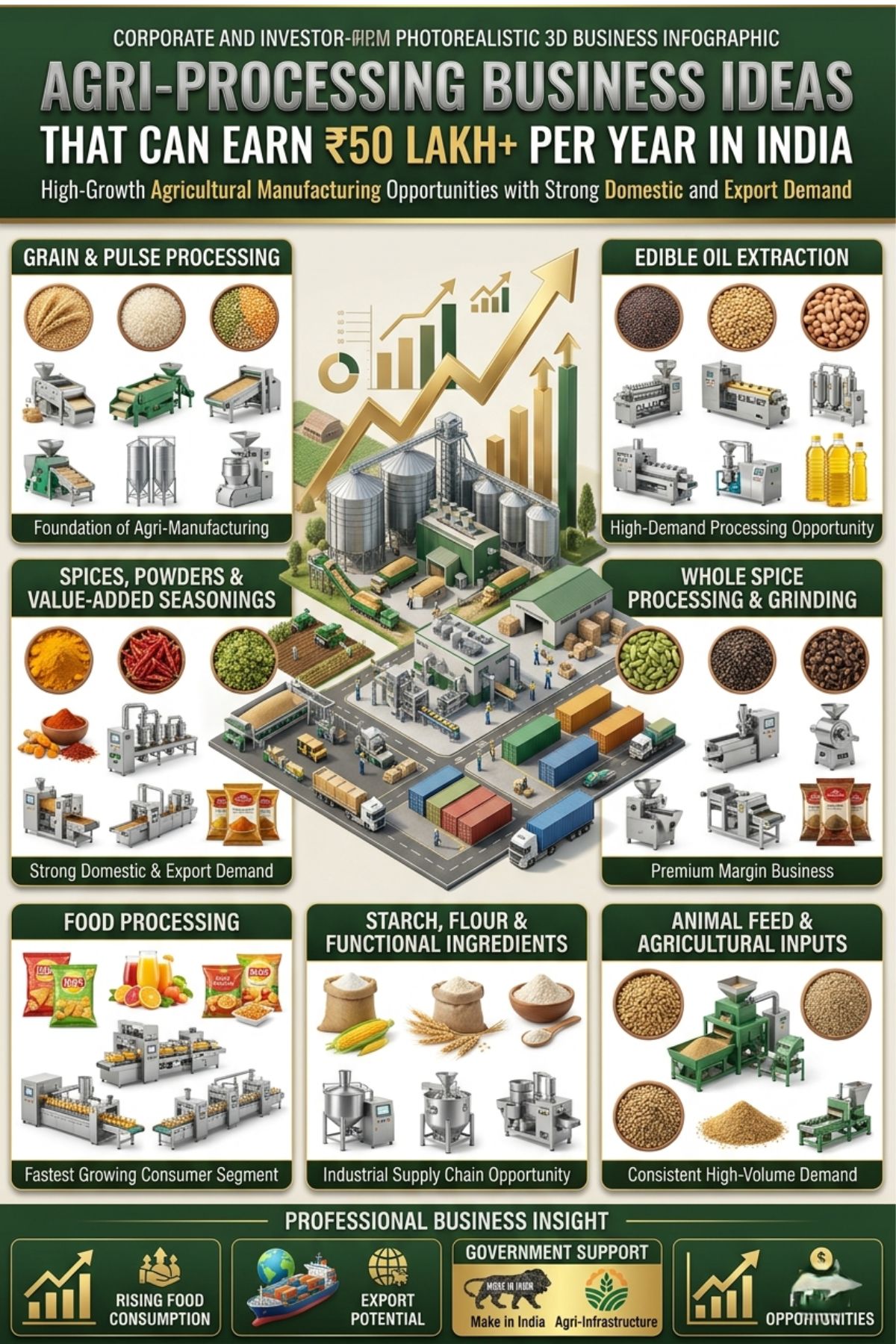
The article analyses more than 35 different business concepts in agri-processing, food processing, spices, edible oils, alternate fuels and animal feed. Each of these is a true opportunity in a market today. What they all share is that most of these products are for massive domestic markets with supply chains that are entrenched in Indian agriculture. Most of them can be entered by MSMEs with institutional scale capital.
The following is a no-glossy-pitch-and-promise roadmap for entrepreneurs wishing to know what they are getting into before investing one rupee.
Get Detailed Project Report (DPR): Food Processing and Agriculture-Based Projects
Grain and Pulse Processing: The Foundation of Agri-Manufacturing
Roller Flour Mill
Wheat is ground into refined flour, semolina and bran using a roller flour mill. It is used in bakeries, confectionery industries, hotels, and packaged food industries in tonnages. A roller mill is not a traditional chakki, but has a sequential break and reduction system. It is able to separate bran, germ and endosperm accurately resulting in better grades of maida, atta and sooji.
The commercial capacity ranges from 5 tonnes of wheat per day and increases from there. Haryana, Punjab, Madhya Pradesh or Rajasthan is the source of raw material. The offtake from institutional buyers like biscuit makers and restaurant chains has been solid, supporting the economics. Flour is an absolute necessity; it doesn’t turn in and out of style — it grows with the population and urbanization.
Dal Mill (Pulses)
Pulse milling is the business process which involves the splitting of whole legumes such as chana, arhar, moong, masoor etc. into split dal, which is one of the most successful agri-processing business in India. India is the leading producer and consumer country of pulses in the world. However, the milling capacity remains scattered and inefficient especially in Madhya Pradesh, Uttar Pradesh, Maharashtra and Karnataka.
A dal mill is a machine that cleans, de-stones, hydrothermally processes, de-husks, splits and polishes raw pulses. The investment for a small-scale unit is about Rs. It is 25-40 lakh per installed capacity. The market of dhal in brands has increased markedly in the last decade, and processors who offer consistent quality are in good position.
Rice Mill (Parboiled Rice)
Parboiled rice (also called sella rice) is a process of soaking raw paddy, steaming it under pressure and drying it prior to milling. In this way nutrients are transported from the bran into the rice grain which results in a better nutritional retention and longer storage time than white rice.
Parboiled rice is the staple in South Indian, West Bengal and Bihar. It also fetches a high price in export markets like the Middle East, West Africa and South East Asia. Investing in a parboiled rice mill that can be operated to meet export quality standards is a long-term strategic investment in rice exporters of the country as India exports a considerable amount of rice to the rest of the world.
Khandsari Sugar
We can say Khandsari sugar is somewhere between raw jaggery and refined white sugar when it comes to processing. It holds onto more molasses and thus is darker, and richer in micronutrients. In comparison, the investment required in khandsari units is much less compared to that of the sugar mill and is suitable for farmer producer organisations, cooperative societies and the rural entrepreneurs in UP, Maharashtra and Karnataka in sugarcane growing belts.
Demand is from the confectionery factories, the mithai makers or traditional food factories. New interest in this category is coming from the increasing consumer segment that is interested in less-processed sweeteners.
High Fructose Corn Syrup (HFCS)
Hydrolysis of corn starch to glucose and subsequent enzymatic conversion to liquid sweetener is cheaper than cane sugar and is better in drinks and baked products is called high fructose corn syrup. Beverage manufacturers have ramped up the use of HFCS in India.
Technically demanding manufacturing process with the need for precise pH and temperature control. Institutional buyers such as soft drink companies and confectionery companies, however, have stable offtake agreements that certainly help de-risk this investment.
Edible Oils: The Extraction Opportunity
Mustard Oil with Packing
Mustard oil is the most widely used in cooking in North India, in Bengal, Bihar, Assam and Odisha. The manufacturing process of extracting mustard oil, which includes expeller pressing, filtration and optional refining is known and the supply chain of equipment is strong.
Packaging and positioning is the difference between a growing and a stagnant mustard oil business. Loose oil in jerry cans gradually being replaced by branded pouches and bottles for consumers in Tier 2 and Tier 3 towns. Those operators that use short-term price fluctuations to manage their working capital and develop a name for the area do tend to do fairly well, over the middle term.
Get Detailed Insights from This Book: Fruits, Vegetables, Corn and Oilseeds Processing Handbook
Peanut Oil
The groundnut oil industry caters to the demand in the strong markets of Gujarat, Rajasthan, Andhra Pradesh and Tamil Nadu. The oil cake remaining after the extraction is a high protein animal feed ingredient and is a valuable by-product revenue stream. The groundnut oil industry has a solid base as the raw material is grown in India and is available in huge quantities, and groundnut oil is available in a meaningful price premium as branded oil versus loose trade.
Palm Oil Refining
India is the biggest importer of palm oil in the world. This opportunity isn’t a primary extraction; it’s a refining and fractionation opportunity. The commercial area of crude palm oil importation and upgrading into refined, bleached, deodorized (RBD) palm oil for industrial food applications is an actively traded market. This is a policy supported segment that needs to be monitored as the government National Mission on Edible Oils (NMEO) has incentivized the cultivation and processing of palm domestically.
Rice Bran Oil Solvent Extraction
Rice bran, which is the outer layer of the rice grains after milling, is a potential source of edible oil, and has about 15–22% oil content. For this, solvent extraction technology is required because cold pressing if the bran has a high oil content is not efficient. A rice bran oil unit should be co-located with the rice mill to have a uniform supply of bran. The premium price for refined rice bran oil for health foods is due to its high smoke point and good fatty acid profile. By-product deoiled bran is fed to animal feed manufacturers which have the added benefit of improving the overall unit economics.
Spices, Powders, and Value-Added Seasonings
Turmeric Powder and Turmeric Milk Drink
The manufacture of turmeric powder involves simple processes of cleaning, drying, polishing, grinding and packing raw turmeric rhizomes which can be easily scaled up to a business. Turmeric is also an important crop in India where more than 80% of the world’s turmeric is produced, largely in the states of Andhra Pradesh, Telangana, Odisha, and Tamil Nadu. It is exported to more than 50 countries. Domestic demand steady, export demand growing due to world-wide interest in curcumin as a functional ingredient for health.
The next level of value addition is provided by the turmeric milk drink, a ready to drink product containing turmeric and milk solids, spices and sweetener. It has already proven to be a market success among health-conscious city-dwellers and is starting to make space in new retail and quick commerce outlets. Most of the MSMEs can enter at the turmeric powder level. The product made from the milk needs more advanced processing methods and is more appropriate as a second stage expansion product.
Mango Powder (Amchur)
Amchur is a sour, dried green mango, sliced, sun dried or mechanically dried and ground into a powder to give Indian dishes their sour, fruity complexity. The window of opportunity for this raw material is narrow in that it is the early season of mango before they are ripe. This requires procurement and drying to be done quickly and efficiently.
Household consumers, food manufacturers, chaat masala blenders and instant food companies use Amchur. Properly dried and sealed the product has a long shelf life and is well suited for domestic distribution as well as for export.
Moringa Oleifera (Drumstick) Powder
In a very short time, moringa powder has traveled from a traditional South Indian food to being a health supplement that is traded all over the world. The drumstick tree is a fast-growing, drought resistant and grown throughout Andhra Pradesh, Tamil Nadu, Karnataka and Rajasthan. The leaves are picked, cleaned, shade-dried at low temperatures to maintain enzymes and nutrients and ground into a fine green powder.
Premium pricing is generated by the export demand from Europe, North America and Japan. Organic and pesticide residue checked Moringa powder commands a much higher FOB price. It is a high value crop product with a definite upward trend in the entire world and for a cultivation cluster type processor it is one of the least developed agri-processing business opportunity in India today.
Whole Spices Processing and Grinding
Spices are traded in three formats in India – whole, ground and blended. Market access is at stake in the processing of whole spices, especially in the cleaning process, grade and size selection and grinding to the desired particle sizes. Aflatoxins, pesticide residues and microbiological counts are stringently controlled by spice boards and import authorities in the EU, US and Gulf markets.
Proper cleaning, colour sorting and laboratory testing provide operators access to top-tier institutional buyers. The segment on blended masalas (curry powder, sambar powder, biryani masala) contributes to the added value as it brings together various spices in uniform and branded mixes.
Related Article: Spice Processing & Packaging Unit Business Guide: Setup, Cost, Profit and Market Opportunity in India
Asafoetida (Hing)
Hing is one of the most commercially interesting spice opportunity in India. Imported raw asafoetida resin is sold to India (mainly from Afghanistan and Iran) and mixed with edible starch and gum to form the familiar asafoetida powder which is used in the kitchen. The production of hing is low capital, and known processing steps. Market giants such as LG Hing and Vandevi have proved that excellent distribution and regular formulation quality builds a strong brand value.
Feasibility Intelligence: Why Research Precedes Investment
Entrepreneurs need to know the technical economics, before investing any money in any manufacturing business. It involves having the actual capacity, equipment costs, raw material prices, processing yields and working capital cycles — and not just estimates.
There are structured feasibility support organizations available such as Niir Project Consultancy Services (NPCS). The Market Survey cum Detailed Techno-Economic Feasibility Reports prepared by NPCS include raw material sourcing information, manufacturing processes details, plant layout, machinery information, financial details, and market demand analysis. A comprehensive feasibility study significantly diminishes the chances of expensive misjudgments in plant sizing, assumptions about input costs, or estimates of market demands for any of the sectors in this article, from the roller flour mills to the biomass briquette manufacturers.
Food Processing: Snacks, Juices, and Functional Products
Banana Wafers and Apple Chips
Green bananas are sliced into strips, fried in refined oil or baked (in premium varieties), seasoned and packed in banana wafers for sale. As far as the domestic production is concerned, Kerala is predominant, though the demand is gradually on the rise. The apple chips come from excess of apple varieties grown in the states of Himachal Pradesh and Jammu & Kashmir and are aimed at the premium snack segment where consumers are looking for alternatives to potato chips based on fruits. The two products are expected to gain from India’s high growth packaged snack segment, which has grown steadily at high single digits per year.
Pineapple Juice
The states of Assam, Meghalaya, West Bengal and Kerala are responsible for the major production of pineapples in India. Excess pineapple can be turned into juice, concentrate or pulp, which has been a problem for a long time, as raw material may go bad in peak season, generating a low-cost procurement window. In addition to retail consumer packs, there is institutional demand for pineapple juice in the form of a pineapple juice unit from food service operators, hotel chains and the airline industry.
Sugarcane Juice Preservation and Bottling
Several food tech companies have been interested in preserving and bottling sugarcane juice, a street drinker favorite in India that is drunk straight from the cane. The technical problem is the enzymatic browning and microbial instability. Units that overcome the quality and shelf-life challenge, have a product that is widely recognized and has a high level of consumer familiarity. The skills remain of technical challenge and commercial interest to the food technologist entrepreneur.
Egg Powder
Egg powder (whole egg, egg white or egg yolk) is used in the bakery, confectionery and processed food, and sports nutrition sectors. The production of egg powder needs spray drying equipment which is capital-intensive equipment with high potential of scaling-up and has established institutional demand from the industrial buyers who require constant protein input. Egg production in India has been increasing over the years and the major producers are Andhra Pradesh and Tamil Nadu.
Barley Malt
Barley malt is obtained by carefully germinating and kilning barley grain. It is mainly used as an ingredient in the brewing process, in malted beverage and for baking. The Indian organized brewing industry has been rapidly growing and the demand for local malting has increased with it. The malt processing unit is a moderately capital-intensive business that has a steady and increasing demand.
Discover business ideas that actually make money
Starch, Flour, and Functional Ingredients
Maize Starch
Wet milling of corn grain separates starch, gluten, oil and fibre from whole corn grain and is a process used to extract maize starch. The resulting starch is used in a variety of applications such as food, pharma, paper, textiles and adhesives. The production of maize has increased considerably in India and it is a natural and logical investment to invest in domestic corn starch production. Most commercial start-up is at 10-20 tons of corn per day. The corn germ oil, gluten meal and steep liquor are sold separately and have their own markets, adding greatly to the economics of the unit.
Soya Bean Flour
Full-fat soya bean flour or defatted soya bean flour is obtained by grinding soybeans or soya meal obtained by solvent extraction. This high protein content (40-50%), usually found in defatted soya flour, makes it an excellent ingredient for bakeries, meat processors and formulators looking for cheap protein fortification. Soybean is grown mainly in Madhya Pradesh, Maharashtra and Rajasthan, in India. The defatted soya flour is a natural product for the solvent extractors who are interested in value addition to their soya meal production.
Table Salt (Food Grade)
The table salt is made from raw salt from saltpans in the coastal areas of Gujarat, Tamil Nadu and Sambhar Lake in Rajasthan that undergoes cleaning, iodisation, anti-caking treatment and packing. The chemistry of the processing is not complicated, but moisture control, iodine level and uniformity of particle size are important for regulatory compliance. The success of Tata Consumer Products in convincing customers that salt is a brand and a premium product meant that they became an example for others. Tata Consumer Products proved that salt can be a premium branded product. Quality specifications matched by the regional processors and efficient distributors reaps adequate and consistent returns.
Animal Feed and Agricultural Inputs
TMR Block Cattle Feed
Total Mixed Ration (TMR) blocks are mixed feeds for cattle that incorporate roughage, concentrates, vitamins and minerals into a single block form that is compressed. It addresses a very real issue that dairy farmers face when trying to formulate rations for their animals. To produce TMR blocks, a mixer, block press and packaging line are needed. The demand is resulting from the 300-million-plus cattle and buffalo population in the country and the government’s thrust towards organized and productive dairy farming. Active institutional buyers for quality cattle feed are NDDB, state dairy cooperatives and private dairy companies.
Alternative Fuels: Biomass Briquette Manufacturing
The agricultural wastes, which are usually burned in field, like rice straw, sugarcane bagasse, groundnut shells, cotton stalks, mustard husk etc. can be densified into biomass briquettes for use in industries rather than being burnt in open field. The densification process takes the loose agro-waste and compacts it into uniform-size briquettes of energy equivalent to low-grade coal. Biomass briquettes have emerged as a significant market segment as industrial facilities look for better Option than Coal, which is a cleaner and cheaper energy. Policy driven demand: A number of state pollution control boards have insisted on fuel switching. Ministry of New and Renewable Energy (MNRE) Biomass Programme supports biomass energy projects on policy and financial support. A biomass briquette unit is a win-win scenario for rural entrepreneurs because it not only provides an income stream, but also helps decrease crop residue burning.
Market Overview: Key Products, Investment Range, and Growth Outlook
The table below provides a comparative view of representative products, entry investment and market growth. These figures are indicative and should be confirmed with a detailed feasibility study prior to investing.
| Product | Entry Investment | Primary Market | Growth Outlook |
| Roller Flour Mill | Rs. 50–200 Lakh | Bakeries, packaged food | Steady — population-driven |
| Dal Mill (Pulses) | Rs. 25–80 Lakh | Retail, wholesale | Stable with branded premium |
| Mustard Oil | Rs. 30–100 Lakh | North India retail | Steady with brand opportunity |
| Turmeric Powder | Rs. 15–50 Lakh | Domestic + export | Strong — wellness demand |
| Moringa Powder | Rs. 20–60 Lakh | Export, health retail | High — global nutraceutical |
| Maize Starch | Rs. 150–400 Lakh | Food, pharma, paper | Strong — industrial diversification |
| Biomass Briquette | Rs. 20–80 Lakh | Industrial fuel buyers | High — policy-driven switch |
| Egg Powder | Rs. 80–250 Lakh | Bakery, FMCG, sports nutrition | Growing — protein demand |
| Banana Wafers | Rs. 15–50 Lakh | Retail snacks | High — snack market expansion |
| Khandsari Sugar | Rs. 40–120 Lakh | Confectionery, mithai | Stable — traditional demand |
| Rice Bran Oil | Rs. 100–300 Lakh | Health foods, FMCG | Growing — health positioning |
| TMR Cattle Feed | Rs. 30–100 Lakh | Dairy farmers, cooperatives | High — dairying modernisation |
| Soya Bean Flour | Rs. 50–150 Lakh | Bakery, protein food mfg. | Growing — protein fortification |
| Pineapple Juice | Rs. 40–120 Lakh | Food service, retail | Moderate — seasonal raw material |
| HFCS | Rs. 200–600 Lakh | Beverages, FMCG | Growing — sugar substitution |
The sector-level view below maps key input states, end-use industries, and the policy incentives available to entrepreneurs entering each space.
| Sector | Key Input States | Major End-Use Industries | Policy Tailwinds |
| Grain Milling | Punjab, Haryana, MP, UP | Food manufacturing, retail | PMFME, PLI Food Processing |
| Edible Oils | Raj., Gujarat, AP, MP | FMCG, food service | NMEO (Natl. Mission on Edible Oils) |
| Spices Processing | AP, Telangana, Kerala, Karnataka | Export, retail, food mfg. | APEDA export incentives |
| Agro-Waste Fuels | Pan-India agricultural states | Industrial fuel users | MNRE biomass mission |
| Dairy Feed | UP, Maharashtra, Rajasthan, GJ | Dairy cooperatives, NDDB | National Livestock Mission |
| Functional Foods | Assam, Kerala, TN, HP | Health retail, export | Horticulture Mission (MIDH) |
Entrepreneur Spotlight: Lessons from Those Who Built It First
Shakti Bhog Foods — Kewal Krishan Kumar
Kewal Krishan Kumar has transformed Shakti Bhog Foods into one of the biggest food companies in India in just a flour milling unit in Delhi. His approach to decision-making was simple: select a product that had inelastic demand, invest in manufacturing scale and in markets where organized actors were not present, make the distribution network. That model, which emphasizes controlling the supply chain and penetration rather than advertising the brand, is directly relevant to dal milling, spice processing and edible oil refiners today.
Tata Salt — Tata Consumer Products
When Tata Salt came on to the scene, the salt was just a purest commodity. The Tata Group proved that even the most commodity like product can fetch a premium price if it is consistently produced, trusted brand and reliable iodisation is maintained. The message to the entrepreneurs entering table salt or mustard oil or atta manufacturing is very clear that commodities can be preimmunized. That investment is not just in equipment; it’s in quality systems and continuous consumer communication.
Priya Gold (Surya Foods) — Anil Arora
Priya Gold’s founder has created a biscuit business that targets the value segment of the price-sensitive market by targeting the value positioning. The ingredients—wheat flour, sugar and fats—are the same as his rivals. He had an advantage because he was able to be more efficient at producing and getting the product to markets where premium brands simply were not interested. That same gap filling logic also performs well in the dal, maize starch, and spice markets.
Frequently Asked Questions
Q1. Which of these business ideas has the lowest entry investment?
Mango powder (amchur), turmeric powder, moringa powder and banana wafers can all be begun at relatively low levels of investment ranging between Rs 15 lakhs to Rs 60 lakhs as per the capacity and locality. There also exists good domestic markets as well as exports value to these products. Thus it would also make an attractive starting point for first generation manufacturers.
Q2. Do I need FSSAI registration for agri-food processing?
Yes, any business that is involved in the manufacturing, processing, packaging, storing, or importing of Food Safety and Standards Authority of India (FSSAI). Based on your turnover per year and business coverage, the types of licenses to be applied for are basic, state or central. FSSAI has a complete guidance and process for all registrations and compliance issues.
Q3. Can I get a government subsidy for a food processing unit?
Yes – there are several schemes. The PM Formalisation of Micro Food Processing Enterprises (PMFME) scheme Provides credit-linked subsidies for the modernization of micro units. The PLI scheme for Food Processing: Encompasses particular product lines. State Government Industrial Promotion Policies: Typically contain concessions on capital subsidies, electricity tariff, concession on land allotment to agri-processing industries, etc.
Q4. What is the typical payback period for a mid-scale spice processing unit?
A mid-scale spice processing unit — cleaning, grinding, and packaging — operating at reasonable utilisation levels typically achieves payback in 4–6 years on fixed investment. This assumes branded sales with better realisations rather than bulk commodity trade at thin margins. Understanding working capital cycles in spice processing is important before committing.
Q5. Is biomass briquette manufacturing viable without assured offtake?
It carries meaningful risk without at least one anchor industrial buyer. Before setting up a briquette unit, prospective entrepreneurs should approach local brick kilns, tea factories, food processing plants, or textile dyeing units currently using coal or furnace oil — and assess their willingness to switch fuels. State pollution control board mandates in several states have created pull demand that can anchor early-stage sales.
Q6. How do I find reliable machinery suppliers for a maize starch unit or roller flour mill?
References from suppliers can be obtained through industry associations such as the Roller Flour Millers Federation of India for flour mills, or the state level food processing associations. Machinery suppliers, along with benchmarking new technologies, are available through machinery exhibitions like Agro Tech India, AAHAR, and the India International Food & Hospitality Fair.
Q7. What export certifications are required for turmeric and moringa powder?
For exporting spices and botanical products out of India registration with Spices Board of India is required in case of spice products and APEDA for all other categories of food items. To export to EU, US and Japanese market pesticide residue limits and limits for aflatoxin must be complied with and often organic certification from an authorized agency. Quality checks and traceablity documents are the new non- negotiable items for high value export.
Conclusion: Manufacturing Success Starts with the Right Category
The 35-plus business ideas covered in this article share a common characteristic: they process Indian agricultural raw materials into higher-value forms that consumers, industrial buyers, and export markets willingly pay for. That is the essential logic of agri-processing as an investment category — and it has held across economic cycles.
What distinguishes a successful manufacturing venture from an unsuccessful one is rarely the idea itself. It is the quality of the feasibility groundwork — real input costs, realistic capacity utilisation ramp-ups, working capital requirements, and credible market access strategies — done before capital is committed. Entrepreneurs who treat feasibility as a formality tend to discover the problem only after the plant is built.
For first-generation manufacturers and MSMEs, the approach that works is disciplined and sequential. Consider these core principles before you begin:
- Choose a product category that matches your geography’s raw material supply.
- Validate demand with real potential buyers before breaking ground.
- Size the plant for a realistic worst-case utilisation scenario.
- Invest in brand or institutional buyer relationships in parallel with infrastructure.
The opportunity across these sectors is real. The question is not whether a business exists here — there clearly is one. The question is whether the entrepreneur approaching it has done the work to understand what kind of business it truly is.


