





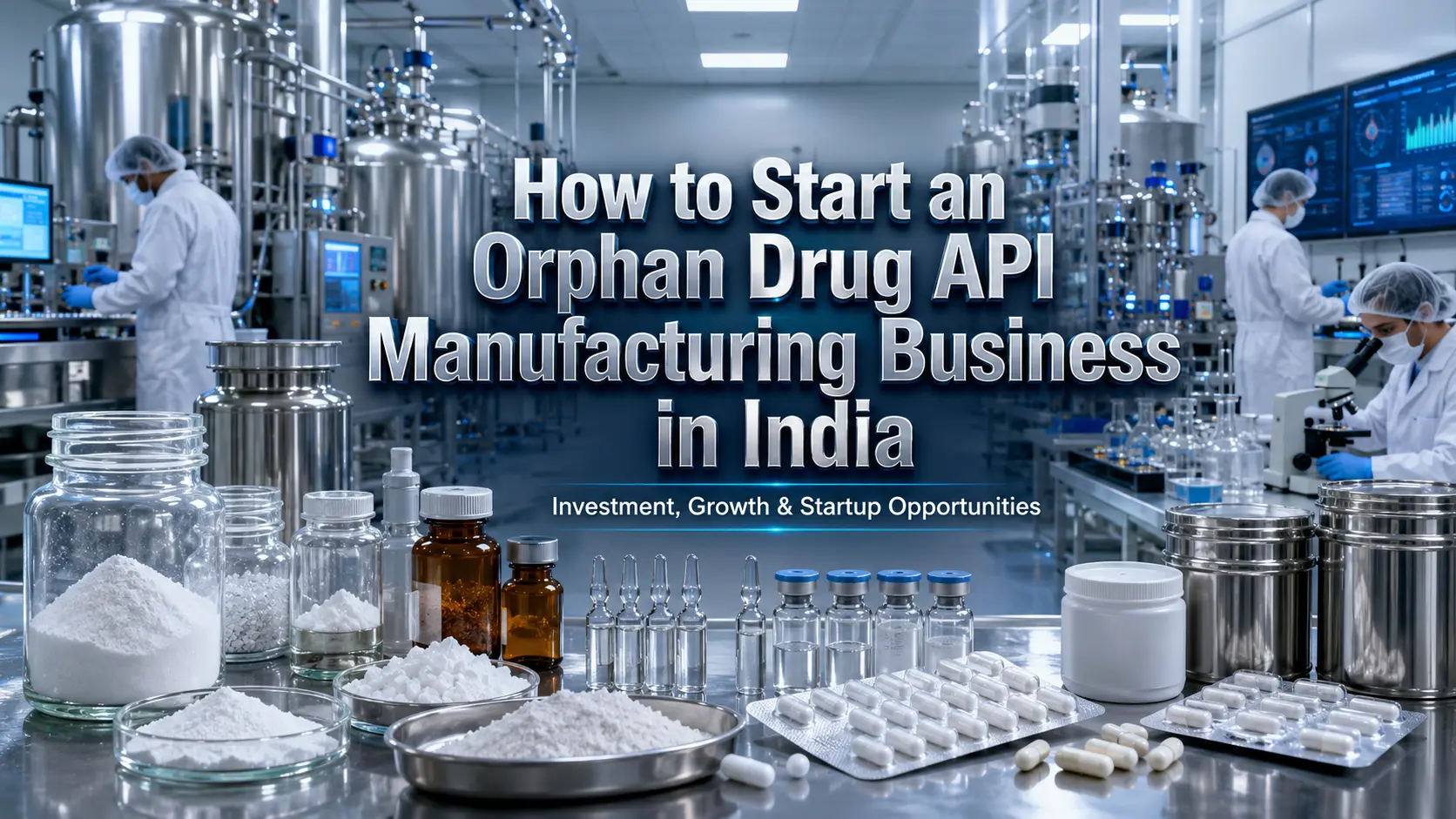
Now there are 55 rare diseases on the official list for treatment priority and the National Policy for Rare Diseases has been launched to fund treatment for patients at Centres of Excellence that are listed as rare diseases up to 50 lakhs rupees per patient. The policy doesn’t address the source of the drugs alone, but for most of these 55 diseases, India imports the API or the finished orphan drug — domestic manufacturers have shied away from a category that has small patient populations and high costs of development. Here’s the start of the story, and it is the avoidance. The manufacturing of Orphan drugs in India demands today is not to be done by targeting all the rare diseases, but by identifying a molecule that has a clearly defined patient population with a government support and establishing manufacturing capacity around that modest patient population.
Global orphan drug prices are high because there is a small number of competitors in the market and an Indian manufacturer who comes in with the support of the regulators would be able to get a higher margin than a commodity generic manufacturer.
Get Detailed Project Report (DPR): Active Pharmaceutical Ingredient (API) Products, Bulk API Manufacturing
Why Orphan Drug API Manufacturing Is a Genuine Opening
Begin with the patient registry information that the Indian government has just begun constructing in a non-trivial way. With the implementation of the National Policy for Rare Diseases, supported by the Ministry of Health and Family Welfare, more than a thousand patients have received treatment in 12 notified Centres of Excellence, government press releases on the policy’s implementation, and the figure is rising as diagnostic awareness grows and newborn screening programmes expand. Each of these patients requires a drug and for a significant number of India’s fifty-five priority rare diseases, that drug is currently imported, either because no domestic manufacturer has the API technology, or because the number of addressable patients was simply too low to warrant domestic investment in an economic sense by the manufacturer.
Government backed procurement changes that. Under the national policy, the centres of Excellence are a focused and publicly supported buyer of orphan drug treatments, eliminating the uncertainty of drug markets for small populations which usually deters drug manufacturers. Add to that the regulatory landscape in India, where an orphan drug designation under a continuously evolving national program can provide accelerated review options for approved molecules, and the prospect for a founder who is prepared to pursue a very focused agenda will seem much more attractive than it did just a couple of years ago.
Entry capex can range significantly with the complexity of the molecule. Nearly 12 to twenty crore rupees could be the prices for an easy-of-use small-molecule orphan API, and forty crore rupees and up are likely the costs of enzyme replacement therapies and more complex biologics-adjacent orphan treatments, and indeed, across the spectrum of orphan treatments, competition is thin.
Business Selection Logic
The margin structure in the manufacture of orphan drugs is significantly higher than conventional generics — this is not accidental, because the regulatory approach of the various countries in the world — including India’s new approach under CDSCO — is built around incentives for pricing and exclusivity, in order to incentivize manufacturers to serve small patient populations that would otherwise never warrant investment. The Department of Pharmaceuticals’ PLI scheme for pharmaceuticals also calls out orphan drugs as a priority category, a testament to the fact that gross margins in the range of thirty-five to fifty percent are normal after a manufacturer gains API technology and regulatory clearance for a particular molecule; a margin significantly higher than that typically achieved in commodity intermediate or generic API manufacturing.
It’s not volume-based pharma production. It’s not the same as scaling up in the pharma industry. One molecule cannot be scaled by a founder; the demand for any particular rare disease treatment will always be limited to the number of patients. Real scalability occurs when building technical and regulatory capability that can be transferred to a second and third API for rare diseases over time, enabling a manufacturer to add multiple APIs to its portfolio after the first one is proven.
Risk focuses in patient population uncertainty and technical complexity, not price competition, as true competitors in any given orphan molecule are typically one or two global manufacturers. For a founder who agrees to a molecule with an unstable or shrinking diagnosed population, however, the demand risk simply can’t be solved with any marketing strategy.
Product and Project Opportunities Worth Evaluating
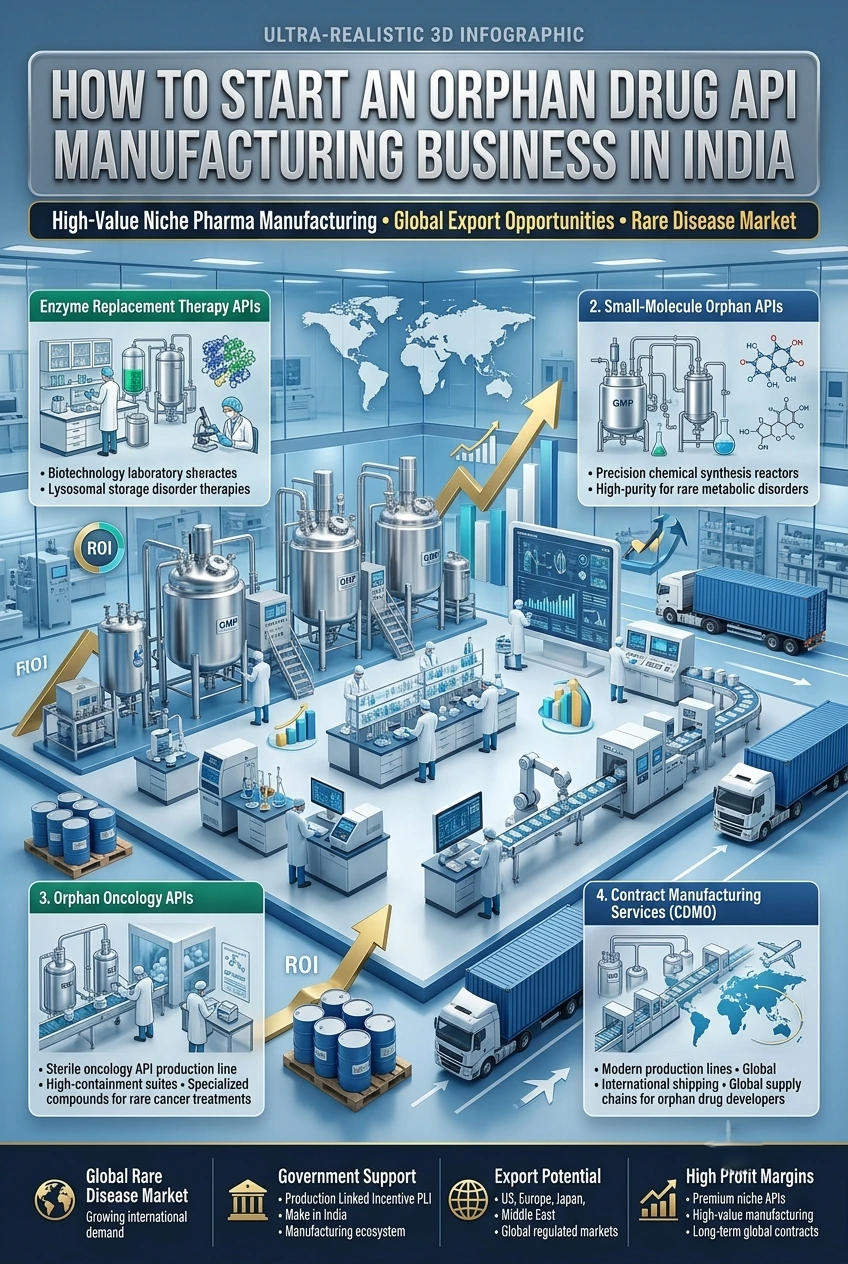
Enzyme Replacement Therapy APIs for Lysosomal Storage Disorders
Even some of the highest priority rare diseases under India’s national policy – such as lysosomal storage disorders like Gaucher, Pompe and Fabry disease – are currently entirely import dependent and are treated by enzyme replacement therapy. The capex for a dedicated enzyme production facility is expected to be in the range of forty to sixty crore rupees due to the biologics-adjacent manufacturing process, and the company will be directly targeting the Centres of Excellence and the specialty hospital pharmacy networks that are government-funded. Margins are 45-55% as soon as regulatory approval is granted, indicating both the technical scarcity and the fact that very few global manufacturers are offering this category at present other than in India.
Small-Molecule Orphan APIs for Metabolic Disorders
A dozen or so types of inborn errors of metabolism, which affect only small numbers of patients each, are often suitable for small molecule therapy, which is chemically easier to produce than enzyme replacement therapy. The founder building capability here requires capex of 12 to 20 crore rupees for a dedicated synthesis unit, along with specialty paediatric hospitals providing newborn screening referrals, within the network of the Centre of Excellence. 35-45% margins and having a lower technical barrier than enzyme therapy makes this an area that is more open for a founder with less experience in biologics manufacturing.
Related Article: API MANUFACTURING: Setting Up an Active Pharmaceutical Ingredient Plant in India: The Complete Guide
Orphan Oncology APIs for Rare Cancer Subtypes
Rare cancer subtypes (or other indications in different therapeutic areas) are those that differ from mainstream indications for oncology drugs already served by larger manufacturers, and are an increasingly large proportion as cancer genomic profiling increasingly identifies cancer subtypes. A dedicated facility with segregation requirement similar to that in the conventional cytotoxic API manufacturing requires capex investment of 30 crores to 45 crores, catering to oncology treatment centres and research hospitals. Margins are in the range of 30- to 40-percent, and the target customer segment is specialized, but the infrastructure for oncology treatments is in place in most of the major hospital networks in India.
Contract Manufacturing for Global Orphan Drug Developers
A founder without the capital or regulatory appetite to develop and register an orphan molecule independently can instead offer contract manufacturing services to global orphan drug developers seeking a lower-cost production base for API supply. This model needs similar capex to direct orphan manufacturing, roughly twenty to thirty-five crore rupees depending on molecule type, but structures revenue around multi-year supply contracts rather than independent market development. Margins run twenty-five to thirty-five percent, somewhat lower than branded orphan manufacturing, but the demand and regulatory risk shift substantially toward the contracting partner, making this a lower-risk entry route into the category.
Indian Entrepreneurs and Institutions Shaping This Frontier
Very few Indian promoters have built dedicated orphan drug manufacturing businesses, which makes the adjacent examples worth studying closely, even as the World Health Organization continues to flag rare disease treatment access as a global gap this category could help close. Kiran Mazumdar-Shaw’s Biocon Biologics built biosimilar manufacturing capability years before Indian regulatory and reimbursement systems could fully support it commercially, a patience-first model directly applicable to orphan drug manufacturing, where government-funded procurement is similarly still maturing.
Yusuf Hamied’s Cipla built its reputation partly on manufacturing complex, low-volume, high-value drugs that larger multinational manufacturers had deprioritized, including early HIV antiretrovirals at a fraction of global pricing — a demonstration that Indian manufacturing capability can serve underserved, price-sensitive patient populations profitably when approached deliberately rather than opportunistically. Habil Khorakiwala’s Wockhardt similarly built biologics and specialty manufacturing capability ahead of clear near-term commercial payoff, absorbing years of regulatory investment before the segment matured. The applicable lesson across all three: orphan drug manufacturing rewards founders willing to build technical and regulatory capability years before the market fully catches up, rather than waiting for demand certainty that this category, by definition, rarely offers upfront.
Discover business ideas that actually make money
Import-Export Opportunity Analysis
India’s orphan drug trade position is almost entirely import-dependent across the fifty-five priority rare diseases the national policy identifies, with enzyme replacement therapies and specialized small-molecule treatments arriving from a concentrated group of global manufacturers who effectively hold monopoly pricing power in most of these categories. That import bill, funded increasingly through public money via the Centres of Excellence programme, represents a direct and quantifiable addressable market for a domestic manufacturer.
Export potential in this category is unusually favourable compared to conventional generics, since orphan drug markets globally remain underserved by manufacturing competition, not just in India. An Indian producer that develops regulatory credibility domestically, then pursues designation in other developing markets facing similar access challenges, particularly across South Asia and Africa, can capture demand that global originator manufacturers have largely left unaddressed given the small population economics involved. The sequencing that works best mirrors other specialized categories: prove manufacturing and regulatory capability against India’s own funded patient population first, then expand.
Government Reference and Feasibility Planning
The National Policy for Rare Diseases, administered by the Ministry of Health and Family Welfare and accessible through its dedicated portal lists the fifty-five priority conditions currently eligible for government-funded treatment support and identifies the twelve notified Centres of Excellence a manufacturer should treat as the primary buyer network for this category. Founders serious about orphan drug API manufacturing should study this policy document closely before selecting a target molecule, since patient population data and funding commitments are documented there directly.
Broader industrial infrastructure supporting specialized pharmaceutical manufacturing also connects back to India’s petroleum and petrochemical base. The Annual Report 2024-25 of Ministry of Petroleum and Natural Gas, Government of India — accessible at mopng.gov.in — documents the refining and petrochemical capacity that underpins solvent and processing input availability for advanced manufacturing facilities of this kind, a connection worth tracing even in a category as specialized as orphan drug production.
Given the technical and regulatory complexity involved, founders in this category benefit substantially from a structured feasibility study before committing capital. Niir Project Consultancy Services prepares Market Survey cum Detailed Techno-Economic Feasibility Reports for entrepreneurs entering specialized pharmaceutical manufacturing, covering process flow, machinery specification, capacity planning, and full project financials — replacing assumption with a defensible number before ground is broken.
Read the Complete Book Here: Drugs & Pharmaceutical Technology Handbook
Conclusion
Orphan drug API manufacturing India needs will never be a volume business, and a founder chasing this category for scale alone is solving for the wrong variable. Broader pharmaceutical sector data compiled by the India Brand Equity Foundation confirms India’s manufacturing strength lies in scale categories — which is precisely why this small-population niche stays open. The scale here is margin and mission overlap — a manufacturer that commits to one or two rare disease molecules seriously can build a defensible, high-margin business precisely because so few competitors find the small patient populations attractive enough to enter.
The decision hierarchy for a founder evaluating this category starts with molecule selection discipline. Pick a rare disease already listed among India’s fifty-five priority conditions, ideally one with an active Centre of Excellence funding pathway, rather than speculating on a molecule with no defined domestic buyer. Build regulatory affairs capability early, since orphan drug designation pathways, where available, can meaningfully shorten review timelines but require documentation discipline from the outset. Consider the contract manufacturing route if independent market development feels too uncertain initially; supplying a global orphan drug developer reduces demand risk considerably while a founder builds domestic regulatory credibility in parallel.
This category will not suit a founder seeking fast returns or broad market share. It suits a founder willing to go deep on one condition, build the technical relationships that government-funded Centres of Excellence require, and treat a small, well-defined patient population as a genuine business opportunity rather than an afterthought. For that founder, orphan drug API manufacturing India remains one of the last genuinely uncrowded categories in the country’s entire pharmaceutical manufacturing landscape.
Capex vs Margin Overview by Product Category
Source: Industry estimates; NPCS sector analysis
| Product Category | Capex Range | Margin Outlook | Target Buyer |
| Enzyme Replacement Therapy APIs | ₹40-60 Cr | 45-55% | Govt Centres of Excellence & specialty hospitals |
| Small-Molecule Metabolic Disorder APIs | ₹12-20 Cr | 35-45% | Centres of Excellence & pediatric hospitals |
| Orphan Oncology APIs | ₹30-45 Cr | 38-48% | Oncology treatment centres |
| Contract Manufacturing for Global Developers | ₹20-35 Cr | 25-35% | Global orphan drug developers |
Frequently Asked Questions
From a founder’s perspective — practical, decision-oriented questions:
How does a founder choose which rare disease molecule to manufacture?
Start with India’s fifty-five priority conditions listed under the National Policy for Rare Diseases, ideally one with active Centre of Excellence funding. A defined, government-backed patient population reduces demand uncertainty considerably compared to speculating on an unlisted condition.
What is the realistic capex range for entering this category?
Small-molecule orphan APIs can start near twelve to twenty crore rupees, while enzyme replacement therapies and biologics-adjacent treatments need forty crore rupees and upward, reflecting the technical complexity difference between these two manufacturing approaches.
How long before regulatory approval allows commercial sale?
Timelines vary by molecule and designation pathway, but founders should budget two to three years minimum, covering regulatory review, quality certification, and Centre of Excellence procurement onboarding, which follows its own administrative timeline separate from manufacturing approval.
Is contract manufacturing safer than independent orphan drug development?
Generally, yes. Supplying a global orphan drug developer under contract shifts demand and regulatory risk substantially toward the contracting partner, offering a lower-risk entry point while a founder builds domestic manufacturing credibility before attempting independent market development.
What is the biggest risk specific to orphan drug manufacturing?
Patient population instability. A molecule targeting a condition with an unclear or shrinking diagnosed population carries demand risk no manufacturing efficiency or marketing effort can offset, so verifying registry data before committing capital matters more than in almost any other pharma category.


