






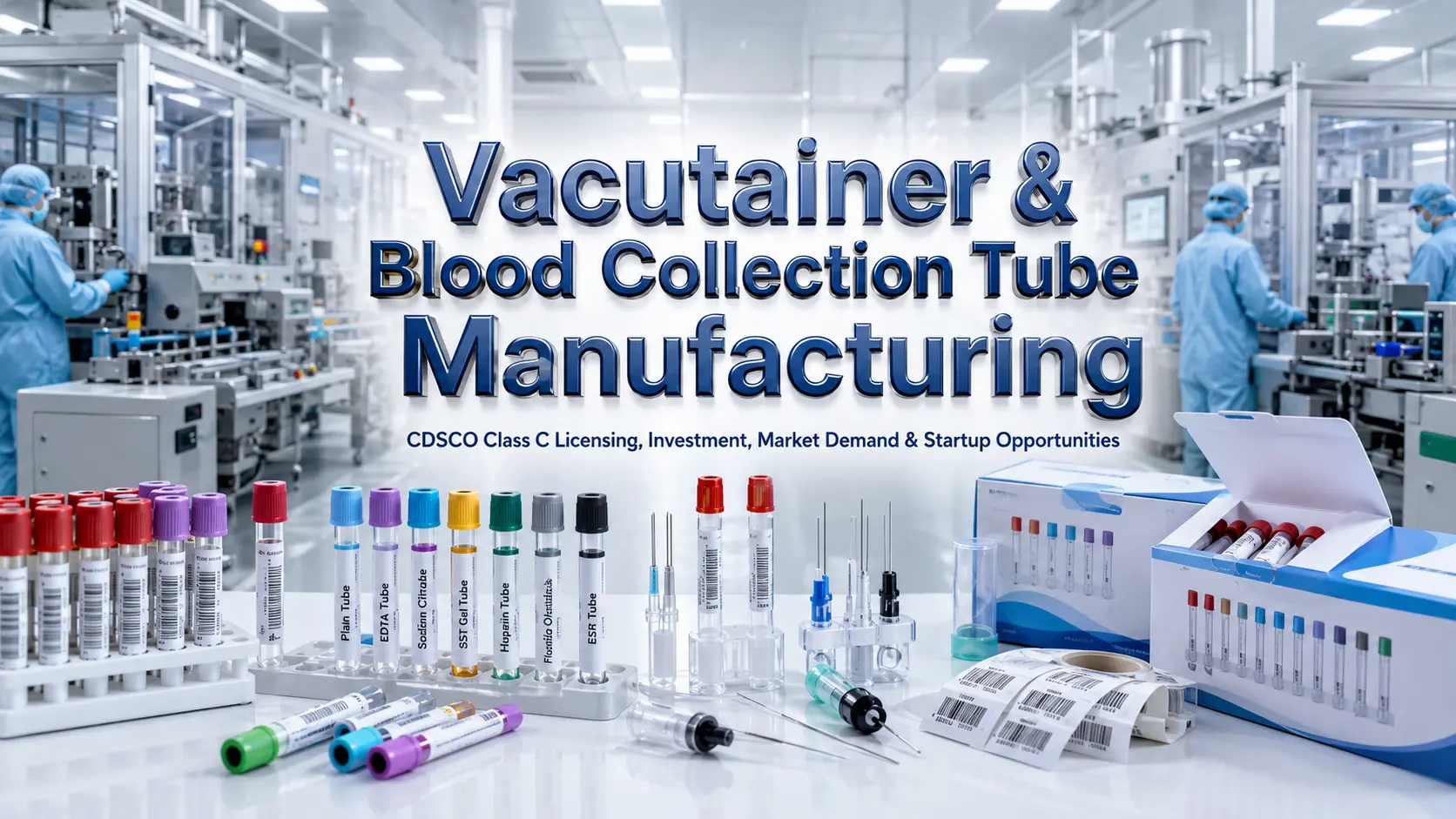
Tips to Start Vacutainer Manufacturing business and blood collection vacuum tube making in India – CDSCO class C license, additive chemistry, demand from diagnostic lab market and investment. The WHO Best Practice for Phlebotomy recommends following guidelines to meet the criteria of a good vacuum tube that would maintain the vacuum during the shelf life and the stoppers meet with requirements of reseal performance and additive chemistry specifications.
The blood collection tubes or “vacutainers” are the sealed vacuum tubes with colour coded rubber stoppers marked with the specific additive that are used for collection of blood samples at blood path labs, hospitals and diagnostic centres in India. The market for such devices is a growing diagnostic consumable market in India, as each blood test requires a new tube and the volume of blood tests performed annually is in excess of 400 million. Presently, the market is dominated by BD (Becton, Dickinson) and a few domestic manufacturers, while there is ample scope for the domestic manufacturers to produce quality tubes at 30-40 per cent lesser cost than the imported ones, if they are willing to obtain certification from the CDSCO. The Wikipedia page on Vacutainer describes the international blood collection tube colour coding system, which is used by all clinical laboratories in the world.
Related Article: A Booming Business of Blood Collection Tubes (Vacutainer)
Market Opportunity: Why This Business Cannot Be Ignored
Blood collection tubes are heavily dependent on imports in India despite the presence of capability in the country for manufacturing polypropylene and specialty chemicals. Blood collection tubes are classified as Class C medical devices, which require central CDSCO licensing — a fact that has historically prevented the development of a domestic market by competitive quality, domestic manufacturers that can compete in price with expensive imported products. CDSCO: Class C Medical Device Licensing Portal includes all the technical dossier requirements and application procedure of Class C blood collection tube manufacturing licences.
India’s diagnostic laboratory industry is one of the fastest-growing in the world with data from ICMR (Indian Council of Medical Research) indicating that the diagnostic industry, both government and private, has experienced an annual increase of 15-20% in volumes of diagnostic test orders. Each incremental test is equal to an incremental vacutainer demand; and with the structural growth of this segment, the business of manufacturing blood collection tubes is one of the most demand-secure businesses in India’s medical devices ecosystem. The IBEF: India Diagnostics and Healthcare Sector has estimated the diagnostic services market to grow at 13% CAGR to USD 32 billion by 2026, which will lead to consistent demand for blood collection tubes in India.
Industry Analysis: Growth Drivers and Demand Outlook
The blood collection tube market is projected to be valued in India at Rs 600-900 crore with a growth rate of 15-18 per cent CAGR. As per the data from AIMED (Association of Indian Medical Device Industry), India is importing more than 50% of blood collection tube requirement, which gives the opportunity to the domestic manufacturers who have been certified by the CDSCO Class C to compete in the import substitution market with Indian manufacturers of CDSCO Class C certified blood collection tube supplying the same product with 30-40% less cost.
The diagnostic laboratory market consists of national chains (Metropolis, SRL Diagnostics, Dr. Lal PathLabs, Thyrocare), hospital-based labs, and government pathology departments are the main customers for blood collection tubes. Enable PLI scheme incentives for Class C device manufacturers who have been approved and support for medical devices by the Make in India regime, which actively incentivises investment in the production of blood collection tubes in India.
Get Detailed Insights from This Book: Handbook on Medical and Surgical Disposable Products
India Blood Collection Tube Market Overview
| Parameter | Market Data | Notes |
| India Market Value | Rs 600 – 900 crore per year | Industry estimates |
| Market Growth Rate | 15-18% CAGR | Diagnostic sector expansion |
| Annual Blood Tests India | 400+ million per year | ICMR estimates |
| BD Vacutainer Market Share (import) | 65-70% of India market | Market leader import brand |
| CDSCO Classification | Class C Medical Device | Central CDSCO licence required |
| Tube Types by Stopper Colour | EDTA (Purple), SST (Gold), Plain (Red), Citrate (Blue) | Additive-specific colour coding |
| Primary Buyers | Diagnostic lab chains, hospital labs, blood banks | Institutional repeat buyers |
How to Start: Step-by-Step Guide for Entrepreneurs
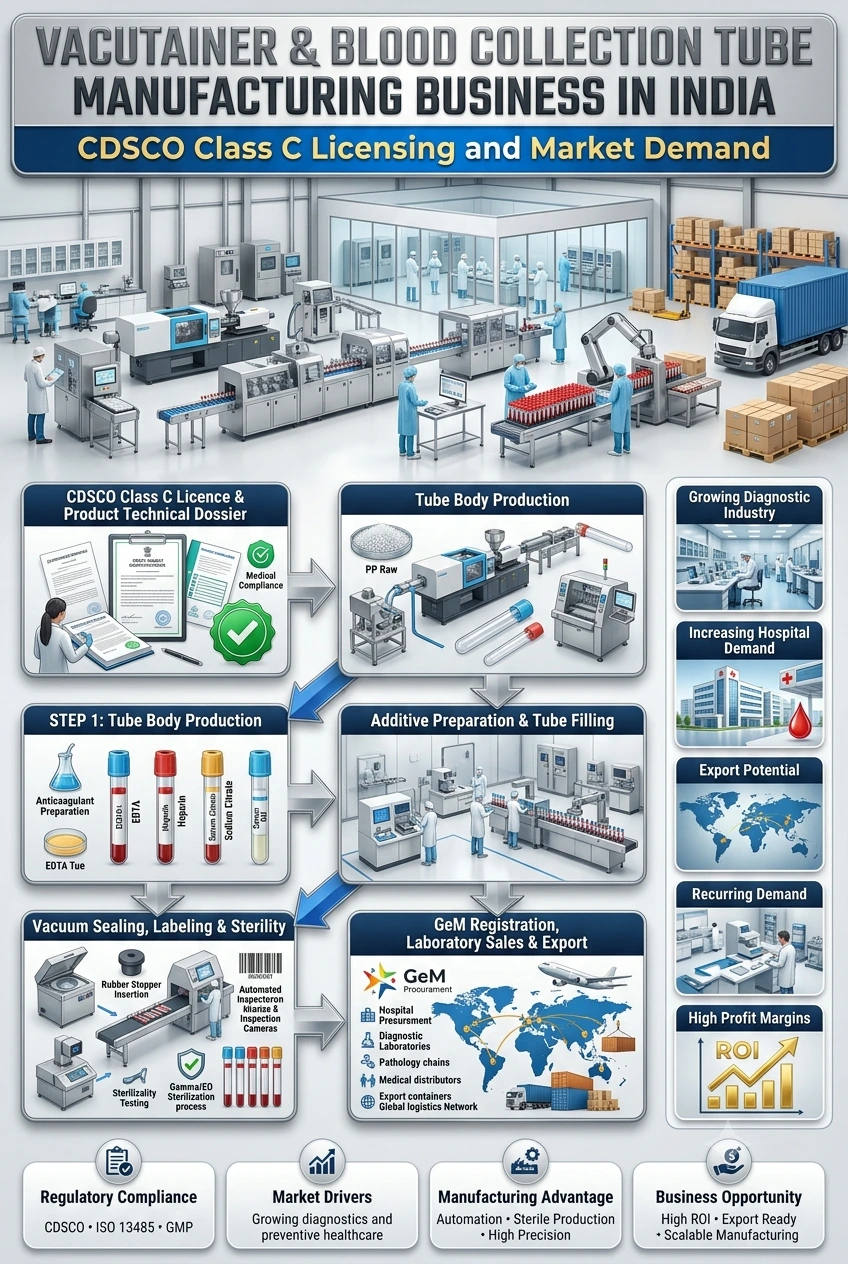
Step 1: CDSCO Class C Licence and Product Technical Dossier
Apply for Class C Medical Device Manufacturing Licence by CDSCO Central. The technical dossier should contain: PP tube material biocompatibility (in accordance to ISO 10993), specification and validation of the vacuum level, additive chemistry dossier (including EDTA, sodium citrate, SST gel formulation), rubber stopper biocompatibility, ISO 13485 QMS documentation and validated ETO or gamma sterility process for sterile tubes. In NCBI: Blood Collection Tube Additive Standards, there is clinical evidence that the reliability of the formulation of the additives is the most important factor in the quality of samples and diagnostic results from vacuum blood collection systems.
Step 2: Tube Body Production: PP Injection Moulding or Extrusion
Blood collection tube bodies are produced using injection moulding (PP rigid tubes) and continuous tube extrusion and cut-to-length (PET tubes). The tube should be able to reach the required vacuum level (250-400 mmHg dependent on the draw volume), which is to be maintained for 18-24 months. Rubber stopper (bromobutyl or chlorobutyl rubber) piercings are required to be tested for closure after being pierced.
Step 3: Additive Preparation and Fill
There is a specific additive for each type of tube: EDTA (K2 or K3 salt for haematology tubes), sodium citrate (for coagulation tubes), serum separator gel (SST tubes — thixotropic polyacrylate gel), lithium heparin (plasma tubes), or fluoride/oxalate (glucose tubes). The volume of additives to be added must be validated and traceability to additive lot numbers and concentration verification must occur.
Get Detailed Project Report (DPR): A Business Plan For Blood Collection Tubes (Vacutainer)
Step 4: Vacuum Sealing, Label, and Sterility
All tubes are filled with known vacuum and sealed with the rubber stopper with automatic vacuum fill-and-seal machinery. Sealed sterile tubes (for collection of sterile body fluid) must be gamma or ETO sterilised. Final QC involves vacuum level testing (single tube or statistical sampling), stopper torque check, additive accuracy check and verification of label against specification.
Step 5: GeM Registration, Lab Chain Sales, and Export
Sign up with GeM for government hospital pathology department procurement. Develop direct procurement links with national diagnostic chain procurement managers (Metropolis, SRL, Dr. Lal PathLabs, Thyrocare) which are centralized at national/regional level. Use connections with field representatives of all SAARC and Middle East diagnostic distributors to export to these countries at medical laboratory trade exhibitions. The PHARMEXCIL: Diagnostic Product Export Council organizes medical laboratory trade fair and match making the Indian diagnostic consumable exporting companies with international buyers.
Project Investment Breakdown
| Cost Item | Estimated Amount (INR) | Notes |
| Clean room construction (ISO Class 8) | Rs 20 – 35 lakhs | CDSCO Class C GMP requirement |
| PP injection moulding machine (tube body) | Rs 20 – 40 lakhs | Tube body production |
| Rubber stopper moulding or procurement | Rs 10 – 20 lakhs | Bromobutyl stopper |
| Automated vacuum fill-seal machine | Rs 40 – 70 lakhs | Core production equipment |
| Additive preparation and fill station | Rs 15 – 25 lakhs | Precision additive dosing |
| ETO or gamma sterilisation access | Rs 20 – 40 lakhs | Or contract sterilisation |
| QC lab (vacuum tester, biocompatibility) | Rs 15 – 25 lakhs | Key QC instruments |
| CDSCO Class C licence and ISO 13485 | Rs 6 – 12 lakhs | Regulatory and QMS |
| Raw material stock (1 month) | Rs 12 – 20 lakhs | PP, rubber stoppers, EDTA, SST gel |
| TOTAL PROJECT COST | Rs 1.58 – 2.87 crore | Scale to Rs 5Cr for full tube range |
Financial Projections and Profitability
A blood collection tube unit producing 2 million tubes per month can generate annual revenues of Rs 5-9 crore at blended pricing across tube types. FICCI’s Healthcare Sector Committee indicates that diagnostic consumable manufacturers who supply national laboratory chains enjoy margins of 18-25 percent and exceptional customer retention — once a national lab chain standardises on a particular tube format, switching costs are high and supply relationships are highly durable.
SST (serum separator tube) gold-top tubes command the highest per-unit pricing (Rs 15-35 per tube) due to the specialty thixotropic gel additive. Diagnostic Sector Analysis by Invest India Forecasts India’s Diagnostic Service Market at USD 32 billion by 2026 which will encourage continued solid demand for Blood Collection Tube (BCT) within the government as well as private lab segment.
Choose the right startup backed by real market demand
Government Schemes and Incentives for Medical Manufacturers
| Government Scheme | Key Benefit for Manufacturer | Eligible Business Type |
| PMEGP (KVIC/MSME) | 25-35% capital subsidy, max Rs 25 lakh for manufacturing | New micro and small units |
| CGTMSE (SIDBI) | Collateral-free loans up to Rs 5 crore for MSMEs | All MSME manufacturers |
| PLI – Medical Devices | 4-6% production-linked incentive on incremental sales | Approved device manufacturers |
| Startup India (DPIIT) | 3-year income tax holiday, fast-track regulatory support | DPIIT-recognised startups |
| State MSME Capital Subsidy | 15-25% subsidy on plant and machinery (varies by state) | State-notified MSME units |
| SIDBI MSME Loans | Concessional term loans for equipment and capacity expansion | All small manufacturers |
Entrepreneur Spotlight
Dr. Rashmi Agarwal | Noida, Uttar Pradesh
A clinical biochemist Dr. Rashmi Agarwal (14 yrs of pathology laboratory work), had a CDSCO class C licensed blood collection tube manufacturing setup in Noida with an initial investment of 2.1 crore via SIDBI loan and a UP state industrial incentive. The startup started with EDTA, plain and SST tubes in 18 months with the approval.
Rashmi currently delivers 800,000 tubes monthly to diagnostic chains across NCR, UP, Rajasthan generating an annual revenue of R4.8 crore at 22 per cent net margin. She has successfully displaced an imported BD Vacutainer contract at a 200-branch diagnostic chain by demonstrating equivalent quality at 32 percent lower pricing.
How NPCS Supports Your Business Launch
Niir Project Consultancy Services (NPCS) has prepared over 8,000 Detailed Project Reports (DPRs) across industrial sectors including medical devices and hospital disposables over 45 years. For blood collection vacuum tube (vacutainer) and diagnostic consumable manufacturing, the NPCS DPR covers plant layout, machinery specifications with supplier contacts, raw material sourcing, CDSCO licensing pathway, financial projections, and bank-ready investment analysis.
Entrepreneurs who commission a NPCS DPR receive guidance on government scheme applications, export registrations, and quality certification roadmaps customised to their state and scale. Visit niir.org to explore project reports for this sector, or browse Entrepreneur India magazine at entrepreneurindia.co for sector case studies and investment analysis.
Frequently Asked Questions
Q: What are the different types of blood collection tubes and their uses?
EDTA tubes (purple/lavender stopper) are for haematology and blood count tests. SST tubes (gold stopper, serum separator gel) are for most chemistry and serology tests. Plain red-top tubes collect serum without anticoagulant. Blue citrate tubes are for coagulation tests (PT, APTT). Green heparin tubes give plasma for emergency chemistry. Grey fluoride tubes prevent glucose breakdown for glucose testing.
Q: Why are blood collection tubes classified as Class C medical devices?
Blood collection tubes come into direct contact with blood, have specific additives active ingredients and they also have specific vacuum. These have to retain the vacuum throughout their shelf-life. If it leaks (stopper) or the additive gets contaminated or if the vacuum is incorrect, the patient may end up getting incorrectly diagnosed, or on the wrong treatment protocol. For class C, CDSCO central license, ISO 13485 QMS and validation of the process are necessary.
Q: What is the serum separator gel (SST) and how is it formulated?
Polyacrylate Thixotropic Gel Serum Separator Gel has a density slightly above blood cell densities and below serum densities, to allow migration to form a barrier after centrifugation to ensure separation of cell layer and serum in chemistry testing. Precise specific gravity and valid thixotropy over a clinical centrifugation rate are needed for gel preparation.
Q: What vacuum level is specified for blood collection tubes?
Standard vacuum level (1-7 cc at varying sizes of standard Vacutainer blood collection tubes – 2 ml to 10 ml for collection). The vacuum shall be retained within a 20% margin (+ or -) during 18-24 months of stability study at room temp and vacuum shall be monitored by means of a calibrated vacuum gage as per QC batch release test.
Q: How do I approach national diagnostic chain procurement for blood collection tubes?
National diagnostic chains (Metropolis, SRL Diagnostics, Dr. Lal PathLabs, Thyrocare) have centralised procurement departments at their corporate offices. Approach with: CDSCO Class C licence certificate, ISO 13485 certificate, detailed product specification datasheet, performance comparison data versus imported reference product, pricing proposal, and sample tubes for their QC laboratory evaluation. Chain adoption typically follows a 3–6-month quality evaluation period.
Q: How can NPCS help plan a vacutainer manufacturing business?
Detailed project report on class c medical devices manufacturers blood collection tube manufacturing can be obtained from niir.org which includes detail of tube manufacturing machines, procurement of additive chemicals, cdsco class c requirements list and checklist, quality management system structure ISO 13485, lab chains sales strategy and project financial viability.
Conclusion
Blood collection tube business has both robust institutional demand from India’s burgeoning diagnostic industry and high import substitution opportunity, with BD’s dominance in this market space. CDSCO Class C certification creates a regulatory moat that protects quality manufacturers while enabling access to national diagnostic chain supply contracts at excellent margins.
Commission a Detailed Project Report from NPCS to structure your tube product range, additive chemistry, CDSCO Class C licensing, and national lab chain sales strategy. Align your investment with Make in India’s PLI incentive framework for Class C devices to maximise government financial support for your capital investment.


