





Business Ideas in Africa
Africa’s Investment Moment Has Arrived
Africa is no more a speculator’s frontier. It’s a place where the investments and energy are flowing and the businesses are booming and it’s where those who take action on the right ideas and concepts a decade ago are going to be the ones to tell the stories of success a decade from now. Economics is at a turning point for the continent, as its GDP exceeds $3 trillion, its population will make up more than a quarter of the world’s consumers in a few decades and its governments are pushing for foreign investments.
This is the sweet zone for investors who have a capital of USD 500,000 to 1,000,000. Small enough to be incapable of megaprojects, but big enough to build profitable, capital efficient operations in markets with acute local supply constraints. The ideas of business outlined in this article are not hypothetical. They are based on actual demand gaps, infrastructure realities, trade data and on ground market behaviour that analysts and consultants have been monitoring throughout the region.
These opportunities cover various industries that Africa’s demand curve is rapidly expanding — and where mid-scale investments can yield disproportionate returns — from agro-processing and healthcare manufacturing to renewable energy and digital logistics.
Why Africa? Understanding the Growth Logic
There are three structural drivers of the core investment thesis for Africa. Firstly, Africa’s population is young and rapidly urbanising, with more than 60% of Africans below the age of 25, and urbanisation consistently outpacing local production. Second, a large and chronic gap between demand and supply of key commodities, such as food processing, health care, construction, and energy. Third, a positive policy environment, as most governments in Sub-Saharan and North Africa have now actively provided incentives for investors, special economic zones and quick-track licensing for preferred sectors.
African Continental Free Trade Area (AfCFTA) is a structural game-changer since 2021. It forms one continental market of 1.3 billion people and $3.4 trillion in consumer spending. It provides pan-African distribution with preferential tariff rates for businesses that are involved in the manufacturing or processing of goods locally. In addition, international institutions like the International Finance Corporation (IFC) and the African Development Bank (AfDB) are also continuing to co-invest with the private sector, thereby helping to lower risk for first-time investors.
Furthermore, commodity cycles have also worked to strengthen the fiscal position of Africa. In the ease of doing business rankings, nations such as Nigeria, Kenya, Ethiopia, Egypt, Ghana, Rwanda, and South Africa have all improved remarkably. For example, Rwanda is in the top three of Africa’s most business-friendly economies worldwide, and this is not hollow talk but a fact of life.
Policy Environment and Investor Incentives
Most African economies have now established incentive regimes for investors, which are structured and mechanistic, as compared to ten years ago. The Rwanda Investment Code, for instance, provides 7-year income tax holiday for priority sector investors in Rwanda. The Industrial Parks (IP), including Hawassa Industrial Park, provide Ethiopia with duty-free machine supplies and export facilitation, together with subsidised utilities. The New Administrative Capital project in Egypt has been made an attractive FDI target with simplified licensing and privileges in special zones.
The African Development Bank (AfDB) is a strong co-financer of agribusiness, energy and healthcare projects in member states. Likewise, the IFC has invested significant resources in private companies filling infrastructure and food security needs.
AfCFTA (African Coordination for the Free Trade of Agricultural Products) is progressively eliminating intra-African trade restrictions, which is thus economically sound and sensible to manufacture in one country and sell in 54 markets. Most countries also have double taxation avoidance treaties with India, EU, China and the US which lowers the tax burden on foreign origin promoters who set up their subsidiaries in these countries.
In addition, eligible products from sub-Saharan African countries are duty-free for entry into the US under the US government’s AGOA (African Growth and Opportunity Act). For entrepreneurs intending to start export-oriented businesses, they should check the eligibility of the African Growth and Opportunity Act as a demand multiplier.
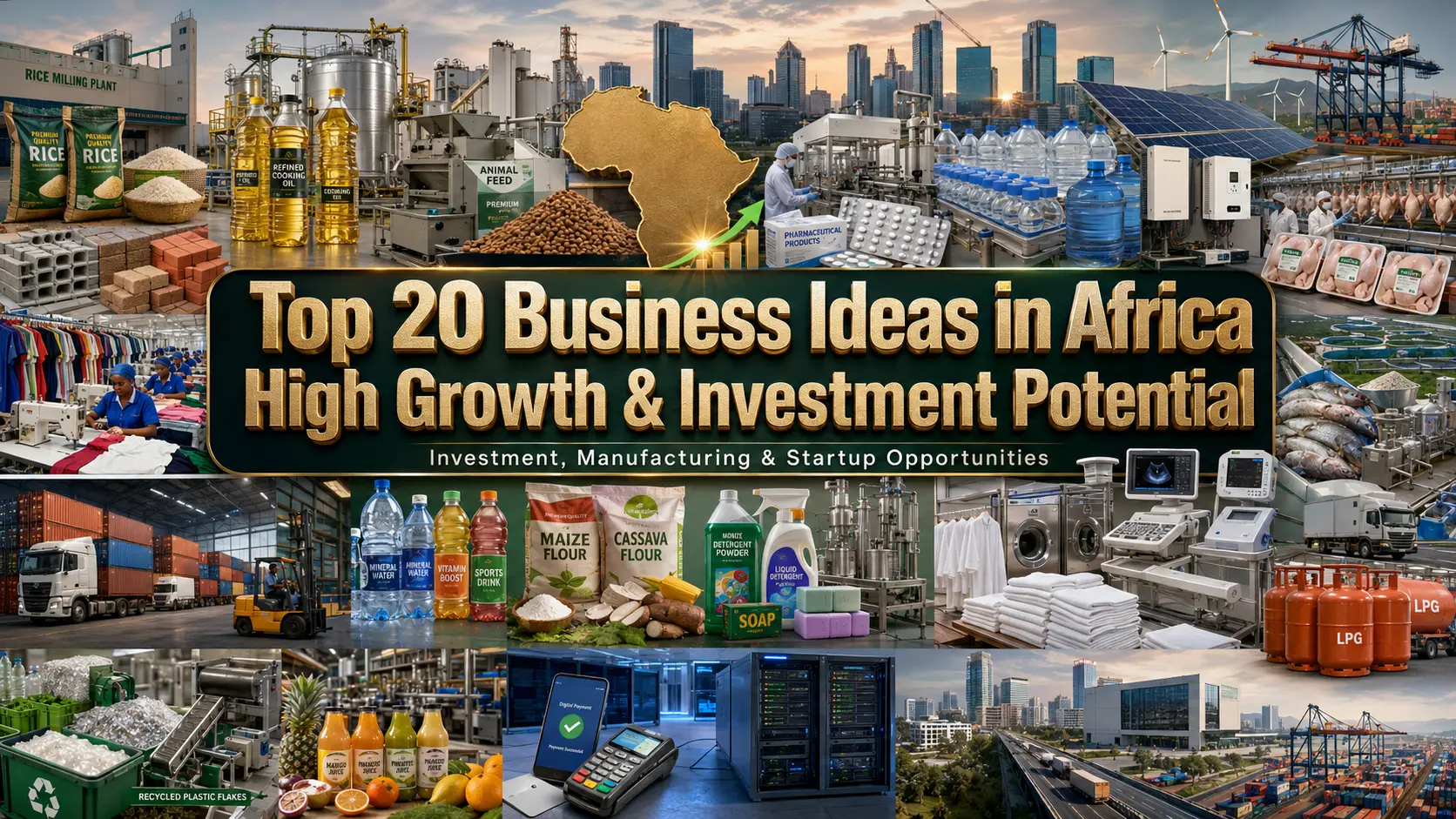
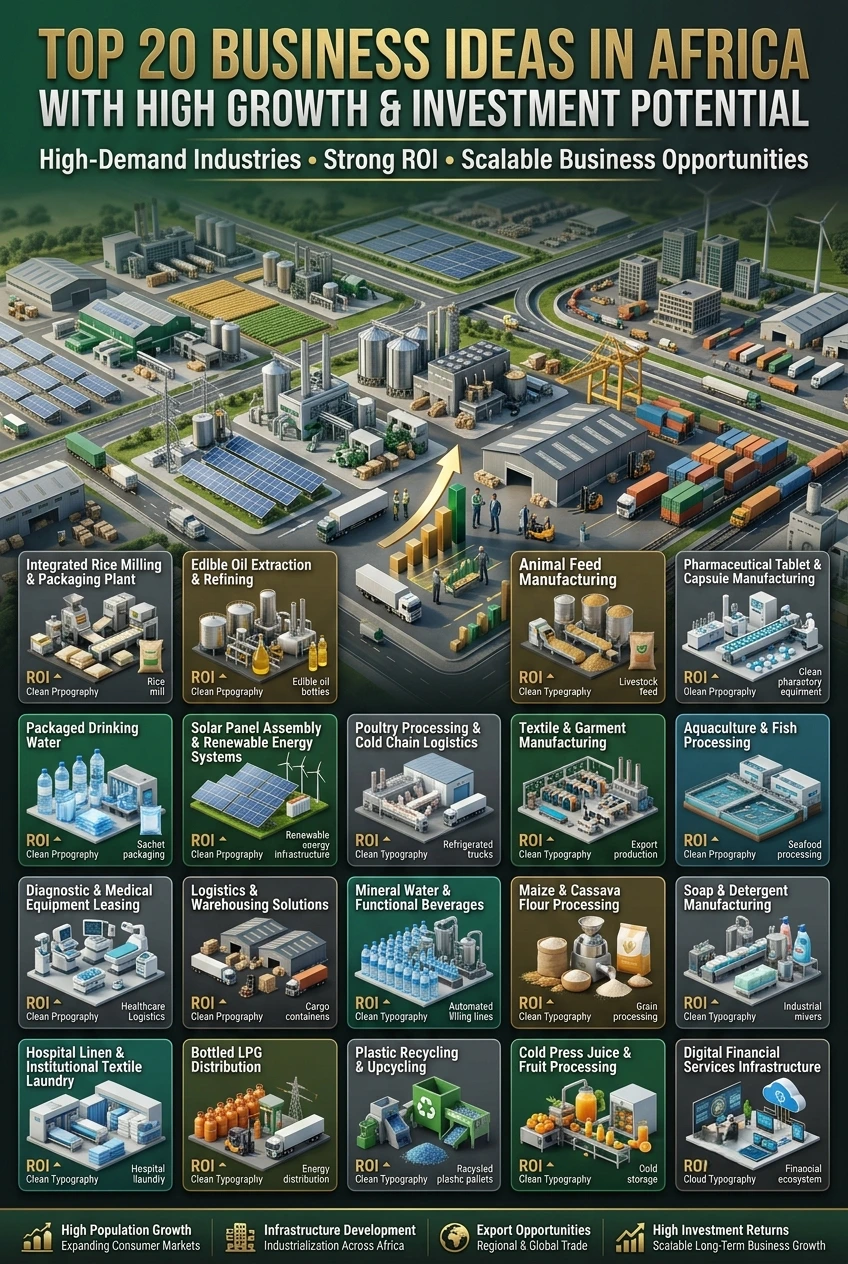
Top 20 Business Ideas in Africa: Investment Range USD 500K – 1,000,000
1. Integrated Rice Milling and Packaging Plant
Rice is a staple food in West, East and Central Africa and the level of dependence on imports is alarmingly high. Nigeria imports more than $1 billion worth of rice every year even though it has land that is very conducive to growing paddy. The integrated milling unit with hulling, polishing, sorting and branded packaging is capable of delivering good margins and guaranteed offtake. A small investment of $600,000 – $800,000 will allow you to build a 2 – 4 tonnes per hour milling unit to support local urban markets.
The key is the brand’s packaging angle: the consumers in major cities like Lagos, Accra and Nairobi have been seen to always be willing to pay more for hygienically packaged, graded rice that is available in the open market. Army, schools, hospitals, and other government procurement channels are various secured demand channels.
2. Edible Oil Extraction and Refining
Increasing demand for palm oil, groundnut oil, sunflower oil and soya oil is seen in the formal markets of urban centres in Africa. However, a significant amount of the domestic cooking oil is imported or made by home methods. A mid-size expeller and refinery unit with a capacity of 10-20 tonnes per day of refined oil lies within the capital range of $700,000-$1,000,000. But the economics get better still if you work with farmer groups to source raw seed. Ghana, Uganda, Tanzania and Zambia are just some of the countries that have both raw material and a significant demand for these products.
In the modern retail system, which is the fastest-growing channel in sub-Saharan Africa’s urban markets, at 20%+ per year, the shelf space allotted to refined, packaged cooking oil in branded 1 litre and 5 litre packs is ample.
Access Complete Business Plan: Edible Oils, Non-Edible Oils, Fats & Vegetable Oils Projects
3. Animal Feed Manufacturing
The livestock and poultry industry in Africa is growing at a fast pace due to growing demand for protein, and the formalisation of the commercial farming sector. But decent compound animal feed, which has a nutritional requirement for broilers, layers, dairy cows and aquaculture is still in dire shortage. Most of the current feed mills are small-scale and of less standard. A 5-10 tonne/day compound feed plant can be established with suitable quality control system, formulation software, and raw material procurement to profitably engage institutional customers such as big poultry farms, dairy cooperatives, and aquaculture industries. Kenya, Ethiopia and Nigeria are some of the markets in which this is a very promising opportunity.
4. Pharmaceutical Tablet and Capsule Manufacturing
About 70-90% of medicinal products consumed by Africa are imported. During the COVID-19 pandemic, this dependence became a public health emergency, prompting policy responses on the continent to encourage local drug production. Nigeria, Kenya, Ethiopia, Rwanda and Ghana have established focused pharmaceutical investment promotion programmes. A simple tablet/capsule manufacturing facility that can produce essential, generic medicines, such as paracetamol, amoxicillin, metformin and multivitamins, can be commissioned for $700,000 – $900,000. Units are automatically eligible for government procurement contracts, they are long term, high volume and credit terms are suitable for a developing business. A potential avenue is to be able to export to lower income African markets through the WHO Prequalification Programme.
5. Packaged Drinking Water (PET Bottle + Sachet)
Access to safe drinking water continues to be a huge problem in most of Sub-Saharan Africa. Sachet water is a uniquely African format, sold in 500ml polythene pouches at USD 0.02-0.05 per litre, and has huge daily sales in African cities such as Accra, Lagos, Kumasi and Abidjan. It is possible to establish a dual format water plant producing both sachet and PET bottle water for a cost of $500,000 – $700,000 including suitable reverse osmosis and UV purification system.
Fast offtake is guaranteed through the distribution network of existing FMCG channels and brand outlets. Water quality certification and uniformity of packaging is a critical part of this business: operators that invest in water quality certification and uniformity of packaging, soon secure defensible market positions.
6. Solar Panel Assembly and Renewable Energy Systems
Solar is not a lifestyle product, it’s a survival solution — they are still in Africa with no reliable grid electricity, over 600 million people still don’t have reliable grid electricity. The business concept goes beyond the panel manufacturing. The investors could enter a complete business of renewable energy systems design, installation and after-sales service. The solar home system, solar water pump for irrigation and solar micro-grids for rural communities are all marketable models.
Some countries such as Kenya, Uganda, Rwanda, Tanzania, and Senegal have solar markets in place, and donor-funded financing programmes that lower consumer price barriers. The cost of an investment of $600,000 to $1,000,000 will enable an assembly unit and dealer network to service the commercial and residential markets.
7. Poultry Processing and Cold Chain Logistics
There is a huge increase in the consumption of commercial poultry in urban areas across Africa, but processing facilities are very underdeveloped, especially slaughtering, dressing and chilling plants, as well as packaged meat suppliers and distributors. The vast majority of the urban markets are still run in the live-bird wet markets, which pose huge threats to food safety and inefficiency in the supply chain. The development of a modern poultry processing plant with cold storage and temperature-controlled distribution is a real infrastructure deficit.
The countries of Ethiopia, Kenya, Nigeria, Ghana and South Africa are all good markets. Consistently graded poultry with hygienic processing is willing to sell for a higher price to the supermarket, hotel chain, food service processor and institutional buyer. The cold chain element also unlocks additional revenue in the dairy, horticulture and marine product chilled logistics market.
8. Construction Materials Manufacturing (Blocks, Tiles, Pipes)
The housing shortage in Africa is now estimated to be more than 51 million units and in almost every major city, construction activity is on the rise. Concrete blocks, cement pipes, ceramic tiles and PVC fittings are essential construction materials that every builder needs. The process of establishing a mechanised block and tile manufacturing plant with local materials such as sand, cement, aggregate and clay is simple and can be commissioned at $500,000–$800,000. The market is captive in that the builders in growing cities such as Nairobi, Dar es Salaam, Addis Ababa, Kampala and Abuja are buying these construction materials in bulk weekly. Good quality, reliable supply with good delivery results in long-term business relationships.
9. Textile and Garment Manufacturing (Export-Linked)
The following advantages make Africa an authentic low-cost producer of garments: lower labour costs than Asia, duty-free access to the markets of the US under the AGOA (Everything But Arms) programme, and preferential access for least developed country producers under the EU EBA (Everything but Arms). The Hawassa Industrial Park in Ethiopia has proven that it is possible to be internationally competitive in the garment industry in Sub-Saharan Africa.
Global apparel brands and retailers looking for supply chain diversification after the pandemic can sign an offtake agreement with investors establishing cut-make-trim (CMT) operations in Ethiopia, Rwanda, Kenya or Senegal. A $700,000-$1,000,000 factory featuring 200-400 operators can address the entry level production volumes of international buyers testing new sourcing geographical areas.
Get Detailed Insights from This Book: The Complete Technology Book on Textile Spinning, Weaving, Finishing and Printing
10. Aquaculture and Fish Processing
Hundreds of millions of Africans rely on fish as their main protein source, but it’s not the same production level that is supplied by domestic aquaculture. Aquaculture sector has active operations in countries such as Nigeria, Uganda, Ghana, Zambia, and Egypt but with regular supply shortages. Fish farming in a pond or cage, processing (guting, filleting, freezing and vacuum-packed retail packages) two additional value-added streams from a single investment. Commercially dominant species vary by geography, with tilapia, catfish and salmon dominating. This is also complemented by a rise in institutional demand–hotels, restaurants, hospitals, and food processors are all facing a demand for a dependable supply of salmon that is processed in a hygienic manner on a large scale.
11. Diagnostic and Medical Equipment Leasing
Most entrepreneurs miss on the commercial model of leasing medical equipment in Africa owing to the gaps existing in the healthcare infrastructure. Hospitals, clinics and diagnostic centres frequently do not have the resources to purchase imaging equipment, laboratory analysers or dialysis machines or surgical equipment outright. A leasing structure means that the investor owns the equipment and bills monthly rentals and includes contracts for services.
A leasing structure will give the investor the regular income because he is the owner of the equipment and will charge rent per month and include contracts for services. The start-up cost of this business is $700,000-$1,000,000 for an initial fleet of high demand diagnostic units. Additional partnerships with equipment manufacturers and African medical associations give both a point of leverage and a network of customers.
12. Logistics and Warehousing Solutions
The demand for professional warehousing and last-mile logistics in Africa is accelerating exponentially from various sources, including e-commerce growth, expansion of FMCG distribution and the trade of agricultural commodities. The continent’s logistics sector development is led by Nigeria, Kenya, Ghana and Egypt. A bonded warehouse or third-party logistics (3PL) facility, with temperature-controlled options, inventory management systems and fleet operations, can be set up for $700,000–$1,000,000. B2B customers like importers, manufacturers, FMCG brands and pharmaceutical distributors have periodic bills every month. Furthermore, the implementation of AfCFTA is generating cross-border trade volumes that are crying for professional clearing, storage and forwarding facilities.
13. Mineral Water and Functional Beverages
In addition to packaged water, Africa’s middle class is quickly embracing health drinks, including mineral water enriched with electrolytes, fruit flavoured beverages, new traditional botanical teas and probiotics, which are drinks designed to boost the immune system. The price of commissioning a beverage plant for this segment that incorporates modern beverage filling lines, PET blow-moulding and regulatory compliant formulation ranges from $600,000-$900,000. Ethiopia, Tanzania and South Africa, among others, have good mineral spring water resources for premium bottling. Rwanda and Kenya are showing strong premiumisation trends in urban beverage consumption with great potential for early movers (especially in the drinks category) to benefit from the business of brands.
14. Maize and Cassava Flour Processing
Maize meal and cassava flour are common products and food items in East and Southern Africa, used daily by hundreds of millions of households. However, much of the processing is still carried out in a traditional manner, and there is considerable post-harvest losses associated with the lack of good milling and storage facilities. The cost of a commercial hammer mill and a roller mill installation that processes 50-100 tonnes of maize or cassava per day is $500,000-$700,000.
Value-addition to improve the nutritional content of foods — such as iron, zinc and vitamin fortification — opens premium institutional channels such as UN food programs, school feeding programs, and retail modern trade. Among the markets for grain processing opportunities, Zambia, Zimbabwe, Tanzania, Uganda and Mozambique are particularly strong.
15. Soap and Detergent Manufacturing
Household cleaning products is one of Africa’s fastest moving consumer goods segments. Almost every African household buy laundry soap, toilet soap, dish soaps, and multipurpose soaps once a week. However, outside the select few main markets, the formal manufacturing sector is weak. The cost of a commissioning a soap and liquid detergent plant with spray-drying equipment for powder formulation is $600,000-$850,000. Business model utilises local raw materials that are cost-effective such as palm oil, caustic soda and fragrances, and also local packaging that allows it to directly compete on price and distribution with imported brands. Private label supply to large retailers provides a revenue stream that has a predictable volume, and is a B2B business.
Discover business ideas that actually make money
16. Hospital Linen and Institutional Textile Laundry
Institutional laundry services are rapidly being in high demand across Africa due to the healthcare expansion. Large volume linen processing is needed in hospitals, hotels, airlines and other large food service operations, as well as being needed frequently and in a hygienic way.Linen processing must be done regularly and in a hygienic manner in large volume processing, as needed in hospitals, hotels, airlines and large food service operations. Most institutions are using poor quality of in-house laundry facilities or using unreliable local dhobis.
The cost of establishing a commercial laundry operation that uses industrial washers, tunnel dryers, flatwork ironers and a commercial pickup delivery fleet is $500,000 to $700,000. The long-term contracts with anchor hospital customers give revenue assurance. There is immediate commercial opportunity in cities with high concentration of healthcare infrastructure like Nairobi, Addis Ababa, Lagos, Accra, Cairo.
17. Bottled LPG Distribution and Last-Mile Cooking Gas
Access to energy for cooking is an important issue not only in urban and peri-urban Africa, but in Africa as a whole. Burning of biomass (wood or charcoal) damages the public health and environment to a large extent. The adoption of LPG is increasing rapidly because of government campaigns for clean cooking as well as the increase in the income of the middle and upper class. In most markets, however, the bottling and distribution of cylinders and the management of the cylinders is lacking.
An investor setting up an LPG bottling plant, cylinder fleet and distribution system can avail an established industry regulated by the government. There are active clean cooking transition programmes in countries such as Nigeria, Ghana, Tanzania, Uganda and Mozambique and funding support from donors and development banks.
18. Plastic Recycling and Upcycling
The challenges of plastic waste management in Africa are on the one hand an environmental crisis and on the other, a business opportunity. There is a growing urgency for local authorities to tackle plastic waste pollution, while a number of African jurisdictions are taking action on the implementation of Extended Producer Responsibility (EPR) regulations.
A plastic waste collection, sorting, washing, granulating and plastic pelleting system can generate recycled PET, HDPE and PP pellets which can then be sold to plastic manufacturers. For a daily processing line of 2-5 tonnes, an investment of $ 500,000 – $ 700,000 is sufficient. The raw material is used waste essentially, and the recycled material (pellets) is sold to the manufacturers at margins similar to virgin plastic. This is also where carbon credit income and CSR collaborations with global ‘food for the masses’ brands that are under sustainability requirements.
19. Cold Press Juice and Fruit Processing
Africa is one of the richest areas of the world for fruit bearing. Some fruits like mangoes, pineapples, passion fruits, guavas, tamarinds and baobab fruit are grown in large numbers, but in most markets post-harvest losses have been found to be over 40% due to poor processing facilities. The modern fruit processing unit can set up a number of product lines that include cold-pressed juice, purees, concentrates and dried fruit powder which can be used in both the local as well as export markets.
African fruit derivatives are actively imported at premium prices in the Middle East, EU and Asian markets. The investment cost required to develop processing capacity to support multiple channels of distribution, such as retail, food service and export is in the range of $600,000 to $900,000.
20. Digital Financial Services Infrastructure (Fintech Support)
Mobile money is Africa’s fastest growing payment system and is creating huge demand for the fintech support infrastructure, such as data centres, payment gateway operations, agent network management, digital identity verification and cyber security services. Don’t have to be a software company to be an investor. Physical infrastructure — co-location data facilities, access to fibre landing stations, server farms for regional fintechs — is one of the high-capital-cost and predictable revenue streams. Continentally, the most developed ecosystems and regulated operating environment for these investments are in countries such as Kenya, Rwanda, Nigeria, Ghana and Egypt.
Import–Export Opportunity Analysis
New businesses have multiple opportunities in Africa’s trade dynamics. On the import side, the continent is spending enormous amounts of money on finished food products, pharmaceuticals, construction materials and processed chemicals – in all of which the local production would be of competitive quality and would be an immediate substitute for the imports thereby bringing cost savings to the importers. On the export side, African agricultural products, minerals and processed intermediate products have high international prices, especially in the EU, UAE, China and India.
AfCFTA’s intra-continental tariff elimination is expected to support businesses, with a specific focus on food processing, pharmaceuticals and textile companies.AfCFTA’s intra-continental tariff elimination will find its biggest beneficiaries among food processing, pharmaceuticals and textile businesses, which will benefit from a progressive phasing out of tariffs on traded manufactured goods between African member states. Rice miller in Uganda can export branded rice to Rwanda and DRC under less stringent tariff conditions, something that was not possible before the AFCFTA.
For export-oriented ventures, the International Trade Centre (ITC) provides market access intelligence, buyer-matching, and export readiness programmes specifically for African SME producers. The African Export-Import Bank (Afreximbank) offers trade finance instruments that reduce working capital stress in export-linked businesses — including factoring, pre-shipment finance, and letter of credit confirmation facilities.
Related Article: Top 20 Manufacturing Business Ideas for Africa: $300K–$500K Investment Guide
Learning from African Business Builders: Success Stories
Tolaram Group – Nigeria (Consumer Goods Manufacturing)
There are few business stories better that illustrate African market opportunity than Tolaram’s story in Nigeria. The Indian business family of Singapore origin started with just one product—indomie instant noodles—and over decades have created a manufacturing and distribution business empire, answering the simplest of questions: how to provide affordable and convenient nutrition for Nigeria’s huge urban population? Today, Tolaram’s operations in Nigeria extend from noodles to dairy to personal care and infrastructure investment. The message of the lesson is clear: select one consumer need which is not being met, produce locally and develop a distribution network to secondary and tertiary towns. Market penetration takes longer in Africa, but the brand loyalty it instills is extremely long-lasting.
Bidco Africa – East Africa (Edible Oil and Consumer Goods)
The Verjee family (a family of Indian origin who are Kenyan entrepreneurs) own and run one of the most successful FMCG manufacturing stories in East Africa – Bidco Africa. Bidco began in the field of edible oil processing, and has since diversified to soap, detergent, margarine, and animal feed, all produced in the country from local raw material sources. A vertical manufacturing model that Bidco has developed is a good example of how a single successful production vertical can be horizontally expanded into a range of complementary products with the same distribution channels. Bidco’s growth path is a live example for investors considering investing in consumer goods manufacturing in East Africa.
Dangote Industries – West Africa (Industrial Scale-Up from MSME Roots)
Aliko Dangote started as a commodity trader and later moved on to manufacturing. The path he followed, from the cement makers to flour millers, to sugar refiners to petrochemicals, is Africa’s most interesting example of manufacturing-led wealth creation. The seamless logic of all Dangote businesses is that of identifying a product that is massively imported by Africa and producing it at scale and then leveraging on market size and distribution to build a cost moat. This is true for mid-market investors and, at a smaller scale, Dangote, as well: In Africa’s key industries, import-substitution manufacturing remains one of the most successful business models.
Feasibility Intelligence: The Foundation of Smart Investment
Any serious investor wanting to pursue a business opportunity, must have a detailed, data-driven feasibility study before they invest capital in any of the business ideas. Niir Project Consultancy Services (NPCS) prepares Market Survey cum Detailed Techno-Economic Feasibility Reports (DPRs) for setting up new industries or businesses.
Our reports include detailed manufacturing processes, Market Research and Demand analysis, Process Flow Diagrams, Product mix analysis and capacity planning, Machinery and Raw Material sourcing details and complete project Financials with profitability analysis (IRR, NPV, Payback period and Break-Even analysis). Our goal is to assist our entrepreneurs in determining feasibility, the profit potential, and the long-term continuation of the business before dedicating capital investment. For those companies that have to make the leap into Africa, where market data is often not readily available, professional feasibility analysis is not a luxury — it’s the difference between an informed investment and costly guesswork.
Sector Investment & Opportunity Snapshot
| Business Idea | Est. Investment (USD) | Target Market | Revenue Potential | Key Country |
| Rice Milling Plant | $600K – $800K | Urban retail + institutional | High | Nigeria, Ghana |
| Edible Oil Refinery | $700K – $1M | Retail, food service | High | Uganda, Tanzania |
| Animal Feed Plant | $500K – $800K | Poultry, dairy farms | High | Kenya, Ethiopia |
| Pharma (Tablets/Caps) | $700K – $900K | Hospitals, gov procurement | Very High | Nigeria, Rwanda |
| Packaged Water | $500K – $700K | Mass retail, FMCG | Medium-High | Ghana, Ivory Coast |
| Solar Assembly | $600K – $1M | Residential, agri, rural | High | Kenya, Senegal |
| Poultry Processing | $700K – $950K | Hotels, supermarkets | High | Ethiopia, Nigeria |
| Construction Materials | $500K – $800K | Builders, contractors | Medium-High | Tanzania, Uganda |
| Garment Manufacturing | $700K – $1M | Export (US/EU) | High | Ethiopia, Rwanda |
| Aquaculture + Processing | $600K – $900K | Retail, food service | High | Nigeria, Uganda |
| Medical Equipment Leasing | $700K – $1M | Hospitals, clinics | High | Kenya, Ghana |
| Warehousing / 3PL | $700K – $1M | FMCG, pharma, e-comm | High | Nigeria, Egypt |
| Functional Beverages | $600K – $900K | Urban premium retail | Medium | Rwanda, Ethiopia |
| Maize/Cassava Flour | $500K – $700K | Retail + institutions | Medium-High | Zambia, Zimbabwe |
| Soap & Detergents | $600K – $850K | Mass retail | Medium-High | Tanzania, DRC |
| Industrial Laundry | $500K – $700K | Hospitals, hotels | Medium | Nairobi, Accra |
| LPG Bottling & Distrib | $700K – $1M | Urban, peri-urban | High | Nigeria, Uganda |
| Plastic Recycling | $500K – $700K | Manufacturers, export | Medium-High | Ghana, S. Africa |
| Cold Press Juice/Purees | $600K – $900K | Local + export (EU/ME) | High | Tanzania, Kenya |
| Fintech Infrastructure | $800K – $1M | Digital finance sector | Very High | Kenya, Nigeria |
Key References and Data Sources
Investors and entrepreneurs can access sector data and investment frameworks from these authoritative sources:
- African Development Bank (AfDB) – Investment and Project Data
- AfCFTA Secretariat – Trade Policy and Tariff Schedules
- International Finance Corporation (IFC) – Africa Investment Reports
- International Trade Centre (ITC) – Export Market Intelligence
- African Export-Import Bank (Afreximbank) – Trade Finance
- UNCTAD Investment Monitor – Africa FDI Data
Frequently asked questions (FAQ)
Q1. What is the first country in Africa which you should start your investment?
This is dependent on your field of activity. The regulatory environments in Rwanda and Kenya are the most business-friendly, having English as the business language, robust institutional frameworks, and access to the regional markets in East Africa. While Nigeria has the biggest consumer market, it has the need for more navigational skills. Ethiopia offers the lowest labor costs, industrial park infrastructure and preferential import and export access to the US and EU for export-oriented manufacturing.
Q2. What is the average period of return on investment in manufacturing in Africa?
Payback periods of 3-5 years are attainable with the investment levels mentioned here in well selected sectors where demand is present as in the case of packaged water, edible oil, animal feed, construction materials etc. Other higher value applications, such as pharmaceuticals production or the leasing of medical equipment, may have a longer payback of 5-7 years, but with more robust cash flows and exit valuations. The crucial factor is the distribution efficiency: companies with own distribution networks are able to recover costs at a faster rate than companies with 3rd party distribution.
Q3. What are the greatest risks to mid-scale investors in Africa?
The three biggest risk factors are: currency volatility (hence USD denominated contracts and currency hedging), infrastructure unreliability (investing in backup power and logistics redundancy), and regulatory unpredictability (hired excellent local law firm and investment contracts with the government). Each of these risks is not insurmountable – they are factored in to the higher return potential that African markets hold relative to “saturated” investments in developed economies.
Q4. Are investments in Africa by Indians increasing and how does it compare with Chinese investments?
Indian investment in Africa has increased significantly and the government of India has officially pledged $75 billion of investment in Africa under the framework of the India-Africa Forum Summit. In infrastructure (roads, ports, power), Chinese investment is prevalent, but Indian investment is more likely to focus on manufacturing, pharmaceuticals, agribusiness, and services, which are business ideas that are very suitable in this article. A number of Indian conglomerates—such as Tata, Kirloskar, UPL, Mahindra and others—have an active presence in African markets, thus developing an ecosystem to support new Indian investors in the African markets.
Q5. What are the sources of solid data regarding the African market before making an investment?
The most readily available ones are the African Development Bank’s Open Data portal, the IFC’s Doing Business reports, UNCTAD’s World Investment Reports, Trade Map by ITC, etc. In addition, NPCS can also prepare country-specific or sector-specific demand analysis, taking into account the presented data and on-ground intelligence, especially for sectors with limited or outdated published data.
Q6. May I set up the business as an Indian company with African activities or is it necessary to register a local company?
The majority of African jurisdictions require foreign invested companies to establish a local subsidiary or a joint venture with a domestic partner (depending on the sector). Several countries (including Ethiopia and Tanzania) require local partnership in certain regulated sectors. But the majority of manufacturing and processing companies are 100% foreign owned and require the appropriate investor registration. The best approach is to work with a local legal advisor and the bilateral investment treaties of your country.
Conclusion: Africa Rewards the Prepared Investor
Africa’s opportunity is real, it is large, and it is time-sensitive in the best possible sense. The infrastructure gaps that make some aspects of business harder here are, simultaneously, the source of extraordinary commercial opportunity. The investors who are building lasting businesses across the continent share one characteristic: they committed early, planned rigorously, and solved genuine problems for real consumers and institutions rather than chasing speculative plays.
The twenty business ideas explored in this article are grounded in Africa’s most structural demand drivers — food, energy, health, shelter, and financial inclusion. At a USD 500,000 to 1,000,000 investment level, each of these presents a viable path to building a commercially significant, scalable enterprise. The work begins with thorough feasibility analysis, strong local market research, and an honest assessment of your own operational strengths.
For those ready to move from interest to action, detailed techno-economic feasibility reports — covering project costs, process technology, market demand, financial projections, and profitability modelling — are the essential first step. The returns Africa offers are genuine. But they reward preparation, not impulse.


