




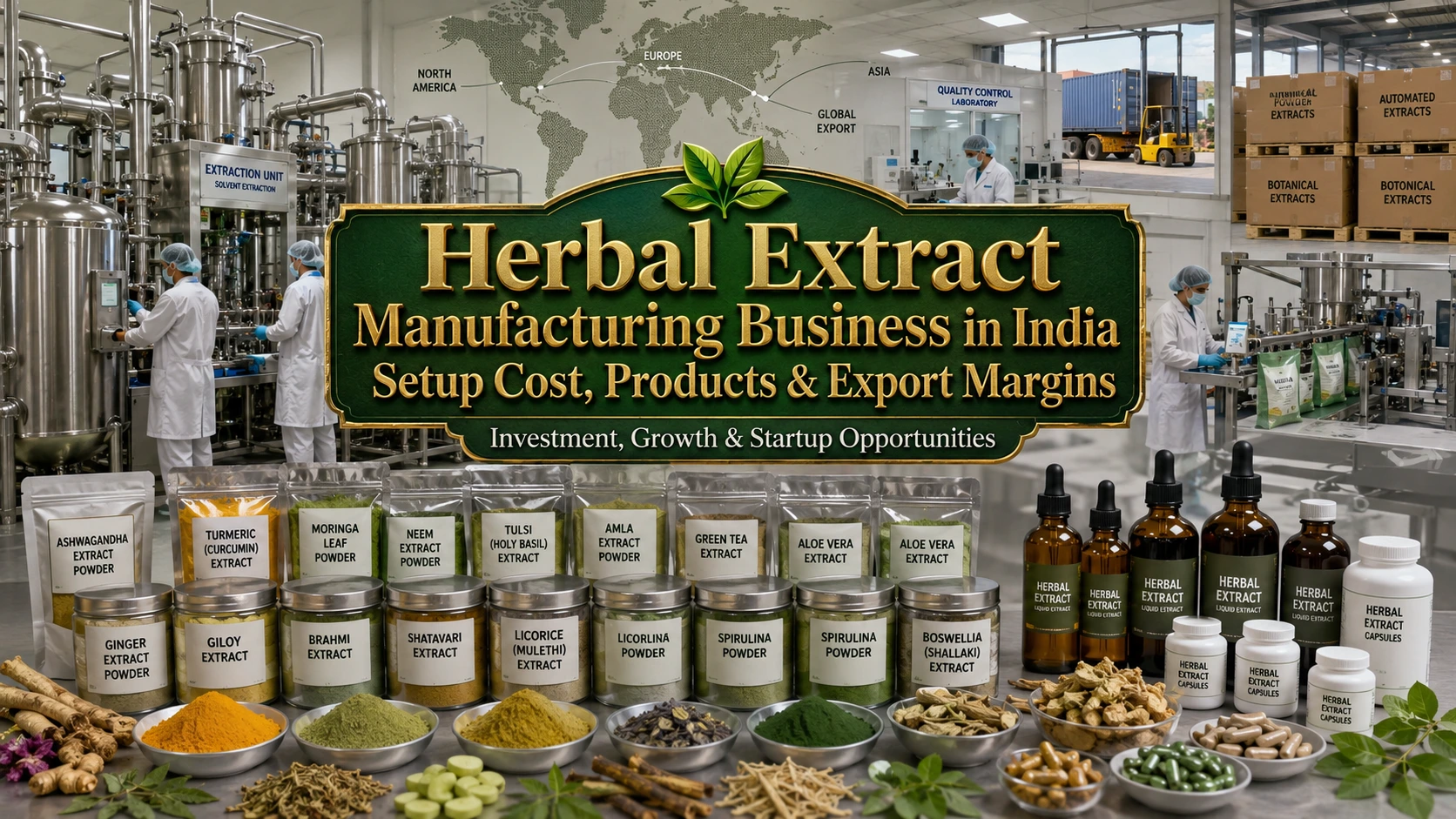
India has a documented knowledge of over eight thousand medicinal plant species; a significant proportion of the raw material used by global nutraceutical brands are grown here, which are then resold as standardised extracts at a much higher price. That is the space – raw herb is cheap and the finished extract is dear – where a herbal extract manufacturing business can be set up in India without having to await the approval of a foreign buyer. This isn’t the segment of the pharmacy wall clogged with hundreds of brands vying for shelf space. Standardised extraction is a processing step upstream, being sold to B2B nutraceutical, pharmaceutical, cosmetic formulators who require a constant supply of standardised herb powder that an herb powder cannot provide. The demand for “clean” (plant-based), actives continue to rise worldwide, and India’s Ayush ministry has been promoting export incentives to grab a larger share of the value chain locally.
Get Detailed Insights from This Book: Herbal Cosmetics & Ayurvedic Medicines (EOU)
Why This Is a Genuine Opening
The demand signal is simple. Sellers of global nutraceuticals and functional foods don’t like to have to sell raw dried herb — with different potency levels from batch to batch. Global buyers of nutraceuticals and functional foods don’t like to buy anything less than standardised extracts with guaranteed potency — ninety-five percent curcuminoids and five percent withanolides, that kind of specificity. Presently, a significant portion of India’s medicinal plant harvest is exported in raw form, thus the value addition process is frequently carried out outside India before the final product is sold back at import prices under Indian brands. The National Medicinal Plants Board provides cultivation and processing subsidies and few State Ayush Departments conduct cluster schemes under the umbrella of National AYUSH Mission for herbal processing units, but hardly any entrepreneurs have established extraction capacity to match the raw material which India already cultivates.
The entry capex is in the moderate range for bulk drug manufacturing. The basic concentration and drying equipment can begin from almost Rs. near two to four crores for a small capacity in a single solvent extraction unit. Multi-solvent plants with capacity to manufacture the Pharmacopeia grade, export certified extracts run in the range of 08 – 15 crore rupees. Typically takes 6 to 12 months to obtain FSSAI or Ayush GMP depending on the end use, and Kosher, Halal or ISO 22000 if the buyer is an international market.
Margin and Risk Structure
There is a significant difference in margins between different levels of standardisation. Low concentration or crude extracts are sold to domestic Ayurvedic manufacturers, where their gross margins are thin (typically 10 to 15 percent), as dozens of small companies cater to this market. Many of the export nutraceutical buyers are willing to pay a lot more for standardised, assay guaranteed extracts as compared to those from India, which can be expected to be far fewer and far less likely to meet the assay specification demanded by international buyers.
The scalability generally follows a three-step process: a pilot plant that proves out one botanical and one solvent system; a mid-size plant that expands with the arrival of export orders into a second extraction line; finally, contract manufacturing capacity for the nutraceutical brand buyers who are seeking an exclusive supplier experience. The main operating risk is raw material seasonality: botanical harvest is seasonal and raw material market prices fluctuate depending on the quality of the monsoon, so that those who lock in raw material contracts with farmers before the season will not face the worst of the price fluctuations. The longer of the two delays for anyone who is setting up a business to manufacture a herbal extract India is likely to face is quality certification, rather than production.
Get Detailed Project Report (DPR): Herbs and Herbal Based Products
Product and Project Opportunities Worth Evaluating
Curcumin and Standardised Turmeric Extract
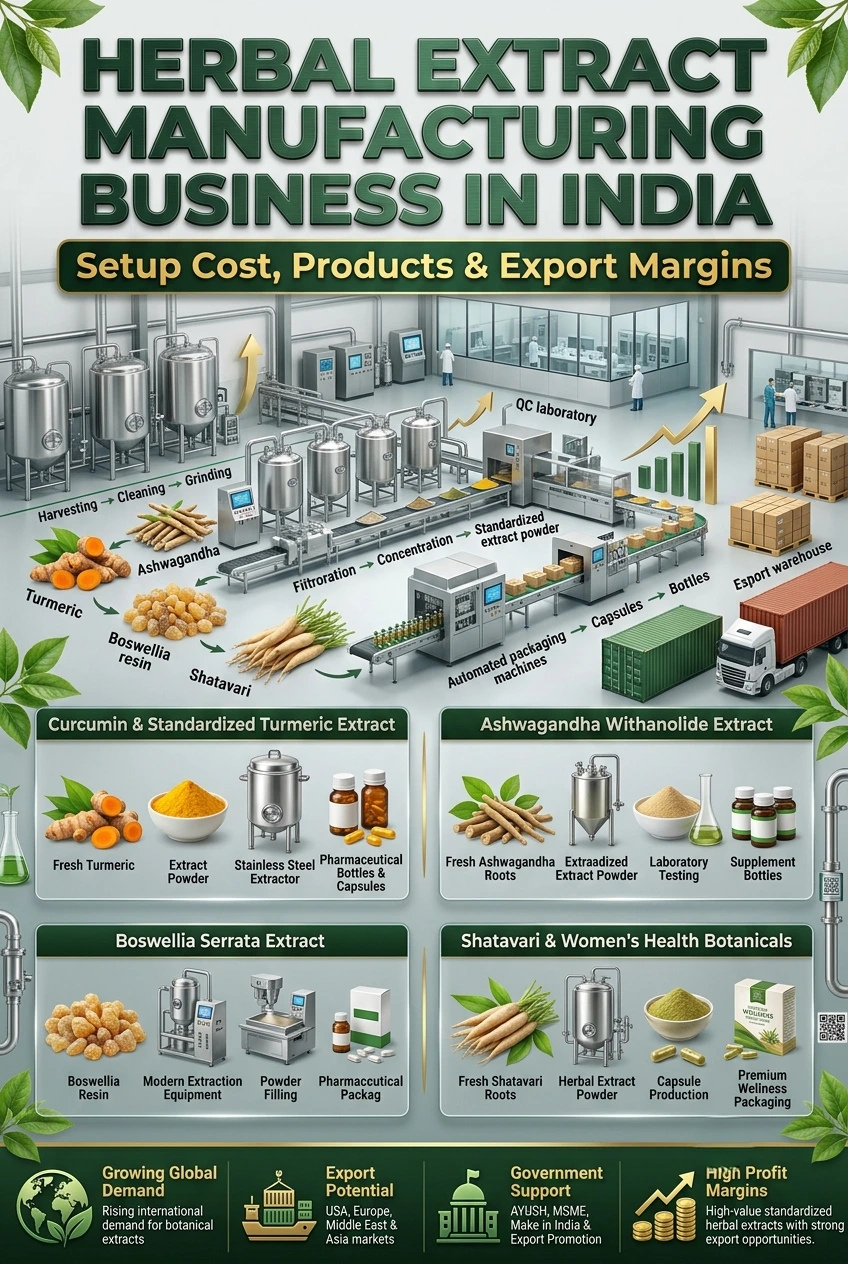
The most exported Indian botanical extract by value is curcumin extract (95% curcuminoids) supplied to the global brands of supplements and functional foods. The capex requirement for solvent extraction, chromatographic purification and spray-drying equipment in a unit with an annual capacity of 5 to 10 tonnes is approximately six to nine crore rupees. The customers of the buyers are US and European nutraceutical formulators and domestic supplement brands. After the initial twelve to eighteen months of assaying for consistency, gross margins are thirty to thirty-eight percent, but buyers on the export market will not usually make volume orders until the assays are consistent.
Ashwagandha Withanolide Extract
Over the past few years, Ashwagandha extract (standardised for withanolides content) has taken the global adaptogen and stress relief supplement market by storm. The unit costing Rs 4 to 7 crore in size is smaller than a curcumin plant, and can serve both domestic and export customers at once. Margins are about 25-30% with export realisation slightly higher than usual when one of the founders gets organic or ISO certification, a few of the international buyers now view this as a standard and not as an added value.
Boswellia Serrata Extract
The extract of Boswellia serrata, which is utilized in medications for joint-health and anti-inflammatory purposes, has less home manufacturers than curcumin or ashwagandha, making competition genuinely slim. For specialty nutraceutical formulators (not mass-market supplement brands), the capex for a unit of 8-12 tonnes annual capacity is in the range of five to eight crore rupees. These margins are projected to be between twenty-eight to thirty-four percent as the supply is less and Boswellia harvesting is concentrated in certain forest areas that are regulated by sustainable harvesting.
Find high-return business ideas based on your budget & ROI
Shatavari and Women’s Health Botanicals
Shatavari standardized with saponin content has a less organised extraction capacity to serve the growing segment of women’s health nutraceuticals. A smaller scale unit (capex of three to five crore rupees) can be used to cater to domestic supplement brands directly and work towards export certification over 18 to 24 months. Margins are in the range of 20 to 26 percent at home, increasing upon the completion of the export documentation, which makes it a good first idea for a founder to test the business model for herbal extract production in India before investing in a larger multi-botanical plant.
Indian Promoters Who Built This
India’s Ayush and herbal products sector, tracked by the India Brand Equity Foundation, continues to expand alongside the broader pharmaceutical economy, and industry bodies such as the Federation of Indian Chambers of Commerce and Industry have repeatedly flagged herbal extraction as an underinvested value-addition layer within that growth. Muhammed Majeed, founder of Sami Labs and its global arm Sabinsa, is the clearest example of what disciplined standardisation can achieve. He built one of the earliest Indian standardised-extract businesses around curcumin and other botanicals, investing heavily in analytical testing capability before investing in extraction capacity, so every batch shipped carried a verifiable assay certificate. That sequencing — testing infrastructure before production scale — is the specific lesson worth copying.
Benny Antony built Arjuna Natural in Kerala around a similar principle, focusing narrowly on a handful of standardised extracts including curcumin and boswellia rather than chasing a wide botanical catalogue, and building direct export relationships instead of relying on trading intermediaries. Acharya Balkrishna, who scaled Patanjali’s herbal manufacturing base, took a different route — vertical integration from cultivation through finished product, prioritising domestic volume over export certification. The applicable lesson across these founders: decide early whether you are building for domestic volume or export margin, since the certification and equipment investment differs sharply between the two paths.
Import-Export Opportunity Analysis
India’s current trade pattern in this category is almost backwards: raw and semi-processed botanical material leaves the country cheaply, while finished standardised extracts often return as imported nutraceutical ingredients at a considerable markup. That gap is exactly where a domestic extraction founder can plug in — capturing the processing margin that currently accrues to buyers overseas. Export facilitation data tracked by the Ayush Export Promotion Council shows India’s herbal exports still skew heavily toward raw material rather than finished extract, reinforcing the same gap. Global demand for non-China botanical sourcing has strengthened this opening further, since several international nutraceutical buyers actively prefer Indian-origin material for provenance and traceability, particularly for turmeric, ashwagandha, and holy basil extracts. A founder who secures ISO 22000 or organic certification early, and builds a direct relationship with two or three export buyers rather than selling through trading intermediaries, captures meaningfully more value than one selling crude extract domestically at commodity prices.
Feasibility Planning and Input Supply Reality
Extraction economics depend on more than botanical sourcing. Solvent cost — largely food-grade ethanol and hexane — is a meaningful input, and India’s own refining and petrochemical base keeps that supply chain domestically available rather than import-dependent. The Annual Report 2024-25 of Ministry of Petroleum and Natural Gas, Government of India — accessible at mopng.gov.in — records that the country’s petroleum product output crossed 283 million tonnes during the year, underlining how deep and stable the domestic solvent and utility supply chain available to a processing unit like this actually is, a factor founders in water- and energy-intensive extraction rarely account for early enough.
Before finalising equipment or a botanical product mix, founders typically commission a Market Survey cum Detailed Techno-Economic Feasibility Report. Niir Project Consultancy Services prepares these specifically for entrepreneurs entering industrial processing, covering process flow, machinery specification, capacity planning, and full project financials — replacing guesswork with a number a lender can actually evaluate.
Related Article: How to Start a Herbal and Medicinal Plants Export Business in India
Conclusion
A herbal extract manufacturing business India builds today does not need a foreign investor’s blessing or a decade of Ayurvedic brand-building to become profitable. It needs a narrow botanical focus, real assay-testing discipline, and the patience to earn export certification properly rather than rushing a first shipment out the door.
The decision hierarchy for a founder evaluating this sector is simple. Pick one or two botanicals, not a wide catalogue, because certification and equipment specialisation compound faster when concentrated. Build testing capability before production scale, following the sequencing that worked for the sector’s most credible builders. Secure at least one committed buyer, domestic or export, before finalising a multi-solvent plant, and treat raw material sourcing as a supply-chain problem to solve contractually with farmers rather than a spot-market gamble each season.
India’s raw botanical base is not the constraint here — the country already grows what the world’s nutraceutical buyers want. The constraint has been processing discipline: too few Indian units invest in the analytical testing infrastructure that assay-guaranteed export sales actually require. That gap is precisely why competition remains thin even as global demand for plant-based, clean-label actives keeps expanding. For a founder willing to build testing rigour alongside extraction capacity, a herbal extract manufacturing business India can genuinely become a defensible, high-margin bet rather than another crowded Ayurvedic brand chasing retail shelf space.
Capex vs Margin Overview by Extract Type
| Extract Type | Capex Range | Gross Margin | Target Buyer |
| Curcumin (95% Curcuminoids) | ₹6-9 Cr | 30-38% | Export nutraceutical/functional food brands |
| Ashwagandha (Withanolide std.) | ₹4-7 Cr | 25-30% | Domestic & export supplement brands |
| Boswellia Serrata (Boswellic acid) | ₹5-8 Cr | 28-34% | Specialty joint-health formulators |
| Shatavari (Saponin std.) | ₹3-5 Cr | 20-26% | Domestic women’s health brands |
| Crude/Low-concentration extracts | ₹2-4 Cr | 10-15% | Domestic Ayurvedic manufacturers |
Source: Industry estimates; NPCS sector analysis
Frequently Asked Questions
From a founder’s perspective — practical, decision-oriented questions:
What capex is needed to start a herbal extract manufacturing business India buyers will trust?
A basic single-solvent unit can start near two to four crore rupees, but export-grade, assay-certified extraction typically needs six to nine crore rupees for the concentration, purification, and testing equipment international buyers require before placing volume orders.
How long before export certification is possible?
ISO 22000, organic, or Kosher/Halal certification typically takes six to twelve months after production stabilises, and buyers usually want two to three consistent assay-verified batches before committing to a long-term contract, so budget eighteen months from commissioning to first meaningful export order.
How is break-even usually reached?
Most units reach break-even in year two or three, once domestic supplement brand orders stabilise cash flow while export certification is completed in parallel. Units that wait for export orders before generating any domestic revenue typically face a longer, riskier break-even path.
What is the biggest raw material risk?
Seasonal price volatility. Botanical harvests depend on monsoon quality, and a founder without a locked farmer contract can see input costs swing thirty to fifty percent between seasons, which is why cultivation tie-ups matter as much as extraction equipment.
Is domestic or export sale more profitable?
Export sale of standardised, assay-certified extract typically earns ten to fifteen percentage points more margin than domestic crude-extract sale, but requires certification investment and a longer sales cycle, so most founders start domestic and add export capacity once quality is proven.


