





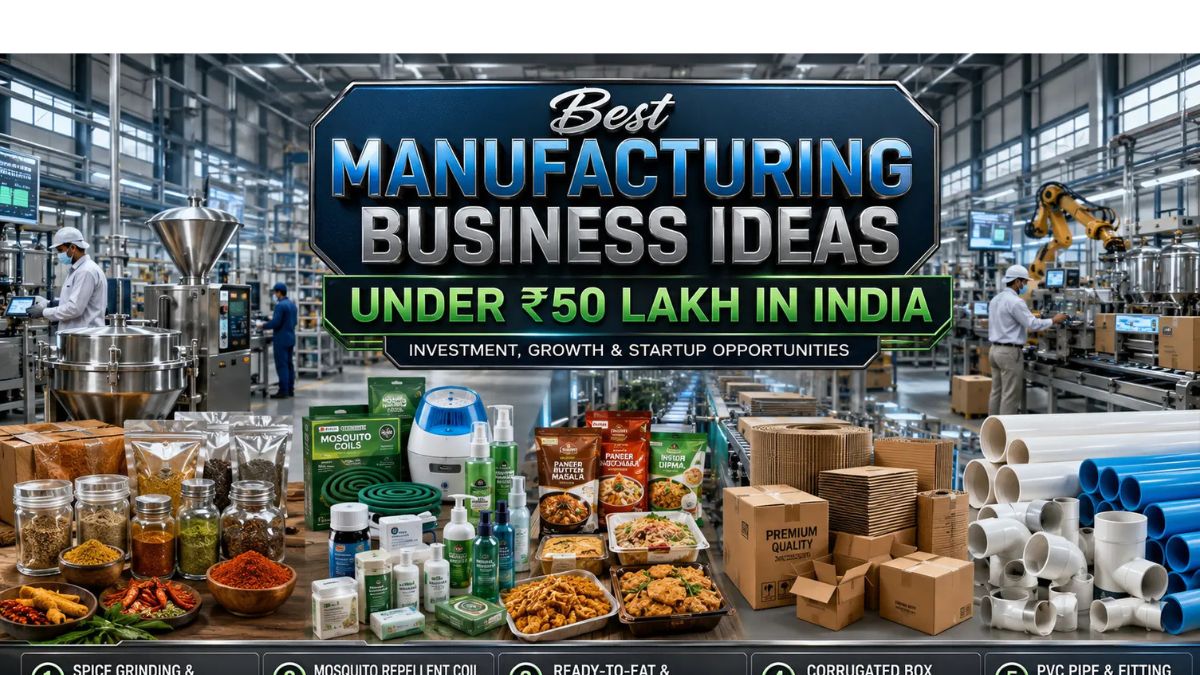
Best Manufacturing Business Ideas
With 50 lakhs of rupees the manufacturing unit that can be created in India today is a real manufacturing unit that will earn revenue, it is not a small workshop. It’s true for companies in Tier-2 and Tier-3 towns, and the facts support it. This article examines businesses with an investment limit of ₹ 50 lakh with the support of demand figures, government incentives, and not just a guess at real business profitability.
Production is in a perfect size band. It is of sufficient size to be equipped with appropriate equipment and employ a small, competent workforce, but not so large as to be burdened with compliance weight. The sections below discuss why this window is important, the relevant schemes and specific businesses that are ideal now.
Why Small-Scale Manufacturing Makes Sense Now
Domestic consumption is moving from unbranded, unorganised supply to packaged, quality certified supply in India. This change opens up opportunities for new players. A first-time manufacturer at Rs.50 lakh can now pick up the demand which the bigger players are not interested in.
New entrants are also given an advantage due to the availability of raw materials. Industries such as food processing, plastics, and personal care are reliant on agricultural or petrochemical-based raw materials already available in the country. Thus, a new unit does not have to import critical inputs and cuts working capital needs to a predictable level.
Then there is the factor of exports. In fact, global buyers are increasingly considering India as their alternate sourcing base to China for packaging, processed food and light engineering goods. With efficient management, a ₹50 lakh unit may serve domestic retail as well as export driven supply chain in 2-3 years of stable operations.
Find the most profitable startup for your investment range
Government Policies and Incentives Supporting New Units
There are a number of schemes which ease the effective burden of the capital investment for a project worth of ₹50 lakh. The Prime Minister’s Employment Generation Programme (PMEGP) supports manufacturing projects up to this exact ticket size with subsidy of up to 15 to 35 % on the project, depending on the category and location of the project.
The Credit Guarantee Fund Trust for Micro and Small Enterprises (CGTMSE) provides collateral-free loans of up to ₹5 crore, eliminating the most significant hurdle for first-time entrepreneurs who lack collateral for loans. This is complemented by Tarun category of MUDRA Yojana for manufacturing assets for machinery top-up up to ₹10 lakh.
Production Linked Incentive access for smaller units
The food processing PLI sub-scheme is applicable to MSME with minimum investment of ₹50 lakh in the following categories: Ready to eat foods, Marine products and Millet based products (FSSAI certified). That’s why food processing is one of the few PLI categories that is actually attainable at this budget.
In addition to central policies, state industrial policies often provide capital subsidy, stamp duty exemption and benefits on electricity tariff to units located in special or designated industrial areas. In effect, effective project cost can be reduced an additional 10-15% due to the right selection of state clusters.
Profitable Business Ideas Within ₹50 Lakh
Spice grinding and blending unit
Despite India being the largest producer and consumer of spices, branded, hygienically packed spices are still not widely available in rural and semi-urban markets. The commissioning cost of a unit based on cleaning machine, pulverisers, blenders and a packaging line is Rs 30 to 50 lakh. The raw material sourcing is very simple as already major markets of spices exist in Madhya Pradesh, Rajasthan and Andhra Pradesh. The margins increase significantly when the manufacturer switches to branded retail packs from a loose supply, and FSSAI Compliant Units can also cater to institutional and export markets that demand uniformity of quality.
Read the Complete Book Here: Handbook on Spices
Mosquito repellent coil and personal care unit
The domestic market for mosquito repellent products is ₹4,000 crore, and the coils continue to have a significant market share in rural and semi-urban households. The cost of setting up a mixing, pressing, drying and packing line is around ₹50 to 75 lakh and contract manufacturing of regional brands is a quick way for you to get regular orders. Active ingredients and packaging machinery are both locally available, streamlining the supply chain. This can also be advantageous to a manufacturer to introduce allied personal care products later on the same production floor.
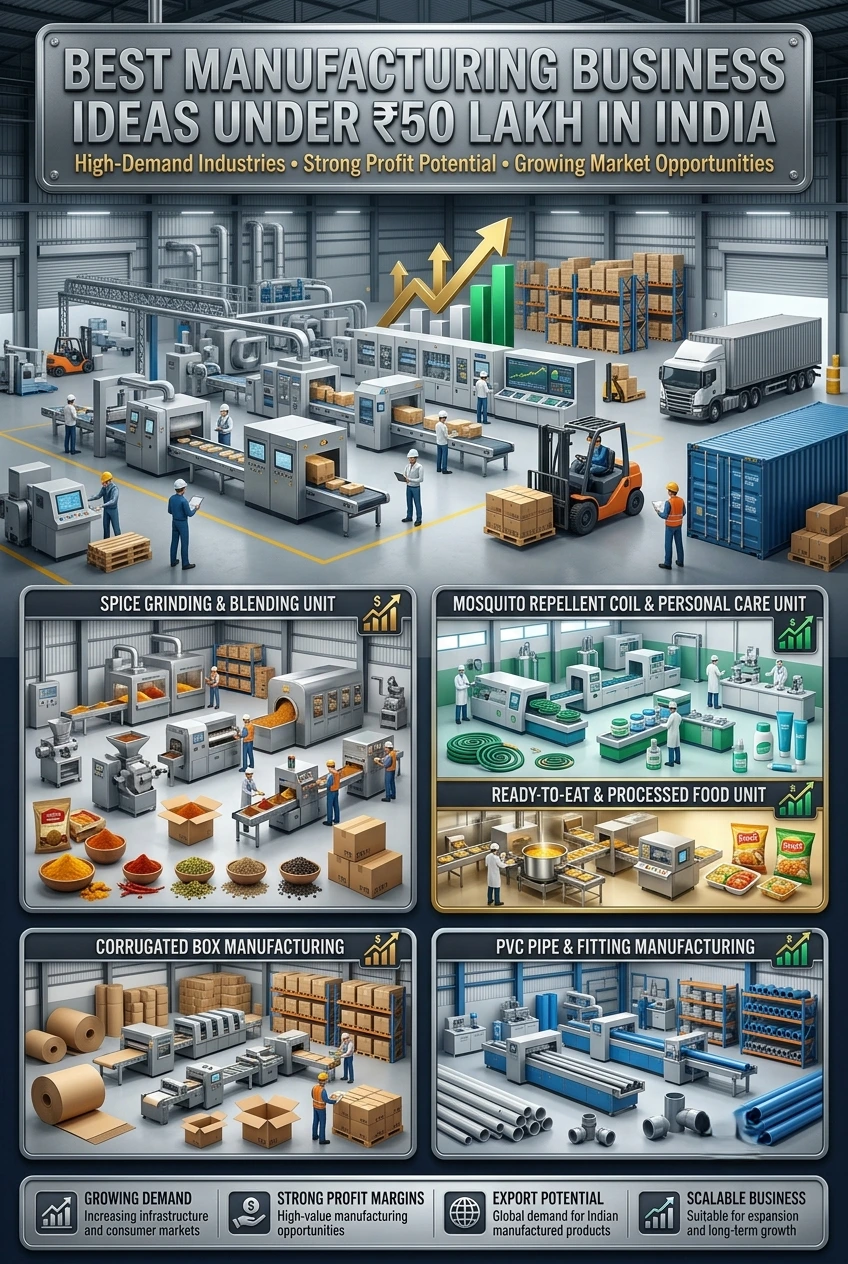
Ready-to-eat and processed food unit
The ready-to-eat food category is expanding faster than food retail and urban consumption habits are oriented towards convenience foods. The cost of a compact processing line (that can be suitable for this segment) is about ₹45 to 50 lakhs in terms of machinery and utilities. This classification also qualifies a unit for the food processing PLI window mentioned above and can offer incentive income along with the regular operating margin. FSSAI licensing and cold chain readiness are two important aspects that any entrepreneur must keep in mind when entering into this space, as these are checked before vendors are allowed to join retail chains.
Corrugated box manufacturing
The e-commerce, pharmaceutical, agricultural produce are all factors that require protective packaging, with the corrugated packaging demand growing by more than 25 percent per year in several industrial clusters. The cost of a unit which has slitter, scorer, and stitching machine for three ply boards is between ₹60 and 80 lakhs. The variety of customers in electronics, pharma, agro-processing, etc., minimises reliance on any single customer while industrial estates generally have a level of local demand which is not being met and can be quickly picked up by new buyers.
Get Detailed Project Report (DPR): The Complete Guide to Packaging Industry
PVC pipe and fitting manufacturing
Demand for plumbing, irrigation and electrical conduit pipes remains high in Tier-2 and Tier-3 cities. The cost of installing two to three extrusion lines and fittings moulds is in the range of ₹65 lakh to 85 lakhs. Here, it is imperative that the pipe be ISI certified as institutional buyers and government contractors don’t accept any uncertified pipe! But once certified, a manufacturer can benefit from tenders from the municipal and irrigation departments, that are typically much more predictable than those available to a retailer.
Import-Export Opportunity Analysis
Several of these categories connect directly to trade flows. Processed food exports from PLI-linked units have grown at a compound annual rate above 13 percent over recent years, which signals strong overseas appetite for Indian packaged food. A new food processing unit, once export-certified, can tap this demand instead of relying only on domestic retail.
Packaging manufacturers benefit indirectly. As pharmaceutical and food exporters scale up shipments, they need reliable corrugated and flexible packaging suppliers close to their production base. Meanwhile, personal care and spice units can explore Gulf and Southeast Asian markets, where Indian branded FMCG products already enjoy strong recall among the diaspora and local retail chains.
Indian MSME Success Stories Worth Studying
Karsanbhai Patel started Nirma from a small terrace-based detergent operation in Ahmedabad and built it into a national FMCG brand by pricing aggressively against multinational competitors while keeping production costs lean. His model shows how a modest manufacturing start can scale through disciplined cost control rather than large upfront capital.
Rajkumar Adukia’s promoted enterprises and, more prominently, the MDH and Everest spice houses demonstrate how regional spice processors converted local trust into national brands over decades. Their decision logic centred on consistent quality and steady reinvestment into branding, a path directly relevant to a new spice unit entrepreneur today.
Falguni Nayar built Nykaa around India’s growing personal care consumption, starting with a sharp read of underserved demand before scaling supply and manufacturing partnerships. The lesson for a new manufacturer is straightforward: identify a demand gap precisely, then build production capacity to match it rather than the other way around.
Related Article: Plastic Pipe Manufacturing Business in India: Cost, Profit & Complete Setup Guide
How NPCS Supports New Manufacturing Entrepreneurs
At Niir Project Consultancy Services (NPCS), we prepare Market Survey cum Detailed Techno-Economic Feasibility Reports for entrepreneurs setting up exactly these kinds of units. Our reports cover the manufacturing process, market and demand analysis, process flow diagrams, product mix and capacity planning, machinery and raw material specifications, and complete project financials with profitability analysis. For a founder evaluating a ₹50 lakh project, this level of detail replaces guesswork with a bankable document that lenders, and the entrepreneur, can actually rely on.
Cost and Revenue Snapshot
The table below summarises indicative figures across the five business ideas discussed above. Actual numbers will vary by location, machinery vendor, and capacity utilisation, so treat these as planning references rather than fixed quotes.
| Business Idea | Investment (₹) | Est. Annual Revenue | Payback Period |
| Spice grinding & blending unit | 30–50 lakh | 1.2–1.8 crore | 3–4 years |
| Corrugated box manufacturing | 60–80 lakh | 2.5–3 crore | 3.5–4.5 years |
| Mosquito repellent coil unit | 50–75 lakh | 2–2.5 crore | 3–4 years |
| Ready-to-eat food processing | 45–50 lakh | 1.5–2 crore | 2.5–3.5 years |
| PVC pipe extrusion unit | 65–85 lakh | 3–3.5 crore | 4–5 years |
Frequently Asked Questions
1. Is ₹50 lakh enough to start a manufacturing unit in India?
Yes, some segments like spice processing, packing and Rte food can fall in this range easily provided the working capital and basic civil work planning is carried out appropriately along with procurement.
2. Which government scheme is most useful at this investment level?
However, PMEGP would be closest to match, because project maximum ceiling is exactly matching 50 Lakhs and also it offering the subsidized percentage from 15 percent to 35percent depending on the category and region.
3. Do I need collateral to get a manufacturing loan?
No, they’re not. As CGTMSE’s loans up to 5 crores come without the need of a guarantor and have no collaterals required, this is where the first-generation entrepreneurs see light of day.
4. Can a small unit qualify for PLI benefits?
Specifically for the food processing sector, yes. The sub scheme requires the minimum investment of 50 lakh provided the unit is FSSAI certified and achieve the incremental sales targeted.
5. How long does it take to become profitable?
Generally, most units in this budget segment payback in three to five years’ period, depending on capacity utilisation and swiftness with which entrepreneur finds buyers in the institutional market or export market.
6. Should I get a feasibility report before investing?
Yes. A detailed techno-economic feasibility report clarifies machinery costs, demand potential, and profitability before capital is committed, and most lenders will ask for one regardless.
Conclusion
A ₹50 lakh budget, deployed carefully, can fund a genuine manufacturing business rather than a token workshop. The businesses covered here share three traits: steady domestic demand, accessible government support, and a realistic path to export income. Entrepreneurs who combine sound project planning with the right scheme support stand a strong chance of building a scalable, profitable operation from this starting point.
References
Ministry of Micro, Small and Medium Enterprises
Department for Promotion of Industry and Internal Trade (DPIIT)
Credit Guarantee Fund Trust for Micro and Small Enterprises (CGTMSE)
Food Safety and Standards Authority of India (FSSAI)
Federation of Indian Chambers of Commerce and Industry (FICCI)


