





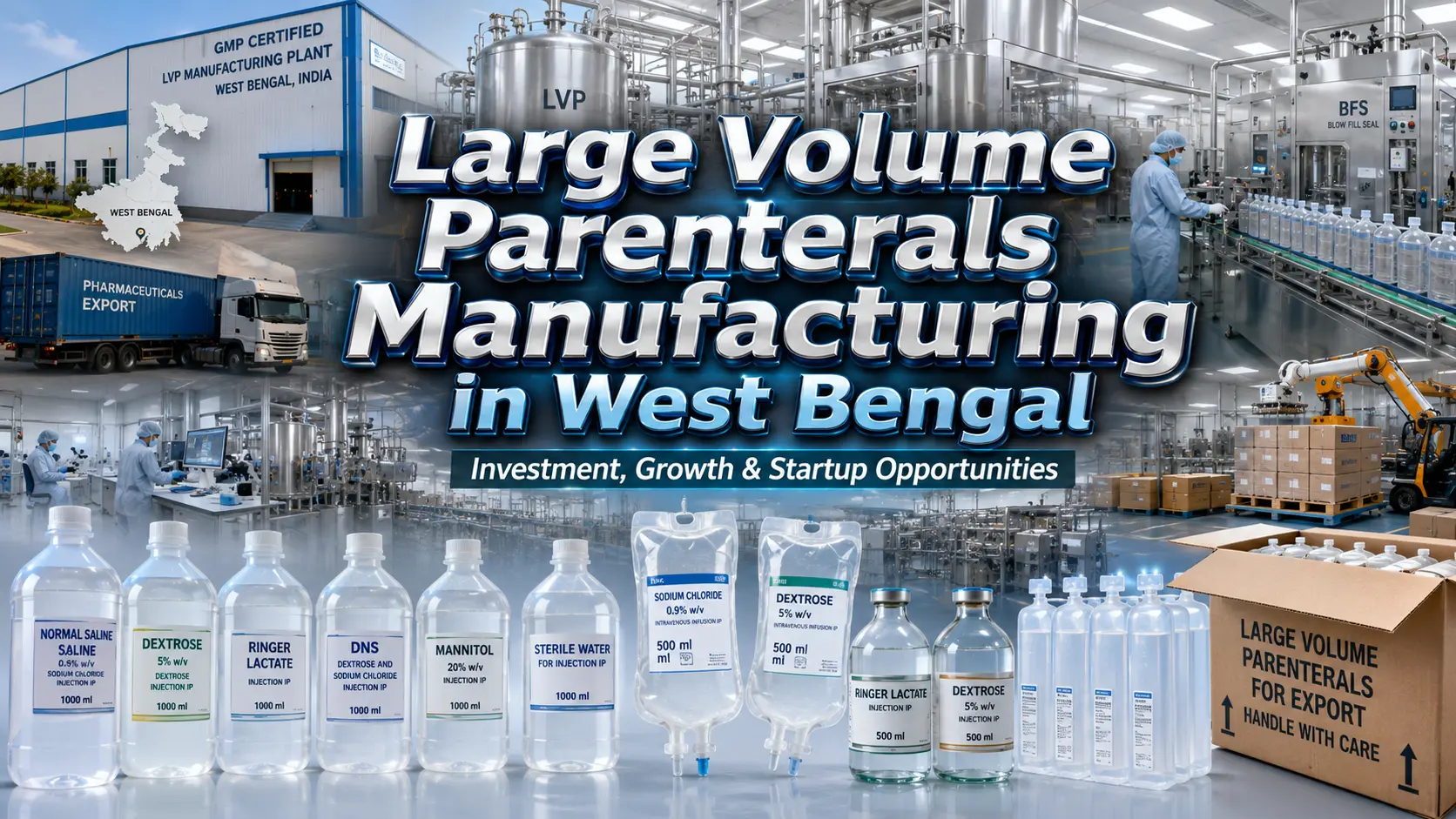
LVP Manufacturing in West Bengal
A Sector That Runs on Urgency
In India, one type of medicines that rarely finds a mention when it comes to news, but is essential to every hospital bed, every emergency ward and every ICU — Large Volume Parenterals (LVPs). These are the IV bags languishing by the bedside of the patients: Normal Saline, Ringer Lactate, Dextrose Injection, Paracetamol IV Infusion, Mannitol and Glycine Irrigation Solution. This market is not for speculation. It is a necessary component of the structure. However, despite all the business ideas that are buzzing in the Indian pharma manufacturing sector, the LVPs are still hugely under-explored, particularly in places like West Bengal which just so happen to have access to raw material, proximity to ports and a significant healthcare base.
Indian IV fluids market has witnessed a significant growth in recent years, backed by the increasing number of hospitals, increasing number of surgical procedures and government spending on healthcare under various schemes such as Ayushman Bharat. The institutional healthcare system spread across the Kolkata, North Bengal and industrial corridors of Howrah and Durgapur makes it an attractive opportunity to new manufacturers to enter into the market of West Bengal.
This article covers the whole business opportunity, from market economics, to the government incentives, to specific project ideas and supply chain strategy. If you are a first-time business owner considering starting a manufacturing business or an MSME investor considering the next vertical to invest, LVP is definitely worth considering in West Bengal.
Why the LVP Sector Is a Smart Industrial Bet Right Now
Large Volume Parenterals are poised on a confluence of three strong demand drivers, which are increased hospitalisations, growth in surgical volumes, and government-led hospital penetration. The Indian pharmaceutical industry is growing at a steady pace, and amongst this, fluids have registered a highest growth rate, which is higher than the average growth rate. The national consumption of IV fluids is in the billions of units per year. Hospitals, nursing homes and government health centres are all frequently purchased targets.
There’s an added logical appeal to this opportunity in West Bengal. The West Bengal Clinical Establishments Regulatory Commission estimates the state has more than 7,000 RNs and hospitals registered. Some of the highest patient numbers are experienced at Kolkata in eastern India. Occupancy of government hospitals in the Health Department of West Bengal is high which leads to a predictable bulk demand of the cost of the services.
In fact, West Bengal is geographically well-placed. It is well connected to the northeast, Bangladesh and Nepal by rail and is a mile from the Haldia port, Kolkata port area. The set up of an LVP unit in the Kalyani Pharmaceutical Special Economic Zone or in the Falta SEZ can cater to both the domestic market and export markets in neighbouring countries.
Get Detailed Insights from This Book: Handbook on Active Pharmaceutical Ingredients (API), Drugs & Pharmaceutical Products
Profitability Logic: Why Margins Hold
Although LVPs appear to be commodity products, their business model is far stronger than that of most MSME manufacturers. Water for injection (WFI), polypropylene bottles/bags, glucose, sodium chloride and lactic acid are widely available in eastern India and the cost of these is the main drivers. Manufacturing is capital-intensive initially, but as the unit gets to optimum batch size, the production cost per unit decreases significantly.
In addition, the basic foundation of LVP demand, government and institutional tenders, are subject to rate contracts, providing manufacturers with a minimum revenue. Private hospital supply chains are transitioning to vendor consolidation and are establishing long-term supply agreements. All of these, combined, create a business model of high volume and moderate margin but with high cash flow predictability.
Government Policies and Incentives Supporting LVP Manufacturing
India has never had a more pro-startup policy regime in the pharmaceutical sector. There are a number of schemes at national and state level which directly favour LVP manufacturers in West Bengal.
Production Linked Incentive (PLI) Scheme for Pharmaceuticals
PLI Scheme for Pharmaceuticals, a scheme launched by the Ministry of Chemicals and Fertilizers, offers financial benefits to the manufacturers of the selected pharmaceutical products, particularly in promoting domestic manufacturing of critical drugs and formulations. Infusions and injections are covered in the eligible category. Details of the scheme are available on the official website:
The Ministry of Chemicals and Fertilizers, PLI Pharma: https://pharmaceuticals.gov.in
MSME Support: Credit Guarantee and Technology Schemes
The Credit Guarantee Fund Trust for Micro and Small Enterprises (CGTMSE) is a scheme under the Ministry of MSME, which allows for providing loans for new manufacturing units without any collateral. In the case of LVP startups, this translates to term loans available without having to tie up personal assets. MSE-CDP is another programme being run by the Department to assist in infrastructure development for pharma clusters.
Ministry of MSME — Schemes Portal: https://msme.gov.in/schemes
West Bengal State Incentives
Single window clearance is provided by the West Bengal government’s portal, known as Silpa Sathi, for new industrial projects. The state’s Industrial Promotion Policy offers capital subsidy, interest subsidy and employment assistance to qualified manufacturing units. The West Bengal MSME Policy provides additional benefits for the Pharma projects in the industrial zones. The Kalyani Pharmaceutical SEZ is dedicated to promoting the pharma formulation manufacturing business with plug and play infrastructure.
The project is named after “Silpa Sathi,” the name of a Buddhist monk.It is named “Silpa Sathi” after a Buddhist monk.
Get Detailed Project Report (DPR): Business Opportunities in West Bengal
Drug Price Control and NPPA Framework
Manufacturers of LVP should know that the National Pharmaceutical Pricing Authority (NPPA) has a regulatory framework for ceiling prices of scheduled formulations. Normal Saline, Ringer Lactate, and Dextrose Injection is subject to price control. But it does provide an equal opportunity — the bigger players can’t out bid quality manufacturers below a minimum price limit. Efficient production allows the entry of new competitors that can compete directly.
Business Ideas for Entrepreneurs Entering the LVP Sector
1. Normal Saline and Ringer Lactate IV Fluids Manufacturing Unit
Normal Saline (0.9% NaCl) and Ringer Lactate are the most hospital-critical fluids made and used in all LVP products. The most feasible first-cut for a first-generation entrepreneur is to establish a niche manufacturing plant for these two products. Investment requirement for a 500ml and 1000ml bottle or bag line which meets Schedule M GMP requirements is Rs. 3 to Rs. 5 crores depending on the plant capacity and automation level. The crucial choice is between manufacturing in polypropylene bottles or in non-PVC flexible bags, which happen to have their own value construction and market preference.
The main market for the sale of institutional tenders is government hospitals and West Bengal state government is the big buyer of the institutional tender annually. If an entrepreneur can get a portion of the annual state tender for NS and RL, he can have a solid revenue base from day one which is recession proof.
2. Dextrose Injection and Dextrose Normal Saline (DNS) Manufacturing
Dextrose based IV fluids (5% Dextrose, 10% Dextrose and Dextrose Normal Saline (DNS) combination) are critical for paediatric applications, diabetic management and post-surgery recovery. These products will have a slightly higher realisation as a result of the active pharmaceutical ingredient, glucose. A manufacturing line dedicated to dextrose solutions can coexist with or be integrated into a saline line with shared facilities.
The challenge is precision of concentration and assurance of sterility, which involves investment in validated WFI systems and LAF zones (Laminar Air Flow). It’s a high-margin product to the LVP product basket for entrepreneurs with pharmaceutical background or qualified technical partner. This is because of the presence of a large paediatric hospital network in West Bengal, such as NRS Medical College, SSKM, and many private chains, which generates uniform demand locally.
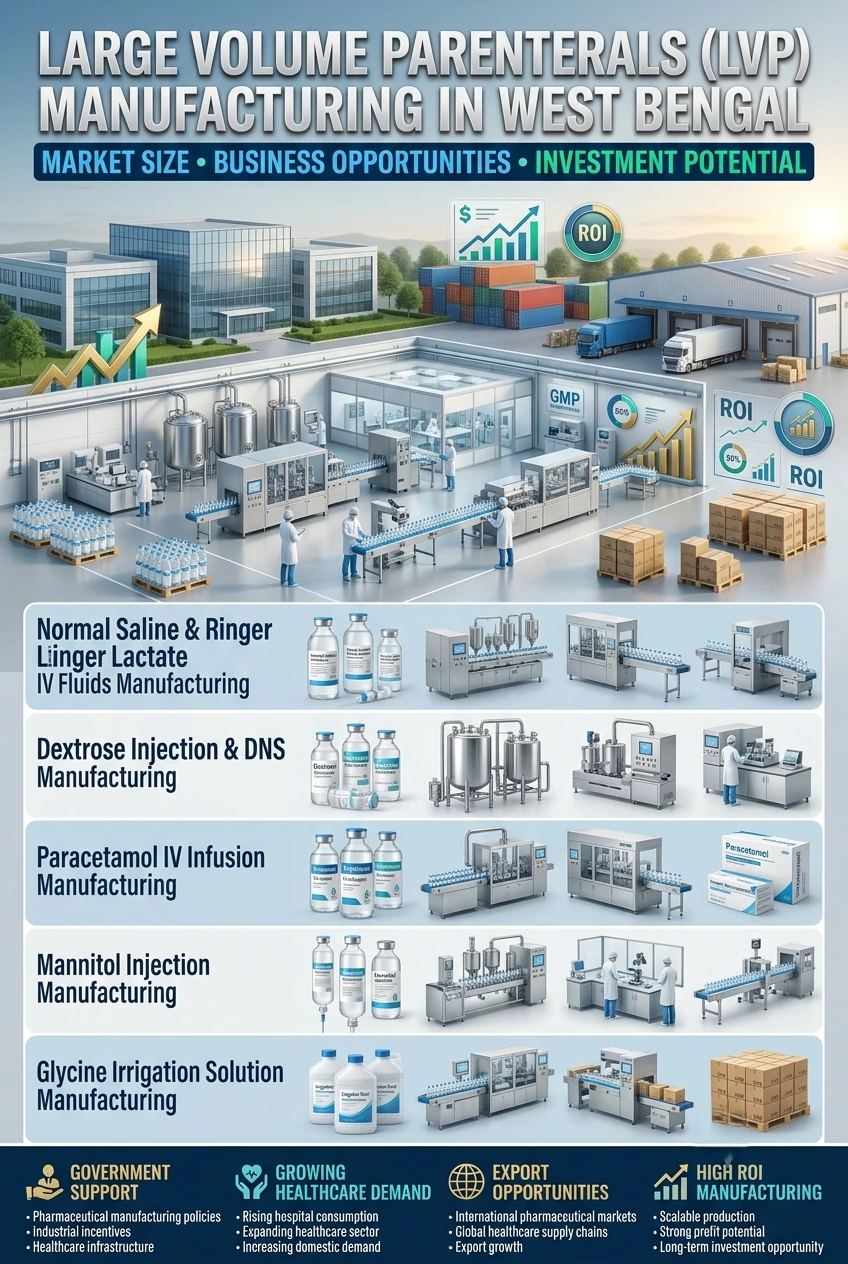
3. Paracetamol IV Infusion Manufacturing
Paracetamol IV Infusion (1000mg/100ml) is one of the fastest growing LVP segments of India. The procurement of IV Paracetamol has surged due to the shift away from intramuscular pain and fever control away from intramuscular injection to safer intravenous (IV) routes in hospitals. Compared to basic saline, the product can be sold at a higher price and competition – though present – has not yet reached commodity level in eastern India. It involves sourcing API from reliable manufacturers (API manufacturers at Hyderabad or Gujarat clusters are the main sources) and formulation process which should ensure stability and sterility during shelf life.
Both the private sector and government institutions are involved in the market. A sales team selling to tier-2 and tier-3 hospital networks (HCNs) in the states of West Bengal and Odisha, can create a sustainable business for an entrepreneur with differentiated product positioning.
4. Mannitol Injection Manufacturing
Mannitol Injection (20% w/v) is a speciality product and plays an important role within the LVP portfolio. It is used as a treatment for cerebral oedema and raised ICP (intracranial pressure) and is used in the neurology and neurosurgery department. Demand is created by tertiary care hospitals, trauma centres and ICUs. Mannitol has much higher unit realisations than saline or dextrose, but not as high as those for volume. For manufacturing, there is a need for specialised formulation skills, such as measures to prevent crystallisation and validated sterilisation procedures.
An MSME unit that is generating Mannitol along with one or two normal LVPs gives them a diversified portfolio that means that they will not rely too much on the price of various commodities. There are a number of super-speciality neurology institutes in West Bengal and demand from the hospitals in Jharkhand and Bihar cannot be met from here as there is no supply in the region, which can be addressed through short haul logistics.
Identify high-growth industries before others do
5. Glycine Irrigation Solution Manufacturing
Glycine 1.5% Irrigation Solution is a commonly underutilized LVP product used for a specific surgical indication: transurethral resection of the prostate (TURP) and other endoscopic urologic surgery. Glycine Irrigation Solution is non-electrolytic, non-conductive and safe for electrosurgical procedures, unlike most LVPs. The need stems from urology departments in hospitals that have surgical theatres. This product is not in a highly competitive market with commodity IV fluids, and commands a higher price/litre.
MSME manufacturers who make connections with urology departments and surgical hospitals in the eastern part of the country such as West Bengal, Jharkhand, Assam, can secure a stable niche business. The raw material (pharmaceutical-grade glycine) is imported or manufactured in the country and it is important to arrange the procurement of the raw materials for new players.
Import–Export Opportunity Analysis for LVP Manufacturers in West Bengal
Exports of IV fluids is indeed a possibility in West Bengal, but has to be strategically planned. The State shares its boundaries with Bangladesh and Kolkata had very close trade relationship with Nepal, Bhutan and Myanmar in the past. Healthcare establishment is expanding in these markets, along with minimal local drug production capabilities.
Bangladesh is one of the major possibilities. Bangladesh’s domestic pharma industry is not capable of producing IV fluids and injectable preparations, and hence, importing them. A unit of LVP in the State of West Bengal, within/close to an SEZ can export goods under the India-Bangladesh Trade Corridor at relatively low logistics cost.
The country with high import of pharmaceutical products is India to Nepal and Bhutan. Indian manufacturers are favored by these markets for their price competitiveness, the use of the Indian Pharmacopoeia Standards and their regulatory familiarity. The IP (Indian Pharmacopoeia) specification is widely used throughout South Asian countries.
Regarding imports, the main factor is API procurement. During shortage, it may be necessary to import dextrose (glucose), amino acids (such as glycine) and sodium lactate for Ringer Lactate from China or Europe. Entrepreneurs need to develop multiple sourcing supply chain to reduce import dependency risk.
The Directorate General of Foreign Trade (DGFT) has established the SION (Standard Input Output Norms) for pharmaceutical exports, which is essential for duty drawback. The entrepreneurs are requested to check the Pharmaceuticals Export Promotion Council of India (Pharmexcil) resources of export market entry support:
Pharmexcil — Pharmaceutical Export Promotion Council of India: https://www.pharmexcil.com
Indian MSME Success Stories in the IV Fluids Sector
Denis Chem Lab — From Gujarat MSME to National IV Fluids Player
Denis Chem Lab, founded by the Patel family in Gujarat, grew from a small IV fluids manufacturing unit to a nationally recognised pharmaceutical company. The founders recognised early that institutional supply — not retail pharmacy — was the right channel for LVP products. By consistently winning state government tenders, maintaining Schedule M GMP compliance, and reinvesting margins into capacity expansion, Denis Chem became one of the most cited examples of MSME success in the IV fluids sector. The lesson for new entrepreneurs is clear: institutional relationships, regulatory compliance, and patient reinvestment are the three pillars of LVP business building.
Related Article: IV Fluid and IV Administration Set Manufacturing Business in India: Drug License, GMP and Investment Guide
Parenteral Drugs India Limited (PDIL) — Indore’s Quiet LVP Giant
Parenteral Drugs India Limited (PDIL), promoted by the Porwal family from Indore, is another compelling model. Starting as a regional IV fluid manufacturer focused on Madhya Pradesh government tenders, PDIL expanded methodically into adjacent states and product lines. The company’s strategy of maintaining price discipline while building a strong distribution network in tier-2 cities created a durable competitive advantage. Today, PDIL is listed and has scaled significantly — a journey that began in a mid-sized MSME plant. For West Bengal entrepreneurs, PDIL’s story shows that regional focus, followed by deliberate expansion, is a sustainable model.
Claris Lifesciences — The Ahmedabad Story of Specialised Injectables
Claris Lifesciences, under promoter Arjun Handa, carved a niche in the global market by focusing on specialised injectable preparations — including IV solutions for critical care. Claris eventually divested its generic injectable business to Baxter International in a landmark transaction, demonstrating that even in the LVP space, a well-built manufacturing business has high strategic value. The key takeaway for MSME founders is that quality, regulatory compliance, and focus on niche products can translate into significant enterprise value over time.
How NPCS Can Help You Evaluate This Business Opportunity
At Niir Project Consultancy Services (NPCS), we provide professional consulting for the preparation of Market Survey cum Detailed Techno-Economic Feasibility Reports (DPRs) for entrepreneurs and investors planning to set up new industrial or pharma manufacturing projects. Our LVP feasibility reports cover detailed manufacturing processes, GMP compliance requirements, plant layout and equipment selection, raw material sourcing strategy, demand analysis and market sizing, and complete project financials — including profitability projections, break-even analysis, and ROI estimation.
For entrepreneurs evaluating an LVP manufacturing project in West Bengal, our DPRs serve as a bankable document for loan applications, investor presentations, and regulatory submissions. We help you evaluate feasibility, profitability, and long-term scalability before committing capital.
LVP Market and Project Data: Key Reference Numbers
Table 1: Key Metrics for LVP Manufacturing — West Bengal Context
| LVP Product | Market Segment | Approx. Project Cost | Primary Buyers | Export Potential |
| Normal Saline (NS) | Commodity/Volume | ₹3–5 Crore | Govt Hospitals, Nursing Homes | Bangladesh, Nepal |
| Ringer Lactate (RL) | Commodity/Volume | ₹3–5 Crore (combined with NS) | Surgical Hospitals, ICUs | Bangladesh, Bhutan |
| Dextrose Injection | Therapeutic | ₹4–6 Crore | Paediatric Hospitals, Govt Centres | Nepal, Myanmar |
| DNS (Dextrose Normal Saline) | Therapeutic/Combination | ₹4–6 Crore (shared with Dextrose) | General Hospitals, Emergency | Nepal, Bangladesh |
| Mannitol Injection 20% | Specialty/ICU | ₹2–3 Crore (add-on line) | Neuro/Trauma Hospitals | Moderate |
| Paracetamol IV Infusion | Analgesic/IV | ₹3–4 Crore | All Hospital Types | High — South Asia |
| Glycine Irrigation Solution | Surgical Niche | ₹1.5–2 Crore (add-on) | Urology Departments | Niche — Moderate |
Frequently Asked Questions (FAQ)
Q1. What is the minimum investment required to start an LVP manufacturing unit in West Bengal?
A basic LVP unit producing Normal Saline and Ringer Lactate in polypropylene bottles requires a minimum capital investment of approximately ₹3 to ₹5 crore, depending on capacity, land cost, and level of automation. A more comprehensive multi-product facility may require ₹8 to ₹12 crore. State subsidies, PLI benefits, and CGTMSE-backed loans can meaningfully reduce the promoter’s equity contribution.
Q2. Do I need a Drug Manufacturing Licence to produce IV fluids?
Yes. LVP manufacturing requires a Drug Manufacturing Licence under the Drugs and Cosmetics Act, issued by the West Bengal Drug Control Authority. The facility must comply with Schedule M (revised) GMP requirements, which include standards for sterile manufacturing, WFI generation, clean rooms, and personnel hygiene protocols. Regulatory compliance is non-negotiable and should be planned at the project design stage.
Q3. How do LVP manufacturers sell their products?
The primary channel is institutional supply — government hospital tenders, private hospital rate contracts, and bulk supply to nursing homes and clinics. State government tenders under the West Bengal Health Department and central procurement through HLL Lifecare (under the Ministry of Health) are the two major demand sources. Some manufacturers also supply through C&F agents and pharma distributors for semi-institutional and clinic-level demand.
Q4. Is there price control on IV fluids in India?
Yes. Standard LVP products like Normal Saline, Ringer Lactate, and Dextrose Injection fall under the NPPA’s Drug Price Control Order (DPCO). The NPPA sets ceiling prices, which all manufacturers must comply with. However, price control creates market stability rather than margin compression — it prevents destructive undercutting and rewards manufacturers who operate efficiently. Specialised products like Mannitol and Glycine Irrigation Solution have different pricing dynamics and are not always under strict price control.
Q5. What are the key raw materials needed for LVP production, and where can they be sourced in West Bengal?
The primary raw materials include Water for Injection (produced on-site via multi-effect distillation or reverse osmosis + distillation), sodium chloride (pharmaceutical grade), glucose monohydrate, sodium lactate, lactic acid, and polypropylene granules for container production. Most of these are available from domestic suppliers. West Bengal has a strong chemical trading network in Kolkata, and proximity to Haldia’s industrial zone provides access to petrochemical intermediates. Pharmaceutical-grade glycine may require national or import sourcing.
Q6. How long does it take to set up an LVP manufacturing unit from planning to production?
A realistic timeline from site identification to first commercial batch is 18 to 24 months. This includes land acquisition or lease, plant construction and equipment installation, regulatory approvals (Drug Manufacturing Licence, Pollution Control NOC, FSSAI if applicable), WHO-GMP compliance validation, and first commercial tender participation. Entrepreneurs who engage experienced project consultants and regulatory advisors from the planning stage consistently achieve faster execution timelines.
Conclusion: West Bengal’s LVP Window Is Open
Large Volume Parenterals manufacturing is not a glamorous sector. However, it is a fundamentally sound one. It operates on real, non-discretionary demand. It benefits from government support, institutional buyers, and a regulatory environment that rewards compliance. And it offers clear export pathways into South Asia’s growing healthcare markets.
West Bengal sits at the right intersection of demand, infrastructure, and policy support to make LVP manufacturing a compelling industrial project. For startup founders willing to invest in regulatory preparation, manufacturing quality, and institutional relationship-building, this sector offers stable, long-term returns.
Additionally, entrepreneurs can reference the following institutional resources for further guidance and industry data:
Indian Pharmaceutical Alliance (IPA): https://www.ipa-india.org
The business ideas explored in this article — from Normal Saline and Mannitol to Glycine Irrigation Solution — represent a diverse, defensible portfolio. West Bengal’s time in the LVP story is now.


