





IV Fluid Manufacturing Business in India
The IV fluid market in India is expected to reach Rs 3,500-4,000 crores in any hospital ward and India’s IV fluid market is growing with each new bed placed in every hospital under the ambit of the National Health Mission and PMJAY. It is one of the most demand assured manufacturing businesses in India, having the stability of an essential medicine and the revenue scale of a large institutional market, for an entrepreneur who can handle the pharmaceutical GMP licensing.
Get Detailed Project Report (DPR): IV Fluids and Intravenous Solutions: A Complete Guide
Market Opportunity: Why This Business Cannot Be Ignored
The Indian IV fluid market is dominated by comparatively few large manufacturers with smaller hospitals in tier-2 and tier-3 towns facing a scarcity of IV fluids and frequent price fluctuations. Normal Saline, Dextrose and Ringer’s Lactate are listed in the government’s National List of Essential Medicines (NLEM) as priority essential medicines, that is government hospitals are required to have them on hand at all times and the government is thus a guaranteed buyer of any licensed regional manufacturer who can provide them on a regular basis. The Invest India Pharmaceuticals sector investment brief features IV fluids as a top priority domestic manufacturing sector that has got preference in government procurements under the Jan Aushadhi scheme and hospital formulary requirements.
In addition to IV fluids, IV administration sets — Class B medical devices — is a low regulatory barrier entry point. IV set makers are able to file for a State Licensing Authority (SLA) clearance under the Medical Devices Rules 2017 and many entrepreneurs who have entered the IV fluid business started with IV sets and then progressed to develop the more complex pharmaceutical GMP infrastructure that is required for IV fluid manufacturing.
Industry Analysis: Growth Drivers and Demand Outlook
IV fluid market size in India is estimated at Rs 3500-4000 crore and is growing at 8-12 per cent per year. All the empanelled hospitals under the hospital empanelment programme of Ayushman Bharat PMJAY are hence mandated to keep a stock of IV fluids, while government CMSD procurement is a big and predictable inflow of revenue for the manufacturers who register on GeM and become NHM approved suppliers. According to the India Pharmaceuticals Sector Report by IBEF, by 2030, India’s pharmaceutical market is projected to grow to USD 130 billion, with IV fluids and large-volume parenteral (LVPs) showing high growth potential in the domestic manufacturing sector.
The IV (intravenous) administration set market is a supplementary opportunity worth more than Rs 800 crore. Set are class B medical devices that are easier to get onto the market than IV fluids because they just need to be authorized by a State Licensing Authority. The MSME Ministry’s CGTMSE scheme helps the entrepreneurs to avail collateral free loan of Rs. 5 crore or more to set up an IV-set manufacturing unit within a period of 12-18 months thus providing an institutional income to the entrepreneurs till they become capable of manufacturing IV fluids in GMP facility. All IV fluid and IV set exporters should register on DGFT foreign trade and RoDTEP portal to avail the duty draw back and RoDTEP refund options as well as advance authorisation schemes to make the export of IV fluids and IV sets more cost competitive in the overseas hospital supply markets.
Get Detailed Insights from This Book: Handbook on Active Pharmaceutical Ingredients (API), Drugs & Pharmaceutical Products
India IV Fluid and IV Set Market Snapshot
| Segment | Market Estimate | Key Notes |
| IV Fluids (NS, RL, Dextrose) | Rs 3,500-4,000 crore | Regulated as Schedule H drugs |
| IV Administration Sets | Rs 800+ crore | Class B medical device (MDR 2017) |
| Combined Market Growth | 8-12% CAGR | Hospital expansion, PMJAY |
| Licensing for IV Fluids | Drug Manufacturing License (Schedule M) | State FDA / CDSCO |
| Licensing for IV Sets | Class B MD License (MDR 2017) | State Licensing Authority |
| Major IV Fluid Brands | Baxter, B.Braun, Fresenius Kabi India | Market leaders |
| Key Raw Material (Fluids) | WFI (Water for Injection), glucose, NaCl | Pharmaceutical grade inputs |
How to Start: Step-by-Step Guide for Entrepreneurs
Step 1: Choose Entry Point: IV Sets or IV Fluids
The first products entrepreneurs should consider producing if they are new to the business of pharmaceutical manufacturing are IV administration sets, which are an easier medical device to comply with, quicker to see revenue and are simpler to obtain than the Drug Manufacturing Licence for IV fluids. This incremental approach provides revenue within 12-18 months while the IV fluid GMP infrastructure is being developed. New IV fluid/IV set manufacturers should register on the Udyam MSME Registration Portal to avail PMEGP capital subsidy, CGTMSE collateral-free loans and SIDBI concessional term loans to invest in capital goods in the manufacturing of IV fluids and IV set.
Step 2: Obtain the Correct Manufacturing Licence
IV fluids are the pharmaceutical drugs which are regulated under the Drugs and Cosmetics Act and need to be manufactured with a Drug Manufacturing Licence from the State Drug Controller and Schedule M GMP certification. IV administration sets require a Medical Device Manufacturing Licence under MDR 2017 from the State Licensing Authority. They have different infrastructure, documents and auditing needs.
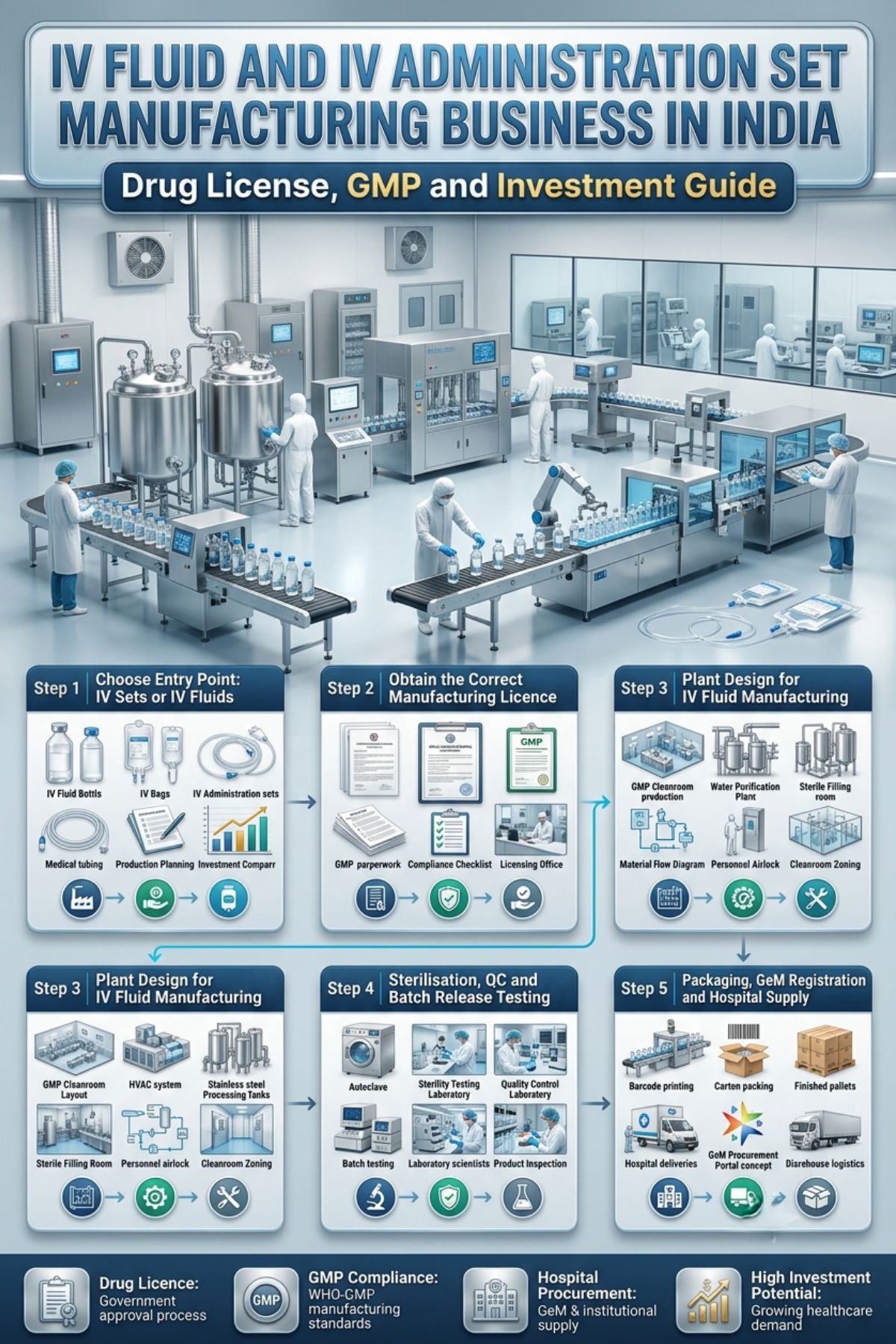
Step 3: Plant Design for IV Fluid Manufacturing
The Water for Injection (WFI) generation system (Multi Effect Distillation or Validated RO Ultrafiltration), large capacity mixing tanks SS316L, Automated bag/bottle filling and sealing machines, Terminal Sterilisation by Autoclave and a clean room ISO Class 7 with differential pressure monitoring are essential for an IV fluid plant. A small IV fluid unit requires about 5,000-8,000 sq ft of space.
Discover business ideas that actually make money
Step 4: Sterilisation, QC, and Batch Release Testing
IV fluid should be terminally sterilized at 121 degrees for 15 minutes minimum (F0 value). Each batch has to pass the following tests prior to release: clarity, pH, endotoxins (LAL test), sterility (USP 71), particulate matter (USP 788), and chemical assay. For batch release, a QC Laboratory needs to be equipped with a laminar air flow cabinet, TOC analyser, endotoxin testing kit and HPLC. To obtain GMP compliance for IV fluids for export to regulated IV fluid markets, WHO Good Manufacturing Practices for Sterile Pharmaceutical Products, sterilisation validation and WFI quality standards.
Step 5: Packaging, GeM Registration, and Hospital Supply
Use 100ml, 250ml, 500ml and 1000ml bags or bottles of IV fluids per hospital specifications. Get registered on GeM for government hospitals supply and get empanelment with state CMSDs. Develop direct business relationships with hospital purchase managers and the institutional medical distributors, where the margins are much greater than those for government tender.
Investment Breakdown for IV Fluid Plant (Small Scale)
| Cost Item | Estimated Amount (INR) | Notes |
| Factory building (8,000 sq ft, HVAC, clean room) | Rs 40 – 65 lakhs | Largest single capital item |
| WFI generation system (RO+UF or MED) | Rs 25 – 45 lakhs | Core GMP requirement |
| Mixing tanks and formulation equipment | Rs 15 – 25 lakhs | SS316L pharmaceutical grade |
| Bag/bottle filling and sealing machine | Rs 30 – 55 lakhs | Semi or fully automated |
| Autoclave / terminal sterilisation system | Rs 20 – 35 lakhs | Validated cycle required |
| QC laboratory (LAF, TOC, HPLC, endotoxin) | Rs 20 – 35 lakhs | Mandatory batch release lab |
| Raw material inventory (1 month) | Rs 15 – 25 lakhs | Water, glucose, NaCl, bags |
| Drug Manufacturing Licence + GMP audit | Rs 5 – 8 lakhs | State FDA processing fees |
| Working capital (3-4 months) | Rs 20 – 35 lakhs | Salaries, power, overheads |
| TOTAL PROJECT COST | Rs 1.90 – 3.28 crore | Scale up to Rs 8Cr for larger plant |
Financial Projections and Profitability
Based on product mix and channel split, an IV fluid plant with a capacity of 1 lakh bags/day can yield annual revenues of Rs 8-14 crore. The Indian Brand Equity Foundation (IBEF) pharma sector report states that the Indian IV fluid market will grow structurally by 8-12 per cent till 2030 on the back of government’s addition of beds and expansion of the private hospital network.
An IV-set manufacturing unit that can be set up in addition to the IV fluid manufacturing can produce Rs 3-5 crore per year with a net margin of 18-25 percent and a quicker payback period of 2-3 years. The MSME Ministry’s SIDBI refinance schemes provide financing that is more concessional for investment in capital equipment, so the dual IV set and the IV fluid strategy makes it more financially friendly for well-prepared applicants who are MSMEs. Pharmexcil export data indicates that the pharmaceutical product exports were valued at more than USD 27 billion in the previous fiscal year with IV fluids and injectable formulations being the fastest growing product groups to the regulated and semi-regulated markets.
Related Article: IV Fluids Manufacturing Plant in India: Market Demand, Investment and Profit Opportunity
Government Schemes and Incentives for Medical Manufacturers
| Government Scheme | Key Benefit for Manufacturer | Eligible Business Type |
| PMEGP (KVIC/MSME) | 25-35% capital subsidy, max Rs 25 lakh for manufacturing | New micro and small units |
| CGTMSE (SIDBI) | Collateral-free loans up to Rs 5 crore for MSMEs | All MSME manufacturers |
| PLI – Medical Devices | 4-6% production-linked incentive on incremental sales | Approved device manufacturers |
| Startup India (DPIIT) | 3-year income tax holiday, fast-track regulatory support | DPIIT-recognised startups |
| State MSME Capital Subsidy | 15-25% subsidy on plant and machinery (varies by state) | State-notified MSME units |
| SIDBI MSME Loans | Concessional term loans for equipment and capacity expansion | All small manufacturers |
Entrepreneur Spotlight
Suresh Patil | Aurangabad, Maharashtra
A pharmacist, Suresh Patil, with 12 years of experience in hospital procurement, started an IV-administration set manufacturing unit in Aurangabad, MIDC with an investment of Rs 1.2 crore in PVC extrusion & assembly line and a Class B medical device licence from Maharashtra FDA. He started supplying to tender hospitals in Maharashtra Medical Goods Procurement Authority within 12 months of the startup of the production.
Suresh, who had successfully run IV set operations for two years, expanded the business with an IV fluid wing of 5,000 sq. ft under Schedule M GMP with the approval of 500ml and 1,000ml Normal Saline from the SIDBI term loan, in addition to the profits generated from the existing IV set operations. His business now is worth Rs 6.2 crore and has 17 hospital clients in Maharashtra and Madhya Pradesh.
How NPCS Supports Your Business Launch
For 45 years, Niir Project Consultancy Services (NPCS) have prepared detailed project reports (DPRs) in over 8000 projects in various industrial businesses, including the medical devices and hospital disposables sector. The NPCS DPR for IV fluid (parenteral) and IV administration set manufacturing includes plant layout, specification of the machines and contacts for the suppliers, sourcing of raw materials, CDSCO licensing pathway, financial projections and bank ready investment analysis.
An entrepreneur seeking NPCS DPR will get expert advice in application for government schemes, export registration & quality certification map, tailored to their state and scale. Visit niir.org to understand project reports of this sector or to read the case studies of this sector and investment analysis in the magazine of Entrepreneur India at entrepreneurindia.co.
Key Reference Links and Further Reading
CDSCO – Central Drugs Standard Control Organisation: https://cdsco.gov.in/opencms/opencms/en/Home/
Ministry of Health and Family Welfare: https://mohfw.gov.in
National Health Mission India: https://nhm.gov.in
CGTMSE – Credit Guarantee Fund Trust for MSMEs: https://www.cgtmse.in
IBEF – India Brand Equity Foundation (Pharma Sector): https://www.ibef.org
Frequently Asked Questions
Q: Is the production of intravenous fluids a drug or medical device?
IV fluids (Normal Saline, Dextrose, Ringer’s Lactate) are regulated as pharmaceutical drugs under Drugs and Cosmetics Act 1940 and must have a Drug Manufacturing Licence (100% Schedule M GMP). IV administration sets are not classified as Class A medical devices and are regulated under MDR 2017 and must be obtained from the State Licensing Authority as a Medical Device Manufacturing Licence.
Q: Schedule M GMP stands for General Management Procedure and it is necessary because of the following reasons.
Good Manufacturing Practice for pharmaceutical manufacturing is outlined in Schedule M of the Drugs and Cosmetics Act. The the following are required by Schedule M for IV fluid: water system quality (WFI), environmental monitoring, batch documentation, sterilisation validation, and QC release testing. The State Drug Controller may take action for non-compliance such as suspension, recall and even legal action.
Q: WFI is a type of distilled water that is used in certain applications, as it is the most vital investment in an IV fluid plant.
A: Ultra-pure water that complies with USP and IP standards for endotoxin, TOC, conductivity and microbial quality is known as Water for Injection (WFI). It is the most important raw material for all IV fluids and should be produced on-site by a validated Multi-Effect Distillation (MED) or RO plus UF system. The investment in WFI system is usually Rs. 25-45 lakh per plant for a small plant.
Q: Can I be small and start with IV sets before I start IV fluid making?
A: Yes, and this is the suggested step-by-step method. The IV sets have lower regulatory hurdles, lower initial capital investment (Rs.1-2.5 crores) and are time to market in 6-12 months. The cash flow, hospital relationships and GMP operational experience gained during the use of IV sets can be used when applying for the Drug Manufacturing Licence for the production of IV fluids.
Q: IV fluids are available in different packaging formats in India.
A: IV fluids are available in soft PVC bags, semi-rigid polypropylene (PP) infusion bottles or in glass bottles. The industry is moving towards PP bags, because of concerns about the leaching of PVC plasticiser (DEHP) from PVC bags. Standard pack sizes are 100ml, 250ml, 500ml, and 1000ml. For terminal steam sterilisation, packaging needs to be breathable film.
Q: NPCS supports the planning of projects for IV fluids and IV sets.
DPRs have been developed for pharmaceutical and medical device manufacturers such as an IV fluid plant, IV set manufacturing line, and parenteral drug unit. Our DPRs include detailed design of the factory, the specifications of the WFI system, equipment lists with price, steps for CDSCO/FDA licensing, and all financial models for bank loan application and investor presentations. Check the available project report titles at the website of Niir.
Conclusion
IV fluid and IV set manufacturing represents one of the most essential and demand-resilient manufacturing opportunities in India’s healthcare sector. The combination of PMJAY hospital expansion, NHM’s district hospital strengthening programme, and growing private hospital networks across tier-2 India creates a multi-decade demand runway for licensed IV fluid and IV set manufacturers.
Make Your Plant Design, Licensing and financial model at least 99% in compliance with CDSCO’s Schedule M GMP requirements and Investor aspirations with NPCS’s Thorough Detailed Project Report. The IV fluid / IV sets manufacturing venture can be Kick-started with the Best technical & financial backing after procuring the DPR from NPCS at niir.org


