





Edible Cutlery Manufacturing Business
India is stealthily developing a deep hunger for sustainable manufacturing and edible cutlery is at the heart of that transformation. So, there is finally an opportunity for entrepreneurs who are looking for business ideas that are sustainable, practical and can be done in the market, as plastic bags, demand for export, and consumer consciousness are on the same path and are moving in the same direction. It seems like a straightforward idea to form a spoon, fork and stirrer from wheat, rice, millet or sorghum, but it’s not. But it requires actual discipline of manufacture, food-grade hygiene, savvy packaging, and competitive positioning in the market.
This article discusses the reasons for its growth, what government schemes actually do to support new manufacturers and what particular business ideas are suitable for the novice entrepreneur. It also features real Indian success stories, a data table on costs and the size of the market, and answers to the questions all founders want to ask before investing money.
Why This Sector Is Turning into a Real Business Opportunity
The edible cutlery demand story isn’t hyped. It’s based on regulation and responsive behaviour modification going hand in hand. In mid-2022, the government imposed an all-round ban on single use plastics, including thermocol, cutlery and straws, across the nation. There was an urgent need to get compliant options in place at restaurants, caterers and hotels, within a short span, which led to captive demand for the biodegradable and edible options.
Today, India’s edible cutlery market is small, valued at approximately USD 1.55 million, but will more than double over the next 10 years and grow at nearly 8.7 percent per year. Only if you don’t consider the base will that number appear small! Demand for edible cutlery is fastest growing globally in Asia-Pacific, and India already accounts for over one-third of global production. Spoons make up more than 60 percent of the global sales, so a founder should begin with a single product to create a business that’s viable.
Get Detailed Project Report (DPR): Paper, Plastic & Thermocol Disposable Products
A Manufacturing Advantage, Not Just an Environmental One
The cost logic is very strong in favour of India. The raw materials used (sorghum, rice bran, wheat flour or similar) are locally available, do not need imported inputs and are inexpensive. Labour is still relatively cheap in comparison to the European manufacturers which allows Indian producers to offer competitive prices to domestic hospitality brands and international buyers. Meanwhile, large industrial players like Balrampur Chini Mills have begun manufacturing PLA biopolymer at scale in Uttar Pradesh, indicating that the large companies also believe that there is long-term value in plastic-replacement materials. This proves the chance for the smaller manufacturers that provide edible cutlery.
Hospitality demand also brings another level of security which most new manufacturing sectors cannot offer. In reality, hotels, airlines and catering companies are not jumping on the bandwagon of using “edible” cutlery because it is in fashion. They’re making it a habit because plastic substitutes can’t be used in numerous places. This translates to a captive market (not discretionary) for the buyer, which is what a first-time manufacturer should seek before spending capital. A founder who comes into this arena is not taking a risk on changing customer preference. Rather, they are providing a compliance obligation for thousands of food service companies whose obligations to comply are required each and every day.
Competition is also relatively uncluttered. Large organised players have been taking the majority of the bulk supply, but there’s still some scope for the smaller, local manufacturers in the market. Local caterers, tier-two city hotels, and wedding planners usually prefer to be more flexible with order sizes and delivery times and have someone that can provide them with a nearby supplier. Thus, a new player isn’t required to take on the competition from the get-go. In fact, they create their own loyal regional consumers first, and then scale up once their products are set.
Government Policies and Incentives Supporting New Businesses
This is not a business that a new entrepreneur will have to finance all the way. The Ministry of MSME and related departments have several schemes which directly minimize the risk of setting up for a first-time manufacturer.
Udyam Registration Is the First Step
All the founders must register on the Udyam Registration Portal prior to any application to any scheme. This registration is free and requires minutes, and unlocks priority sector lending, delayed payment protection, and preference in government tenders. Most subsidy schemes are inaccessible if there is no Udyam registration.
PMEGP Funds the Initial Setup
Prime Minister’s Employment Generation Programme (PMEGP): It is a scheme of the Khadi and Village Industries Commission, under the Ministry of MSME for providing margin money subsidy to new manufacturing unit ranging from 15% to 35% of project cost. The scheme would allow manufacturing projects to get up to Rs 50 lakh. This makes PMEGP one of the most viable options for a first-time edible cutlery unit as the subsidy is a one-time payment (non-repayable) and the remaining amount is paid as a term loan from the bank.
CGTMSE, CLCSS, and State-Level Incentives
Founders who don’t have their property to pledge will find it helpful that the Credit Guarantee Fund Trust for Micro and Small Enterprises provides collateral-free loans. The Cost of Moulding and Baking Equipment can also be reduced by a 15% subsidy under the Credit Linked Capital Subsidy Scheme for the purchase of new machinery. Many states also provide additional support such as capital subsidy, exemption from electricity duty and reimbursement of SGST in case of new manufacturing units.
Startup India and Make in India Recognition
Startup India also offers tax exemption and simplified compliance for the initial years to the founders, which is managed by DPIIT. The umbrella Make in India campaign also promotes local manufacturing, a point that resonates with an edible cutlery business that aims to cater to the needs of the hospitality sector in India and export to other countries.
Multiple Business Ideas for Startups in Edible Cutlery Manufacturing
Anyone who is thinking about launching a business in this niche should select a business model which is appropriate with their capital, skills and intended customer. There are 6 specific directions to consider.
1. Basic Wheat and Rice Spoon Manufacturing Unit
The simplest and most common starting point for a first-time manufacturer is a spoon unit. The model has wheat flour, rice bran and water as the basic ingredients which are combined with a semi-automatic baking or moulding press. The cost of a small unit is generally Rs 10 lakh to Rs 25 lakh, which remains within the manufacturing criteria of PMEGP. As the product is simple itself, quality control is the actual differentiator. Consistent thickness, the right baking temperature and an easy-to-store packaging system are common strengths of successful founders who are likely to be given repeat business by local caterers.
It’s also a great option for founders who wish to focus on the market before branching out into flavoured or export variants. Sales to local wholesalers, organic stores and direct sale to caterers helps to limit working capital requirements in the first year.
Related Article: India Agriculture Waste-Based Products Market
2. Millet-Based Gourmet Cutlery for Hotels and Cafés
Hotels and high-end cafes seek products that are DOING something, not just meeting requirements. Spoons with gourmet qualities, made using millet, jowar and naturally flavoured spices like cumin, pepper or jaggery can fetch a higher price than regular plastic or wooden spoons. It works well for foodies and those who know about the hospitality relationships involved in selling food, as the selling process relies on tastings, chef relationships, and menu integration instead of price discounts. Here, margins are much higher, but volumes remain lower. Hotel purchasers consider presentation to be as important as taste and biodegradability, and founders in the segment should invest in it.
3. Export-Oriented Edible Cutlery Unit
Some countries have completely prohibited plastic cutlery, such as European Union countries, while some regions in the U.S. have implemented state-level laws. This is also a real demand for compliant, food-safe alternatives and Indian manufacturers already have a significant presence in that market. For an export unit, compliance is more robust than that of a domestic only business; this requires more support such as FSSAI certification, export documentation, and package designs that are suitable for long term transits. Early investment by the founders in these certifications puts them in position to sell directly to European retailers, catering companies and airline caterers, as well as bypassing the margins of the middlemen.
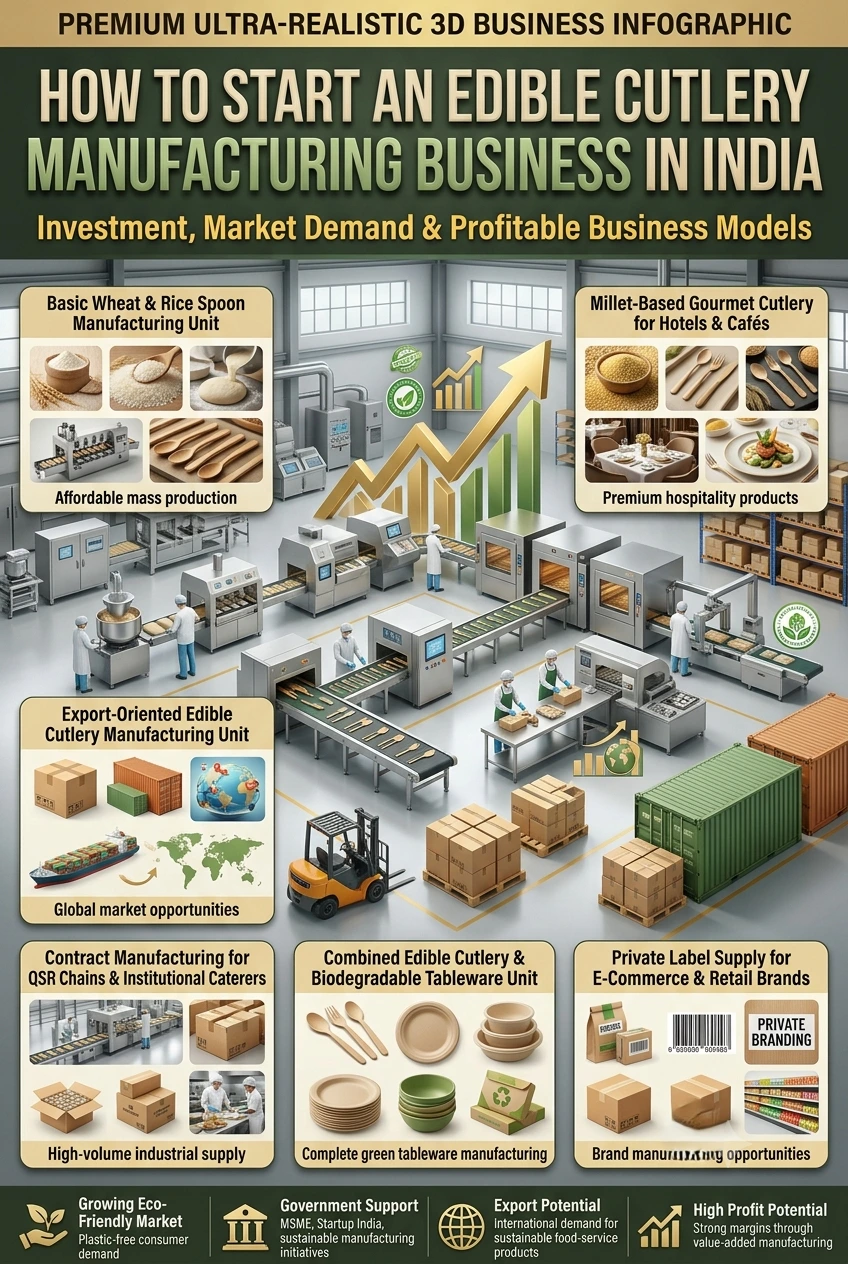
4. Contract Manufacturing for QSR Chains and Institutional Caterers
Quick-service restaurant chains/catering services (large institutions) require regular, large-volume products rather than boutique products. The contract model addresses this need by entering into agreements for contracts with retailers rather than retail sales. This concept is appropriate for founders who have a bit more capital, as QSR chains require consistent production and food-safety record keeping. The downside, though, is that the revenue is guaranteed, and the marketing expenses cut because the buyer relationship is the primary growth source. The founders who are successful here usually begin with one QSR partner in a specific region and then add more.
5. Combined Edible Cutlery and Biodegradable Tableware Unit
Some entrepreneurs produce edible dishes, utensils and even straws along with biodegradable plates, bowls and straws certified by the allied materials such as sugarcane bagasse or areca leaf. It increases the product range while not necessitating an entirely new production line, as there are a great many commonalities between sourcing, quality control and the buyer relationships. One vendor who offers the entire package of disposable table service is of special interest to event planners and wedding caterers. It requires some extra working capital, a wider sourcing base, but also creates a more “sticky” customer relationship than a single product business.
Get Detailed Insights from This Book: Paper Water Bottles, Bioplastics & Biodegradable Products Manufacturing Handbook
6. Private Label Supply for E-Commerce and Retail Brands
There are a number of brands that have proven themselves to be sustainable that prefer outsourcing of manufacturing instead of constructing their own. A private label model provides your company edible cutlery under its own brand name, thus eliminating the need to build consumer brand awareness from the ground up. If this is the path chosen, production consistency and on-time delivery will be key selling points of the product for the founders to work on and the Private label buyer will make their decision primarily on this. It’s also an option for a brand owner’s own directly to consumer arm; the same production line can be used for both channels with relatively minimal additional investment.
Import-Export Opportunity Analysis
India is catching on to the growing demand for edible cutlery globally, primarily due to regulatory concerns in other regions. Catering firms and food-service chains are searching for biodegradable alternatives on a larger scale, as a ban on the use of single-use plastic cutlery from the European Union (EU) has forced them to consider alternative options. Likewise, some of the U.S. states, such as California, New York and Washington have enacted their own bans on single-use plastic tableware.
India is well poised to fulfil this need as it already manufactures more than a third of the edible cutleries for the world. The low cost of raw materials, a well-established grain supply chain, increasing governmental backing of agri-based exports via agencies such as APEDA, etc., are some of the advantages enjoyed by the manufacturers here. Domestic farmers have a cost advantage over European farmers in wheat, rice and millet production, as European farmers are forced to import wheat during a shortage of supply.
For the founders thinking of exporting, certification should not be something they do as a last resort. The time taken to obtain FSSAI license, export documentation, and conforming with food-contact material regulations of the country to which it is being exported all require a certain amount of time. Establishing these certifications early allows a manufacturer to speed up response to bulk export enquiries as opposed to having certification delayed and missing the order.
Packaging and logistics must not be neglected. Edible cutlery needs to withstand weeks of sea transport without getting damaged in any way or developing moisture, compared with a local caterer supplying the same week it is baked. Before entering into an export contract, packaging should be tested under real shipping conditions, including changes of humidity and temperature. Furthermore, engaging a freight forwarder with a solid grasp of the food goods export process minimizes the risk of customs clearance delays, which could compromise a potentially great deal.
Also, working with a freight forwarder with a solid understanding of the food goods export procedure minimizes the risk of customs clearance delays that could compromise an otherwise great deal. These arrangements need to be correct from the outset to develop that trust that will ensure that export orders are not made as one-off transactions but also will be made again.
Indian MSME Success Stories Worth Studying
Narayana Peesapaty and Bakey’s Foods
Narayana Peesapaty-who once worked as a scientist at ICRISAT in Hyderabad-was shocked by how much groundwater cultivation of rice devoured in comparison to the parched cultivation of millets. Peesapaty aimed to build a market for the Indian millets and came up with a simple-but radical idea: edible spoons, made of jowar, rice, and wheat flour. He launched bakey’s foods in 2010; funded most of the research for the product himself; and toiled for almost ten years for the edible cutlery business to find its footing.
Now bakey’s edible spoons turn over about Rs 2 crore every year. The message for entrepreneurs just starting their journeys: be confident and believe in the problem that you are solving. Most of the time, it works better than funding, at least initially.
Shaila and Lakshmi’s EdiblePRO
Shaila and Lakshmi, two former IBM employees based in Bengaluru, left stable corporate careers to build EdiblePRO after recognising plastic cutlery’s environmental cost. Their process of research and development with Food Research Laboratory of Defence Research and Development Organisation took about a year. From being a bootstrapped venture focusing on designing just a spoon, they ended up having a portfolio of around 25 products within two years, selling primarily to hotels, ice cream parlours and other traders across India. This makes for one more instance where a keenly thought of B2B strategy proved more effective and efficient than wide B2C campaigns.
Find the most profitable startup for your investment range
How NPCS Supports Founders Entering This Sector
Turning any of these business ideas into an actual factory requires more than enthusiasm. Founders need a realistic feasibility study, correct machinery specification, and an honest financial projection before they approach a bank or investor. Niir Project Consultancy Services, known as NPCS, prepares Market Survey cum Detailed Techno-Economic Feasibility Reports for exactly this purpose.
These reports cover manufacturing process details, market and demand analysis, process flow diagrams, product mix and capacity planning, machinery and raw material specifications, and complete project financials with profitability analysis. For an edible cutlery entrepreneur, this kind of report removes guesswork from decisions like machine selection, working capital planning, and export readiness. It also gives banks the documentation they need to sanction PMEGP or term loans with confidence.
Edible Cutlery Market Data at a Glance
| Metric | Current Estimate | Growth Outlook |
| India edible cutlery market value | Approx. USD 1.55 million | Projected to reach USD 3.48 million, growing near 8.7% a year |
| India’s share of global edible cutlery output | Over 35% | Expected to rise with export demand |
| Global share held by edible spoons | Over 60% of units sold | Remains the largest single product category |
| Basic manufacturing unit project cost | Rs 10 to 25 lakh | Scalable up to Rs 50 lakh under PMEGP |
| PMEGP margin-money subsidy | 15% to 35% of project cost | Non-repayable government support |
Source: Industry market research reports and Ministry of MSME scheme documentation, compiled for indicative planning purposes.
Frequently Asked Questions
How much capital do I need to start an edible cutlery manufacturing business?
A basic wheat or rice-based spoon unit can start within Rs 10 to 25 lakh, covering machinery, raw material stock, and working capital. Costs rise for gourmet, export-grade, or combined tableware units.
Which government scheme suits a first-time founder best?
PMEGP tends to be most well-suited to start-ups, because it involves a subsidy that does not need to be repaid, combined with a normal bank term loan. This facility requires the least of any business experience on the part of the applicant.
Do I need FSSAI licensing for edible cutlery?
Yes. FSSAI License is compulsory as food is an article of food, in addition to which export customers would require food contact compliance in the destination country.
How long does edible cutlery stay fresh?
Most edible cutlery products remain shelf-stable for several months when packaged correctly, though shelf life varies with recipe and moisture content. Founders should test shelf life extensively before committing to large production runs.
Is export demand real, or mostly a domestic opportunity?
Export demand is genuine. Plastic cutlery bans across the European Union and several American states have created real buying interest, and India’s raw material advantage supports competitive export pricing.
What is the biggest mistake new entrepreneurs make in this business?
New founders usually have too little appreciation for quality control. Business founders fail more often for cracks in thickness of the item that are transmitted because of weak packaging than a demand for.
Can this business be started on a part-time or small scale first?
Yes. Many small food producers start at a similar small semi-automatic household level with the idea of supplying local catering companies and organics outlets before buying the bigger more industrial equipment. This is not only less risk for the founder but gives valuable experience learning about the product and packaging.
Conclusion
Edible cutlery manufacturing sits at a rare intersection of environmental necessity, growing regulation, and genuine profitability. India’s low-cost raw material base, expanding government support, and rising global plastic bans all point in the same direction. Founders who choose the right business idea, secure the right scheme, and invest early in quality and certification stand a real chance of building a durable manufacturing business rather than a short-lived trend. The opportunity is open right now, and entrepreneurs who move first with a clear feasibility plan will likely capture the most durable market position.


