





Fish Feed Manufacturing Business
Fish feed production has subtly become one of the most reliable business ventures for businessmen seeking a constant demand supported by substantial government assistance. The aquaculture industry caters to the needs of millions of households and contributes billions of dollars to the export of seafood every year in India. But this whole process relies on an easily overlooked part – quality fish feed. Consequently, a viable manufacturing opportunity is now available for entrepreneurs with an understanding of feed formulation, farmer relations and some basic project planning. This article outlines the rationale behind the market, policy support, and some business concepts for those who are interested in pursuing a business in fish feeds.
Why Fish Feed Manufacturing Is a Smart Bet Right Now
India is one of the top suppliers of farmed fish and shrimp in Asia-Pacific. This also means that the nation uses a significant proportion of the commercial aquafeed products from the region. The aquafeed market is estimated to be valued at approximately $3.47bn in India, and is projected to grow almost 6.8% per year to reach $4.84bn. This isn’t a guess curve; it’s a clear trend that farmers are continuing to shift to branded pellets over home-made.
The State of Andhra Pradesh continues to be the top fish-feed consuming State in the country, mainly due to its high concentration of shrimp farms. In addition, pellet feed already accounts for almost 48% of the market for feed in the form of pellets, due to the fact that it reduces waste and adapts to mechanised feeding systems. So, if a new manufacturer enters the pellet market, they are not taking a chance on a new trend, rather they are entering a proven and growing preference.
Rising Demand from Farmers
Commercial feed is becoming popular among fish farmers, due to its ability to absorb nutrients better and reduce the growth period. Home-made feed, on the other hand, may be low in protein at times, resulting in slow growth and greater losses. Profitability in fish farming is decreasing, leading farmers to seek out manufacturers who can ensure uniformity of formulations.
Related Article: How to Start a Fish Farming Business in India
Export-Led Growth Multiplies Opportunity
The quality of shrimp feed is a major factor in the export industry in India as import countries have strict regulations for residues and traceability. The feed manufacturers, therefore, are able to have a competitive edge over the export-oriented shrimp farmers, who invest in cleaner, well-documented shrimp production processes. Besides, big names like Cargill and Charoen Pokphand have already established their plants in India, indicating good faith in this scenario for domestic entrepreneurs too.
Profitability Logic Behind This Business
In farming of fish and shrimp, feed can cost as much as 50-60% of the overall operating cost. This one reason is why farmers are so keen on the price and quality of feed, and why manufacturers who can address both issues successfully are likely to attract loyal customers. A feed mill doesn’t have to be the cheapest; equal conversion ratios – or how much feed a fish needs to put on one kilogram of weight – are equally important to a farmer’s profitability. So, manufacturers that invest in improved formulation science generally make better margins than those that solely play the price game.
The raw material price volatility also follows general prices of soya and fishmeal in the global market, and it is the sourcing strategy of a manufacturer which will have direct impact on profitability. Multi-month supply contracts, or even mixing locally available ingredients such as rice bran and groundnut cake, help founders to dampen these cost pressures compared with those that purchase raw materials from the spot market each month.
Get Detailed Project Report (DPR): Fish and Prawn Feed
Government Policies and Incentives Supporting New Businesses
The Pradhan Mantri Matsya Sampada Yojana (PMMSY) is the largest policy support to the sector spearheaded by the Department of Fisheries under the Department of Fisheries, Animal Husbandry and Dairying (MFD). The total outlay of the scheme is around ₹ 20,050 crore, and it provides direct assistance to the feed procurement, hatcheries, Re-circulatory Aquaculture Systems, and biofloc units.
A general beneficiary under PMMSY can avail funding assistance of up to 40% on the project cost and a woman entrepreneur and a Scheduled Caste or Scheduled Tribe can avail up to 60% funding under PMMSY. This directly reduces the capital requirement for those who are establishing a small or medium sized fish feed unit. State Fisheries Departments are the nodal agencies and hence the first port of call for an applicant.
Interested Founders are able to verify eligibility and apply through the official PMMSY portal, which provides details regarding subsidy structure component-wise and the contact person at the State-level.
In addition to fisheries-specific schemes, there is also general support for MSME. The Credit Guarantee Fund Trust for Micro and Small Enterprises and priority-sector lending by banks are also available to the entrepreneurs who have registered with Udyam. The skill development and cluster-based support offered by the Ministry of MSME can also be availed by the fish feed manufacturers.
Further, DPIIT recognised startups under Startup India initiative is provided with tax exemption on profits for specific period, compliance filing becomes simplified and patent processing becomes faster. Further, the government’s overall initiative of Make in India is also providing an incentive to the manufacturing of fish feed locally as it will cut down on import of fishmeal and fish oil into the country.
Multiple Business Ideas for Fish Feed Startups
There is no single model for fish feed manufacture. For the founders, based on their capital, location, and target customer, there are various business ideas available in this space. Investment logic is different for each model listed below and entrepreneurs should correspond to their market and their own capital.
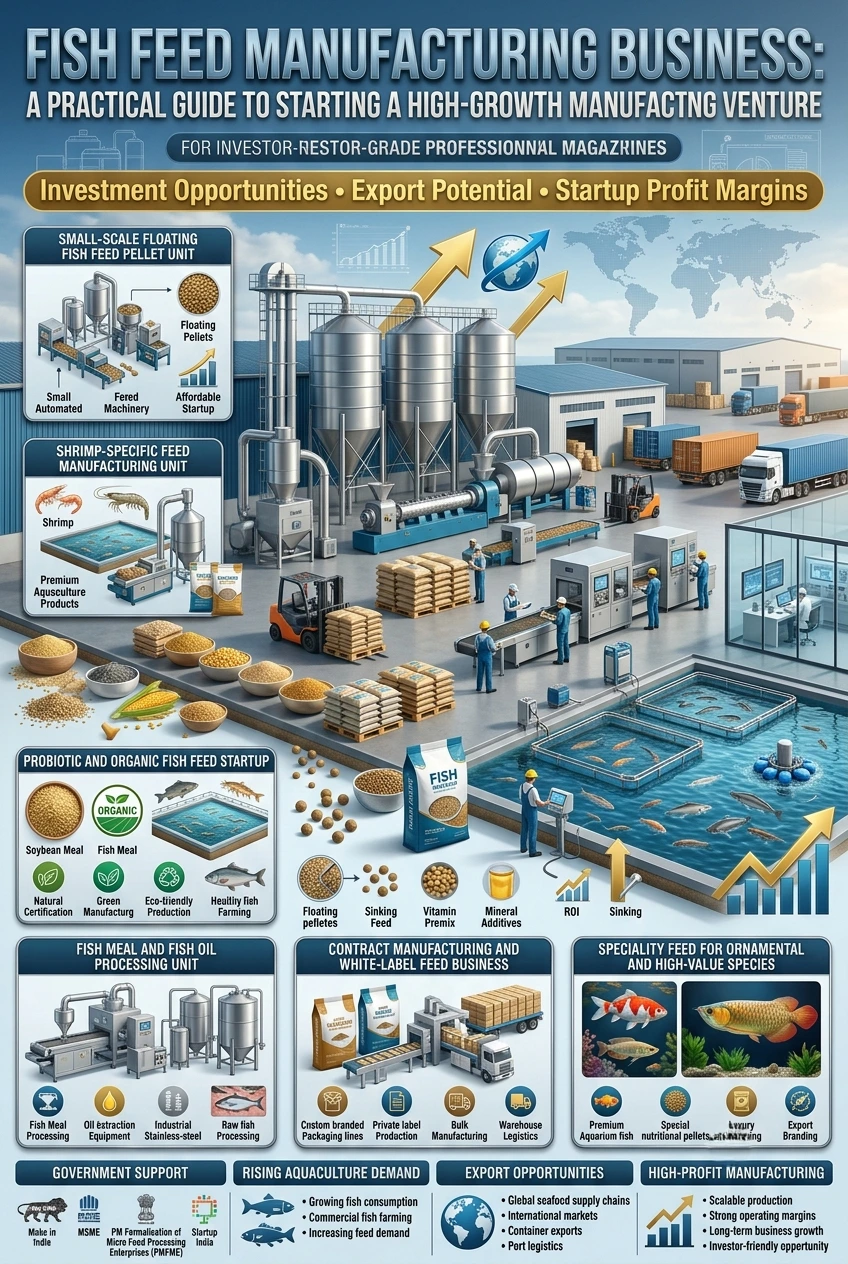
Small-Scale Floating Fish Feed Pellet Unit
For first generation entrepreneurs, the small pellet extrusion machine is still the easiest way to get into pelleting. It is a single-screw or twin-screw extruder model which changes raw material (soybean meal, rice bran, fishmeal, etc.) into floating pellets. Floating pellets allow farmers to observe feeding behaviour directly, and therefore are fetchable a premium price compared to sinking feed. A founder should begin with a small capacity of one or two tonnes per day, increasing it gradually as there is an increasing demand in the area. This model is very suitable for small freshwater fish farmers in the clusters in the States such as West Bengal, Andhra Pradesh and Odisha, who are presently depending on irregular local feed sources.
Shrimp-Specific Feed Manufacturing Unit
Shrimp feed margins are more profitable than general fish feed due to the need for the shrimp to be fed according to desired ratios of proteins and minerals. Therefore, a shrimp feed plant, even of a moderate size, can achieve higher unit economics than a generic feed plant. The concept is somewhat flawed, however, because shrimp are much more susceptible to contamination than many types of fish. Relationships need to be established with export-oriented shrimp farmers early on as they are willing to pay a premium for traceable, residue-free feed to meet international standards with respect to the United States, the European Union and Japan.
Probiotic and Organic Fish Feed Startup
A new business concept is the production of probiotic enriched fish feed or plant-based feed. In fact, researchers in India have already developed these bio-fermented alternatives to boost fish immunity and cut reliance on marine-source ingredients. Leading the way into this niche will help the founder establish a premium brand that focuses on sustainability and reduces the use of antibiotics, a key issue for export buyers. This niche area is still a small share and is expected to continue to have strong growth terms in the long term as environmental compliance becomes tighter in export markets.
Fish Meal and Fish Oil Processing Unit
Some entrepreneurs decide to sell the raw material feed mills demand the most – fish meal and fish oil. This model eliminates fish waste and low value catch from the system and converts it to protein rich feed meal, which is sold in bulk to large feed manufacturers. India continues to import some fishmeal, so a well-managed fishmeal plant can meet the demand that otherwise goes to expensive imports. Gujarat, Tamil Nadu and Kerala are the most suitable places for this business as the logistic of raw materials is important in coastal states where the marine landings are high, rather than inland feed manufacturing.
Contract Manufacturing and White-Label Feed Business
Large aggregators and regional distributors tend to seek out dependable manufacturing partners rather than establish their own manufacturing facilities. When a first-time entrepreneur decides to launch a feed producing business, they can sell the product under another brand with a contract or by white-label production by their business partner. This type of model works best for founders who are knowledgeable in production but don’t have a distribution system. As they accumulate enough working capital and farmer trust over time, more and more contract manufacturers begin to launch their own brand.
Speciality Feed for Ornamental and High-Value Species
Another business concept that is less extensive but with high profits is the production of feed for ornamental fish and high value fishes such as trout and some carp species that are exported. The demand for special feeds for ornamental fish includes high nutrient content levels and is often not met by the mass market producers. The resulting low volumes allow high prices to be charged by the founders, and packaging quality can be as important as the formulation. This concept is appropriate for the entrepreneurs who have limited manufacturing area, because the production of ornamental feed generally requires less space compared to the manufacturing of feed for commodity fish.
Read the Complete Book Here: Rabbit, Goat, Sheep, Poultry, Fish and Pig Farming with Feed Technology
Import-Export Opportunity Analysis
This industry is influenced both ways by trade. In the imports, India still imports a significant amount of fishmeal, fish oil, and some feed additives, as the domestic supply is not sufficient to meet the demand. It opens a direct possibility to the entrepreneurs who can localise these inputs as import substitution is still a policy priority in Make in India.
Shrimp export business in India relies on the quality of the feed to a greater extent than is known by most of the founders of the business. Traceability from hatchery to harvest is becoming a growing demand in Japan, the United States and European Union.The demand for traceability from hatchery to harvest, including documented feed sourcing, is on the rise in Japan, the United States and the European Union. This means that feed manufacturers who invest in the early certification of feed quality or in clean-label formulations will have an advantage in the access to export-oriented shrimp producers.
This is the reason why major feed companies from all over the world like Charoen Pokphand and the successor of Cargill have made an aggressive growth in Andhra Pradesh which accounts for a major share of shrimp export volume.
The Marine Products Export Development Authority (MPEDA) releases information on exports along with quality guidelines which can help the manufacturers to formulate the product according to the standards set by the international buyer, thereby improving the credibility and export capabilities of the manufacturers.
Meanwhile, Indian producers are facing competition from mature feed exporters in Thailand, Vietnam and China in the broader Asia-Pacific region. Nevertheless, India has a unique advantage in the availability of raw materials since the production of soyabean and rice bran in the country helps keep some of the input costs at a lower level than in some of its neighbouring countries. Therefore, the founders who are able to establish effective local sourcing networks can be able to compete against their larger regional competitors on cost, especially in the freshwater fish feed segment where the competition from imports is limited.
Indian MSME Success Stories in Fish Feed
There are few companies in India that have developed their small fish feed businesses into a big success. A few companies in India have developed their small fish feed business into a large one with discipline. Their journeys serve as lessons to those who are assessing this sector today.
Avanti Feeds Limited, established by promoter C. Ramachandra Rao, started out as a small enterprise in the State of Andhra Pradesh but joined hands with Thai Union Group for technology. That choice provided Avanti with cutting-edge shrimp feed formulation know-how before many domestic competitors. Avanti is now the biggest organised aquafeed producer that has a production capability of approximately 800,000-900,000 metric tonnes per year in India. For new entrepreneurs, the lesson is simple: a powerful technical relationship can shorten the learning curve of years and years of trial and error.
Godrej Agrovet, a part of the Godrej group, expanded its animal feed business into fish and shrimp feed. Instead of from scratch, the company used its current distribution system and raw material supply chain throughout the agri-business. At the lower end of the scale, new companies can adapt the same idea and leverage their relationship with suppliers or distributors in other industries instead of starting from scratch.
It was an Andhra Pradesh regional feed manufacturer which has become a well-known shrimp and fish feed brand in the country through the name Growel Feeds Private Limited. The growth trajectory of the company reflects the company’s ability to capitalise on the farmer value chain and product quality, thus positioning itself to be competitive against larger, well-funded competition in one region, and then expanding outward.
Challenges New Entrants Should Plan For
As with any business concept, there are going to be some challenges. But in this industry, there are no surprises to be kept as part of honest planning—you need to know what they are before the machines arrive.
Raw Material Price Volatility
Having products like soybean meal, fishmeal and vitamin premixes that change in price with world commodities can cause a first-time manufacturer with less buying influence to absorb the fluctuating costs, which can put margin pressure on Year 1. This risk can be greatly mitigated by building relationships with at least two manufacturers with each key ingredient.
Farmer Trust Takes Time
Fish farmers do not change feeds brands abruptly as they will lose all their season’s income if they choose a poor batch of feed. This means that new producers can not anticipate a rapid growth year because they will be waiting for farmers to sample small amounts before buying their product in bulk. Providing samples at no cost before committing to a full order gives credibility to a product over a hard sell approach.
Seasonal Demand Patterns
Fishing and aquaculture of fishes and shrimp have different seasonal patterns by region and species. This can make year-round demand for feed non-uniform, ensuring that manufacturers need year-round working capital planning that takes into account the lean months. A solid feasibility report would explicitly account for this seasonality in its cash flow projections, as opposed to the assumption of steady monthly sales.
Build a profitable business with the right idea
Planning Your Feasibility Study Before You Invest
While each of the above business ideas may seem like a good business idea on paper, they still need a bit of project planning for them to be profitable. This is where a structured feasibility study is a necessary, not an optional, tool.
As a professional consulting firm, we at Niir Project Consultancy Services (NPCS) are able to offer professional services for developing Market Survey cum Detailed Techno-Economic Feasibility Reports (DRPs) for entrepreneurs starting up new industries or businesses. Our reports include detailed manufacturing process, market research and demand analysis, process flow diagram, product mix and capacity planning, machinery and raw materials details and complete project financials with profitability analysis. We want to help our clients assess feasibility, profitability, and scalability of their fish feed manufacturing projects before making any investment.
Fish Feed Manufacturing Business at a Glance
The table below shows some of the important statistics that the founders should consider when assessing this business. These figures can be useful for setting sensible expectations when talking with lenders and/or consultants.
| Parameter | Approximate Figure / Detail |
| India aquafeed market size | Around $3.47 billion, growing toward $4.84 billion |
| Market growth rate (CAGR) | Roughly 6.8% to 8.4%, depending on the segment |
| Dominant product form | Pellet feed, close to 48% market share |
| Leading consuming state | Andhra Pradesh |
| PMMSY subsidy (general beneficiaries) | Up to 40% of project cost |
| PMMSY subsidy (women / SC / ST beneficiaries) | Up to 60% of project cost |
| Small pellet unit entry capacity | 1 to 2 tonnes per day, scalable |
| Key export markets for shrimp feed users | United States, European Union, Japan |
Frequently Asked Questions
What is the amount of capital required for small fish feed manufacturing unit?
A small single line of extrusion equipment, with moderate capacity, usually requires a moderate investment, including the purchase of the equipment, in addition to a small shed and a moderate amount of working capital. The costs depend on the state, capacity and whether the founder is buying the new or refurbished machinery, so an adequate feasibility study helps to specify exact costs.
Do you need a licence to do this business?
Yes. Generally, the Udyam registration, factory or trade licence from the local authority, GST registration and in many states, FSSAI licence is required to be obtained by the founders as fish feed also falls under food and agricultural regulatory requirements.
Which raw materials are most important to the fish feed industry?
The basis raw material basket consists of soybean meal, fishmeal, rice bran, wheat flour, and vitamin-mineral premixes. Consistent quality and price is often more important than the machinery.
Is this business eligible for government funding?
Yes. Support available for aquaculture related Feed activities through PMMSY is direct subsidy support and for general MSME activity, the support is available in the form of collateral-free credit and further support is available through the Industry department of state level.
How long until you start making money?
Most small and medium units become operational stable in the first one or two years, as long as the founder is able to get a regular supply of raw materials and establishes trust with the local fish farmers from the beginning.
Can export be a viable option for a new feed producer?
However, it is rare for new manufacturers to be directly involved in export; indirect exposure to export market is possible only when the manufacturing unit acquires reputation for quality and consistency via the involvement of shrimp farmers with shrimp export-oriented manufacturers connected with MPEDA.
Conclusion
The fish feed industry is one of the rare industries in which the demand is stable, the government is actively supporting the industry and there is also space for new industries to enter the market. It doesn’t matter whether the founder wants to go for a small pellet unit, or a shrimp plant or a raw material business such as fishmeal processing, the market logic is sound. But, success within this enterprise isn’t anything dependent on enthusiasm alone but it is additionally reliant on discipline in preparation. Study the numbers, get the right subsidies, and develop farmers’ trust early, and entrepreneurs outperform those who rush in without a feasibility study.
The other important thing is location choice, which is more important than most first-time founders realize. A plant located close to a strong fish-farming cluster would see cost advantages in logistical operations and would establish quicker trust with the local farmers; on the other hand, a plant located near a port would benefit raw-material or export-oriented enterprises. Smartest founders therefore go to their target area and interview farmers face-to-face before they make decisions on capacity and product mix. If you’re thinking about exploring any of these business concepts, the next logical step is to perform a detailed techno-economic analysis prior to investing money.
Sources referenced: PMMSY | Ministry of MSME | Startup India (DPIIT) | Make in India | MPEDA


